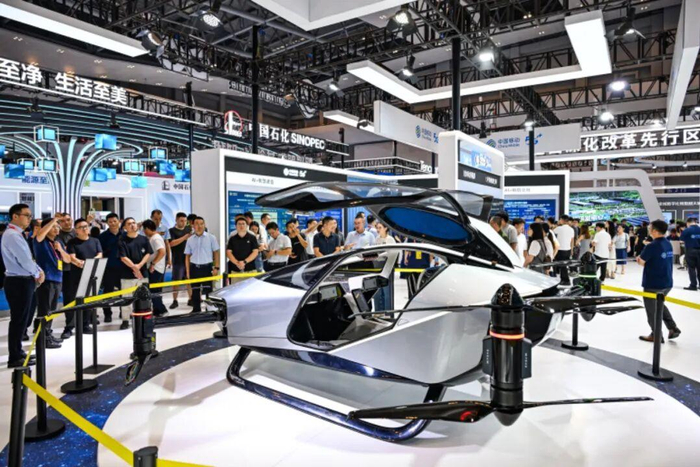
无人驾驶载人eVTOL

Search documents
视频丨满满科技感 揭秘春晚合肥主舞台“皖美之瞳”设计巧思
Yang Shi Xin Wen Ke Hu Duan· 2026-02-19 08:07
Core Viewpoint - The 2026 Spring Festival Gala's Hefei sub-venue showcases innovative stage design and technology, emphasizing Hefei's cultural and technological advancements through the "Wanmei Zhitong" theme. Group 1: Stage Design and Concept - The main stage, named "Wanmei Zhitong," is located in Luogang Park, which spans 12.7 square kilometers, making it the largest urban park globally. It serves as a cultural landmark and a site for low-altitude flight and drone applications [1]. - The stage design features a "three-legged cauldron" symbolizing three major technological innovation hubs in Anhui: quantum information, fusion energy, and deep space exploration [2]. - The 61 light pillars represent Hefei's 61 universities, integrating local cultural elements with modern technology [2]. Group 2: Technological Innovations - The "flying light" technology, a first for the Spring Festival Gala, utilizes unmanned eVTOLs to create a "heaven and earth matrix" above the main stage [6]. - The design team spent over two months modifying the flying vehicles, incorporating intelligent algorithms to achieve synchronized performances with the ground stage [6]. - A total of 16 "flying lights" were designed, utilizing advanced domestic technology for intelligent and digital control, showcasing China's capabilities in the lighting field [9]. Group 3: Cultural Significance - The lighting design draws inspiration from the "I Ching," symbolizing a connection between history and future foresight [4]. - Each beam of light in the Hefei sub-venue narrates the city's story of "inheriting the ancient and opening up the new," paying homage to its historical legacy while expressing aspirations for technological innovation [10].

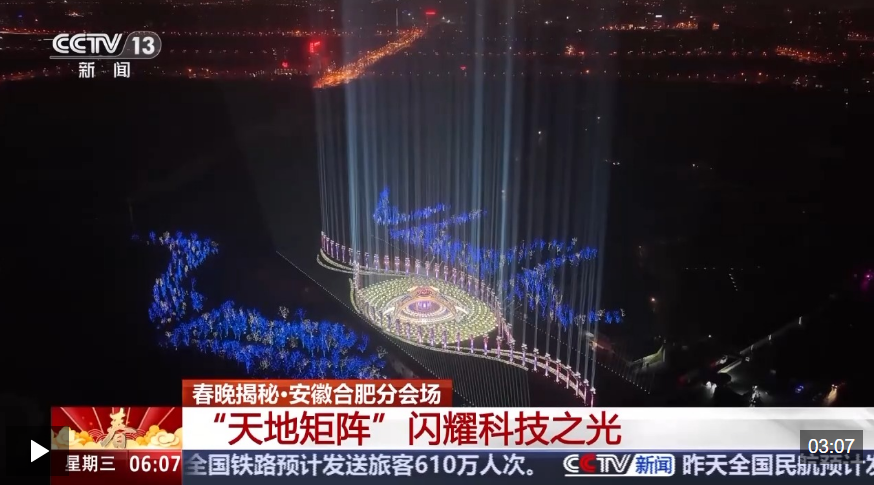
满满科技感 揭秘春晚合肥主舞台“皖美之瞳”设计巧思
Yang Shi Xin Wen· 2026-02-18 01:24
Core Viewpoint - The 2026 Spring Festival Gala's Hefei sub-venue showcases a blend of culture, technology, and innovation through its stunning stage design and lighting, emphasizing Hefei's vision for the future [1][4][19] Group 1: Stage Design and Concept - The main stage, named "Wán Měi Zhī Tóng," is located in Luogang Park, which spans 12.7 square kilometers, making it the largest urban park globally [1] - The stage design features a "tripod" structure symbolizing three major technological innovation hubs in Anhui: quantum information, fusion energy, and deep space exploration [3] - The lighting design incorporates 61 light pillars representing Hefei's 61 universities, merging cultural elements with technological advancements [6] Group 2: Technological Innovations - The "Flying Light" technology, used for the first time in the Spring Festival Gala, involves low-flying drones creating a "heaven and earth matrix" above the main stage [12] - The technical team spent over two months modifying the drones to integrate smart algorithms for synchronized performances with the ground stage [14] - A total of 16 "Flying Lights" were designed, utilizing advanced domestic technology in China's lighting field [17] Group 3: Cultural Significance - The lighting and stage elements narrate the city's story of "承古开新" (inheriting the past and opening up to the new), paying homage to Hefei's historical legacy while expressing aspirations for future innovation [19]

广货行天下,低空领新潮!解锁广东低空经济的致胜密码
2 1 Shi Ji Jing Ji Bao Dao· 2026-01-27 08:43
Core Insights - The article discusses the evolution of low-altitude economy in Guangdong, emphasizing the shift from traditional aviation paradigms to a more integrated and system-oriented approach, termed "Guangdong goods going global" [1] Group 1: Technological Paradigm Shift - Guangdong is leading the transition of low-altitude flight from a "pilot-centered" model to an "algorithm-centered" model, utilizing autonomous flight algorithms and cloud-based scheduling for systematic governance [2] - This shift not only showcases technological advancement but also highlights the compatibility of regulations, allowing low-altitude airspace to transform from a "exclusive resource" to a "governable public space" [2] Group 2: Business Model Expansion - The scalability of low-altitude economy hinges on organizational capabilities rather than merely the number of flying vehicles, with Guangdong enterprises demonstrating a rational approach to industry integration [3] - Companies like EHang and XPeng are embedding their technologies into high-value, time-sensitive applications rather than attempting to replace existing transportation systems entirely [2][3] Group 3: Public Governance Implications - The low-altitude economy is not just a market issue but also a public governance challenge, with Guangdong's exploration reflecting a strong public orientation [4] - The development of unmanned, modular, and rapidly deployable low-altitude equipment positions flying capabilities as a form of "public infrastructure," moving away from reliance on individual operators [5] Group 4: Cultural and Narrative Dimensions - Low-altitude flying vehicles symbolize more than transportation; they represent a narrative of innovation intertwined with urban identity and national branding [6] - Guangdong's low-altitude economy offers a new narrative for "Guangdong goods going global," focusing on systemic innovation and public value rather than just cost advantages [6] Group 5: Future Paradigms of Public Space - The key question in low-altitude economy is shifting from "can it fly" to "how can it be effectively utilized by society," showcasing a comprehensive innovation approach [6] - The practices in Guangdong illustrate that sustainable disruptive innovation arises from a complete industrial system and clear public logic, forming a unique competitive edge in the low-altitude sector [6]
机械行业2026年策略:聚焦新市场、新场景、新周期
Dongxing Securities· 2025-12-16 06:17
Group 1 - The mechanical sector has shown strong performance in 2025, with the Shenwan Mechanical Equipment Index rising by 36.11%, outperforming the Shanghai Composite Index by 19.74 percentage points and the Shenzhen Component Index by 8.78 percentage points [4][16][19] - In the first three quarters of 2025, the mechanical industry reported revenues of 15,135.34 billion yuan, a year-on-year increase of 7.35%, and a net profit attributable to shareholders of 1,080.76 billion yuan, up 16.80% year-on-year [4][22][27] - The public fund allocation ratio for the mechanical equipment sector increased by 0.25 percentage points in Q3 2025 compared to Q3 2024, indicating improved fundamentals and positive policy impacts [29] Group 2 - The equipment manufacturing industry has maintained export resilience, with significant growth in new overseas markets. From January to October 2025, the export delivery value of general equipment, specialized equipment, and transportation equipment reached 6,173.20 billion yuan, 5,319.30 billion yuan, and 4,124 billion yuan respectively, with year-on-year growth rates of 5.5%, 9.3%, and 24.20% [5][33][36] - The overseas sales of engineering machinery continued to grow, with a year-on-year increase of 11.84% in export value from January to October 2025, driven by technological innovation and diversified market strategies [37][41] - The motorcycle industry has established a strong competitive advantage in overseas markets, with exports reaching 1,101.85 million units and 7.278 billion USD in value from January to October 2025, reflecting a year-on-year increase of 22.28% and 28.2% respectively [42][43] Group 3 - The emergence of new manufacturing scenarios signifies a profound transformation from "single technology upgrades" to "systematic ecological restructuring," enhancing production efficiency, product quality, and innovation capabilities [5][46] - Human-shaped robots are expected to address customization challenges in traditional manufacturing, with a market space projected to expand significantly as they transition from industrial applications to household use [47][54] - The intelligent logistics equipment market in China is expected to grow rapidly, with a projected market size of 1,261 billion yuan in 2025, driven by advancements in IoT and AI technologies [64][72]




美媒:电动汽车实力助推中国“低空经济”雄心
Huan Qiu Wang Zi Xun· 2025-12-01 23:22
Group 1 - The article highlights the rapid development of the flying car industry in China, driven by advancements in the drone and electric vehicle sectors, along with government support for futuristic inventions [1][2] - A factory in Guangzhou has begun trial production of a dual-seat flying vehicle, capable of producing one unit every 30 minutes at full capacity, with over 7,000 orders received [1] - The Chinese government has identified the "low-altitude economy" as a strategic emerging industry, with various local governments implementing supportive policies [2] Group 2 - EHang, a Chinese company, has become the first globally to obtain complete commercial operation qualifications for unmanned passenger eVTOLs [2] - A report by Boston Consulting Group predicts that the eVTOL market in China will reach $41 billion by 2040, indicating a critical turning point for the flying car market [2] - Future competition in the flying car industry will increasingly depend on cost control and supply chain efficiency, areas where China holds significant advantages [2]


这件事,首次在国家层面作出部署
Xin Lang Cai Jing· 2025-11-18 16:27
Core Viewpoint - The recent release of the "Implementation Opinions on Accelerating Scene Cultivation and Open Promotion for Large-Scale Application of New Scenes" marks the first systematic deployment at the national level in China regarding "scene cultivation and openness" [1] Group 1: Definition and Importance of Scenes - "Scenes" are defined as the application and verification of new technologies, products, and business models in specific contexts, serving as a systematic "social pilot" [2] - Scene cultivation and openness target the critical link in the transformation of scientific and technological achievements, providing a platform for emerging entities to accelerate industrialization and avoid stagnation [2] Group 2: Strategic Focus Areas - The "Implementation Opinions" emphasize the creation of application scenarios in new fields such as digital economy and artificial intelligence, as well as in manufacturing and transportation for industrial transformation [2] - Specific sectors highlighted include mining, emergency response, and social governance, aiming to enrich application scenarios in people's livelihoods [2] Group 3: Robotics and Unmanned Systems - The Ministry of Industry and Information Technology plans to implement the "Robot+" application initiative, promoting industrial and humanoid robots in complex production environments [4] - A humanoid robot training center in Beijing is operational, focusing on various real-world application scenarios, enhancing robots' capabilities through extensive training [5] Group 4: Collaborative Ecosystem - The establishment of scenes requires multi-party participation and collaboration, with government agencies, state-owned enterprises, and private sectors encouraged to engage in scene cultivation [6] - The initiative aims to leverage China's vast market and complete industrial system to gain strategic advantages in global technological competition [6]