智能卫星

Search documents
铂力特:国家支持核心技术研发,公司如何把握政策机遇
Xin Lang Cai Jing· 2026-02-13 10:09
Group 1 - The company acknowledges the government's opening of national scientific research projects and sharing of major experimental facilities, which presents opportunities for the development of core technologies such as reusable rockets and smart satellites [1] - The company expresses gratitude for investor interest and emphasizes its commitment to leveraging these policy opportunities [1]

“十五五”深空科技行业深度研究及趋势前景预测报告
Xin Lang Cai Jing· 2026-01-21 13:49
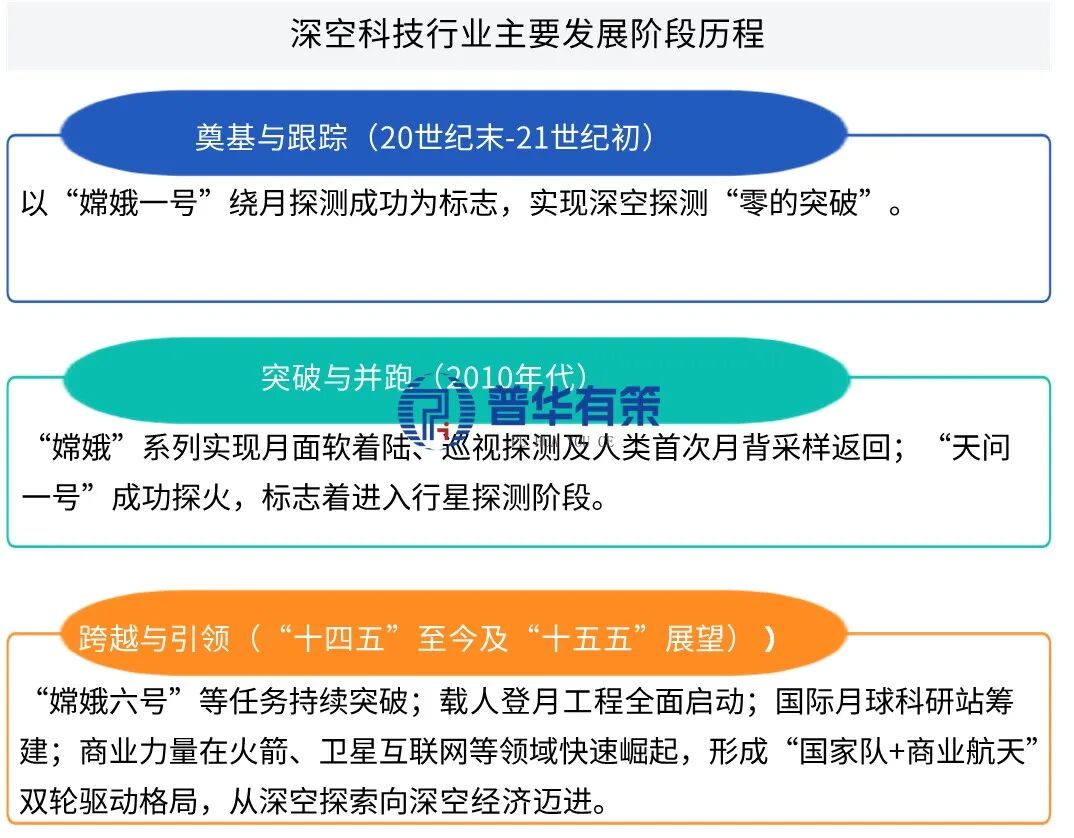
Core Insights - The deep space economy is entering a golden decade, driven by new productive forces that will stimulate future growth [1] - The deep space technology sector focuses on the exploration, development, and sustainable utilization of celestial bodies beyond the Moon, integrating advanced technologies such as AI and renewable energy [1][24] - China's deep space technology has evolved from lunar exploration to interplanetary missions, with significant achievements like the Tianwen-1 Mars mission and plans for human lunar landings by 2030 [4][24] Industry Overview - Deep space technology encompasses cutting-edge scientific research, disruptive technology development, and major equipment manufacturing aimed at sustainable utilization [1][24] - The industry has transitioned from a planned research model to a market-oriented and ecological model, characterized by collaboration between state-owned enterprises and private companies [25] Competitive Landscape - The competitive structure of China's deep space technology industry features a "national team" leading system innovation, commercial enterprises focusing on niche breakthroughs, and collaborative development among academia, industry, and research [25] - The first tier consists of state-owned enterprises like China Aerospace Science and Technology Corporation, which dominate design and integration for major national projects [25] - The second tier includes commercial companies making breakthroughs in key subsystems and emerging launch sectors, while the third tier comprises startups focused on new applications and data services [26] Key Drivers of Industry Development - National strategic goals, such as building a "strong aerospace nation," serve as a fundamental driving force for the industry [27] - The integration of disruptive technologies, particularly AI, is transforming deep space activities and enhancing mission success rates [28] - Strong market demand, particularly in satellite internet and resource utilization, is attracting global capital and driving sustainable growth expectations [29] Policy Environment - Since the 14th Five-Year Plan, policies have accelerated the transition of deep space technology from top-level planning to industry cultivation, emphasizing the importance of technological innovation [11] - The 2025 Central Economic Work Conference highlighted the need for technological innovation to lead the construction of a modern industrial system, providing clear directives for the deep space sector [11]

调研 | 银行对硬科技要投早,要早到多早?
券商中国· 2026-01-13 06:25
Core Viewpoint - The financing accessibility for technology-based enterprises has significantly improved, with a loan approval rate of 50.3% for small and medium-sized tech enterprises as of September 2025, and interest rates continuing to decline [2]. Group 1: Industry Changes - The banking sector has optimized its technology financial services by enhancing approval efficiency and offering preferential policies on access and pricing [2]. - There is a high concentration of credit and value-added services in established tech companies, while early-stage and smaller enterprises still face challenges in accessing these services [2]. - The concept of "early investment" is emphasized, with Hangzhou Bank being a pioneer in this approach, exemplified by its role as the first lender to the private aerospace company Diwei II [2][3]. Group 2: Diwei II's Business Model - Diwei II focuses on providing satellite services and ground systems to countries lacking satellite infrastructure, with a business model that includes full-chain services such as satellite construction and technical training [4]. - The AI satellites developed by Diwei II can perform 400 trillion calculations per second, enabling rapid data processing that traditional satellites cannot achieve [4]. - Diwei II has secured contracts with Oman for satellite services aimed at land surveying and urban planning, indicating a strong international market potential [5]. Group 3: Collaboration with Hangzhou Bank - Hangzhou Bank has provided Diwei II with a low-interest loan of 20 million for payroll and R&D, showcasing its commitment to supporting early-stage tech companies [8]. - The bank employs a dynamic evaluation model for assessing the growth potential of startups, focusing on policy, capital, technology, team, and industry [8]. - Hangzhou Bank's technology loan balance reached 115.2 billion as of June 2025, with increasing support for emerging sectors like AI and commercial aerospace [10]. Group 4: Strategic Focus and Future Plans - Hangzhou Bank plans to target key areas in the AI industry, such as computing hardware and industrial applications, over the next 3-5 years [11]. - The bank's strategy includes a specialized organizational structure to support early investments and a risk management framework that allows for higher risk tolerance in tech financing [10]. - The bank aims to enhance its "early investment" approach by collaborating with research institutions and focusing on companies with stable teams and promising technology [9].


券商晨会精华 | 人形机器人板块持续反弹 布局窗口开启
智通财经网· 2025-12-02 00:31
Market Overview - The market experienced a rebound yesterday, with the Shanghai Composite Index returning above 3900 points, and both the Shenzhen Component Index and the ChiNext Index rising over 1% [1] - The total trading volume in the Shanghai and Shenzhen markets reached 1.87 trillion yuan, an increase of 288.1 billion yuan compared to the previous trading day [1] - By the end of the trading session, the Shanghai Composite Index rose by 0.65%, the Shenzhen Component Index increased by 1.25%, and the ChiNext Index gained 1.31% [1] Humanoid Robot Sector - The humanoid robot sector has shown significant rebound, with a noticeable inflow of funds and the overall index entering an upward channel [2] - The core driving factors include the nearing end of the sector's adjustment, sufficient risk release, and a more rational and unified industry outlook [2] - By 2026, humanoid robots are expected to enter mass production, with major companies entering the market and policy support and subsidies likely to materialize [2] Commercial Aerospace Development - The establishment of the Commercial Aerospace Office by the National Space Administration aims to enhance the efficiency of launch approvals and licensing, promoting standardized and large-scale development of the industry [3] - The "Action Plan for Promoting High-Quality and Safe Development of Commercial Aerospace (2025-2027)" outlines four core objectives, including support for low-cost technologies and the establishment of a national fund to optimize the industry ecosystem [3] - By 2025, the industry is expected to accelerate, with over 100 in-orbit satellites and private rocket companies entering the national satellite launch market [3] Space Computing and Perovskite Materials - Space computing is transitioning from concept to reality, with major overseas tech companies making significant investments [4] - The energy supply for space computing will heavily rely on photovoltaic technology, with perovskite materials emerging as a promising solution due to their high efficiency and low cost [4] - Since 2025, the industrialization of perovskite technology is expected to accelerate, with multiple GW-level production lines being launched, presenting investment opportunities in the perovskite sector [4]



中信建投:商业航天司落地及行动计划发布,我国商业航天高质量发展有望加速
Mei Ri Jing Ji Xin Wen· 2025-12-02 00:18
Core Viewpoint - The establishment of the Commercial Space Administration by the National Space Administration aims to enhance the efficiency of launch approvals and licensing, promoting the standardized and large-scale development of the commercial space industry [1] Group 1: Regulatory Developments - The Commercial Space Administration will serve as a dedicated regulatory body to improve the efficiency of launch approvals and licensing [1] - The release of the "Action Plan for Promoting High-Quality and Safe Development of Commercial Space (2025-2027)" outlines four core objectives [1] Group 2: Strategic Goals - The action plan includes support for low-cost technologies such as reusable rockets and smart satellites through open research projects [1] - It aims to promote the integration of civil and commercial standards by sharing national resources like measurement and control stations and testing grounds [1] - Establishment of a national fund to optimize the industrial ecosystem is also a key goal [1] - A comprehensive safety regulatory system covering the entire lifecycle of the industry will be constructed [1] Group 3: Industry Outlook - By 2025, the industry is expected to accelerate with over 100 in-orbit satellites from GW and Qianfan Constellation, and private rocket companies entering the national satellite launch market [1] - The Ministry of Industry and Information Technology will open satellite communication services to operators, promoting consumer-level applications of direct connection technology [1] - Following the clarification of the policy framework, commercial space is projected to enter a phase of high-frequency launches starting in 2026, with low Earth orbit satellite internet and the rocket launch supply chain becoming core beneficiary areas [1]
中信建投:商业航天司落地及行动计划发布 我国商业航天高质量发展有望加速
Di Yi Cai Jing· 2025-12-02 00:13
Core Viewpoint - The establishment of a dedicated Commercial Space Administration by the National Space Administration aims to enhance the efficiency of launch approvals and licensing, promoting the standardized and large-scale development of the commercial space industry [1] Group 1: Regulatory Developments - The newly formed Commercial Space Administration will serve as a specialized regulatory body to improve the efficiency of launch approvals and licensing [1] - The release of the "Action Plan for Promoting High-Quality and Safe Development of Commercial Space (2025-2027)" outlines four core objectives to support the industry [1] Group 2: Industry Goals and Initiatives - The action plan includes initiatives to support low-cost technologies such as reusable rockets and smart satellites through open research projects [1] - It emphasizes the integration of civil and commercial standards to share national resources like measurement and control stations and testing grounds [1] - The establishment of a national fund aims to optimize the industrial ecosystem and create a comprehensive safety regulation system throughout the lifecycle of space projects [1] Group 3: Market Outlook - By 2025, the industry is expected to accelerate, with over 100 in-orbit satellites from GW and Qianfan Constellation, and private rocket companies entering the national satellite launch market [1] - The Ministry of Industry and Information Technology will open satellite communication services to operators, promoting consumer-level applications of direct connection technology [1] - Following the clarification of the policy framework, commercial space is projected to enter a phase of high-frequency launches starting in 2026, with low Earth orbit satellite internet and the rocket launch supply chain becoming key beneficiary sectors [1]
西湖区:聚焦“六六行动”彰显首善风采
Hang Zhou Ri Bao· 2025-05-29 02:52
Core Insights - West Lake District is experiencing significant economic growth, surpassing a total economic output of 200 billion, and is committed to becoming a model for high-quality development and common prosperity in Zhejiang [7][19] - The district emphasizes "three innovations integration" as a driving force for development, focusing on technology, industry, and cultural innovation [7][10] Group 1: Technological Innovation - The district has established five university innovation ecosystems, achieving second place in the province for technology achievement transformation index and third for technology talent index [8][9] - Plans include creating various innovation centers and service complexes across different innovation ecosystems, aiming to enhance collaboration between scientists, entrepreneurs, and investors [9] - The digital economy's core industry added value has exceeded 71 billion, ranking third in the city, with a focus on artificial intelligence and smart applications [10] Group 2: Cultural Development - Three companies from West Lake District were recognized in the "2025 National Cultural Enterprises Top 30," showcasing the area's cultural vitality [12] - Ongoing projects include the construction of cultural spaces and art centers to enhance community engagement and cultural consumption [13][14] Group 3: Urban and Rural Integration - The district is committed to urban quality upgrades and rural revitalization, with plans for new community developments and digital rural models [15] - The establishment of a tea innovation research institute marks a strategic move towards becoming a "new tea drink capital" [15] Group 4: Resource Allocation and Efficiency - West Lake District is implementing innovative service platforms to enhance efficiency in business and healthcare, including AI-driven solutions [16][17] - The district aims to facilitate smoother flows of quality resources to boost productivity [16] Group 5: Quality of Life Improvements - The district plans to create 85,000 job opportunities and enhance educational resources, focusing on youth employment and community education [18] - Initiatives to improve elderly care and child-friendly services are underway, aiming to create a supportive environment for families [18][19]