智能消费

Search documents
四维共振驱动春季行情 多元策略适配不同风险偏好
Zhong Guo Zheng Quan Bao· 2026-02-06 20:24
Core Viewpoint - The current A-share market is characterized by a blend of upward continuation and short-term volatility, necessitating investment strategies that align with risk preferences and market dynamics [1][2]. Market Conditions - Analysts believe that the market is poised for an upward trend driven by four key factors: ample liquidity, policy catalysts, calendar effects, and the interplay of valuation and earnings [3][4]. - The upcoming Spring Festival is seen as a critical period for investment decisions, with historical data indicating a strong performance of the market during this time [2][4]. Investment Strategies - Analysts recommend focusing on two main lines: technology growth and resource products, while also diversifying into cyclical consumption, price increases, and defensive assets [6][7]. - For medium-risk investors, a balanced approach involving profit-taking and a "barbell strategy" is suggested, combining dividend and technology assets [2][3]. Sector Insights - The technology sector is expected to be a core focus for long-term investments, particularly in AI and related fields, with a shift from hardware to application-based investments anticipated in 2026 [6][7]. - The cyclical and resource sectors are highlighted for their potential price increases and recovery opportunities, with specific attention to industrial metals and energy products [7][8]. Defensive Assets - High-dividend assets are recommended as a core component of defensive strategies, with sectors such as utilities, banks, and consumer staples being favored for their stability and yield [8]. - Analysts emphasize the importance of maintaining a diversified portfolio that balances offensive and defensive assets to mitigate risks associated with market fluctuations and external uncertainties [8].
发布28条政策促进消费和服务业联动发展 上海:优化汽车贷款流程 放宽申请条件
Zhong Guo Zheng Quan Bao· 2026-01-13 21:03
Group 1 - The core viewpoint of the article is the introduction of 28 policy measures by the Shanghai Municipal Government to enhance service quality and boost consumption across six key sectors: finance, information services, transportation, cultural and entertainment services, life services, and inspection and certification [1][3] Group 2 - In the financial sector, the measures encourage innovation in financial products tailored to new consumption trends, such as holiday, night, nostalgic, and anime economies, and include personal consumption loan interest subsidies and optimized auto loan processes [1][2] - In transportation services, the government supports airlines in launching new international routes and developing luxury tourism trains, as well as enhancing airport commercial layouts to create composite consumption scenarios [2] - In the cultural and entertainment sector, there is a focus on promoting the gaming and esports industry, supporting the development of original IP games, and incentivizing quality micro-short film content creation [2] Group 3 - The next steps involve ensuring the effective implementation of the measures by coordinating service supply with consumer demand, promoting digital, green, and intelligent consumption, and enhancing service quality [3] - The government aims to create a favorable environment for sustained consumption growth by implementing fiscal and financial support policies and improving service quality management and brand building [3]
统筹做好提振消费大文章
Jing Ji Ri Bao· 2025-10-15 22:17
Core Viewpoint - The article emphasizes the significant role of final consumption as a driving force for economic growth in China, highlighting the historical achievements in expanding consumer demand and the effectiveness of policies implemented during the "14th Five-Year Plan" period [1]. Consumption Structure Changes - The contribution of final consumption expenditure to GDP has surpassed that of capital formation and net exports, with a projected contribution rate of 44.5% in 2024 [2]. - Both household and government consumption are showing sustained growth, supported by policies aimed at stimulating consumption in key sectors such as automobiles, home goods, electronics, and tourism [2]. - Production consumption is also accelerating, driven by large-scale equipment updates and advancements in technology, leading to rapid growth in demand for production materials and services [2]. Rural Consumption Dynamics - Since the 18th National Congress, rural consumption has significantly improved, with an average annual growth rate from 2013 to 2024 approximately double that of urban levels [3]. - The shift towards higher-quality consumption is evident, with a 1.4 percentage point decrease in the Engel coefficient from 2013 to 2024, indicating a transition from basic needs to a pursuit of better living standards [3]. Service Consumption Expansion - The service sector has become the largest contributor to GDP, surpassing 50% for the first time in 2014, with a focus on enhancing service supply to meet diverse consumer demands [4]. - New service consumption areas such as elderly care and cultural tourism are emerging as significant growth points [4]. New Consumption Models and Scenarios - The application of new technologies like cloud computing and big data is fostering the emergence of new consumption scenarios and business models, with online retail growth outpacing overall retail growth from 2014 to 2024 [5]. - The rise of "Z generation" and senior consumers is driving the market towards more personalized and high-quality consumption [5]. Key Directions for Boosting Consumption - Enhancing consumer capacity is crucial, addressing income disparities and stabilizing income for flexible employment groups [6]. - Increasing disposable income for residents and improving government consumption capabilities are essential for stimulating overall consumption [7]. - Strengthening consumer willingness is necessary to address the current lack of effective demand, with strategies to improve income expectations and expand consumer choices [7]. Promoting Consumption Upgrades - Reducing rigid expenditure burdens and enhancing the quality of traditional consumption are vital for meeting diverse consumer needs [8]. - Improving public services and increasing the supply of quality cultural and entertainment products are also key to upgrading consumption [8]. Improving the Consumption Environment - Strengthening regulatory frameworks and consumer rights protection is essential for fostering a high-quality consumption environment [9]. - Enhancing infrastructure for immediate, digital, and shared consumption will support the development of a more integrated consumption landscape [9]. Implementation of Specific Measures - Coordinated reforms are necessary to support job creation and improve income distribution, including raising minimum wage standards and optimizing tax policies [10]. - Expanding government spending on public services and encouraging social participation in public goods provision will enhance overall consumption quality [10]. Continuous Policy Optimization - Accelerating the implementation of consumption-boosting actions and optimizing policies related to product upgrades and consumer support mechanisms are critical for fostering a vibrant consumption market [11]. - Establishing a robust system for consumer rights protection and promoting healthy consumption practices will further enhance consumer confidence and engagement [12].
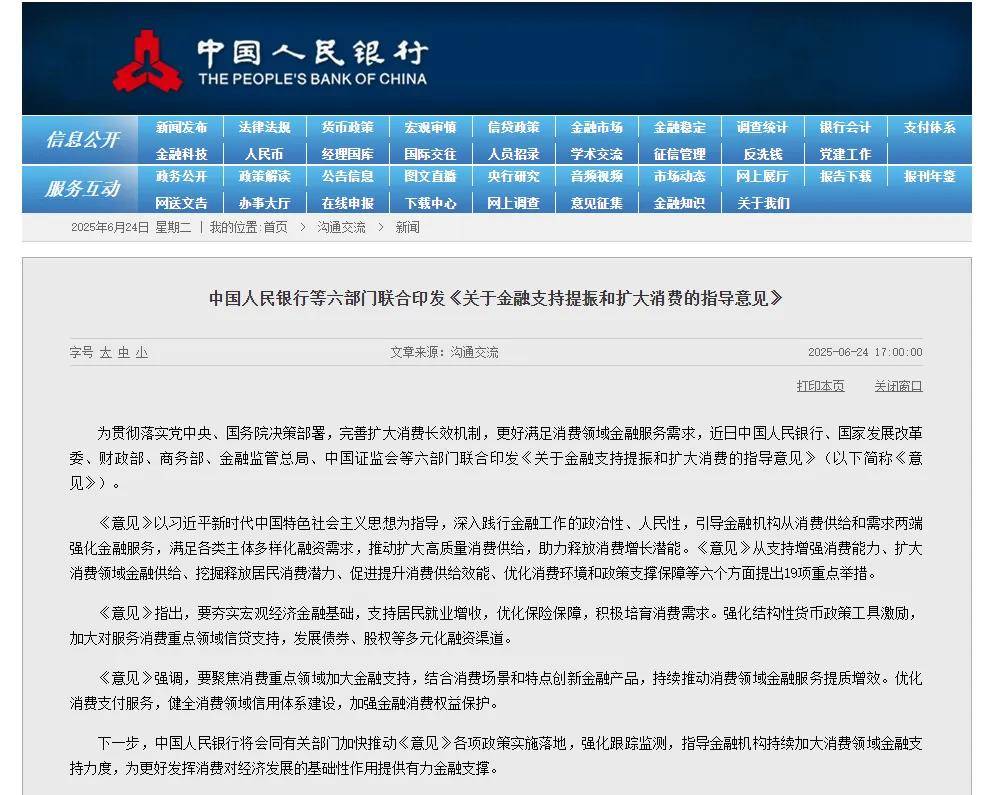
央行等六部门发文提振和扩大消费 家电以旧换新、家装厨卫“焕新”等领域迎利好
Sou Hu Cai Jing· 2025-06-24 11:53
Group 1 - The core viewpoint of the news is the issuance of the "Guiding Opinions on Financial Support for Boosting and Expanding Consumption" by six Chinese government departments, aimed at enhancing consumer capacity and stimulating consumption [1] - The Opinions propose 19 key measures across six areas, including enhancing consumer capacity, expanding financial supply in consumption sectors, and optimizing the consumption environment [1] - The focus is on increasing financial support for key consumption areas, such as promoting the replacement of old goods and providing credit support for recycling and upgrading essential consumer goods [4] Group 2 - There is an emphasis on strengthening financial support for green and smart home appliances, optimizing approval processes, and improving service quality [5] - The Opinions encourage financial innovation to support new consumption models, including digital, green, and health consumption, and promote collaboration between financial institutions and merchants [5] - The policy is expected to alleviate financing pressures for enterprises, lower consumer purchase thresholds, and highlight the importance of the home improvement industry in expanding domestic demand and promoting consumption [5]