
资源品

Search documents
A股市场投资策略周报:资本市场将聚焦五个提升,市场短期以稳为主-20260312
BOHAI SECURITIES· 2026-03-12 09:50
Market Overview - In the past five trading days (March 6 to March 12), major indices showed mixed performance, with the Shanghai Composite Index rising by 0.50% and the ChiNext Index increasing by 3.13% [6][34] - The average daily trading volume in the two markets decreased to 2.44 trillion yuan, down by 239.64 billion yuan compared to the previous five trading days [13][34] - Among the sectors, the power equipment, coal, and agriculture industries saw the highest gains, while the oil and petrochemical, defense, and non-ferrous metal sectors experienced the largest declines [23][34] Inflation and Trade Data - The CPI for February increased by 1.3% year-on-year and 1.0% month-on-month, primarily driven by a low base effect from the previous year and recovery in consumer demand due to the holiday effect [27][30] - The PPI for February decreased by 0.9% year-on-year but increased by 0.4% month-on-month, with the decline in PPI continuing to narrow due to the effects of policies aimed at stabilizing prices in certain industries [27][30] - Exports in January-February grew by 21.8% year-on-year, supported by competitive advantages in new sectors and short-term export behaviors due to tax rebate policies [30][34] Policy and Market Resilience - The Chairman Wu Qing emphasized five key enhancements for the capital market during the 14th National People's Congress, including improved market resilience, more inclusive regulations, higher quality of listed companies, and better investor protection [33][34] - The capital market is expected to maintain a "slow bull" trend, with a focus on performance as the end of March approaches and the first quarter earnings season nears [34][36] Investment Opportunities - Investment opportunities are identified in the computing power sector due to policy support for supercomputing cluster construction and increased capital expenditure from domestic and foreign cloud vendors [36] - The power equipment sector is also highlighted for investment due to anticipated demand for energy storage driven by policy initiatives [36] - The resource sector presents investment opportunities as geopolitical situations clarify and the importance of resource security increases [36]
策略周报:两会前后市场如何演绎?
Guoxin Securities· 2026-02-28 10:50
Market Performance Insights - Historical data shows a high probability of market gains before and after the Two Sessions, with the probability of increase being 76.2% for the Shanghai Composite Index in the 20 trading days before the sessions[19] - The average gain for the Shanghai Composite Index before the Two Sessions is 1.8%, while the average gain after is 3.1%[20] - The probability of small-cap stocks outperforming large-cap stocks is nearly 90% before the Two Sessions, but drops to 50% afterward[20] Sector Analysis - Resource sectors such as steel and non-ferrous metals have shown high probabilities of gains before the Two Sessions, with probabilities exceeding 80%[22] - Consumer sectors tend to perform better during the Two Sessions, with a 60% probability of gains in industries like food and beverage[20] - Post-Two Sessions, real estate and consumer sectors have a high probability of gains, with real estate at 76.2%[20] Policy Impact - The Two Sessions serve as a critical window for observing economic policy directions, influencing market sentiment and performance[24] - Pre-Two Sessions, there is typically an increase in growth-stabilizing policy expectations, leading to active trading[24] - Post-Two Sessions, the acceleration of policy implementation often boosts optimistic market expectations, particularly for cyclical sectors[24] Current Market Conditions - The spring market rally continues, with the Shanghai Composite Index showing a 3.7% increase since February 3, and a recent weekly gain of 2.0%[1] - Recent trading volumes have increased, with average daily trading rising from 2.1 trillion to 2.4 trillion yuan[1] - Leverage funds have shifted from outflows to inflows, indicating improved market sentiment, with net purchases reaching 258.7 billion yuan recently[1] Investment Strategy - A balanced allocation strategy is recommended, focusing on sectors like AI applications, resources, and real estate, given the current market dynamics[29] - The anticipated continuation of the spring rally is supported by positive macroeconomic policies and increased liquidity in the market[28] - The focus on expanding domestic demand is expected to be a key theme in the upcoming Two Sessions, influencing investment opportunities[24]
策略周报:两会前后市场如何演绎?-20260228
Guoxin Securities· 2026-02-28 09:26
Core Conclusions - Historical data indicates a high probability of market gains before and after the Two Sessions, with cyclical industries showing stronger performance [2][19] - Market performance around the Two Sessions is closely tied to policy expectations, which significantly influence market trends [3][24] - The spring market rally is expected to continue, supported by multiple positive factors, with a balanced allocation strategy recommended, particularly emphasizing AI applications and sectors like resources, real estate, and liquor [1][28] Market Performance Analysis - Since mid-December last year, the spring market rally has gradually unfolded, with a notable increase in trading volume post-holiday. The Shanghai Composite Index has seen a rise of 3.7% from February 3 to the present, with the CSI 300 and the Wind All A Index increasing by 2.3% and 5.2%, respectively [1][13] - Historical analysis from 2005 onwards shows that the market tends to rise significantly in the 20 trading days before the Two Sessions, with probabilities of 76.2% for the Shanghai Composite Index and 85.7% for the Wind All A Index [19][20] Style and Sector Performance - Before the Two Sessions, small-cap stocks outperform, with an 85.7% probability of gains, while post-Two Sessions, the performance of large-cap stocks improves [20][22] - Cyclical sectors tend to perform better before and after the Two Sessions, with resource sectors like steel and non-ferrous metals showing high probabilities of gains [20][22] Policy Influence - The Two Sessions serve as a critical window for observing economic policy directions, with expectations for stable growth policies to rise before the meetings, leading to increased trading activity [3][24] - Post-Two Sessions, as policies are clarified and implemented, there is often a seasonal uptick in high-frequency data, which can enhance optimistic market expectations [3][24] Investment Opportunities - The report suggests a balanced investment approach, focusing on cyclical sectors and real estate, alongside technology driven by AI applications. The resource sector is expected to benefit from domestic policies and global liquidity conditions [28][29] - The real estate sector is highlighted as having a 76.2% probability of gains post-Two Sessions, with recent policy changes in major cities indicating a recovery in the housing market [20][29]
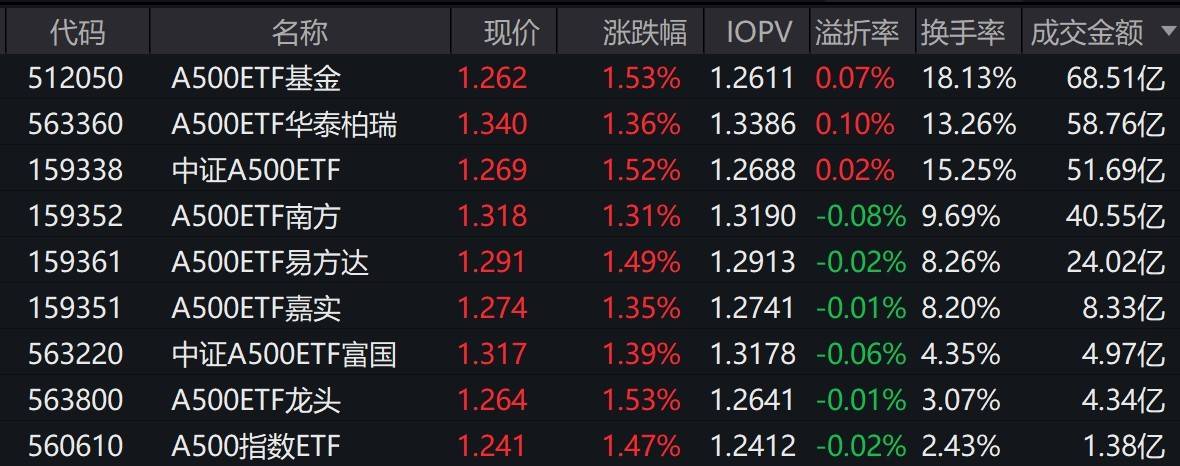
市场早盘震荡拉升,中证A500指数上涨1.4%,2只中证A500相关ETF成交额超58亿元
Sou Hu Cai Jing· 2026-02-25 03:54
Group 1 - The market experienced a morning rally, with the CSI A500 index rising by 1.4% [1] - Lithium mining and rare earth permanent magnet sectors showed significant gains, while the film and cinema sector weakened [1] - As of the morning close, ETFs tracking the CSI A500 index saw an increase of over 1%, with nine related ETFs exceeding a trading volume of 100 million yuan, and two surpassing 5.8 billion yuan [1] Group 2 - The A500 ETF fund and A500 ETF Huatai Baichuan had trading volumes of 6.851 billion yuan and 5.876 billion yuan respectively during the morning session [1] - A brokerage noted that global major assets exhibited a general upward trend during the Spring Festival holiday, with AI and resource products becoming market focal points [1] - Historical data indicates that A-shares typically enter a high-probability window for gains after the Spring Festival, with a significant increase in the likelihood of index rises [1]

私募配置聚焦双主线 “弯道位置要控制好重心”
Zhong Guo Zheng Quan Bao· 2026-02-24 20:45
Group 1 - The A-share market experienced a strong opening on February 24, with both volume and price rising, indicating a strong willingness for capital entry after the Spring Festival holiday [1][2] - There is a structural divergence in the market, with resource sectors like oil, gas, and chemicals performing well, while sectors such as film and AI applications saw significant pullbacks [1][2] - Multiple private equity institutions noted that the market's performance aligns with pre-holiday optimistic expectations, but the main investment themes are gradually shifting, requiring investors to recalibrate their strategies between "technology" and "resources" [1][2] Group 2 - The A-share market on the first trading day of the Year of the Horse showed a clear "resource + technology growth" dual-driven pattern, with resource sectors and hard technology sectors like AI and semiconductors leading the gains [2][3] - Analysts observed that the performance of technology growth sectors was relatively disappointing compared to resource sectors, which performed stronger than expected [2][3] - The market's structural divergence is seen as exceeding expectations, with some investors feeling cautious despite the overall market rise [2][3] Group 3 - Private equity institutions are focusing on certain industry trends, emphasizing the importance of sectors with clear growth trajectories, particularly in AI and resource commodities [3][4] - The investment logic is supported by the rising global capital expenditure in AI and the structural demand for industrial metals due to a recovering global manufacturing cycle [3][4] - Some institutions express caution towards the technology sector due to recent volatility, preferring to wait for clearer market signals before making significant investments [4] Group 4 - The general attitude among private equity institutions is to adopt a balanced and flexible approach to investment, with a focus on core products and adaptable positions [5][6] - There is a consensus on the need for careful selection within the technology sector, prioritizing companies with strong performance metrics and clear commercial paths [5][6] - The market is expected to experience structural opportunities, with low-valuation value stocks and price increases driven by spring construction activities being potential areas for capital rotation [6]
多数保险机构今年计划小幅增配A股
Zheng Quan Ri Bao· 2026-02-24 15:42
Core Insights - The China Banking and Insurance Asset Management Association (CBIAMAA) has released a survey indicating that insurance institutions are optimistic about domestic investment assets, particularly stocks and securities investment funds, for 2026 [1][2] - The survey highlights a significant increase in the investment confidence index for equity investments among insurance institutions [1] Domestic Investment Outlook - Insurance institutions plan to slightly increase their allocation to A-shares, with a majority expressing optimism about the A-share market for 2026 [4] - 64.86% of asset management institutions and 62.63% of insurance companies intend to moderately or slightly increase their stock allocations [2] - For bonds, most institutions maintain a neutral outlook, expecting 10-year government bond yields to be between 1.8% and 1.9%, and 30-year yields between 2.2% and 2.4% [2] Foreign Investment Preferences - The most favored foreign investment for 2026 is Hong Kong stocks, with half of the asset management institutions planning to slightly increase their allocation [3] - Gold and U.S. stocks are also receiving significant attention from insurance institutions [3] A-share Investment Focus - The focus for A-share investments will be on two main themes: new productive forces and economic recovery [4] - Key sectors of interest include technology, non-ferrous metals, power equipment, and pharmaceuticals, with specific attention to themes like semiconductor chips and AI computing [4][5] Fund Investment Strategy - Nearly half of the insurance institutions plan to slightly increase their allocation to public funds in 2026, favoring equity funds and mixed funds [4] - Asset management institutions are inclined towards stock funds and ETFs, while insurance companies prefer secondary bond funds and growth-oriented funds [4]
帮主郑重:去年拿得住就行,今年得多个心眼
Sou Hu Cai Jing· 2026-02-24 03:49
Core Viewpoint - The market has become more challenging in 2023, with increased volatility and a shift from broad market gains to sector-specific performance [4][5]. Market Dynamics - Last year saw a general rise in stock prices, but this year has experienced a more differentiated market where some sectors thrive while others falter [5][10]. - The performance of stocks is now heavily influenced by tangible orders and earnings rather than speculative narratives [9][10]. Sector Performance - Certain sectors, such as AI computing power, optical modules, and storage chips, are experiencing strong demand with orders extending into the end of the year [5]. - Conversely, stocks driven by hype without solid fundamentals, such as some AI applications and non-core technology companies, are facing significant volatility [5][7]. Stock Examples - Companies like Zhihui Technology and MiniMax have seen drastic declines of 22% and 13% respectively due to overvaluation and unmet expectations [6][7]. - In contrast, companies like Huagong Technology, which have solid orders, are maintaining stable stock prices [8]. Investment Strategy - Investors are advised to focus on stocks with real orders and performance metrics, rather than those reliant on market sentiment [10][13]. - Maintaining a low cost basis is crucial, as high entry costs can lead to panic during market fluctuations [11]. - It is recommended to avoid full positions and to keep cash available for future opportunities, as the market will continue to present chances for investment [12][14]. Actionable Steps - Review and adjust holdings to prioritize stocks with tangible performance over speculative ones [13]. - Control trading rhythm by avoiding high-risk purchases and being strategic about selling and buying [14]. - Exercise patience, as significant market movements are expected to unfold over time rather than in a straight line [15].

莫斯科突发!普京:发展“三位一体”核力量是绝对优先事项!白银 开盘大涨
Qi Huo Ri Bao· 2026-02-23 01:06
International Situation - Moscow airports have implemented restrictions on aircraft takeoffs and landings to ensure flight safety, although specific details and duration of these measures have not been disclosed [3] - Russian President Putin emphasized the development of "triad" nuclear forces as an absolute priority, highlighting the importance of nuclear capabilities for national security and strategic deterrence [6] Market Analysis - Analysts suggest that despite external complexities, the A-share market is likely to experience a structural upward trend post-holiday, driven by domestic macro policies and a reduced likelihood of panic selling [12][14] - The recent U.S. Supreme Court ruling against Trump's tariff measures is seen as a short-term positive for both U.S. and A-share markets, potentially easing tariff pressures on Chinese exporters [13][14] - The anticipated visit of Trump to China in March may improve Sino-U.S. relations, contributing to a more favorable external environment for A-shares [15] - The focus for A-share growth is expected to be on sectors such as AI, semiconductors, and resource-based companies, with a long-term investment logic supporting precious metals and resource sectors due to supply shortages [16]
四维共振驱动春季行情 多元策略适配不同风险偏好
Zhong Guo Zheng Quan Bao· 2026-02-06 20:24
Core Viewpoint - The current A-share market is characterized by a blend of upward continuation and short-term volatility, necessitating investment strategies that align with risk preferences and market dynamics [1][2]. Market Conditions - Analysts believe that the market is poised for an upward trend driven by four key factors: ample liquidity, policy catalysts, calendar effects, and the interplay of valuation and earnings [3][4]. - The upcoming Spring Festival is seen as a critical period for investment decisions, with historical data indicating a strong performance of the market during this time [2][4]. Investment Strategies - Analysts recommend focusing on two main lines: technology growth and resource products, while also diversifying into cyclical consumption, price increases, and defensive assets [6][7]. - For medium-risk investors, a balanced approach involving profit-taking and a "barbell strategy" is suggested, combining dividend and technology assets [2][3]. Sector Insights - The technology sector is expected to be a core focus for long-term investments, particularly in AI and related fields, with a shift from hardware to application-based investments anticipated in 2026 [6][7]. - The cyclical and resource sectors are highlighted for their potential price increases and recovery opportunities, with specific attention to industrial metals and energy products [7][8]. Defensive Assets - High-dividend assets are recommended as a core component of defensive strategies, with sectors such as utilities, banks, and consumer staples being favored for their stability and yield [8]. - Analysts emphasize the importance of maintaining a diversified portfolio that balances offensive and defensive assets to mitigate risks associated with market fluctuations and external uncertainties [8].
上银基金:市场调整不改中期向上,可聚焦AI、国产出海等三大机会
Xin Hua Cai Jing· 2026-02-03 05:40
Core Viewpoint - The medium-term upward trend of the A-share market remains unchanged despite recent volatility and significant sector differentiation, supported by three main factors [1]. Group 1: Market Trends - The global backdrop of "asset scarcity" continues, coupled with frequent geopolitical conflicts, maintaining the long-term trend of "patient capital" flowing into the stock market [1]. - Domestic policies aimed at reducing "involution" are being deeply implemented, gradually improving corporate profit expectations and providing a floor for the capital market [1]. - The recent rapid adjustments in sectors are primarily reactions to short-term market sentiment and trading dynamics, not fundamentally altering the medium to long-term upward trend [1]. Group 2: Investment Opportunities - Focus on AI-related industries, as domestic AI industry chain support policies continue to be implemented, with expectations of increased global capital expenditure in computing power and steady improvement in AI adoption rates [2]. - Attention to the enhancement of Chinese brand competitiveness, with domestic brands transitioning from "cheap goods" to "quality products at reasonable prices" and achieving significant advancements in sectors like innovative pharmaceuticals, power equipment, and construction machinery [2]. - Resource sectors, particularly copper and minor metals, exhibit genuine scarcity and anti-inflation properties, forming stable supply alliances and showcasing significant long-term investment value [2]. - The adjustment in the non-ferrous metals sector is seen as a trading reaction rather than a fundamental change, with expectations that the market will present more attractive buying opportunities post-adjustment [2].