
机器人ETF南方

Search documents
机器人ETF南方(159258)上涨2.82%,连续7日获资金净流入,从“量产”迈向“智能”,人形机器人应用场景加速扩容
Xin Lang Cai Jing· 2026-01-14 05:20
Group 1 - The Southern Robot ETF (159258) has seen a 2.82% increase as of January 14, 2026, with a turnover of 2.47% and a transaction volume of 47.12 million yuan [1] - The CSI Robot Index (H30590) has risen by 2.59%, with notable increases in constituent stocks such as Zhongkong Technology (up 11.13%), Tianzhihang (up 8.53%), and Keyuan Wisdom (up 7.71%) [1] - The Southern Robot ETF has experienced continuous net inflows over the past seven days as of January 13 [2] Group 2 - The Jiangsu provincial government has released an "Artificial Intelligence +" action plan aimed at promoting the development of embodied intelligent robots, focusing on enhancing environmental perception, language interaction, reasoning, and decision-making capabilities [2] - A significant breakthrough in deep-sea exploration technology has been achieved with the successful testing of China's first robot capable of three-dimensional drilling and monitoring in seabed strata [2] - Guoyuan Securities predicts that 2025 will mark the year of mass application for humanoid robots, with an expansion of application scenarios expected in 2026 [2] Group 3 - The Southern Robot ETF closely tracks the CSI Robot Index, which includes system solution providers, digital workshop and production line integrators, automation equipment manufacturers, and other robot-related listed companies [3] - The top ten weighted stocks in the index include Keda Xunfei, Huichuan Technology, Top Group, Dahua Technology, and others [3]

风起青萍,财随势动——解读十五五中暗藏了哪些机会
点拾投资· 2025-11-07 06:45
Core Viewpoint - The article emphasizes the importance of the "15th Five-Year Plan" in shaping investment strategies, highlighting the shift towards a modern industrial system and the prioritization of technological self-reliance and innovation as key drivers for economic growth [1][12]. Summary by Sections Introduction - The "15th Five-Year Plan" prioritizes the construction of a modern industrial system and sets "technological self-reliance" as the second development goal, providing quantifiable targets for the capital market [1]. Historical Context - Previous five-year plans have led to the emergence of significant industries: - The 12th Five-Year Plan (2011-2015) focused on seven strategic emerging industries including energy conservation and new energy vehicles [2]. - The 13th Five-Year Plan (2016-2020) emphasized supply-side reforms [3]. - The 14th Five-Year Plan (2021-2025) introduced a focus on carbon neutrality and supply chain security [4]. Investment Opportunities - The "15th Five-Year Plan" is expected to drive investment in strategic emerging industries, with a focus on sectors such as new energy, biotechnology, and high-end equipment [7][12]. - Historical data shows that industries highlighted in the 14th Five-Year Plan have outperformed the market, with significant excess returns observed in sectors like photovoltaics and new energy vehicles [6][8]. Policy Tools - The article outlines the policy tools prepared for the "15th Five-Year Plan": 1. Fiscal measures to enhance macroeconomic policies and increase central government spending. 2. Monetary policies aimed at developing direct financing and financial markets. 3. Industrial policies to boost innovation and new productivity [4]. Strategic Focus Areas - The "15th Five-Year Plan" identifies key strategic areas for investment, including: - Advanced manufacturing, artificial intelligence, and semiconductor industries as core components of the hard technology sector [15][18]. - Emphasis on the integration of technology and industry, with a focus on scaling innovations [12][16]. ETF Recommendations - Specific ETFs are highlighted as investment vehicles to capitalize on the trends outlined in the "15th Five-Year Plan": 1. Chip ETF focusing on semiconductor industries. 2. AI ETF targeting companies in the artificial intelligence sector. 3. Robotics ETF covering the entire robotics supply chain [18][29]. Conclusion - The article concludes that the "15th Five-Year Plan" is not just a domestic economic strategy but also a framework for global capital reallocation, with significant implications for investment in technology and innovation [28].


大洗牌!这三只ETF爆了
Ge Long Hui· 2025-09-15 07:55
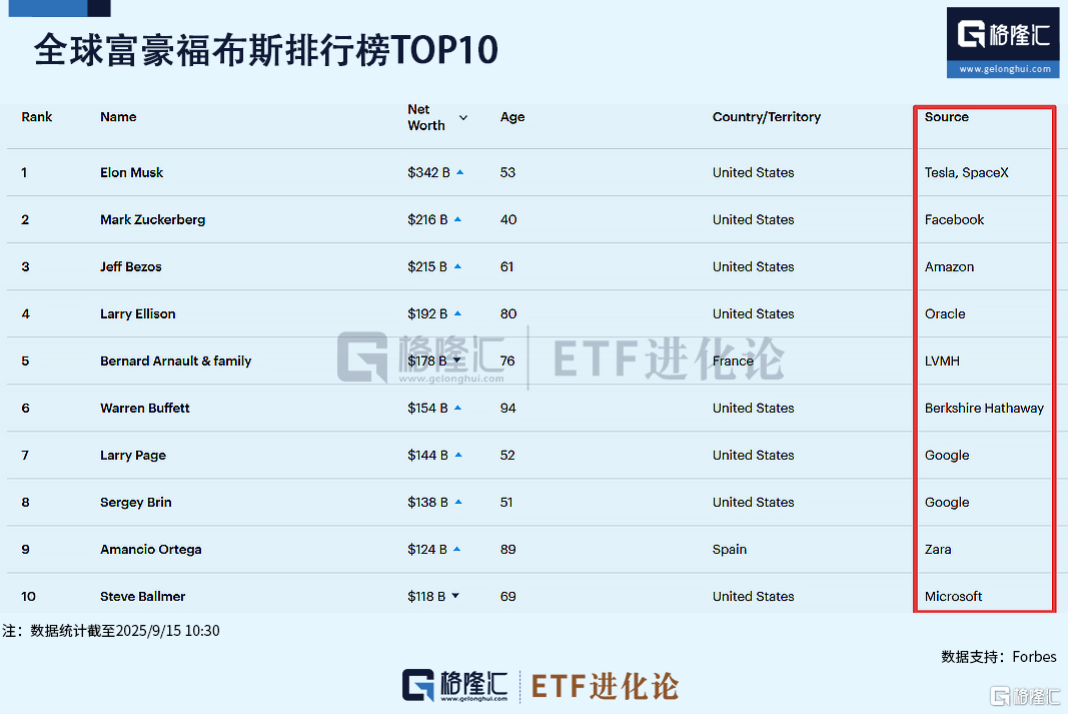
Core Insights - The emergence of AI is leading to a significant wealth redistribution among global billionaires, with technology giants dominating the top ranks of the wealth list [1][2] - Oracle's stock surged nearly 36% following a strong earnings report, marking its largest single-day gain since 1992, driven by substantial cloud contracts with major AI players [3][4] - The AI arms race among North America's major cloud providers is intensifying, with a 64% year-over-year increase in capital expenditures in Q2 2025 [4] Company Highlights - Oracle reported a remarkable increase in remaining performance obligations (RPO) to $455 billion, a 359% year-over-year growth, and projected significant revenue growth in its cloud business over the next four years [3][4] - The CEO of Oracle emphasized the vast potential of the AI inference market, suggesting that the demand for computing power will be broader and more sustained than previously anticipated [3][4] - The stock performance of ETFs related to AI, such as the Southern AI Chip ETF and the Southern Entrepreneurial AI ETF, has seen significant gains, reflecting market interest in the AI chip industry [1][3][4] Industry Trends - The AI infrastructure is undergoing a transformation, with a focus on co-packaged optics (CPO) becoming crucial for the next phase of AI data center upgrades [5] - The semiconductor industry is experiencing a surge in orders, with a notable increase in AI-related orders, indicating a robust demand for AI computing capabilities [10] - The robotics sector is gaining traction, with significant investments and interest in humanoid robots, which are seen as a key application of AI technology [12][18] Investment Opportunities - The three ETFs—Southern AI Chip ETF, Southern Entrepreneurial AI ETF, and Southern Robotics ETF—are positioned to capitalize on the AI revolution, covering critical segments of the AI industry from chips to applications [19][21] - The Southern Robotics ETF has shown impressive growth, reflecting the increasing market interest in robotics and AI applications [13][15] - The focus on AI applications, particularly humanoid robots, is expected to drive future growth and investment in the sector [12][18]

机器人ETF南方(159258)上涨2.52%,大华股份涨停,首届世界人形机器人运动会圆满落幕
Xin Lang Cai Jing· 2025-08-18 04:03
Group 1 - The core viewpoint is that the humanoid robot industry is experiencing rapid development, with significant advancements showcased at the 2025 World Robot Conference, highlighting the potential of AI technology in humanoid robots [1][2] - The Southern Robot ETF (159258) has seen a 2.52% increase, with a trading volume of 24.19 million yuan and a weekly scale growth of 160 million yuan as of August 15 [1] - The China Securities Robot Index (H30590) rose by 2.53%, with notable increases in constituent stocks such as Stone Technology (688169) up 14.51% and Dahua Technology (002236) up 9.99% [1] Group 2 - AI technology's implementation at the edge is expected to drive significant commercial value in humanoid robots, AI PCs, and AI smartphones, forming a commercial closed loop [2] - The first global humanoid robot sports event in Beijing featured over 500 robots from 16 countries, testing their motion control and task execution capabilities [2] - The humanoid robot industry is projected to reach a cumulative demand of approximately 2 million units by 2030, indicating a critical breakthrough phase [2]

