标普500指数(SPX)

Search documents
大摩盘点2026年三大可能颠覆市场的意外!
Jin Shi Shu Ju· 2025-12-25 09:24
Core Viewpoint - Analysts generally expect the stock market to continue its upward trend next year, but unforeseen events and risks could disrupt this outlook. Morgan Stanley identified three potential unexpected factors that could impact the market in 2026, predicting a 13% increase in the S&P 500 index due to strong corporate earnings and a "rolling recovery" in the U.S. economy [1]. Group 1: Jobless Productivity Boom - The U.S. economy may experience a "jobless productivity boom," which could suppress inflation and open the door for more interest rate cuts by the Federal Reserve. A weak job market could help contain wage growth and inflation, while accelerated productivity gains would support stable economic growth, potentially driving core inflation below 2% [1][2]. Group 2: Stock-Bond Paradigm Shift - The typical inverse relationship between stock and bond prices may reverse again. In 2025, both markets rose steadily, driven by a "bad news is good news" dynamic, where weak economic data fueled optimism for Fed rate cuts. However, if inflation falls to the Fed's target, this dynamic could shift back, making bonds a safe haven and a hedge against inflation [3]. Group 3: Surge in Commodity and Energy Prices - Commodity prices, including precious metals, saw significant increases in 2025 and may continue this trend in 2026. Factors such as ongoing Fed rate cuts, rising demand from China, and a weaker dollar could lead to a "blowout" in commodity prices. Predictions indicate that energy prices and overall commodity performance will improve due to supply constraints and increased demand driven by AI-related transactions [4][5][6].
2025年避险资产大洗牌:贵金属独领风骚,传统安全港集体失色
Jin Shi Shu Ju· 2025-12-23 08:22
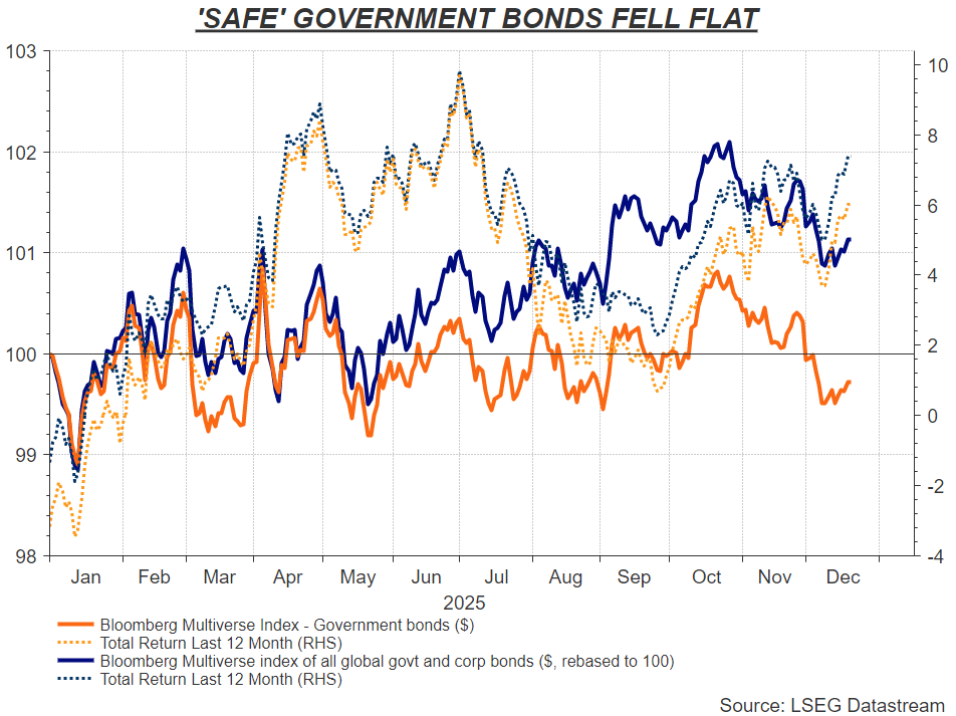
Group 1: Market Overview - In 2025, precious metals emerged as the biggest winners, while traditional "safe-haven" investments performed poorly amid market turmoil, conflicts, and concerns over an AI bubble [1] - The global economy showed strong growth, with politicians advocating for loose monetary policies, leading to a decline in recession fears and a surge in AI enthusiasm, alongside escalating geopolitical tensions [1] - The commodity index performed poorly due to an oversupply of crude oil, with oil prices dropping by 20% year-on-year, currently at about half of the previous highs [1] Group 2: Defense Sector Performance - For investors concerned about global conflicts, the best investment option was the defense sector, with U.S. aerospace and defense stocks rising by 36% and European counterparts increasing by 55% as Germany and Europe accelerated military rearmament [1] Group 3: Bond and Defensive Asset Performance - Most traditional hedging tools and safe assets underperformed this year, with global "risk-free" government bond indices declining by approximately 1% and total returns slightly exceeding 6% [2] - The Bloomberg Multiverse index, which includes government, supranational, agency, and corporate bonds, saw a price increase of about 1% and total returns close to 7% [2] Group 4: Stock Market Insights - The MSCI All-Country Stock Index's performance was more than double that of government bonds, indicating a strong recovery in the stock market [4] - The S&P 500 index rose by 15% due to the boost from large tech stocks and AI themes, with growth stocks outperforming value stocks by more than double [4] - Defensive sectors like utilities, healthcare, and financials saw gains over 10%, but still lagged behind major indices, while the consumer staples sector had a meager increase of about 2% [4] Group 5: Currency Performance - Traditionally safe-haven currencies like the yen and Swiss franc underperformed, with the yen dropping approximately 4% against its major trading partners despite initial gains [7] - The Swiss franc maintained its early-year gains, becoming one of the few standout safe-haven assets alongside gold and silver [7] - The U.S. dollar index fell by 12% during the year's most turbulent months, raising questions about its status as a safe-haven asset [7] Group 6: Volatility and Investment Strategies - Strategies involving options and volatility indices failed to yield profits in 2025, with the VIX closing down 2 points from the beginning of the year [9] - The MOVE index for bond market volatility was less than two-thirds of its initial level, indicating a decline in market volatility [9] - Overall, overly cautious investment strategies did not prove profitable this year [10]

高盛预警:美股未来十年将跑输全球同行
Jin Shi Shu Ju· 2025-11-12 15:04
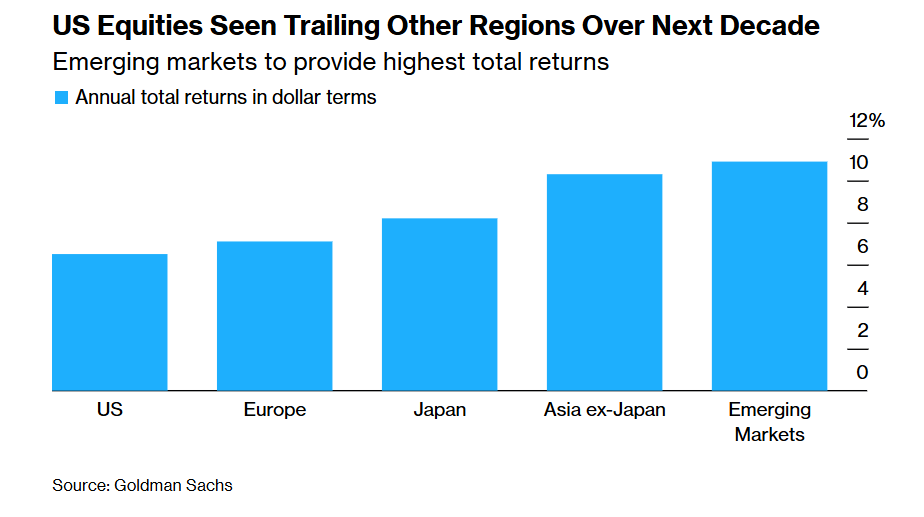
Core Viewpoint - Oppenheimer and its team suggest that investors should diversify away from the U.S. market due to high stock valuations limiting upside potential, predicting a 6.5% annualized return for the S&P 500 over the next decade, the weakest among all regions. Emerging markets are expected to be the strongest, with an annualized return of 10.9% [1][5]. Group 1 - The S&P 500 index has significantly lagged behind global peers this year, with a 16% increase compared to a 27% rise in the MSCI global index excluding the U.S. [5] - Oppenheimer's report emphasizes the benefits of diversifying investments towards emerging markets, driven by higher nominal GDP growth and structural reforms, with long-term AI benefits expected to be widespread rather than limited to the U.S. tech sector [5][6]. - Strong earnings growth in China and India is anticipated to drive the rise of emerging markets in the coming years [5]. Group 2 - The annualized return for Asian markets, excluding Japan, is projected at 10.3%, while Japan is expected to yield 8.2% and Europe 7.1% [5]. - Oppenheimer warned last year that U.S. stock valuations were becoming excessive and advocated for a shift towards international markets, predicting that the S&P 500's performance will lag behind most regions by 2025 [5][6]. - The S&P 500's forward P/E ratio has surged to 23 times, nearing record highs seen before the internet bubble, with current valuations over 50% higher than global peers [6].
美联储9月降息已板上钉钉,CPI颠覆不了?
Jin Shi Shu Ju· 2025-09-10 12:27
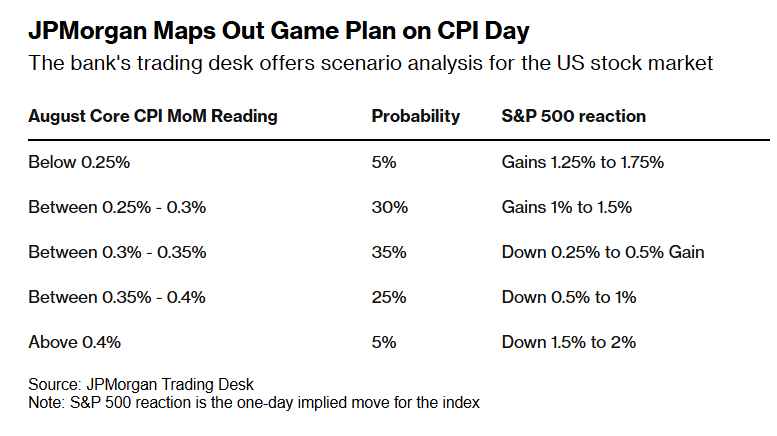
Group 1 - Wall Street expects the upcoming Consumer Price Index (CPI) report to show rising inflation, but the employment market will dominate market narratives, leading to moderate stock market volatility predictions [1][2] - Citigroup's U.S. equity trading strategist Stuart Kaiser indicates that options traders anticipate a mild fluctuation of about 0.7% in the S&P 500 index (SPX) post-CPI report, lower than the average actual volatility of 0.9% on CPI release days over the past year [1][2] - Market expectations suggest that the Federal Reserve may lower the federal funds rate by 25 basis points at the September meeting, with potential further cuts in October and December, influenced by signs of economic growth threats from weak employment data [1][2] Group 2 - Economists predict that the core CPI, excluding food and energy, will rise by 0.3% month-over-month in August, maintaining a year-over-year increase of 3.1%, significantly above the Fed's 2% target [2][3] - JPMorgan's Andrew Tyler outlines various scenarios for the S&P 500's reaction based on core CPI readings, with probabilities assigned to different ranges of CPI increases [3] - The Atlanta Fed's GDPNow model indicates a robust annualized GDP growth rate of 3% for Q3, despite a slight decline from Q2's 3.3%, contributing to a lower risk perception among traders in the coming weeks [3][4] Group 3 - The Chicago Board Options Exchange Volatility Index (VIX) remains below the critical level of 20, indicating that traders are not overly concerned about market volatility [4] - Citigroup's U.S. Economic Surprise Index is near its highest level since January, suggesting that positive economic surprises could complicate the Fed's inflation control efforts, potentially leading to prolonged high interest rates [5][6] - The employment market will be crucial in determining the Fed's actions; a rate cut in October may signal continued pressure on employment data and no unexpected inflation increases [6]