桌游

Search documents
从「中老年专属」到热门打卡地,洗浴中心为何迎来年轻化浪潮?
声动活泼· 2026-03-04 09:34
Core Insights - The bathing center industry is experiencing a significant shift, with the Z generation becoming the main consumer group, particularly in major cities like Beijing, Shanghai, and Wuhan, where individuals aged 25-35 account for over half of the customer flow [4][5] - The average stay duration in popular bathing centers has increased from 6-7 hours to over 10 hours, with some centers achieving a repurchase rate exceeding 35%, far surpassing the industry average [4][5] Industry Trends - The transformation of bathing centers from being primarily frequented by older generations to becoming popular among younger consumers is attributed to the integration of entertainment and dining options, such as KTV, gaming areas, and all-you-can-eat buffets [5][6] - The emergence of "office-friendly bathing centers" equipped with quiet workspaces and high-speed WiFi caters to young professionals, further expanding the consumer base [6][7] - The market for overnight stays in bathing centers is growing rapidly, with transaction numbers increasing by over 60% year-on-year, as consumers seek convenient and cost-effective alternatives to traditional hotels [8][10] Market Dynamics - The number of bathing-related enterprises in China has surged by nearly 50% in recent years, exceeding 1.05 million last year, significantly higher than the approximately 600,000 in 2020 [10] - The overall market size of the bathing industry reached nearly 110 billion yuan last year, with a year-on-year growth rate exceeding 20% [10] Competitive Landscape - The industry is facing challenges of homogenization, as many bathing centers adopt similar entertainment and dining offerings, leading to a lack of differentiation [11][12] - The operational costs for large bathing centers are substantial, with initial investments exceeding 50 million yuan and monthly operating costs around 3 million yuan, necessitating high customer traffic to remain viable [12][12] - There is a clear divide in the industry, with leading companies benefiting from a comprehensive model that allows for higher customer spending and repeat visits, while smaller centers struggle with competition and cost pressures [12]


孩子沉迷游戏 家长应如何引导?
Xin Lang Cai Jing· 2025-12-22 19:21
Group 1 - The article discusses the challenge parents face in managing children's gaming habits in the digital age, advocating for a shift from prohibition to constructive engagement with games [1][2]. - It suggests creating a "gamified" framework for family rules, where parents and children collaboratively set goals and rewards, making learning and tasks more engaging [1][2]. - The article emphasizes the importance of "immersive" board games as a substitute for video games, which can enhance rule awareness, focus, and planning skills while improving parent-child communication [2][3]. Group 2 - The article categorizes games into three types: consumption games, gambling games, and creative games, advising parents to limit exposure to the first two while being open to the third [2]. - It encourages parents to engage in discussions about "creative games" with their children, fostering reflection and creativity, which can help develop self-regulation and cognitive skills [2][3]. - The ultimate goal is to create a supportive family environment where children learn to balance digital and real-life experiences, gaining autonomy, responsibility, and growth throughout their journey [3].
汉台青年生活文化季在武汉启幕
Xin Lang Cai Jing· 2025-12-20 11:54
Group 1 - The event "Voice Warm Winter Solstice, Sounding Jiangcheng" is a cultural market held in Wuhan, featuring over 20 Taiwanese enterprises collaborating with local cultural and culinary businesses to promote cross-strait cultural exchange [1][3] - The market includes a special area for Taiwanese cuisine and creative cultural exhibitions, showcasing authentic Taiwanese snacks such as braised pork rice, ginger duck, and winter melon tea, attracting many visitors [1] - Taiwanese musicians and local university bands performed on stage, while a handmade tangyuan (glutinous rice ball) experience area allowed young people from both sides to engage in traditional food-making, fostering closer connections [1][3] Group 2 - Taiwanese entrepreneur Liu Peipei introduced a new product that combines flavors from both regions, specifically a Hubei-style pancake, aiming to promote her brand and learn from local culinary practices [3] - Taiwanese musician Li Mengxiu and his wife Yang Ren brought over 20 ethnic music albums to promote traditional Chinese culture, emphasizing the importance of young people engaging in cultural activities [3] - The event serves as a platform for cross-strait youth to showcase their talents and interact, while also encouraging Taiwanese enterprises to better understand local consumer needs and adjust their business strategies for success in Wuhan [3]

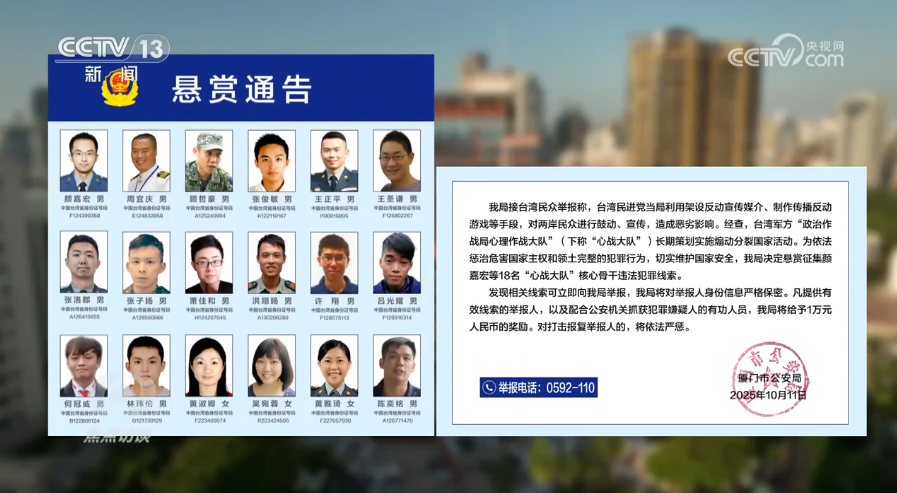
焦点访谈|揭露“心战大队”恶劣行径,对“台独”分裂势力零容忍!
Yang Shi Wang· 2025-10-12 13:52
Core Viewpoint - The Xiamen Public Security Bureau in Fujian Province has issued a reward notice seeking information on 18 core members of Taiwan's "Psychological Warfare Brigade," who are suspected of inciting separatism and undermining national unity [1][3][23] Group 1: Background and Investigation - The "Psychological Warfare Brigade" is linked to Taiwan's military and has been involved in activities aimed at inciting division between Taiwan and mainland China [3][7] - The investigation was initiated after reports from Taiwanese citizens about the Democratic Progressive Party's (DPP) use of propaganda to influence public opinion and create a negative impact on cross-strait relations [3][5] - The case has been officially filed and is currently in the investigation stage, with the public being encouraged to provide evidence [3][5] Group 2: Activities of the "Psychological Warfare Brigade" - The brigade employs various methods, including the use of media and psychological manipulation, to promote "Taiwan independence" and create societal division [5][7] - Historical context shows that Taiwan has a long history of psychological warfare tactics, evolving from radio broadcasts to modern digital platforms [7][9] - The brigade has been accused of distorting historical facts and spreading misinformation, particularly regarding the legitimacy of the "One China" principle and the United Nations Resolution 2758 [9][11] Group 3: Specific Incidents and Tactics - The brigade has produced and disseminated propaganda through various channels, including websites and games, to promote separatist ideologies among Taiwanese youth [11][13] - A specific tabletop game designed to distort geographical and historical facts has been linked to the brigade, highlighting their efforts to influence young people's perceptions [11][13] - The brigade's tactics include creating false narratives about economic issues in Taiwan, such as the "egg shortage," to undermine public trust in mainland China [15][16][18] Group 4: Legal and Political Implications - The recent reward notice reflects a broader governmental strategy to combat separatist activities and enforce legal consequences for those involved in inciting division [23] - The Chinese government has taken a firm stance against "Taiwan independence" movements, indicating a commitment to legal action against individuals and groups promoting such ideologies [23]
如何在三四线城市赚大钱?教你10个复制策略,缺什么就复制什么
Sou Hu Cai Jing· 2025-08-25 10:40
Core Insights - The article argues that third and fourth-tier cities present significant wealth opportunities that are often overlooked due to perceptions of lower consumer power compared to first and second-tier cities [1][47][50] Group 1: Investment Opportunities - Many successful business models from first and second-tier cities can be replicated in third and fourth-tier cities, where competition is lower and investment costs are reduced [5][50] - The consumer behavior in third and fourth-tier cities shows a strong tendency for "follow-the-trend" consumption, making it easier to introduce new concepts [5][50] Group 2: Replication Strategies - **Food and Beverage**: Replicating popular dining concepts from first and second-tier cities can attract young consumers in third and fourth-tier cities [8][9] - **Health and Fitness**: Establishing well-equipped gyms can fill a gap in the market, as health consciousness is rising among younger demographics [12][13] - **Retail Innovations**: Introducing modern retail formats like convenience stores and fresh supermarkets can significantly improve the shopping experience [15][16] - **Education and Training**: There is a demand for educational services, including tutoring and skill training, which remains underdeveloped in smaller cities [20][21][24] - **Entertainment and Leisure**: Creating social venues and entertainment options can cater to the lack of recreational activities in these areas [25][27] - **Marriage and Social Services**: There is a notable absence of marriage and social platforms, presenting an opportunity to introduce these services [27][28] - **Home Services**: The demand for reliable home services is high, and replicating successful models from larger cities can quickly build a customer base [32][33] - **Local Internet Business**: Leveraging e-commerce and social media marketing can help local businesses thrive in third and fourth-tier cities [35][37] - **Elderly Care**: The aging population in these cities creates a market for elder care services, which are currently lacking [39][40] - **Platform Thinking**: Transitioning from small businesses to platform-based models can yield greater financial returns [44][45] Group 3: Conclusion - The article concludes that third and fourth-tier cities are often underestimated as wealth generation areas, and the key to success lies in replicating proven business models rather than creating unique concepts [47][48][50]

少年朋友的好奇心,比我们「有气势」得多
声动活泼· 2025-04-20 10:23
我们的新播客「Knock Knock 世界」上线之后,每期节目的评论区和播客的选题投递箱,不断地出现听众们想 要了解的问题。这种应接不暇的感觉,我们已经很久没有体会到了。少年朋友们的好奇心,砰砰地「敲起门」 来,果然比我们大人要有气势得多。 一起来看看节目上线的前三周,我们都收到了听众们提出的哪些观察和疑问。希望他们的好奇心,能碰撞出更 多的好奇心。欢迎在我们的选题投递箱入口 https://sourl.cn/uwvZsy,或者直接在「Knock Knock 世界」每期节 目的评论区留言,把你感兴趣的问题发送给我们。 为什么现在像好特卖、赵一鸣等 特别便宜的超市这么多,而且地 段也都开的不错,他们是怎么赚 钱的?——节目组已经在研究这 个选题了! 我很喜欢吃太二酸菜鱼,为什么 之前要排队的太二酸菜鱼现在关 了这么多门店? 为什么小学生不能有手机? 乐高为什么这么好玩? 做一个乐高玩具设计师,需要具 备哪些技能和专业,平时都会干 些什么? 为什么 Minecraft 这么深受小孩 喜爱? 小朋友想知道桌游是怎么做出来 的、有哪些流程? 小朋友托我向节目组反馈,希望 听到关于花粉过敏的解读。 10 岁男孩问: 听 ...
少年朋友的好奇心,比我们「有气势」得多
声动活泼· 2025-04-20 10:23
Core Viewpoint - The podcast "Knock Knock World" has received a significant amount of listener inquiries and curiosity, indicating strong engagement and interest from the audience, particularly children [1]. Group 1: Podcast Overview - "Knock Knock World" is a collaborative production by "One Tenth" and "Sound Alive," designed for children aged 9 and above, focusing on global news and interesting topics [6]. - The podcast releases episodes every Monday, Wednesday, and Friday at 6:00 AM, with each episode lasting 10 minutes [6]. - The first season is available on major audio platforms, offering three free trial episodes, with a regular price of 365 yuan and an early bird price of 292 yuan until April 30, 2025 [6]. Group 2: Listener Inquiries - Listeners have shown interest in various topics, such as the business model of "Tai Er" restaurant chain and the reasons behind the closure of many of its locations [3]. - Questions from children include the appeal of Minecraft, the process of making board games, and the reasons for the rising cost of durian [4][5]. - There is also curiosity about the skills required to become a LEGO toy designer and the societal trends in South Korea regarding declining birth rates [5].