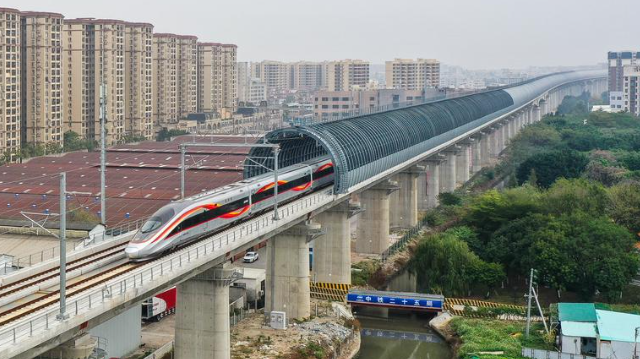
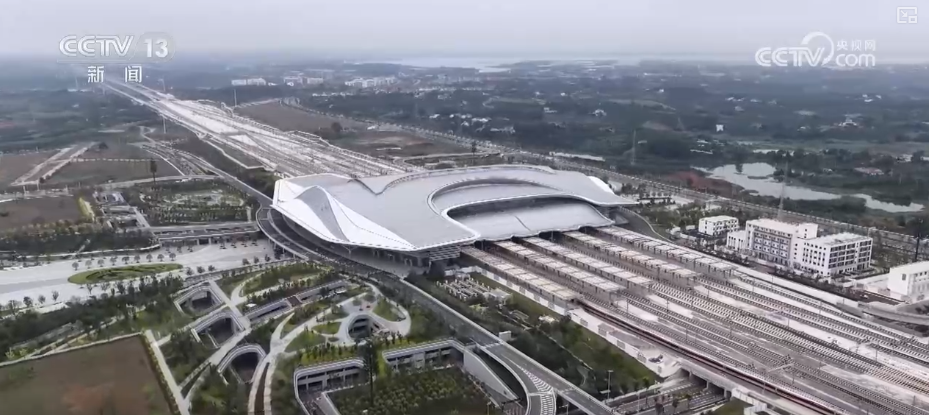
沪渝蓉沿江高铁武汉至宜昌段

Search documents
【海报】盘点2025年开通了哪些高铁,有你的家乡吗
Zhong Guo Jing Ji Wang· 2025-12-31 01:05
Core Viewpoint - By 2025, China's high-speed rail operating mileage will exceed 50,000 kilometers, marking the largest and most modern high-speed rail network in the world, with several new lines opening across the country [1] Summary by Sections New High-Speed Rail Openings - The Xiangyang to Jingmen high-speed rail opened on September 28, 2025, with a length of 116 kilometers and a design speed of 350 km/h, allowing travel from Xiangyang East to Jingmen West in just 29 minutes [3] - The Shenyang to Baihe section of the Liu Jia high-speed rail also opened on September 28, 2025, featuring multiple stations and enabling travel from Shenyang North to Changbai Mountain in as little as 1 hour and 39 minutes [4] - The Panzhou to Xingyi high-speed rail, part of Guizhou's "city-to-city" high-speed rail initiative, opened on November 28, 2025, with travel times from Xingyi South to Panzhou in 33 minutes [5] - The Nanning to Pingxiang high-speed rail, which connects to the ASEAN international corridor, was fully operational by December 5, 2025, allowing travel from Nanning to Pingxiang in 1 hour and 15 minutes [6] - The Zhanjiang to Beibu Gulf high-speed rail, completed on December 22, 2025, spans 401 kilometers with a design speed of 350 km/h [7] - The Baotou to Yinchuan high-speed rail, part of the Jinglan corridor, opened on December 23, 2025, covering 519 kilometers with a travel time of 2 hours and 38 minutes from Baotou to Yinchuan [8] - The Wuhan to Yichang section of the Huzhou-Yichang high-speed rail opened on December 26, 2025, with a length of 314 kilometers and a travel time of 69 minutes from Wuhan to Yichang [9] - The Hangzhou to Quzhou high-speed rail, which creates a dual high-speed rail corridor between the two cities, opened on December 26, 2025, covering 131 kilometers [10] - The Maba high-speed rail, serving the revolutionary areas of northern Shaanxi, also opened on December 26, 2025, with a length of 299 kilometers [11]


出行更便利、物流更高效!多项交通工程迎新进展
Yang Shi Xin Wen Ke Hu Duan· 2025-12-27 06:40
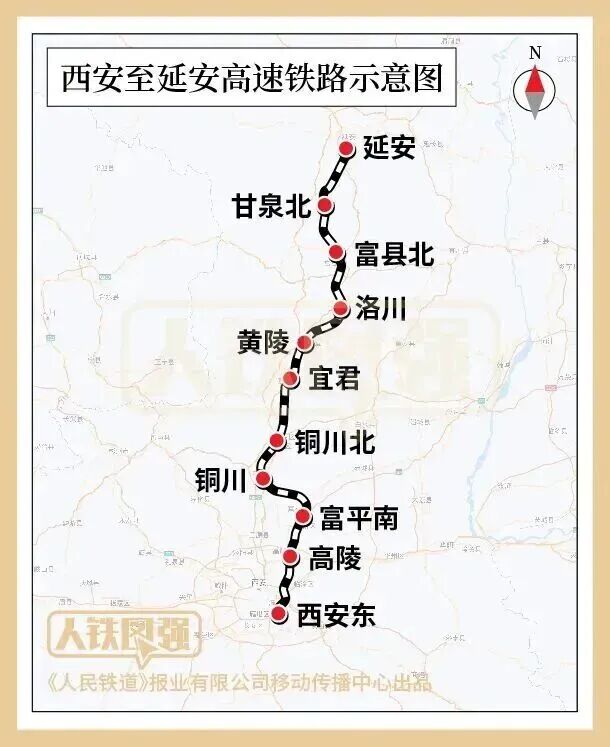
Core Insights - A series of new transportation projects have been launched in China, enhancing connectivity and efficiency in logistics and travel, which is expected to accelerate economic and social development. Group 1: High-Speed Rail Developments - The Xi'an to Yan'an high-speed railway officially opened on December 26, marking the entry of the Shaanxi revolutionary area into the high-speed rail era, with a total length of 299 kilometers and a design speed of 350 km/h. Travel time from Xi'an North to Yan'an is reduced to 68 minutes, a 62-minute decrease compared to conventional trains [1]. - The Hangzhou to Quzhou high-speed railway also commenced operations on December 26, adding a new artery to the Yangtze River Delta intercity rapid transit network. The line is 131 kilometers long with a design speed of 350 km/h, allowing travel from Hangzhou West to Quzhou West in 73 minutes [1]. - The Wuhan to Yichang section of the Huhuo Railway opened on December 26, creating a new rapid passenger transport corridor in the Yangtze River Economic Belt. The line is 314 kilometers long with a design speed of 350 km/h, reducing travel time to 69 minutes, a 34-minute reduction from previous services [4]. Group 2: Highway Infrastructure - The Urumqi to Yili Highway was completed on December 26, significantly improving north-south transportation in Xinjiang. The travel time from Urumqi to Korla is cut from 7 hours to 3.5 hours, enhancing local mobility and logistics [5][7]. - The Yin-Chong Highway, connecting Chongqing and Shaanxi, was completed on December 25, reducing travel time from 140 minutes to approximately 40 minutes between Chongqing Chengkou and Shaanxi Ankang [8]. Group 3: Airport Developments - The Jiaxing Nanhu Airport, the first specialized air cargo hub in the Yangtze River Delta, officially commenced operations on December 26, focusing on cargo with supplementary passenger services. Initial routes include flights to Beijing Daxing and Guangzhou [12]. - The third runway at Xi'an Xianyang International Airport was successfully put into operation on December 25, making it the first airport in Northwest China to operate three runways, enhancing its capacity as a major international aviation hub [13].
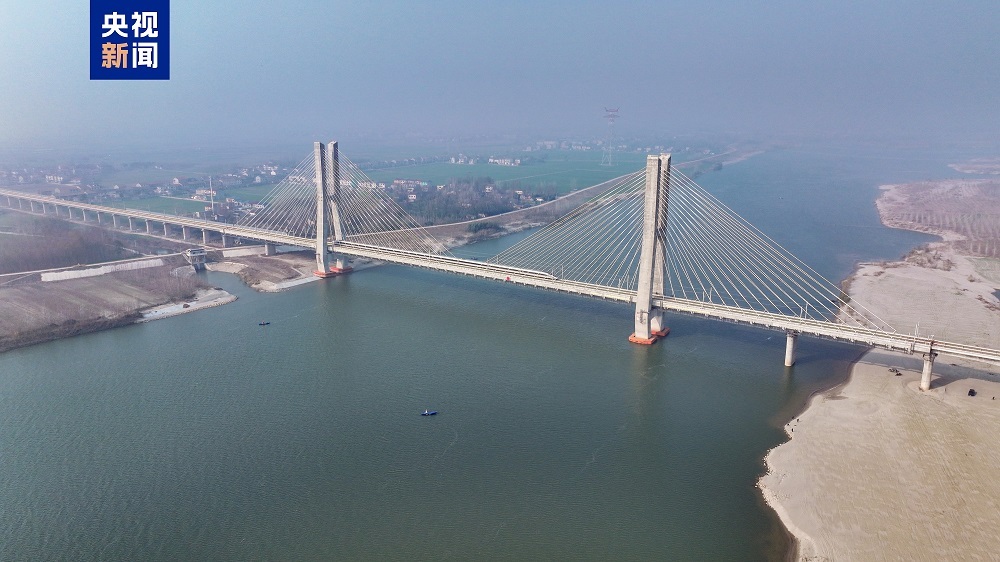
沿江高铁开通一段
Mei Ri Shang Bao· 2025-12-26 22:18
Core Viewpoint - The Wuhan to Yichang section of the Shanghai-Chongqing-Chengdu high-speed railway officially commenced operations on December 26, enhancing the high-speed rail connectivity in the region [2] Group 1 - The total length of the Wuhan to Yichang section is 314 kilometers [2] - The design speed of the railway is 350 kilometers per hour [2] - This new section will create a dual high-speed rail corridor between Wuhan and Yichang, complementing the existing Wuhan to Chongqing high-speed railway [2]
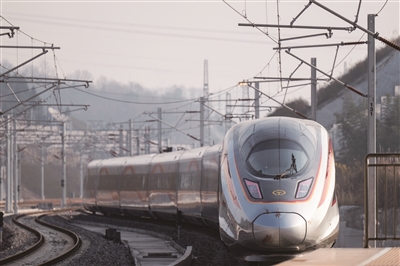
高铁织网绘宏图 荆楚协同启新程
Zhong Guo Jing Ji Wang· 2025-12-26 13:56
Core Viewpoint - The opening of the Wuhan to Yichang section of the Huhuo Railway marks a significant development in China's high-speed rail network, enhancing regional connectivity and economic collaboration, while also improving the quality of life for residents in the area [1][2][3] Group 1: Time and Space Restructuring - The travel time between Wuhan and Yichang has been reduced from 2 hours to approximately 1 hour, facilitating a new lifestyle where residents can enjoy local delicacies from both cities [1] - The new high-speed rail line connects seamlessly with other high-speed rail services, creating a "Golden Triangle" high-speed rail loop that links Wuhan, Xiangyang, and Yichang, thereby connecting 23 million people within a 1-hour commuting radius [1] Group 2: Industrial Synergy - The Wuhan to Yichang section serves as a major transportation corridor that links the Chengdu-Chongqing economic circle, the central Yangtze River city cluster, and the Yangtze River Delta, fostering industrial collaboration [2] - The complementary industrial strengths of Wuhan's optoelectronics and automotive sectors with Yichang's fine chemicals and Jingmen's equipment manufacturing are accelerating the formation of a division of labor model [2] - The reduction in logistics costs and increased flow of resources due to the high-speed rail are enabling local agricultural products to reach national markets, thus promoting the formation of industrial clusters along the route [2] Group 3: National Strategic Support - The completion of the Wuhan to Yichang section enhances the national high-speed rail framework, making the comprehensive transportation corridor of the Yangtze River Economic Belt more efficient [2] - The new rail line strengthens Hubei's strategic position as a transportation hub, addressing traffic bottlenecks in the central Yangtze River city cluster and enhancing the development capabilities of provincial sub-centers like Xiangyang and Yichang [2]
超级开通日!多条高铁高速上新,你的出行要更方便了
Huan Qiu Wang· 2025-12-26 13:19
Group 1 - A series of new high-speed rail and highway projects have been launched in China, enhancing transportation convenience and logistics efficiency, thereby accelerating economic development [1] - The Xi'an to Yan'an high-speed railway officially opened on the 26th, marking the entry of the Shaanxi revolutionary area into the high-speed rail era, with a total length of 299 kilometers and a design speed of 350 km/h, reducing travel time to 68 minutes [1] - The Hangzhou to Quzhou high-speed railway also commenced operations, connecting Hangzhou and Quzhou with a total length of 131 kilometers and a design speed of 350 km/h, allowing travel in as little as 73 minutes [3] Group 2 - The Wuhan to Yichang segment of the Shanghai-Chongqing-Chengdu high-speed railway opened, creating a new rapid passenger transport corridor in the Yangtze River Economic Belt, with a total length of 314 kilometers and a design speed of 350 km/h, reducing travel time to 69 minutes [5][6] - The Urumqi to Yili highway was completed after over five years of construction, significantly improving transportation between northern and southern Xinjiang, with travel time reduced from 7 hours to 3.5 hours [8] - Two highways in Yunnan, the Mouding to Yuanmou and the Yongping to Changning (Dali section), were also opened, enhancing connectivity in the region [9][12]
多条新线投运畅通钢铁“大动脉” 一路“畅”行增强经济发展与民生服务双“引擎”
Yang Shi Wang· 2025-12-25 10:09
Core Viewpoint - The Wuhan to Yichang section of the Shanghai-Chongqing-Chengdu high-speed railway will commence operations on December 26, significantly reducing travel time and enhancing transportation connectivity in the region [1][12]. Group 1: Project Details - The Wuhan to Yichang high-speed railway spans 314 kilometers with a design speed of 350 km/h and includes eight stations: Hankou, Hanchuan North, Tianmen, Jingmen South, Zhongxiang South, Jingmen West, Dangyang West, and Yichang North [9][11]. - The project features a high bridge and tunnel ratio, requiring precise engineering due to complex geological conditions, including soft soil and karst formations [4][7]. Group 2: Economic Impact - The new railway line will create a dual high-speed rail corridor between Wuhan and Yichang, facilitating easier travel for local residents and promoting high-quality development along the Yangtze River Economic Belt [11]. - Initial operations will include up to 58 daily train services, reducing travel time from Hankou to Yichang by 34 minutes, now taking only 69 minutes [12]. Group 3: Related Infrastructure Developments - Concurrently, the G69 Yinbai Expressway's Shaanxi-Chongqing section has been completed, marking the full opening of the 2,281-kilometer expressway, which enhances regional connectivity [13][16]. - The new expressway will reduce travel time from Chongqing to Ankang, Shaanxi, from 140 minutes to approximately 40 minutes, transforming the area into a regional hub [18].
广东登顶“高铁第一省”
第一财经· 2025-12-22 12:52
Core Viewpoint - Guangdong has surpassed Shandong to become the "first high-speed rail province" in China, with the recent opening of the Guangzhang and Shantou high-speed rail lines, adding over 420 kilometers to its total high-speed rail mileage, which now exceeds that of Shandong [3][5]. Summary by Sections High-Speed Rail Development - On December 22, 2023, the Guangzhang high-speed rail (401 kilometers) and the Shantou section of the Shantou high-speed rail (19.8 kilometers) were opened, contributing to Guangdong's total high-speed rail mileage of over 3,000 kilometers [3][5]. - Shandong's high-speed rail mileage increased from 2,110 kilometers to 3,055 kilometers during the 13th Five-Year Plan, ranking it first at that time, but Guangdong's recent developments have now placed it ahead [5][6]. Regional Connectivity and Economic Impact - The Guangzhang high-speed rail connects the eastern and western parts of Guangdong, enhancing the integration of the Greater Bay Area with the western and eastern regions of Guangdong, thus injecting strong momentum into regional development [6][7]. - The strategic significance of the Guangzhang high-speed rail extends beyond provincial borders, forming a crucial part of China's "eight vertical and eight horizontal" high-speed rail network, facilitating efficient connections between major economic zones [7]. Industrial and Talent Development - The Shantou section of the Shantou high-speed rail, now fully operational, serves as a "golden corridor" for regional development, promoting the circulation of talent, industry, and capital between the Greater Bay Area and the eastern coastal economic belt [7]. - This connectivity is expected to open broader markets and upgrade pathways for local industries, such as textiles and electronics in Shantou and Shanwei, while also activating rich marine and cultural tourism resources [7]. National High-Speed Rail Progress - As of December 19, 2023, the Baotou-Yinchuan high-speed rail is set to open, further enhancing the high-speed rail network in Northwest China, which is crucial for the high-quality development of the Yellow River basin [8]. - By the end of 2024, 13 provinces in China are expected to have high-speed rail mileage exceeding 2,000 kilometers, with notable increases in provinces like Anhui and Hubei, which are also expanding their high-speed rail networks [9][10].

广东登顶“高铁第一省”,全国还有多条线路准备开通
Di Yi Cai Jing· 2025-12-22 12:48
Core Insights - Guangdong has surpassed Shandong to become the "first high-speed rail province" in China, with a total high-speed rail mileage exceeding 3000 kilometers as of the end of 2024 [1][2] - The opening of the Guangzhang High-Speed Railway and the Shantou South to Shantou section of the Shantou-Shantou High-Speed Railway has significantly contributed to Guangdong's high-speed rail expansion, adding over 420 kilometers to its total [1][2] - The Guangzhang High-Speed Railway connects various cities in Guangdong and enhances the integration of the Guangdong-Hong Kong-Macao Greater Bay Area, promoting regional development [3][4] Summary by Sections High-Speed Rail Development - As of the end of 2024, 13 provinces in China have high-speed rail operating mileage exceeding 2000 kilometers, including Shandong and Guangdong [5] - Shandong's high-speed rail mileage increased from 2110 kilometers to 3055 kilometers during the "14th Five-Year Plan" period, ranking it fourth nationally [2][5] Guangdong's High-Speed Rail Achievements - The Guangzhang High-Speed Railway has a design speed of 350 kilometers per hour and connects key cities in Guangdong, marking the entry of the region into the 350 km/h high-speed rail era [3] - The Shantou-Shantou High-Speed Railway's full operation enhances connectivity between the Greater Bay Area and the eastern coastal economic belt, facilitating the flow of talent and resources [4] Other Provinces' Developments - Anhui is set to add a new high-speed rail line, bringing its total high-speed rail mileage close to 3000 kilometers [6] - Hubei is expected to see significant growth in high-speed rail mileage, with projections to exceed 2500 kilometers by the end of the year, moving it into the top five provinces nationally [6]