
油气主题ETF

Search documents
油气ETF领涨 资金流向或迎反转
Zhong Guo Zheng Quan Bao· 2026-02-24 21:03
Group 1 - The A-share market showed strength on February 24, with resource-related ETFs leading the gains, particularly oil and gas ETFs which rose over 9% [2][3] - The overall market saw a net outflow of over 830 billion yuan in ETFs since the beginning of 2026, with a notable trend of funds flowing into bond ETFs and out of broad-based stock ETFs [1][5][6] - The outlook for the non-ferrous metals sector remains positive, driven by increased demand from new industries such as electric vehicles and renewable energy, alongside a tightening supply of quality mineral resources [3][4] Group 2 - Bond ETFs, particularly short-term bond ETFs, experienced high trading volumes, with the Hai Fu Tong short-term bond ETF exceeding 55 billion yuan in transaction value [4] - The China Securities A500 ETF saw significant trading activity, with multiple funds exceeding 5 billion yuan in transaction value, indicating strong investor interest [4] - Despite the overall net outflow in broad-based ETFs, specific industry ETFs such as chemicals and non-ferrous metals have attracted substantial inflows, each exceeding 10 billion yuan since the start of 2026 [5][6]
这类ETF,集体飙涨
Xin Lang Cai Jing· 2026-02-24 12:19
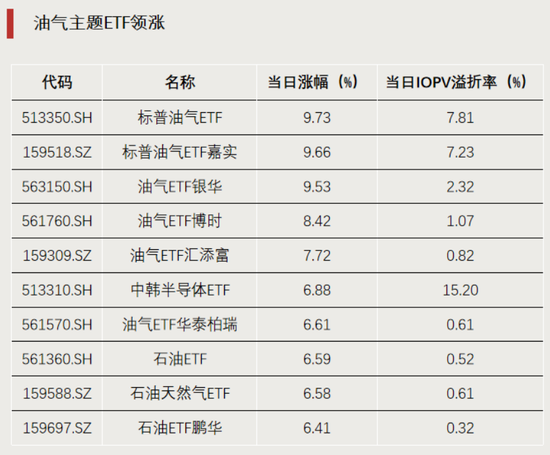
Core Viewpoint - The A-share market saw a collective rise on February 24, with oil and gas-themed ETFs leading the gains, while several gold-related ETFs also performed well [1][15]. ETF Performance - On February 24, oil and gas, non-ferrous metals, and telecommunications sectors showed significant gains, with oil and gas-themed ETFs leading the charge. The S&P Oil & Gas ETF (513350) rose by 9.73%, followed closely by the S&P Oil & Gas ETF Jiashi (159518) at 9.66%, and the Oil & Gas ETF Yinhua (563150) at 9.53% [3][17][18]. - Several gold-related ETFs also saw increases, with the Industrial Bank Gold ETF (159315) and others rising over 5% [3][19]. Bond and Stock ETF Activity - Bond ETFs were actively traded, with the Short-term Bond ETF Haifutong (511360) achieving a transaction volume exceeding 55 billion yuan on February 24. Multiple technology innovation bond ETFs also ranked high in trading volume [9][22]. - In the stock ETF category, the A500 ETF series, including A500 ETF Fund (512050) and A500 ETF Huatai Bairui (563360), saw transaction volumes surpassing 5 billion yuan [9][21]. Fund Flows - During the week leading up to the Spring Festival (February 9-13), several bond ETFs experienced net inflows, while broad-based stock ETFs faced net outflows. Notably, the Short-term Bond ETF Haifutong (511360) had a net inflow of 119.55 billion yuan [11][23][24]. - Year-to-date, industry-specific ETFs such as the Chemical ETF (159870) and Non-ferrous Metals ETF (512400) have seen significant net inflows exceeding 10 billion yuan, while broad-based ETFs like the CSI 300 ETF faced substantial outflows exceeding 100 billion yuan [11][23][24]. Market Outlook - Analysts from Haifutong Fund anticipate that the A-share market will likely maintain a trend of oscillating upward, with cyclical price increases and the expansion of AI-related markets being key themes. The focus should be on technology sectors, including semiconductors and robotics, as well as industries related to external demand such as chemicals and machinery [25].

超千亿!股票型ETF持续遭遇资金净流出
Zhong Guo Zheng Quan Bao· 2026-01-22 23:15
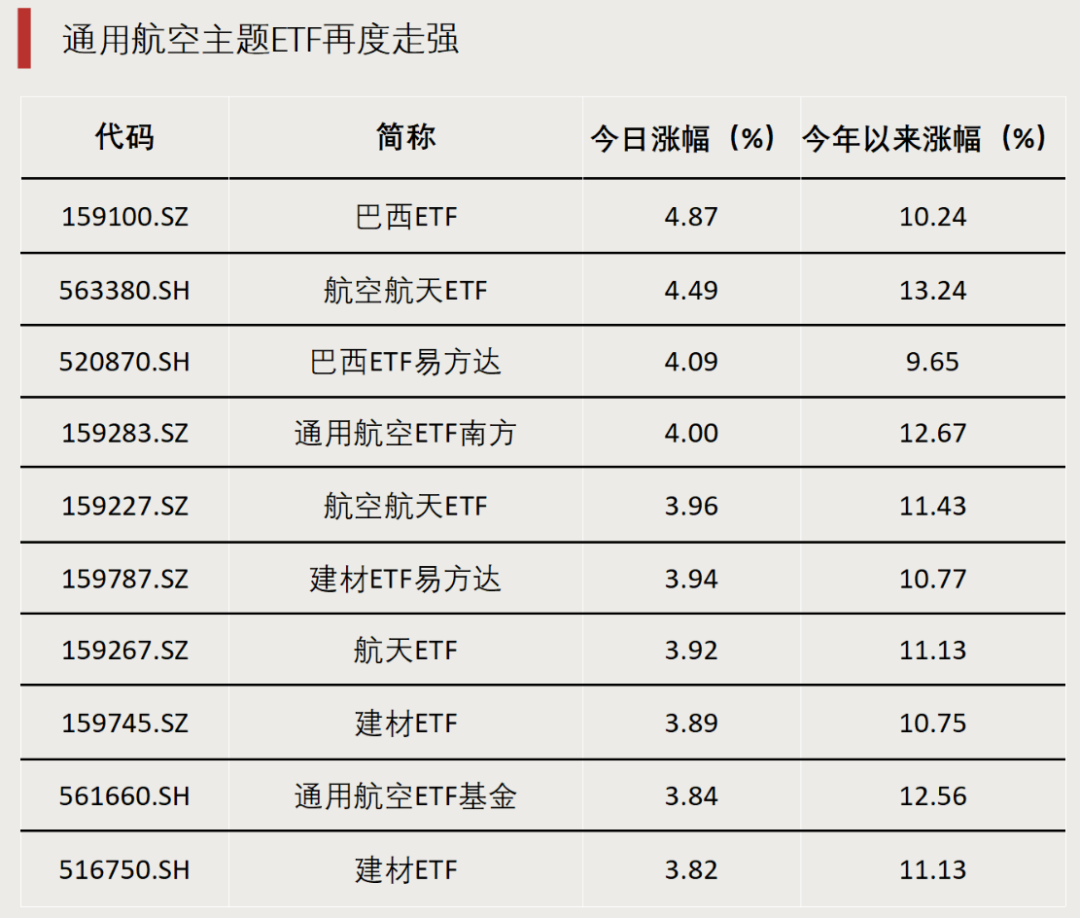
Group 1: Market Performance - The A-share general aviation sector strengthened again on January 22, with multiple aviation-themed ETFs rising nearly 4%, while military and satellite-related ETFs also saw gains of over 3% [1][3] - Conversely, previously hot sectors such as semiconductor equipment, power grid, and gold stocks collectively cooled down, with several semiconductor equipment-themed ETFs dropping over 2% [1][5] Group 2: ETF Fund Flows - On January 21, stock-type ETFs experienced a record net outflow exceeding 100 billion yuan in a single day, marking a historical high [1][9] - Major broad-based ETFs, including those tracking the CSI 300, CSI 1000, and SSE 50 indices, were the primary contributors to this net outflow, with the CSI 1000 ETFs alone seeing a collective outflow of over 28.5 billion yuan [9][10] Group 3: ETF Trading Activity - As of January 22, the Huatai-PineBridge CSI 300 ETF recorded over 20 billion yuan in trading volume for two consecutive trading days, while the E Fund CSI 300 ETF achieved a trading volume of over 16 billion yuan, setting a new single-day historical high since its listing [7][8] - The trading volume for the CSI 1000 ETF significantly decreased, dropping by over 11 billion yuan compared to the previous day [7] Group 4: Central Huijin Holdings - As of January 21, the latest share quantities of several broad-based products, including Huatai-PineBridge CSI 300 ETF and E Fund CSI 300 ETF, have fallen below the holdings reported by Central Huijin for the end of 2025 [2][12]
规模“激战”座次生变 中证A500相关ETF大幅“吸金”
Zhong Guo Zheng Quan Bao· 2025-08-08 07:16
Group 1 - Several brokerages in Hong Kong have been approved to provide virtual asset trading services, leading to significant gains in related ETFs, with some increasing over 10% [1][2] - The newly launched Huatai-PB CSI A500 ETF saw a net inflow of 11.279 billion yuan, surpassing a total scale of 20 billion yuan, becoming the largest ETF tracking the CSI A500 index [1][3] - The total scale of stock ETFs has returned to over 3 trillion yuan, reflecting a recovery in the market [4] Group 2 - The approval of virtual asset trading services has positively impacted the market sentiment, with financial technology-themed ETFs experiencing substantial gains [2] - The oil and gas sector faced declines due to international oil price adjustments, with several ETFs in this category dropping around 4% [2] - The pharmaceutical sector, particularly Hong Kong innovative drugs, attracted significant capital inflows, with related ETFs seeing over 1 billion yuan in net inflows [3] Group 3 - The market outlook for the second half of the year suggests a return to profit-driven growth, supported by low domestic interest rates and favorable global capital flows [5] - The current market structure indicates a focus on financials and growth sectors, with stablecoins and defense industries emerging as key catalysts [6] - The technology sector, particularly in AI and innovative pharmaceuticals, is expected to see continued investment and growth opportunities [6]