波浪能

Search documents
南海区海洋可再生能源发展的实践路径
Zhong Guo Zi Ran Zi Yuan Bao· 2026-02-05 10:57
Core Viewpoint - The South China Sea is identified as a region rich in marine renewable energy resources, including wind, wave, tidal, and temperature difference energy, which presents significant development potential for optimizing energy structure and ensuring energy security in Guangdong, Guangxi, and Hainan provinces [1] Policy Guidance and Practical Progress - The three provinces have established a multi-layered policy support system focused on offshore wind energy while exploring diversified marine energy development [3] - Guangdong aims to strengthen offshore wind power bases in cities like Yangjiang and Shantou, while Guangxi focuses on developing offshore wind power and exploring advanced technologies [3] - Hainan is leveraging its free trade port status to accelerate the construction of offshore wind and distributed photovoltaic projects [3] Development Status and Achievements - By 2025, Guangdong's offshore wind power installed capacity is expected to exceed 12.5 million kilowatts, ranking first in the country [4] - Guangxi has achieved a breakthrough in offshore wind power with its first demonstration project, generating over 1.4 billion kilowatt-hours [4] - Hainan has initiated large-scale offshore wind power development with several projects achieving full capacity grid connection [4] - Wave energy development has seen significant advancements, including the world's first megawatt-level floating wave energy device [4] Challenges and Constraints - There is insufficient regional coordination among the three provinces, leading to fragmented resource development and risks of redundant construction [6] - Core technology and equipment for floating wind power are still reliant on imports, and there is a gap in performance compared to international standards [7] - The industrial chain in Guangxi and Hainan is not fully developed, with low localization rates for key components and equipment [7] - Conflicts between development and ecological protection are becoming more pronounced, with potential long-term impacts on marine ecosystems [7] Strategic Solutions and Recommendations - A systematic approach is needed to plan the development of marine wind and renewable energy, emphasizing unified planning and collaborative implementation [9] - Optimizing spatial layout to create a gradient development pattern is essential, with Guangdong extending nearshore wind clusters into deeper waters [9] - Strengthening technological innovation and self-sufficiency in equipment is crucial, with the establishment of a collaborative innovation community among the three provinces [10] - Building a modern marine wind and renewable energy industrial chain that leverages regional advantages and enhances cooperation is necessary [10] - Promoting regional interconnectivity and establishing green collaborative mechanisms to address power consumption and transmission bottlenecks is vital [11]

科技领航现代化海洋产业体系构建
Zhong Guo Zi Ran Zi Yuan Bao· 2026-01-19 07:31
Core Viewpoint - The article emphasizes the importance of advancing China's marine economy through high-quality development and technological innovation, highlighting the country's achievements in marine science and technology as a foundation for building a modern marine industry system [2][4]. Group 1: Technological Innovation in Marine Industry - Technological innovation is identified as the core driving force for upgrading the marine industry, with breakthroughs in deep-sea exploration, marine equipment manufacturing, marine renewable energy, and marine biomedicine [4]. - Significant advancements include the successful trials of deep-sea equipment like "Jiaolong" and "Fendouzhe," and the development of intelligent systems for deep-sea resource extraction [4]. - The establishment of a comprehensive marine observation network utilizing satellites, drones, and underwater gliders enhances marine monitoring capabilities [4]. Group 2: Growth and Structure of Marine Economy - China's marine economy continues to grow, with the marine production value expected to exceed 10 trillion RMB in 2024, and the added value of emerging marine industries increasing by 7.2% year-on-year [7]. - Traditional marine industries are transitioning towards high-end development, with modern facilities like deep-sea cages and intelligent fishing vessels reducing environmental pressure [7]. - The marine transportation sector maintains a global leadership position, with major ports like Shanghai and Ningbo-Zhoushan consistently ranking among the world's top ports [7]. Group 3: Emerging Marine Industries - New marine industries are becoming significant growth points, with the oil and gas sector advancing into deep-sea exploration, exemplified by the successful production of the "Deep Sea No. 1" gas field [8]. - The marine engineering equipment manufacturing sector has achieved a 60% global market share, with significant advancements in the design and construction of deep-water drilling platforms [8]. - The desalination industry is expanding, with increasing self-sufficiency in technology and equipment [9]. Group 4: Policy and Ecosystem Support - Strong policy support at both national and local levels, including the "14th Five-Year Plan for Marine Economic Development," provides strategic guidance for technological research and development [5]. - Collaborative ecosystems involving academicians, platforms, and technologies are being established in regions like Shandong and Guangdong to foster innovation [5]. Group 5: Challenges and Future Directions - Despite progress, challenges remain, including reliance on foreign technology in key areas and the need for improved coordination within the marine industry [11]. - Future strategies should focus on enhancing core technologies, promoting the integration of innovation, industry, and finance, and fostering international cooperation in marine science and sustainable development [12][13].
中国能建:公司前瞻布局潮流能波浪能新兴海洋能领域
Zheng Quan Ri Bao Wang· 2025-12-18 10:45
Core Viewpoint - The company is actively implementing the marine power strategy, focusing on energy security and promoting innovation in the marine economy through various technological and industrial layouts in offshore wind power, offshore photovoltaics, marine engineering equipment, coastal engineering, and emerging marine energy sectors [1] Group 1: Strategic Focus - The company is committed to enhancing its nearshore business while focusing on deep-sea wind power and floating photovoltaics as core areas for technological breakthroughs and integrated development [1] - The company is advancing the digital and intelligent technology in marine energy, aiming to strengthen its core competitiveness and leadership in the marine energy market [1] Group 2: Emerging Energy Sectors - The company is proactively investing in emerging marine energy sectors such as tidal and wave energy, fostering new industrial growth through technology research and demonstration [1] - The company aims to cultivate leading enterprises in marine energy and the marine economy, investing in advantageous sectors and regions within the marine economy [1]

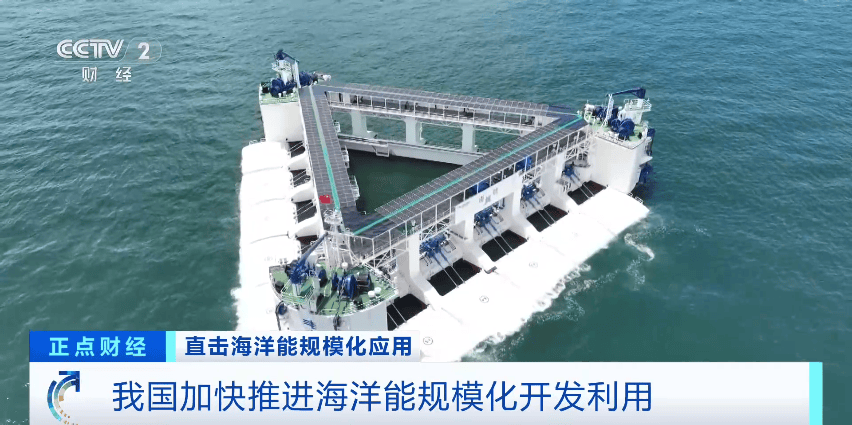
我国加快推进海洋能规模化开发利用!海洋能是什么?一文了解→
Sou Hu Cai Jing· 2025-11-13 08:36
Core Insights - Marine energy is recognized as a significant area of international energy competition, with major economies like the EU, UK, and US aiming to develop it as the next offshore energy industry after wind power [4] Group 1: Marine Energy Overview - Marine energy encompasses energy derived from physical ocean processes such as tides, waves, and ocean currents, as well as energy stored in salinity differences and temperature gradients between surface and deep seawater [1] - The main forms of marine energy include tidal energy, tidal current energy, wave energy, temperature gradient energy, and salinity gradient energy [1] Group 2: Development Goals - The "14th Five-Year Plan" suggests advancing the development and utilization of marine energy resources and coastal islands [3] - China aims to achieve a marine energy installed capacity of 400,000 kilowatts by 2030 [3]
加快发展海洋新能源 推动广东经济绿色转型
2 1 Shi Ji Jing Ji Bao Dao· 2025-10-16 22:20
Core Viewpoint - Guangdong Province has significant potential for marine renewable energy development, including offshore wind, solar, and wave energy, and aims to lead the nation in low-carbon transformation under various policy frameworks [2][3][4][5][6] Group 1: Offshore Wind Energy - Guangdong Province ranks first in the nation for offshore wind power installed capacity and is developing a competitive offshore wind industry [2] - The province plans to enhance offshore wind power capacity and technology, focusing on domestic equipment production and supply chain control [2] - There is an emphasis on advancing deep-sea wind power projects and improving transmission efficiency through innovative technologies [2] Group 2: Hydrogen Energy - Guangdong has a significant position in hydrogen equipment production, which supports the development of offshore hydrogen energy [3] - The province aims to innovate hydrogen production technologies and reduce costs while expanding applications in transportation, electricity, and chemical industries [3] - Key cities like Guangzhou and Shenzhen will focus on establishing hydrogen energy research centers [3] Group 3: Wave and Temperature Energy - The province seeks to develop wave and temperature energy resources, enhancing the efficiency of energy conversion technologies [4] - Collaboration with existing marine renewable energy research platforms is crucial for overcoming technical challenges in large-scale utilization [4] - Upgrading existing wave energy equipment is part of the strategy to improve economic viability [4] Group 4: Offshore Solar Projects - There is a focus on addressing the stability and economic issues of offshore solar projects, including the development of resilient solar components [5] - The integration of offshore wind, solar, and hydrogen resources is being explored to create a synergistic development model [5] - The province aims to enhance the overall efficiency of offshore renewable energy projects through innovative collaborations [5] Group 5: Environmental Protection and Integration - Environmental protection is prioritized in the development of marine renewable energy, utilizing digital technologies for monitoring [6] - The integration of marine renewable energy with fisheries and tourism is seen as a key development model [6] - The province plans to optimize policies and regulations to support sustainable development in the marine renewable energy sector [6]
青岛国信集团与中国华电山东公司签订战略合作协议,打造海洋产业“央地合作”新模式
Da Zhong Ri Bao· 2025-09-20 03:26
Core Points - Qingdao Guoxin Group and China Huadian Shandong Company signed a strategic cooperation agreement to collaborate in marine renewable energy, marine equipment, financial services, and urban operations, aiming to create a new model of "central-local cooperation" in major project investments and technological innovation [1][2] Group 1: Company Overview - Qingdao Guoxin Group is the only municipal enterprise in Qingdao that incorporates marine industry into its main business, focusing on the modern marine industry "4+4+2" system [2] - China Huadian Group is a large central enterprise under the supervision of the State-owned Assets Supervision and Administration Commission, consistently ranked among the world's top 500 companies for 14 consecutive years [1] Group 2: Project Details - Huadian Shandong Company has a complete energy industry layout including coal power, wind power, solar energy, heating, and port logistics, with an installed capacity of 2.38 million kilowatts in Qingdao [1] - The company plans to invest in a 2 million kilowatt offshore wind power project in Jimo, which is expected to generate an annual electricity output of 6.1 billion kilowatt-hours [1] Group 3: Strategic Initiatives - Qingdao Guoxin Group is establishing a marine science and technology innovation center and a marine equipment industry alliance, planning to build a marine equipment industrial park to enhance the local supply chain [2] - The collaboration with Huadian on offshore wind power projects aims to strengthen industry-academia-research cooperation and attract upstream and downstream enterprises in the wind power equipment sector [2] - The company is implementing an "innovation-driven + internationalization" strategy to position itself as a world-class enterprise in marine leadership, financial support, and efficient operations [2]
面向东盟蓝色经济合作发展论坛丨水电水利规划设计总院副院长张益国:中国—东盟海上能源合作前景广阔
Zhong Guo Zi Ran Zi Yuan Bao· 2025-09-17 07:28
Group 1 - The forum on "Innovation, Green, Intelligent, China-ASEAN Blue New Future" was held in Nanning, Guangxi, focusing on blue economy cooperation and development [1] - Over 500 representatives and experts from China and ASEAN countries participated, discussing innovation-driven development, industrial updates, and harmonious human-ocean relationships [1] Group 2 - The global consensus emphasizes the development of renewable energy, particularly offshore energy, as a crucial part of the renewable energy system [2][3] - Offshore energy is characterized by wide resource distribution, strong predictability, proximity to load centers, and diverse application scenarios [2] Group 3 - ASEAN is becoming a new growth pole for energy development, with significant potential for offshore energy due to its long coastlines and vast marine areas [7] - The development of offshore energy in ASEAN is still in the early exploration and technology validation stages, with multi-energy integration being a key direction [7] Group 4 - Four priority areas for China-ASEAN offshore energy cooperation include strengthening intergovernmental cooperation mechanisms, joint core technology R&D, promoting key demonstration projects, and establishing experimental verification and standard recognition [8][9]


张天:消费侧新能源资产是新蓝海
2 1 Shi Ji Jing Ji Bao Dao· 2025-08-29 22:46
Group 1 - The core viewpoint emphasizes the interconnection between green transformation, technological innovation, and ESG, with green transformation being the primary investment goal and qualitative measure [1] - Investment decisions are significantly influenced by the potential for green transformation, which directly impacts investment returns and effectiveness [1] - Current asset investments are leaning towards mature technologies, while cutting-edge technologies require longer commercialization cycles and incubation scenarios [1] Group 2 - Future opportunities in the consumption-side renewable energy assets, such as photovoltaic, energy storage, and charging facilities driven by carbon-neutral parks, will become a key component of major asset management platforms [2] - China has developed a multi-trillion yuan renewable energy asset market, with consumption-side assets increasingly showcasing market-oriented and tradable characteristics due to policy openness and improved comprehensive energy utilization [2] - Renewable energy assets possess high levels of digitization and informatization, allowing integration with blockchain technology for traceable and immutable data, making them reliable income-generating assets in the Web3 domain [2]
深石资本张天:消费侧新能源资产正成为机构配置“新蓝海”
2 1 Shi Ji Jing Ji Bao Dao· 2025-08-19 10:53
Group 1 - The core viewpoint emphasizes the interconnection between green transformation, technological innovation, and ESG, with green transformation being the primary investment goal and qualitative measure [1][4] - Zhang Tian, founder of Deep Stone Capital, highlights that the potential for green transformation is the most critical dimension in investment decisions, directly influencing investment returns and effectiveness [4] - Deep Stone Capital focuses on integrating innovative technologies and solutions for urban carbon neutrality, using the "Biosphere No. 3" project in Shenzhen as a testing ground for advanced energy technologies [4] Group 2 - Future opportunities in the consumption-side renewable energy assets, such as photovoltaic, energy storage, and charging facilities driven by carbon-neutral parks, are expected to become a significant component of major asset management platforms [5] - The market for renewable energy assets in China has reached trillions, with increasing marketization and transaction attributes due to policy openness and improved comprehensive energy utilization [5] - RWA and other blockchain financial innovations are anticipated to promote the trend of integrating renewable energy assets with digital technologies, enhancing traceability and reliability in the Web3 domain [5]