
活牛

Search documents
政策滴灌产业兴旺
Xin Lang Cai Jing· 2026-01-19 22:17
Group 1 - The core idea of the articles reflects the transformation of agriculture in Wanrong County over the past five years, emphasizing the shift from scattered small-scale farming to a more organized and technology-driven agricultural industry [1][2] - The agricultural development has focused on five major sectors: grain, fruit, mushrooms, traditional Chinese medicine, and livestock, achieving significant improvements in productivity and efficiency [1][2] - The implementation of high-standard farmland has led to a stable annual grain production target of 400 million jin, with a focus on increasing yield and profitability rather than merely maintaining acreage [1] Group 2 - The county has adopted a circular agriculture model, turning agricultural waste into valuable resources, such as using apple branches to produce mushroom cultivation sticks, resulting in a scale of 40 million sticks and the establishment of 15 standardized production centers [2] - The establishment of a standardized base for traditional Chinese medicine has expanded from scattered cultivation to a 100,000-acre standardized base, enhancing local processing and increasing farmers' income [2] - The livestock sector has seen rapid growth with the establishment of standardized breeding bases, successfully entering the Hong Kong and Macau markets, thereby extending the industrial chain and increasing added value [2] Group 3 - Looking ahead, the company aims to modernize agriculture by leveraging digital technologies such as IoT, big data, and e-commerce, transitioning from traditional farming to smart farming [2] - The agricultural industry is expected to expand beyond single-function farming to include processing, circulation, tourism, culture, and health, creating new business models and growth drivers [2] - The commitment to rural revitalization is emphasized, with confidence in a brighter future for Wanrong agriculture supported by strong agricultural policies [2]
国家统计局:2025年农业经济形势稳中向好
Xin Lang Cai Jing· 2026-01-19 04:11
Core Viewpoint - The overall producer price level for agricultural products in China is projected to decline by 3.7% in 2025 compared to the previous year, indicating a stable yet challenging agricultural economic environment [1] Price Trends - Agricultural product prices are expected to decrease by 2.1% year-on-year, with specific declines in livestock and animal products by 7.5%, forestry products by 2.5%, and fishery products by 1.2% [1] - In terms of specific crops, rice prices are expected to rise slightly by 0.1%, while wheat, corn, and soybean prices are projected to fall by 1.9%, 3.8%, and 3.6% respectively [1] - Vegetable prices are anticipated to decrease by 2.9%, while fruit prices are expected to increase by 0.6% [1] Livestock Prices - The price of live pigs is forecasted to drop significantly by 11.2%, whereas live cattle prices are expected to rise by 2.8%. Live sheep prices are projected to decrease by 0.8%, and live poultry prices are expected to decline by 4.0% [1] Economic Outlook - The agricultural economic situation in China is expected to remain stable and improve, with steady production of grain and key agricultural products, providing strong support for addressing risks and promoting high-quality economic and social development [1]
137亿美元进口牛肉保障措施调查背后:中国养殖户期待保障措施尽快落地
Di Yi Cai Jing· 2025-12-30 07:07
Core Viewpoint - The Ministry of Commerce has reported a ruling on beef safeguard measures to the WTO, with domestic industries urging for prompt action to protect local producers from the impact of low-priced beef imports [1] Group 1: Background and Context - The investigation was initiated based on applications from the China Animal Agriculture Association and nine major beef-producing regional associations, with a case value of $13.7 billion, marking the largest import investigation in China to date [1] - Major beef import countries to China include Brazil, Argentina, Uruguay, Australia, New Zealand, and the United States [1] Group 2: Industry Challenges - The domestic beef industry is facing severe challenges, with producers experiencing long-term price suppression due to an influx of low-priced imports, leading to widespread losses across the supply chain [2][3] - The processing sector is particularly affected, with each additional slaughter of a cow resulting in a loss of approximately 300 yuan, creating a vicious cycle of increased losses and reduced slaughter volumes [2] - The market is experiencing a significant contraction, with reports indicating that up to 50% of cows traded in certain markets are now breeding cows, a sharp increase from the normal turnover rate of about 20% [2] Group 3: Economic and Social Implications - The majority of beef producers in China are small-scale operators, and the ongoing price decline threatens their livelihoods, potentially leading to widespread economic distress among rural households [3] - The investigation is seen as necessary not only for commercial reasons but also for the social stability of rural communities dependent on beef production [3] Group 4: Strategic Responses - The safeguard measures are intended to provide a "window period" for the industry to adjust and upgrade, allowing for improvements in production efficiency and product quality [5] - There is a need for the industry to enhance processing techniques and develop quality grading standards to better align production with market demands, thereby increasing competitiveness [5][6] - The investigation is expected to stabilize beef prices, allowing processing companies to maintain operational viability and encouraging technological upgrades within the industry [6]
2025年南非口蹄疫疫情导致畜牧业出口收入损失约56亿兰特
Shang Wu Bu Wang Zhan· 2025-12-27 16:51
Core Insights - The South African livestock industry is facing significant export restrictions and revenue losses due to the foot-and-mouth disease outbreak in 2025, with estimated losses amounting to approximately 5.6 billion Rand [1] Revenue Loss Breakdown - The annual revenue loss from fresh and frozen beef is projected to be 3.7 billion Rand [1] - The annual revenue loss from goat and sheep meat is estimated at 1.4 billion Rand [1] - The annual revenue loss from live cattle, sheep, and goats is expected to be 0.5 billion Rand [1] Export Market Impact - As of January 2025, markets including China, Eswatini, Mozambique, Zimbabwe, and Namibia have completely banned imports of South African products [1] - The UK has also imposed a total ban on the import of mohair from South Africa [1] - Middle Eastern countries such as Jordan, Lebanon, and Saudi Arabia maintain partial restrictions, requiring guarantees that imported products do not carry the foot-and-mouth disease virus [1]
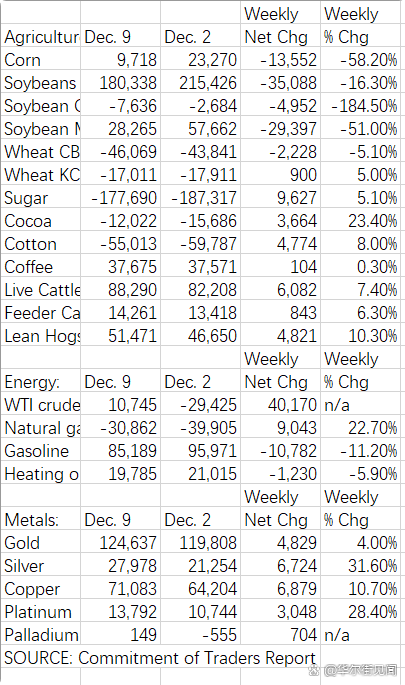
美国商品期货交易委员会(CFTC)补充发布12月9日当周持仓报告。CBOT大豆净多头头寸减少35,088手合约。WTI原油净多头头寸增加40,170手合约。COMEX铜增加6,879手合约。
Sou Hu Cai Jing· 2025-12-19 21:10
Group 1: Agricultural Commodities - CBOT soybean net long positions decreased by 35,088 contracts, representing a 16.30% decline from the previous week [1][2] - Corn net long positions fell by 13,552 contracts, a significant decrease of 58.20% [2] - Wheat CB net positions decreased by 2,228 contracts, showing a 5.10% decline [2] - Sugar net positions improved by 9,627 contracts, reflecting a 5.10% increase [2] - Cocoa net positions increased by 3,664 contracts, marking a 23.40% rise [2] - Live cattle net positions rose by 6,082 contracts, a 7.40% increase [2] - Lean hogs net positions increased by 4,821 contracts, showing a 10.30% rise [2] Group 2: Energy Commodities - WTI crude oil net long positions increased by 40,170 contracts, with no previous week comparison available [1][2] - Natural gas net positions improved by 9,043 contracts, reflecting a 22.70% increase [2] - Gasoline net positions decreased by 10,782 contracts, a decline of 11.20% [2] - Heating oil net positions fell by 1,230 contracts, showing a 5.90% decrease [2] Group 3: Metals - Gold net positions increased by 4,829 contracts, representing a 4.00% rise [2] - Silver net positions rose significantly by 6,724 contracts, a 31.60% increase [2] - Copper net positions increased by 6,879 contracts, reflecting a 10.70% rise [1][2] - Platinum net positions improved by 3,048 contracts, marking a 28.40% increase [2]

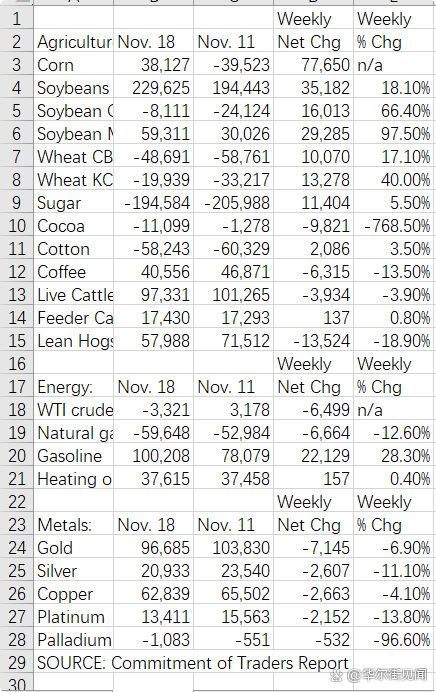
美国商品期货交易委员会(CFTC)补发11月18日当周交易员持仓报告:CBOT玉米净多头头寸增加77,650手合约。NYMEX汽油净多头头寸增加22,129手合约。COMEX黄金头寸减少7,145手合约。
Sou Hu Cai Jing· 2025-12-12 20:58
Group 1: Agricultural Commodities - CBOT corn net long positions increased by 77,650 contracts, reversing a previous decline of 39,523 contracts [1][2][3] - Soybeans net long positions rose by 35,182 contracts, representing an 18.10% increase [2][4] - Wheat CB net positions improved by 10,070 contracts, marking a 17.10% increase [2][7] - Sugar net positions decreased by 11,404 contracts, a 5.50% reduction [2][9] - Cocoa net positions saw a significant decline of 9,821 contracts, equating to a -768.50% change [2][10] Group 2: Energy Commodities - NYMEX gasoline net long positions increased by 22,129 contracts, a 28.30% rise [1][2][20] - WTI crude oil net positions decreased by 6,499 contracts, reflecting a shift from a previous increase [2][18] - Natural gas net positions fell by 6,664 contracts, a 12.60% decline [2][19] Group 3: Metals - COMEX gold positions decreased by 7,145 contracts, a -6.90% change [1][2][24] - Silver net positions dropped by 2,607 contracts, representing an 11.10% decrease [2][25] - Copper positions fell by 2,663 contracts, a -4.10% change [2][26]
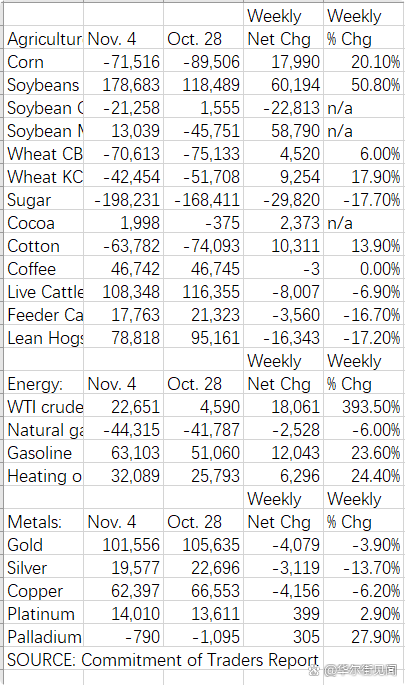
提醒:美国商品期货交易委员会(CFTC)补充发布11月4日当周的(投机者)持仓报告。其中,WTI原油净多头头寸增加18,061手合约。COMEX铜(净多头头寸)减少4,156手合约。CBOT大豆净多头头寸增加60,194手合约。
Sou Hu Cai Jing· 2025-12-09 21:15
Group 1: Commodity Positions - WTI crude oil net long positions increased by 18,061 contracts, reaching a total of 22,651 contracts, representing a 393.50% change from the previous week [1][4]. - COMEX copper net long positions decreased by 4,156 contracts, totaling 62,397 contracts, which is a 6.20% decline [2][4]. - CBOT soybean net long positions increased by 60,194 contracts, totaling 178,683 contracts, reflecting a 50.80% increase [3][4]. Group 2: Weekly Changes in Agricultural Commodities - Corn net positions improved by 17,990 contracts, moving from -89,506 to -71,516 contracts, a change of 20.10% [4]. - Wheat CB net positions increased by 4,520 contracts, changing from -75,133 to -70,613 contracts, a 6.00% increase [4]. - Sugar net positions decreased by 29,820 contracts, moving from -168,411 to -198,231 contracts, a decline of 17.70% [4]. Group 3: Weekly Changes in Energy and Metals - Natural gas net positions decreased by 2,528 contracts, totaling -44,315 contracts, a 6.00% decline [4]. - Gasoline net positions increased by 12,043 contracts, moving from 51,060 to 63,103 contracts, a 23.60% increase [4]. - Gold net positions decreased by 4,079 contracts, totaling 101,556 contracts, a 3.90% decline [4].
(乡村行·看振兴)从“粮袋子”到“钱袋子” 山西繁峙绘就乡村振兴新图景
Zhong Guo Xin Wen Wang· 2025-12-02 09:03
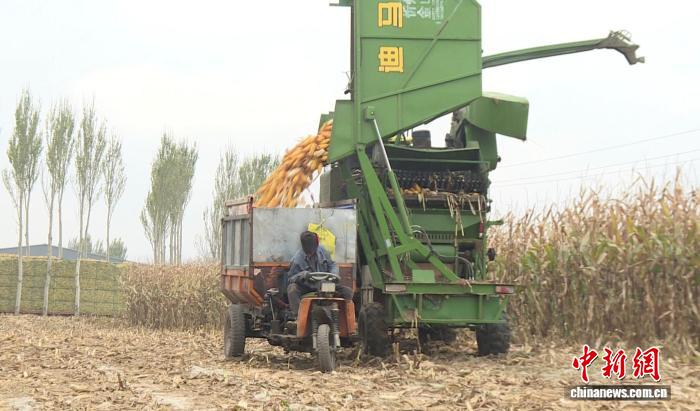
Core Viewpoint - Shanxi Province's FanZhi County is transforming its agricultural landscape by focusing on food security, industrial revitalization, technological empowerment, and improving livelihoods, creating a new vision for rural revitalization [1] Group 1: Food Security and Agricultural Development - The county has stabilized the planting area of food crops at 555,900 acres during the 14th Five-Year Plan, with organic dry farming demonstration bases promoting small grain planting reaching 88,700 acres, accounting for 15.98% of the total planting area [2] - A three-tier scheduling mechanism has been established to ensure the harvest of autumn grains, including the deployment of 50 harvesters and the establishment of 8 grain drying points, enhancing the agricultural productivity [2] Group 2: Industrial Strengthening and Product Transformation - FanZhi County has developed four major industrial clusters: small grains, brewing products, meat products, and traditional Chinese medicine products, under the "special" and "superior" strategy [3] - The county's agricultural product processing park has won the 108th Panama Pacific International Gold Award for its "HuYuan" yellow wine, indicating a strong market presence [5] Group 3: Technological Empowerment in Agriculture - The county has increased its total agricultural machinery power from 154,800 kW to 195,800 kW, with the mechanization rate of major crops rising to 84.95% during the 14th Five-Year Plan [6] - Technology is integrated throughout the agricultural chain, with experts providing guidance on breeding and field management, and e-commerce technology helping local products reach national markets [6] Group 4: Improvement of Livelihoods and Rural Environment - The county is enhancing rural infrastructure and aesthetics through the "Ten Thousand Projects" initiative, creating 9 boutique demonstration villages and 53 upgraded villages [7] - A long-term mechanism involving party members and villagers is established to maintain a clean and beautiful rural environment, contributing to the overall quality of life [7]
中信证券:本轮周期活牛价格仍有上行空间 继续看好肉牛原奶周期共振
Xin Lang Cai Jing· 2025-11-27 00:42
Core Viewpoint - After the Double Festival, supply and demand remain stable, with milk prices entering a bottoming phase, and both contract and spot prices showing stable month-on-month changes. The demand for dairy products continues to face pressure, with ambient products performing weaker than chilled ones. However, deep processing and overseas expansion are growing rapidly from a low base, indicating a promising future [1] Group 1: Dairy Industry - Milk prices are stabilizing after the holiday season, indicating a bottoming phase [1] - Demand for dairy products is under pressure, particularly in ambient segments compared to chilled segments [1] - Deep processing and overseas markets are experiencing rapid growth from a low base, suggesting a bright outlook for the future [1] Group 2: Beef Industry - In Q3, beef cattle prices have shown high volatility, with a cumulative reduction in stock expected to exceed 10% since the beginning of 2024 [1] - By 2026, there is anticipated downward pressure on the supply side of beef cattle, referencing the previous cycle's reduction and price recovery patterns [1] - The current cycle for live cattle prices is expected to have upward potential, with a positive outlook for the synergy between beef cattle and raw milk cycles [1]

农业农村部:11月第3周生猪产品、鸡蛋、蛋鸡配合饲料价格环比下跌
Xin Hua Cai Jing· 2025-11-24 09:27
Core Insights - The agricultural market shows mixed trends in livestock and poultry prices, with some products experiencing price increases while others decline [1][2][3][4][5][6] Livestock Prices - The average price of piglets nationwide is 24.14 yuan/kg, down 1.0% week-on-week and 29.2% year-on-year [2] - The average price of live pigs is 12.50 yuan/kg, down 1.1% week-on-week and 26.6% year-on-year [2] - The average price of pork is 23.02 yuan/kg, down 0.5% week-on-week and 19.1% year-on-year [2] - In contrast, the average price of beef is stable at 71.37 yuan/kg, with a year-on-year increase of 6.7% [4] - The average price of lamb is 71.32 yuan/kg, up 0.3% week-on-week and 2.0% year-on-year [4] Poultry Prices - The average price of eggs is 8.61 yuan/kg, down 0.6% week-on-week and 22.4% year-on-year [3] - The average price of chicken is 22.34 yuan/kg, down 0.1% week-on-week and 5.2% year-on-year [3] - The average price of broiler chicks is 3.50 yuan each, down 0.8% week-on-week and 11.8% year-on-year [3] Feed Prices - The average price of corn is 2.43 yuan/kg, stable week-on-week and up 3.4% year-on-year [6] - The average price of soybean meal is 3.29 yuan/kg, stable week-on-week and down 1.8% year-on-year [6] - The average price of feed for fattening pigs is 3.36 yuan/kg, stable week-on-week and down 0.9% year-on-year [6]