贸易救济

Search documents
巴西规范牛肉出口,维护中巴农贸合作
Huan Qiu Shi Bao· 2026-02-13 23:01
巴西财经媒体InfoMoney称,政府部门认为,除了减轻对出口企业的影响外,从公共政策角度来看,配 额措施也有积极一面,因为中国占巴西牛肉出口量的近一半,此类措施能够遏制贸易中断风险,并确保 出口持续良好表现。 中国农业科学院北京畜牧兽医研究所研究员朱增勇13日告诉《环球时报》记者,中方实施的保障措施是 阶段性的,目的是保护国内产业,并非限制牛肉正常经贸。他说,受进口牛肉的冲击等影响,中国肉牛 养殖产业在2024年陷入深度亏损,肉牛屠宰企业出现大范围亏损,国内产业根基受到冲击,急需采取保 障措施,保障措施是世贸组织允许使用的贸易救济工具之一。 朱增勇告诉记者,对进口牛肉进行调控,是促进国内产业走出低谷、稳定母牛数量和核心生产能力的最 直接有效方法,此次为期3年的保护措施,有助于科学调控进口规模和节奏,为国内产业争取到缓冲 期。同时,他表示,作为中国重要的牛肉进口来源国,巴西对牛肉出口进行规范管理,有利于中国恢复 肉牛行业的良性发展,也将为中巴两国广泛的农产品贸易合作打下更坚实的基础。 "G1"新闻网称,2025年巴西平均每月对华出口近14万吨牛肉,110.6万吨的免征额外关税额度,意味着 巴西出口商平均每月对 ...
瑞达期货热轧卷板产业链日报-20260203
Rui Da Qi Huo· 2026-02-03 08:47
1. Report Industry Investment Rating - Not provided in the report 2. Core View of the Report - On Tuesday, the HC2605 contract rebounded under pressure. Macroscopically, the Ministry of Finance and the State Taxation Administration issued an announcement on February 2nd, clarifying matters related to the deduction of input VAT. In terms of supply and demand, the weekly output of hot-rolled coils increased, with a capacity utilization rate of 78.99% and a production volume of 3.0921 million tons; terminal demand increased while inventory continued to decline. Overall, the downstream demand for hot-rolled coils is relatively resilient, but the weakening of furnace materials and the strong rebound of the US dollar index put pressure on steel prices. Technically, the 1-hour MACD indicator of the HC2605 contract shows that DIFF and DEA are running at a low level with a stable green bar. It is recommended to conduct short - term trading and pay attention to risk control [2] 3. Summary by Relevant Catalogs 3.1 Futures Market - The closing price of the HC main contract is 3,265 yuan/ton, up 4 yuan; the position volume of the HC main contract is 1,477,230 lots, down 21,563 lots; the net position of the top 20 in the HC contract is - 15,885 lots, up 15,291 lots; the spread between the HC5 - 10 contracts is - 21 yuan/ton, down 6 yuan; the daily warehouse receipt of the HC on the Shanghai Futures Exchange is 204,847 tons, unchanged; the spread between the HC2605 - RB2605 contracts is 166 yuan/ton, up 3 yuan [2] 3.2 Spot Market - The price of 4.75 hot - rolled coils in Hangzhou is 3,300 yuan/ton, up 10 yuan; in Guangzhou, it is 3,270 yuan/ton, up 10 yuan; in Wuhan, it is 3,300 yuan/ton, down 10 yuan; in Tianjin, it is 3,160 yuan/ton, unchanged. The basis of the HC main contract is 35 yuan/ton, up 6 yuan; the spread between hot - rolled coils and rebar in Hangzhou is 40 yuan/ton, up 20 yuan [2] 3.3 Upstream Situation - The price of 61.5% PB powder ore at Qingdao Port is 793 yuan/wet ton, up 6 yuan; the price of quasi - first - grade metallurgical coke in Hebei is 1,490 yuan/ton, unchanged; the price of 6 - 8mm scrap steel in Tangshan is 2,170 yuan/ton, unchanged; the price of Q235 billet in Hebei is 2,920 yuan/ton, unchanged. The inventory of iron ore at 45 ports is 170.1852 million tons, up 2.5567 million tons; the inventory of coke at sample coking plants is 441,400 tons, up 22,000 tons; the inventory of coke at sample steel mills is 6.784 million tons, up 164,100 tons; the inventory of billets in Hebei is 1.5875 million tons, up 25,500 tons [2] 3.4 Industry Situation - The blast furnace operating rate of 247 steel mills is 79.02%, up 0.36 percentage points; the blast furnace capacity utilization rate is 85.45%, down 0.08 percentage points. The weekly output of hot - rolled coils at sample steel mills is 3.0921 million tons, up 38,000 tons; the capacity utilization rate of hot - rolled coils at sample steel mills is 78.99%, up 0.97 percentage points. The inventory of hot - rolled coils at sample steel mills is 772,500 tons, up 6,100 tons; the social inventory of hot - rolled coils in 33 cities is 2.7833 million tons, down 28,100 tons. The monthly output of domestic crude steel is 68.18 million tons, down 1.69 million tons; the monthly net export volume of steel is 1.078 million tons, up 130,000 tons [2] 3.5 Downstream Situation - The monthly output of automobiles is 3.296 million vehicles, down 235,600 vehicles; the monthly sales volume of automobiles is 3.2722 million vehicles, down 156,800 vehicles. The monthly output of air conditioners is 21.6289 million units, up 6.6029 million units; the monthly output of household refrigerators is 10.0115 million units, up 569,500 units; the monthly output of household washing machines is 11.975 million units, down 38,000 units [2] 3.6 Industry News - In January 2026, the China Trade Remedy Information Network successively announced 15 anti - dumping and countervailing investigations or rulings on Chinese steel products by foreign countries, involving carbon steel galvanized wire mesh, cold - rolled steel sheets, hot - rolled coils, stainless - steel washing troughs, and silicon - manganese steel wires. The Ministry of Commerce and eight other departments issued the "2026 'Happy Shopping during the Spring Festival' Special Activity Plan", encouraging localities to increase subsidies for the replacement of old consumer goods during the Spring Festival, strengthening support for offline physical retail, and mobilizing enterprises to carry out exhibitions and sales activities related to automobiles, home appliances, digital, and intelligent products during the Spring Festival [2]
【行业动态】最高113.8%,中国对美韩多晶硅反倾销税再延五年
Sou Hu Cai Jing· 2026-01-15 04:10
Core Viewpoint - The Chinese Ministry of Commerce announced the extension of anti-dumping duties on imported solar-grade polysilicon from the US and South Korea, effective from January 14, 2026, for a period of five years, to protect the domestic polysilicon industry [2][3]. Group 1: Anti-Dumping Measures - The anti-dumping duties will range from 0% to 2.1% for related products from the US, with specific rates for different companies: Hemlock Semiconductor Corporation at 53.3%, and others at 57% [2]. - South Korean companies will face varied rates, with OCI Corporation at 4.4%, Hanwha Solutions at 8.9%, and others up to 113.8% due to severe dumping circumstances [3]. Group 2: Historical Context - The current measures are a continuation of trade relief actions initiated in 2014, when it was found that US and South Korean companies were exporting polysilicon at prices below normal value, harming domestic producers [3][4]. - The initial duties were set for five years, with adjustments made in 2017 and a review in 2020 leading to the extension of these measures [3]. Group 3: Industry Impact - The policy aims to enhance the cost threshold for US and South Korean imports, thereby stabilizing market shares for domestic leaders like Tongwei and GCL, while also facilitating investment recovery and technological development [4]. - The short-term effect may pressure component manufacturers due to rising raw material costs, but long-term benefits include reduced dependency on foreign supply chains and enhanced competitiveness in the global market [4][5]. Group 4: Global Trade Dynamics - The policy is expected to shift the global polysilicon trade flow, as US and South Korean companies may redirect exports to regions like Southeast Asia, India, and Europe, where no anti-dumping measures are in place [5]. - This move is seen as a countermeasure to previous US tariffs on Chinese solar products, preserving negotiation leverage for China in international trade discussions [5]. Group 5: Strategic Importance - The extension of these duties is crucial for China's energy transition goals, as polysilicon is a key material in the photovoltaic industry, directly impacting the stability of the entire supply chain [5]. - The five-year policy period provides a valuable window for technological upgrades in the domestic polysilicon industry, promoting advancements in high-end materials like N-type and electronic-grade silicon [5].


24小时已过,中方反补贴税准时落地,卢拉给欧盟下最后通牒
Sou Hu Cai Jing· 2026-01-04 05:05
Group 1 - The EU is facing significant challenges as China has initiated anti-subsidy tax procedures on EU dairy products, impacting a market valued at €12 billion [1] - Brazil's President Lula has issued an ultimatum to Brussels regarding a long-negotiated free trade agreement, which has been in discussion for 26 years [1][6] - The EU's decision-making process is a major obstacle, requiring agreement from at least 15 member states representing over 65% of the population, complicating the approval of the trade agreement [3] Group 2 - Starting December 23, all dairy products imported from the EU to China will incur anti-subsidy tax rates ranging from 21.9% to 42.7%, with an average rate of 28.6% for compliant companies [5] - The EU has initiated 15 trade remedy investigations against China, while China has only concluded three anti-dumping cases this year, highlighting a disparity in trade actions [5] - EU dairy companies are increasingly anxious as the cost of doing business rises due to these new tariffs, threatening their competitiveness in the Chinese market, which is projected to reach €12 billion in exports by 2024 [5][12] Group 3 - Internal EU debates continue, with thousands of farmers protesting in Brussels over fears of increased competition from South American agricultural products [8] - To address farmer concerns, the EU has proposed agricultural safeguard measures that would trigger investigations if imports exceed an 8% annual increase for certain products [8][10] - These safeguard measures require formal approval from the European Parliament and the EU Council, which could lead to further delays in the trade agreement process [10] Group 4 - The EU's delay in signing the trade agreement until January 2026 is seen as a gamble on Italy's support, but this could have significant consequences if the situation changes after Lula's presidency [12] - The ongoing trade friction with China and the potential loss of the Latin American market are pressing issues for the EU, as internal divisions over protectionism and open cooperation persist [12]
我国对进口牛肉实施保障措施 释放哪些信号?
Xin Hua Wang· 2025-12-31 10:03
Core Viewpoint - The Ministry of Commerce has decided to implement safeguard measures on imported beef for three years, from January 1, 2026, to December 31, 2028, due to significant damage to the domestic industry caused by increased imports and declining prices [1][2]. Group 1: Impact on Domestic Industry - The average retail price of beef in 36 major cities dropped to 36.82 yuan per pound by March 19, 2025, marking a six-year low, which has severely pressured the domestic beef industry [1]. - The surge in imported beef, which increased by 73.2% from 2019 to 2024, has led to a significant market share shift, with imports rising from 20% to approximately 30% during the same period [2]. - The domestic beef industry is facing substantial losses, with many farmers reducing their cattle herds due to unprofitable prices, leading to a potential long-term supply shortage [2][6]. Group 2: Safeguard Measures Implementation - The safeguard measures are designed to provide a temporary relief to the domestic industry without restricting normal beef trade, reflecting a balanced approach to protect local interests while maintaining openness to international trade [4][5]. - The measures include country-specific quotas and additional tariffs on imports exceeding these quotas, rather than imposing blanket tariffs, to minimize disruption to normal trade [5]. - This is the third instance of China implementing safeguard measures since joining the WTO, indicating a cautious approach to trade protectionism [5]. Group 3: Future Industry Outlook - The implementation of safeguard measures is expected to create a buffer period for the domestic beef industry, allowing for necessary adjustments and improvements in production efficiency [3][6]. - The industry anticipates that with the support of these measures, beef consumption demand will rise, potentially leading to a reasonable recovery in beef prices by 2026 [7]. - The Ministry of Agriculture supports these measures as a means to control import levels and address the immediate challenges faced by the domestic industry, while also promoting sustainable development in the beef sector [6].
商务部对进口牛肉启动三年保障措施,为国内牛肉产业提供救济
Di Yi Cai Jing· 2025-12-31 08:32
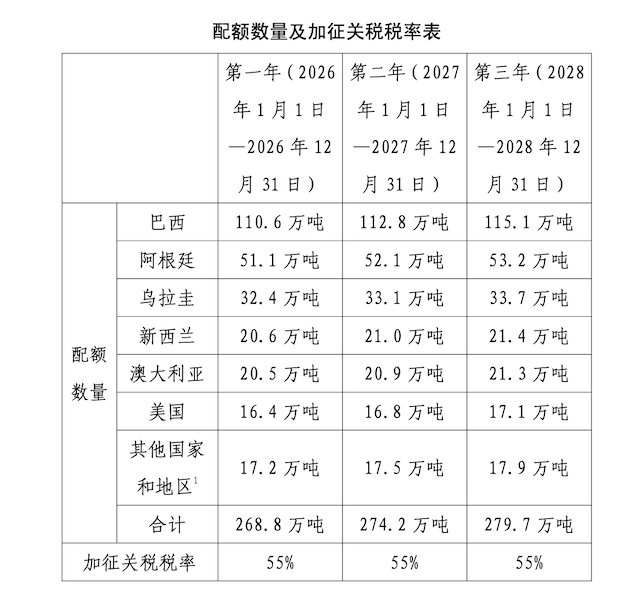
Core Viewpoint - The Chinese Ministry of Commerce has announced safeguard measures on imported beef to protect the domestic industry, which has been severely impacted by rising imports and low prices [1][5][9]. Group 1: Safeguard Measures - The safeguard measures will be implemented in the form of "country-specific quotas and additional tariffs" starting January 1, 2026, and will last until December 31, 2028 [1][5]. - The measures include a gradual increase in import quotas for major beef-exporting countries, with total quotas set at 268.8 million tons in 2026, increasing to 279.7 million tons by 2028 [3][5]. - An additional tariff of 55% will be imposed on any imports exceeding the established quotas starting from the third day after the quota is exceeded [6]. Group 2: Impact on Domestic Industry - The rapid increase in beef imports has led to a significant decline in the domestic beef industry, with the import volume rising from 1.66 million tons in 2019 to 2.87 million tons in 2024, a 73.2% increase [1][5]. - The domestic beef industry has faced severe losses, with a reported decline in the breeding cow population by approximately 3% in 2024, threatening the industry's foundation [1][7]. - The entire supply chain, from breeding to processing, has experienced widespread losses, creating a vicious cycle of price drops and further sell-offs [7][8]. Group 3: Industry Recovery and Future Outlook - The safeguard measures are expected to boost industry confidence and lay the groundwork for recovery, although a substantial recovery will take time [2]. - The measures aim to balance the need for domestic industry support while maintaining reasonable trade relations with exporting countries [9]. - The industry is encouraged to enhance competitiveness through policy support, technological advancements, and improved production efficiency [10].
(经济观察)中国进口牛肉保障措施调查进入最后阶段 国内业者期待尽快破局
Zhong Guo Xin Wen Wang· 2025-12-30 08:42
Group 1 - The investigation into China's safeguard measures for imported beef is nearing its conclusion, with the final deadline set for January 26, 2026, after two extensions [1] - The rapid increase in beef imports, which rose by 73.2% in 2024 compared to 2019, has significantly impacted the domestic beef industry, leading to lower prices and financial losses for local producers [1][2] - The influx of imported beef has disrupted the supply-demand balance in the domestic market, causing a decline in prices and resulting in the culling of breeding cows, which threatens the foundation of the beef industry [2] Group 2 - Industry experts emphasize the need for protective measures to stabilize the market and provide an opportunity for domestic producers to adjust and improve their operations [2] - Recommendations for the domestic beef industry include enhancing beef quality, innovating production methods, and improving efficiency through technology and resource management [3] - There is a call for establishing quality grading standards for domestic beef to support sustainable development and strengthen the industry's foundation during this critical period [3]
137亿美元进口牛肉保障措施调查背后:中国养殖户期待保障措施尽快落地
Di Yi Cai Jing· 2025-12-30 07:07
Core Viewpoint - The Ministry of Commerce has reported a ruling on beef safeguard measures to the WTO, with domestic industries urging for prompt action to protect local producers from the impact of low-priced beef imports [1] Group 1: Background and Context - The investigation was initiated based on applications from the China Animal Agriculture Association and nine major beef-producing regional associations, with a case value of $13.7 billion, marking the largest import investigation in China to date [1] - Major beef import countries to China include Brazil, Argentina, Uruguay, Australia, New Zealand, and the United States [1] Group 2: Industry Challenges - The domestic beef industry is facing severe challenges, with producers experiencing long-term price suppression due to an influx of low-priced imports, leading to widespread losses across the supply chain [2][3] - The processing sector is particularly affected, with each additional slaughter of a cow resulting in a loss of approximately 300 yuan, creating a vicious cycle of increased losses and reduced slaughter volumes [2] - The market is experiencing a significant contraction, with reports indicating that up to 50% of cows traded in certain markets are now breeding cows, a sharp increase from the normal turnover rate of about 20% [2] Group 3: Economic and Social Implications - The majority of beef producers in China are small-scale operators, and the ongoing price decline threatens their livelihoods, potentially leading to widespread economic distress among rural households [3] - The investigation is seen as necessary not only for commercial reasons but also for the social stability of rural communities dependent on beef production [3] Group 4: Strategic Responses - The safeguard measures are intended to provide a "window period" for the industry to adjust and upgrade, allowing for improvements in production efficiency and product quality [5] - There is a need for the industry to enhance processing techniques and develop quality grading standards to better align production with market demands, thereby increasing competitiveness [5][6] - The investigation is expected to stabilize beef prices, allowing processing companies to maintain operational viability and encouraging technological upgrades within the industry [6]
受权发布 | 中华人民共和国对外贸易法
Xin Hua She· 2025-12-27 13:39
Core Points - The law aims to promote high-level opening-up and high-quality development of foreign trade, maintain trade order, protect the legitimate rights and interests of trade operators, and safeguard national sovereignty, security, and development interests [1]. Group 1: General Principles - The law applies to foreign trade and related intellectual property protection [2]. - Foreign trade is defined as the import and export of goods, technology, and international service trade [3]. - Foreign trade work should serve national economic and social development and promote the construction of a strong trading nation [4]. - The State Council is responsible for overseeing national foreign trade work [5]. Group 2: Trade Operators - Foreign trade operators are defined as individuals or organizations that engage in foreign trade activities in accordance with the law [9]. - Operators must obtain qualifications for foreign labor cooperation and comply with relevant regulations for foreign contracting projects [10]. Group 3: Import and Export Regulations - The state allows the free import and export of goods and technology, except as otherwise provided by law [16]. - The State Council may implement automatic licensing for certain goods based on monitoring needs [17]. - The state can prohibit or restrict the import and export of goods and technology for reasons such as national security and public interest [14][15]. Group 4: International Service Trade - The state encourages various modes of international service trade, including cross-border delivery and overseas consumption [27]. - The State Council manages international service trade in accordance with the law [28]. Group 5: Intellectual Property Protection - The state strengthens intellectual property protection related to foreign trade and can take measures against the import of goods that infringe on intellectual property rights [32][33]. Group 6: Trade Order - In foreign trade activities, operators must not engage in monopolistic or unfair competition practices [36]. - The law outlines specific prohibited behaviors, including forgery of origin marks and smuggling [37]. Group 7: Trade Investigation and Relief - The State Council can conduct investigations into foreign trade activities to maintain order and may take appropriate relief measures based on investigation results [41][44]. Group 8: Trade Promotion - The state formulates strategies to promote balanced development in foreign trade and supports the establishment of financial institutions for trade services [56][57]. - The state encourages the development of digital trade and green trade systems [61][62]. Group 9: Legal Responsibilities - Violations of the law can result in fines and restrictions on future trade activities [71][72]. Group 10: Miscellaneous Provisions - The law will take effect on March 1, 2026 [49].
针对欧盟乳制品补贴政策,商务部依法调查并采取措施
第一财经· 2025-12-27 07:05
Core Viewpoint - The article discusses China's preliminary ruling on anti-subsidy investigations against EU dairy products, highlighting the significant subsidy rates and the impact on domestic industries, while emphasizing the legal basis and fairness of China's actions [3][4][7]. Group 1: Anti-Subsidy Investigation - The Ministry of Commerce announced a preliminary ruling on anti-subsidy investigations against EU dairy products, with subsidy rates ranging from 21.9% to 42.7% [3][4]. - The investigation is seen as a response to unfair competition and subsidies from the EU, aiming to protect China's domestic dairy industry [3][4][7]. - The investigation process adhered to legal standards, ensuring transparency and fairness, including consultations with the EU prior to the announcement [4][5]. Group 2: Impact on Domestic Industry - Preliminary evidence indicates that EU subsidies have caused substantial harm to China's domestic dairy industry, particularly affecting cheese and high-fat cream products [7][8]. - The subsidies allow EU producers to maintain profitability even during low international milk prices, enabling them to export at prices below production costs [7][8]. - The financial health of domestic dairy companies has deteriorated due to price pressures from subsidized EU products, leading to increased inventory and operational difficulties, especially for small and medium-sized enterprises [8]. Group 3: Trade Relations and EU's Subsidy Practices - The article highlights the disparity in trade remedy investigations between China and the EU, with the EU initiating numerous investigations against Chinese products while China has been more restrained [10][11]. - The EU's use of the Foreign Subsidies Regulation (FSR) is criticized for being overly aggressive and discriminatory, raising concerns for Chinese companies operating in Europe [11]. - Despite ongoing trade tensions, China expresses a willingness to resolve disputes through dialogue and cooperation, as evidenced by recent adjustments in anti-dumping measures [10][11].