
海外投资基金

Search documents
激烈!公募基金最新数据出炉!非货万亿俱乐部再添新丁,5家机构规模缩水超百亿元
Sou Hu Cai Jing· 2026-01-23 01:37
Core Insights - The public fund industry in China has experienced significant changes in fund sizes and investor preferences, with a notable shift towards index funds and mixed bond funds while actively managed equity funds continue to face net redemptions [1][2][3][4][7][9] Fund Performance and Trends - As of December 31, 2025, the total net asset value of public funds exceeded 37.64 trillion yuan, marking a historical high, with continued net inflows into the public fund market [1] - Actively managed equity funds faced net redemptions despite improved performance, indicating a lack of investor confidence [1] - Index equity funds, particularly the A500 index ETFs, saw significant inflows, with several funds growing by over 10 billion yuan in the fourth quarter [2] Bond Fund Dynamics - Bond fund sizes rebounded, with a quarterly increase of over 300 billion yuan, reaching nearly 11 trillion yuan, driven mainly by mixed bond funds and bond ETFs [3] - Six out of ten bond funds that grew by over 10 billion yuan in the quarter were bond ETFs, highlighting their appeal due to low fees [3] Multi-Asset Fund Growth - 2025 marked a year of explosive growth for multi-asset funds, with overseas investment funds, commodity funds, and FOFs (funds of funds) seeing substantial increases in size [4] - Commodity funds experienced a quarterly growth rate exceeding 45%, with significant increases in gold and silver products [4] Competitive Landscape - The public fund industry exhibits a pronounced "Matthew Effect," where leading firms maintain strong positions while smaller firms face intense competition [7][9] - The top ten public fund companies by non-monetary scale remained unchanged compared to the previous quarter, with three firms surpassing the trillion-yuan mark [8] - Notable growth was observed among mid-sized firms, with some achieving substantial quarterly increases in non-monetary scale [9]
激烈!公募基金最新数据出炉!非货万亿俱乐部再添新丁,5家机构规模缩水超百亿元
券商中国· 2026-01-23 01:17
Core Viewpoint - The public fund industry in China is experiencing significant shifts in product scale and investor preferences, with a notable divergence in risk appetite among investors, leading to a mixed environment of opportunities and challenges for the industry [2]. Group 1: Market Trends - Since the fourth quarter of last year, there has been a rapid rotation in market styles, with a clear adjustment in the scale of industry products. Index funds, mixed bond funds, commodity funds, overseas investment funds, and FOFs have all seen growth, while actively managed equity funds and pure bond funds continue to shrink [2]. - As of December 31, 2025, the total net asset value of public funds exceeded 37.64 trillion yuan, marking a historical high, with continued net inflows into the public fund market [3]. - The bond fund sector has rebounded, with a quarterly growth exceeding 300 billion yuan, bringing the total scale close to 11 trillion yuan, also a historical high [4]. Group 2: Fund Performance - Actively managed equity funds faced net redemptions, with investors losing confidence despite improved performance. The overall share of these funds showed a net outflow in the fourth quarter [3]. - In contrast, investors favored index equity funds, particularly the A500 index ETFs, which saw significant inflows, with several funds growing by over 10 billion yuan in the fourth quarter [3]. Group 3: Multi-Asset Growth - 2025 is marked as a year of explosive growth for multi-asset funds, with overseas investment funds, commodity funds, and FOFs experiencing substantial increases in scale. The commodity fund sector saw a quarterly increase of over 45%, with gold and silver products leading the growth [5][6]. - The FOF products regained popularity, with several newly established funds achieving impressive fundraising results in the fourth quarter [6]. Group 4: Competitive Landscape - The public fund industry exhibits a pronounced "Matthew Effect," where leading firms maintain strong competitive positions, while mid-tier firms face intense competition. The top three firms in non-monetary fund scale are E Fund, Huaxia Fund, and GF Fund, with GF Fund recently surpassing the 1 trillion yuan mark for the first time [7][8]. - Smaller firms, some with non-monetary scales below 100 billion yuan, have also shown significant growth, with several achieving over 10 billion yuan in quarterly increases [9].


2026,资管人的钱该往哪里投?——第十九届HED中国峰会·深圳即将开幕
Zhong Jin Zai Xian· 2026-01-09 03:07
Core Insights - The year 2026 marks the beginning of the "14th Five-Year Plan" and is seen as a pivotal moment for China's asset management industry, facing new opportunities amid ongoing international volatility and the transformative impact of AI on investment research [2] - The upcoming HED China Summit aims to address critical questions regarding policy direction, low interest rate challenges, and the potential disruption caused by AI in asset allocation decisions [2] Group 1: Macro Outlook - Dongwu Securities' Chief Economist, Lu Zhe, will provide an in-depth analysis of the "New Cycle of the 14th Five-Year Plan: Asset Allocation Outlook," covering growth and structural targets, fiscal and monetary policy coordination, and trends in exchange rates and commodities [4] - A roundtable discussion featuring experts from major banks will combine macro policy guidance with wealth management experience, offering strategic insights for the industry [4] Group 2: Practical Strategies - The summit will focus on actionable solutions to asset allocation challenges in a low-interest-rate environment, with presentations on global macroeconomic trends and multi-asset strategies [5] - Insights into the futures asset management sector and its investment strategies for 2026 will be shared by industry leaders [6] Group 3: Quantitative Focus - A dedicated forum on "The Next Phase of Chinese Quantitative Strategies" will address key concerns in the quantitative field, including innovations in quantitative stock strategies and the development of cross-border funds [7] - Discussions will also focus on the opportunities for institutional funds in quantitative stock strategies, facilitating connections between quantitative firms and mainstream investors [7] Group 4: Efficient Collaboration - The summit emphasizes practical outcomes by facilitating high-efficiency business connections between mainstream institutional investors and private fund managers through tailored networking opportunities [8] Group 5: Industry Recognition - The "19th Jiefu Honor Night" awards ceremony will recognize outstanding contributions in asset management, insurance, and banking, serving as a benchmark for excellence in the industry [9] - The summit aims to create a high-level exchange platform for industry elites to address challenges and seize opportunities, contributing to the high-quality development of the asset management sector in 2026 [9]

公募基金规模暗战正酣
2 1 Shi Ji Jing Ji Bao Dao· 2025-11-04 23:08
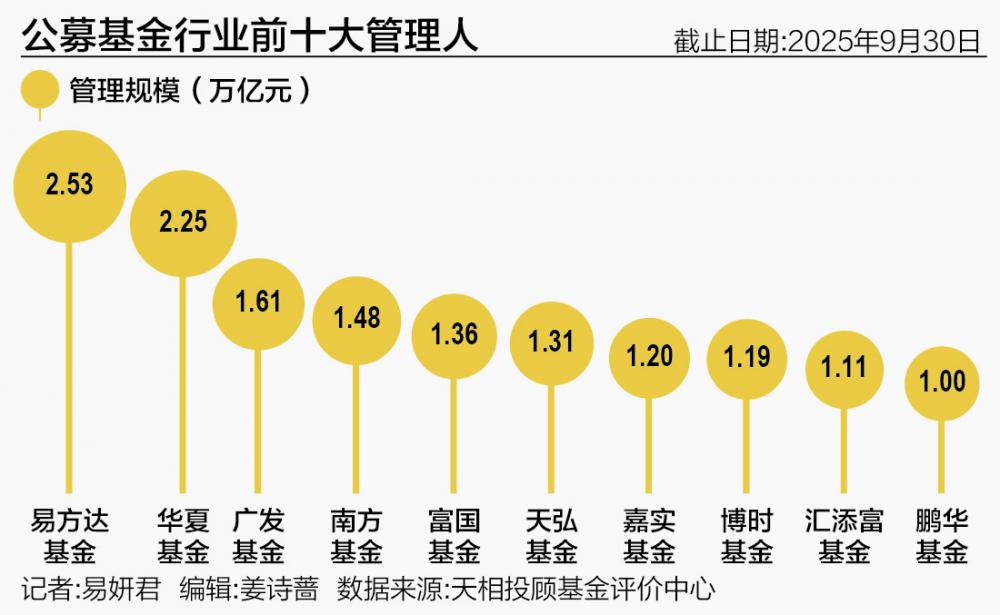
Core Insights - The total net asset value of public funds in China reached a historical high of 36.74 trillion yuan by the end of September 2025, marking a nearly 7% increase from the end of Q2 2025 and a 14.56% increase year-on-year [1][4]. Fund Management Landscape - There are 165 public fund management institutions in China, including 150 fund management companies and 15 asset management institutions with public qualifications [1]. - The top two fund management companies, E Fund and Huaxia, have assets exceeding 2.5 trillion yuan and 2.2 trillion yuan, respectively, while eight other firms have surpassed 1 trillion yuan in assets [1][7]. Fund Type Performance - All major fund types, except bond funds, experienced growth in Q3 2025. The fastest-growing were overseas investment funds, which increased by 33.18%, followed by stock funds with a 25.3% increase [4][5]. - The total net asset value of stock funds reached 5.94 trillion yuan, while mixed funds grew to 3.91 trillion yuan [4]. Bond Fund Trends - Bond funds saw a decline in total net asset value, dropping to 10.62 trillion yuan, a decrease of 1.33% from the end of Q2 2025 [6]. Market Dynamics - The top ten fund managers accounted for 41.31% of the total market size, with their combined assets reaching 15.06 trillion yuan, reflecting a trend of "the strong getting stronger" [7][8]. - The top ten fund managers in terms of equity fund size include E Fund, Huaxia, and others, with E Fund leading at 1.29 trillion yuan [9]. Investor Behavior - There is a significant divergence in the subscription trends of equity funds, with thematic ETFs and cross-border ETFs being particularly popular, achieving net subscriptions exceeding 100 billion units in Q3 2025 [10][11]. - Some actively managed equity funds also attracted substantial net subscriptions, but their levels were lower compared to ETF products [12]. Redemption Trends - Despite the overall market expansion, there is a notable trend of profit-taking among investors, leading to significant redemptions in certain funds, particularly those that had previously experienced long periods of adjustment [14][15]. - For instance, the Huaxia Science and Technology 50 ETF and E Fund Medical ETF saw substantial reductions in their fund sizes during Q3 2025 [16].
易方达规模首破2.5万亿
2 1 Shi Ji Jing Ji Bao Dao· 2025-11-04 07:56
Core Insights - The total net asset value of public funds in China reached a historic high of 36.74 trillion yuan as of September 2025, marking a nearly 7% increase from the end of Q2 2025 and a 14.56% increase year-on-year [1][3][4]. Fund Management Landscape - There are 165 public fund management institutions in China, including 150 fund management companies and 15 asset management institutions with public qualifications [1]. - The top two fund management companies, E Fund and Huaxia, have assets under management (AUM) exceeding 2.5 trillion yuan and 2.2 trillion yuan, respectively [1][8]. - The top ten fund managers collectively manage 15.06 trillion yuan, accounting for 41.31% of the total market size, indicating a trend of "the strong getting stronger" [6][8]. Fund Type Performance - In Q3 2025, the total scale of public funds increased by 2.35 trillion yuan, with all fund types except bond funds showing growth [4][6]. - The fastest-growing fund types were overseas investment funds, which saw a 33.18% increase, and stock funds, which grew by 25.3% [5][6]. - The total scale of stock funds reached 5.94 trillion yuan, while mixed funds reached 3.91 trillion yuan, reflecting significant growth in these categories [5][9]. Investor Behavior and Trends - There has been a notable demand for thematic ETFs and cross-border ETFs, with several funds seeing net subscriptions exceeding 10 billion units in Q3 2025 [13][14]. - Despite the overall growth, there is a significant divergence in the subscription patterns of equity funds, with some experiencing heavy redemptions as investors lock in profits [14][15]. - High-performing active equity funds also attracted net subscriptions, but their levels were lower compared to ETF products [14]. Redemption Trends - Some ETFs, particularly in sectors that had previously seen long adjustments, experienced significant redemptions as investors opted to cash out after recent performance recoveries [15]. - Notable examples include the Huaxia Sci-Tech 50 ETF and E Fund Medical ETF, which saw reductions in fund shares of 307.89 billion and 133.28 billion, respectively [15].

公募基金规模暗战正酣:万亿俱乐部扩容,易方达首破2.5万亿
2 1 Shi Ji Jing Ji Bao Dao· 2025-11-04 06:33
Core Insights - The total scale of public funds in China reached 36.74 trillion yuan by the end of September 2025, marking a 7% increase from the second quarter of the year and a 14.56% increase year-on-year [1][2][5] Fund Management Landscape - As of September 2025, there are 165 public fund management institutions in China, including 150 fund management companies and 15 asset management institutions with public qualifications [1] - The top ten fund managers account for 41.31% of the total market scale, with their combined asset value reaching 15.06 trillion yuan, reflecting a trend of "the strong getting stronger" [5][7] Fund Type Performance - In the third quarter of 2025, various fund types, except for bond funds, experienced growth. Notably, overseas investment funds saw the highest growth rate at 33.18%, followed by stock funds at 25.3% [2][4] - The total scale of stock funds reached 5.94 trillion yuan, while mixed funds reached 3.91 trillion yuan, and money market funds totaled 14.40 trillion yuan [4][5] ETF and Active Fund Trends - Tools that capture market trends, such as thematic ETFs and cross-border ETFs, have become highly sought after, with several funds seeing net subscriptions exceeding 10 billion units in the third quarter [10] - Some actively managed equity funds also attracted significant net subscriptions, although their "capital-absorbing" capacity was lower than that of ETF products [11] Redemption Trends - Despite the overall market expansion, there is a notable trend of investors cashing out, particularly in sectors that have seen recent rebounds. For instance, several ETFs experienced significant reductions in fund shares during the third quarter [12][14][15]

重磅榜单来了,排名大洗牌
中国基金报· 2025-10-29 05:54
Core Insights - The public fund industry in China experienced significant growth in the third quarter of 2025, particularly in equity funds, driven by a strong performance in the A-share market [2][4][24] - The total management scale of public funds reached 36.45 trillion yuan, marking a 7.07% increase from the previous quarter [4][6] - Active equity funds and stock index funds saw substantial growth, with active equity funds increasing by nearly 700 billion yuan and stock index funds growing by 1.1 trillion yuan [5][6] Fund Performance - The stock fund category saw a quarter-on-quarter increase of 1.2 trillion yuan, a growth rate of 25.3%, with pure index stock funds leading the increase at 1.06 trillion yuan [4][6] - Mixed funds also performed well, with a growth of nearly 600 billion yuan, reflecting a 17.89% increase [5][6] - In contrast, bond funds experienced a decline, with a reduction of 142.8 billion yuan, the only category to shrink during this period [5][6] Company Rankings - E Fund and Huaxia Fund emerged as the top two companies in terms of non-monetary fund scale, with 1.81 trillion yuan and 1.52 trillion yuan respectively [9][10] - Five public fund companies reported non-monetary fund growth exceeding 100 billion yuan, with E Fund leading at an increase of 286.6 billion yuan [13][14] Active Equity Fund Growth - E Fund led the active equity fund category with a scale of 3.129 trillion yuan, followed by China Europe Fund and GF Fund, both exceeding 2 trillion yuan [24][25] - The growth in active equity funds was significant, with several companies reporting increases of over 500 billion yuan, indicating a strong market recovery [27][28] Index Fund Developments - The total scale of public index products approached 8 trillion yuan, with E Fund and Huaxia Fund both surpassing the 1 trillion yuan mark in index fund management [16][22] - The growth in index funds was supported by a favorable market environment and the performance of underlying assets [22][24] Market Trends - The third quarter saw a return of the "money-making effect" in the market, which positively impacted the growth of active equity funds [29] - The demand for long-term stable returns is driving interest in actively managed equity products, positioning them as a key focus for fund companies [29]

权益类基金业绩强势反弹 三季度股债跷跷板效应显著
Zheng Quan Shi Bao Wang· 2025-10-28 23:33
Core Insights - The public fund industry in China has shown significant growth in the third quarter of this year, driven by a rebound in the A-share market and strong performance of equity funds, particularly technology-themed funds [1] - The competition among fund companies has intensified, with varying degrees of success in capitalizing on the current investment trends [1] Industry Overview - As of the end of the third quarter, the total management scale of domestic public fund management institutions reached 36.45 trillion yuan, an increase of approximately 2.41 trillion yuan from 34.05 trillion yuan at the end of the second quarter, marking two consecutive quarters of substantial growth [1] - The growth is primarily attributed to the recovery of the equity market and the continuous rise in ETF scales [1] Fund Performance - Index funds and enhanced index funds saw a scale increase of 1.1 trillion yuan in the third quarter, while mixed funds grew by nearly 600 billion yuan, and overseas investment funds increased by 225.3 billion yuan [1] - In contrast, bond funds experienced a contraction, shrinking by 142.8 billion yuan due to weaker performance and investor redemptions [1]
三季度股债跷跷板效应显著 公募规模排位赛格局悄然生变
Zheng Quan Shi Bao· 2025-10-28 22:36
Core Insights - The public fund industry in China has shown significant growth in the third quarter, particularly in equity funds, driven by a rebound in the A-share market and strong performance in technology-themed funds [1][2] - The competition among fund companies has intensified, with varying performance in fund management scale, particularly between those capitalizing on passive investment trends and those lagging behind [2][3] Fund Management Scale - As of the end of Q3, the total management scale of domestic public funds reached 36.45 trillion yuan, an increase of approximately 2.41 trillion yuan from the end of Q2 [1] - The non-monetary management scale of public funds exceeded 22.05 trillion yuan, marking a continuous increase of over 1 trillion yuan for two consecutive quarters [2] - Leading fund companies like E Fund and Huaxia Fund saw significant increases in their non-monetary management scale, with E Fund's growth exceeding 250 billion yuan in Q3 [2] Performance of Fund Types - Equity funds, particularly ETFs, have outperformed bond funds, with notable inflows into stock ETFs and "fixed income plus" products [4][5] - The top-performing funds in Q3 were primarily ETFs, with significant growth in products like Huatai-PB CSI 300 ETF, which increased by over 500 billion yuan [4] - "Fixed income plus" products also gained popularity, with notable increases in funds like Yongying Stable Enhancement and Invesco Great Wall Stable Growth [5] Market Dynamics - The "see-saw" effect between equity and bond markets has become evident, with funds shifting from pure bond funds to equity assets [4] - Over 70 smaller public funds experienced a decline in non-monetary management scale, primarily due to redemptions in bond funds and insufficient growth in equity funds [5][6] Active Equity Funds - Active equity funds, particularly those focused on technology themes, have seen a resurgence, with a total scale of approximately 4.3 trillion yuan, an increase of over 700 billion yuan from Q2 [7] - E Fund leads in active equity fund scale, followed by other firms like China Europe Fund and GF Fund, all exceeding 200 billion yuan [7] - The performance of specific active equity products has been outstanding, with some funds achieving year-to-date gains exceeding 200% [7][8]
二季度公募基金整体利润超3850亿元;公募最新非货币基金规模排名出炉丨天赐良基早参
Sou Hu Cai Jing· 2025-07-22 08:10
Group 1 - The latest list of the top ten heavy stocks held by public funds has been released, with Tencent Holdings and CATL being the only two stocks with over a thousand funds heavily invested in them [1] - As of the end of Q2 2025, the total market value of Tencent Holdings held by public funds is approximately 59.2 billion yuan, with 1,039 fund products invested, while CATL has a total market value of 52.1 billion yuan with 1,150 funds [1] Group 2 - The management scale of public funds has reached a new historical high, surpassing 34 trillion yuan, with a quarterly increase of over 2.24 trillion yuan [2] - As of the end of Q2 2025, the scale of stock funds is 4.74 trillion yuan, mixed funds 3.32 trillion yuan, bond funds 10.77 trillion yuan, and money market funds 13.93 trillion yuan [2] Group 3 - The overall profit of public funds in Q2 reached 385.1 billion yuan, showing a quarter-on-quarter increase [3] - Stock and bond funds were the main contributors to the profits, with profits of 120.5 billion yuan and 102.9 billion yuan respectively [3] Group 4 - The ranking of non-monetary fund scales has been released, with E Fund leading at 1.52 trillion yuan, followed by Huaxia Fund at 1.33 trillion yuan [4] - Several other funds, including GF Fund and China Universal Fund, have non-monetary fund scales exceeding 600 billion yuan [4] Group 5 - QDII funds have shown two main adjustment directions in Q2, with some increasing allocation to Hong Kong stocks while reducing exposure to US stocks [5] - For example, Morgan China Biopharmaceutical Mixed Fund has reduced its A-share allocation from 54.96% to 47.53% while increasing its Hong Kong stock allocation from 29.40% to 45.56% [5] Group 6 - Fund reports indicate a focus on innovative drugs, with several stocks entering the top ten heavy stocks of the funds managed by Guo Lan and Xie Zhiyu [6][7] - Stocks such as Bai Li Tianheng and Xin Li Tai have entered the top ten, while others like Mai Rui Medical and Ai Er Eye Hospital have exited [6][7] Group 7 - The market showed a positive trend on the previous trading day, with the Shanghai Composite Index rising by 0.62% and the Shenzhen Component Index by 0.84% [8] - Sectors such as engineering machinery, coal, and cement materials saw significant gains, while packaging materials and gaming sectors experienced declines [8] Group 8 - The S&P Oil and Gas ETF led the decline, falling by 2.18% [9]