海洋碳汇

Search documents
绘就“海上新广东”生态底色
Zhong Guo Zi Ran Zi Yuan Bao· 2026-01-30 07:24
Core Viewpoint - Guangdong Province is prioritizing marine ecological protection and restoration during the 14th Five-Year Plan period, implementing significant projects and innovative measures to improve water quality and strengthen ecological barriers [1][3]. Group 1: Marine Ecological Restoration Initiatives - Guangdong has launched five major marine ecological restoration projects focusing on coastal line rehabilitation, beach enhancement, ecological seawall construction, coastal wetland restoration, and beautiful bay development [3][4]. - The province has established a marine ecological protection red line covering 16,600 square kilometers, accounting for 25.62% of the total marine area under its jurisdiction [3]. - Over the 14th Five-Year period, Guangdong has received more than 3.3 billion yuan in special funds for marine ecological restoration, completing 33 projects that restored over 200 kilometers of coastline and 7,600 hectares of coastal wetlands [4]. Group 2: Sustainable Development and Economic Growth - Guangdong is balancing development and protection by creating a comprehensive coastal development and protection framework, planning marine ecological spaces of 20,700 square kilometers and development zones of 44,000 square kilometers [7]. - The province's marine production value is projected to exceed 2 trillion yuan in 2024, maintaining its position as the top in the country for 30 consecutive years [7]. - The "Blue Bay" restoration project on Nan'ao Island has significantly improved the area's landscape and attracted over 10 million visitors in 2024, generating more than 4 billion yuan in tourism revenue [8]. Group 3: Innovation in Marine Carbon Trading - Guangdong is exploring pathways for realizing the value of marine ecological products, including establishing a carbon trading platform for ecological products and promoting blue carbon trading [10]. - The province has successfully completed the first blue carbon project in China, certifying and trading 380 hectares of newly planted mangrove carbon credits [10]. - Innovative models for carbon credit trading, such as public subscription for mangrove protection credits, have been developed, expanding the scope of blue carbon trading [10]. Group 4: Future Directions - Guangdong will continue to uphold the principle of ecological priority, deepen integrated land-sea governance, and advance marine ecological protection and high-quality economic development [11].

以正义之锚守护壮阔蔚蓝
Xin Lang Cai Jing· 2026-01-28 00:15
Core Viewpoint - The article emphasizes the importance of marine law enforcement and judicial protection in promoting high-quality development of China's marine economy, aligning with national strategies for maritime security and ecological sustainability [6][9][20]. Group 1: Marine Law Enforcement and Judicial Collaboration - The Supreme People's Procuratorate has initiated collaborative efforts with marine law enforcement agencies to enhance legal supervision and ensure marine safety, resource protection, and ecological conservation [6][9]. - A comprehensive cooperation mechanism has been established between coastal procuratorial agencies and maritime law enforcement, facilitating information sharing and joint investigations [9][10]. - The collaboration has proven effective in handling complex maritime cases, such as smuggling and illegal fishing, by ensuring timely intervention and coordinated legal actions [10][11]. Group 2: Marine Resource Protection Initiatives - The article highlights the annual release of 350,000 juvenile clams in Fujian as part of ongoing efforts to protect marine biodiversity and restore overfished species [12][13]. - A comprehensive protection system has been developed to combat illegal fishing and enhance public awareness, resulting in the release of over 2 million clam seedlings since 2021 [13]. - Cross-regional cooperation has been initiated to address illegal fishing and aquaculture, leading to the dismantling of over 800 acres of illegal facilities and the resolution of 22 fishing violations [14]. Group 3: Ecological Restoration and Sustainable Practices - The article discusses innovative ecological restoration methods, including the introduction of carbon credit mechanisms to fund marine ecosystem recovery efforts [15][19]. - The protection of the endangered Chinese white dolphin has been prioritized, with collaborative efforts among multiple provinces to enhance biodiversity conservation [16][19]. - The establishment of a judicial alliance for mangrove protection signifies a shift towards collaborative governance in ecological restoration, integrating legal accountability with environmental sustainability [19]. Group 4: Support for Marine Economic Development - The article outlines the role of coastal procuratorial agencies in supporting the development of the marine economy through legal services and risk prevention strategies for marine enterprises [20][21]. - Initiatives have been launched to regulate the burgeoning marine tourism industry, addressing safety concerns and illegal operations to ensure orderly development [21][22]. - The establishment of marine equipment inspection service stations aims to provide comprehensive legal support for the marine industry, enhancing its international competitiveness [21][22].

“十四五”以来广东整治修复海岸线超200公里 新营造红树林面积居全国首位
Nan Fang Ri Bao Wang Luo Ban· 2026-01-21 08:16
Core Viewpoint - Guangdong Province is accelerating the construction of a comprehensive protection and governance framework for marine ecology, aiming for integrated land-sea development and protection during the 14th Five-Year Plan period [1][2]. Group 1: Marine Ecological Protection Achievements - Over 200 kilometers of coastline have been restored, with more than 40 kilometers of new ecological restoration coastline added, exceeding national targets for maintaining natural coastline [1][2]. - The area of newly created mangroves ranks first in the country, with over 4,900 hectares of new mangroves and more than 2,600 hectares of restored mangroves, surpassing the 2025 target of 1,500 hectares [3]. - The proportion of excellent water quality in coastal waters is expected to reach 91.2% by 2025, with significant improvements in nearshore water quality over the past five years [1][3]. Group 2: Regulatory Framework and Funding - Guangdong has established a marine ecological protection red line covering 16,600 square kilometers, accounting for 25.62% of the province's marine area, and implemented detailed management of coastline protection [2]. - The province has received over 3.3 billion yuan in central and provincial funding for marine ecological restoration projects, with 33 projects initiated [2]. Group 3: Pollution Control and Water Quality Improvement - The province has completed a comprehensive survey of over 9,900 river mouth pollution outlets, achieving a 100% remediation rate in six cities including Guangzhou and Shenzhen [3]. - By 2025, the total nitrogen concentration in rivers entering the sea is expected to show a negative growth compared to 2020 levels, with 73.9% of the water quality in the Pearl River Estuary meeting excellent standards [3]. Group 4: Marine Ranching and Aquaculture Development - Guangdong is promoting the construction of modern marine ranches, with over 70,000 acres of aquaculture facilities upgraded and traditional net cages being transformed [4]. - The province has built 8,000 gravity-type deep-water cages and 28 truss-type cages, facilitating the development of deep-sea aquaculture [4]. Group 5: Green and Low-Carbon Shipping Initiatives - The Guangdong Maritime Bureau has implemented a monitoring platform for ship water pollutants, conducting over 13,510 inspections and reducing illegal discharges by 40% compared to the previous five years [5]. - Support has been provided for the construction or retrofitting of 228 liquefied natural gas-powered vessels during the 14th Five-Year Plan period [5]. Group 6: Innovative Carbon Trading Projects - Guangdong has launched several pioneering carbon trading projects, including the first "blue carbon" project in 2021, generating approximately 388,000 yuan from the sale of carbon credits [6][7]. - In 2023, Shenzhen completed the first carbon credit transaction for mangrove protection, achieving a record price of 485 yuan per ton [7]. - The province has also initiated public subscription models for carbon credits, expanding the scope of blue carbon trading [7].
让大海成为“绿色聚宝盆”
Zhong Guo Zi Ran Zi Yuan Bao· 2025-09-24 05:46
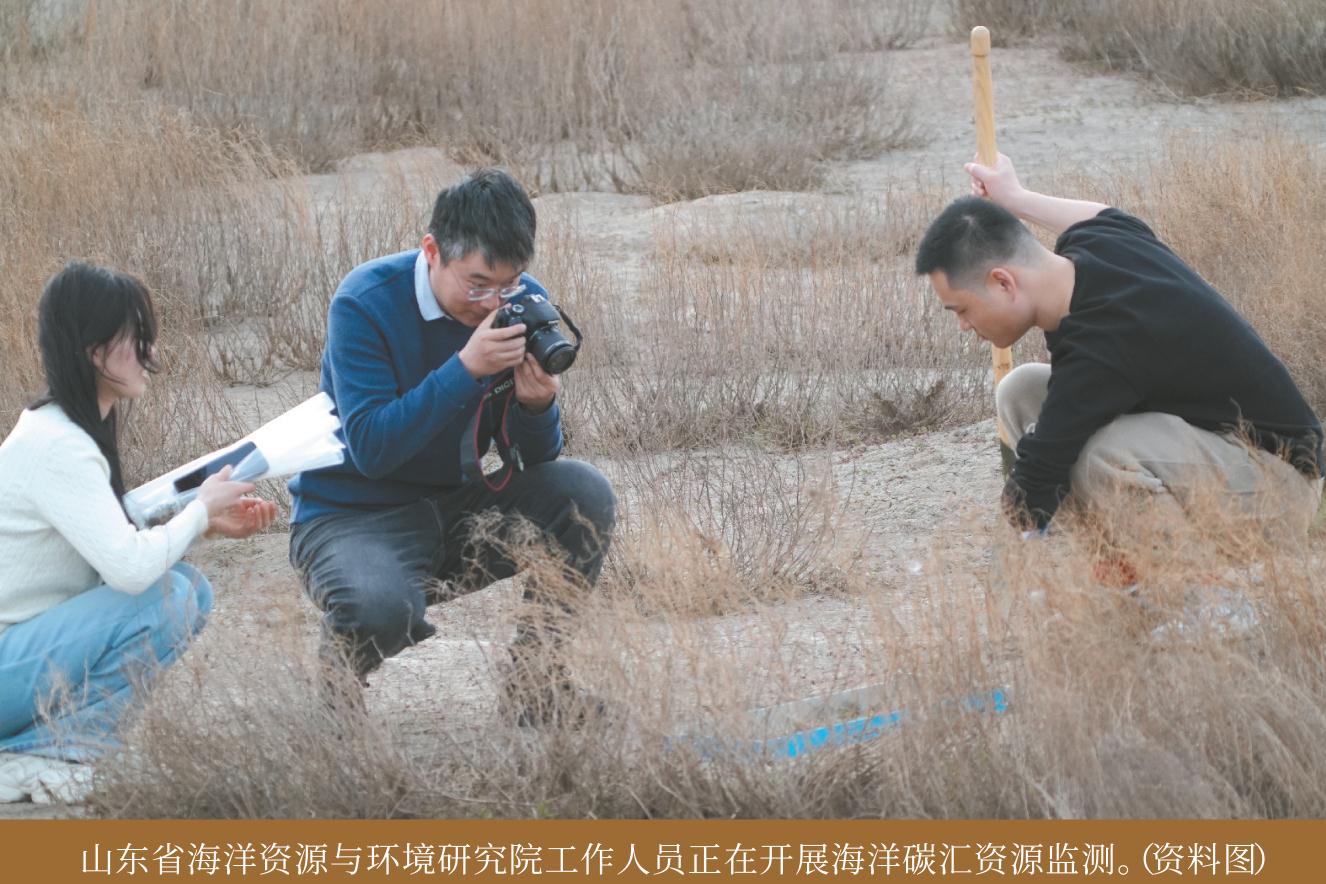
Core Viewpoint - The implementation of the "Shandong Seagrass Bed Carbon Sink Carbon Benefit Methodology" aims to transform monitoring data into marketable "blue carbon certificates," addressing the challenge of quantifying the value of seagrass resources in Shandong [2] Group 1: Research and Development - Shandong is establishing a systematic foundation for marine carbon sink work by collaborating across institutions, teams, and talent, with the Shandong Marine Resources and Environment Research Institute leading the efforts [4] - A cross-disciplinary research team has been formed, focusing on key areas such as carbon storage assessment technology and carbon sink monitoring methods [4] - The establishment of the Shandong Marine Carbon Sink Industry Alliance aims to break down industry barriers and enhance collaboration [4] Group 2: Resource Assessment - Shandong has initiated a series of foundational blue carbon surveys to accurately assess the status of blue carbon resources, providing solid data support for the methodology [6] - The province has created a comprehensive map detailing the locations and distributions of major salt marshes, seagrass beds, and typical algal carbon sink resources [6] - Ongoing pilot investigations into carbon storage in typical blue carbon ecosystems are underway, contributing to the understanding of carbon storage resources [6] Group 3: Practical Implementation - The methodology has been successfully implemented across Shandong, leading to various blue carbon economic practices that convert theoretical value into tangible outcomes [8] - Financial institutions, such as Weifang Commercial Bank, are actively purchasing marine carbon sinks to achieve carbon neutrality, creating a closed-loop system of protection, accounting, and trading [8] - The methodology is expected to be applied in broader marine areas, allowing fishermen to earn income through marine protection and supporting economic growth through blue carbon initiatives [8]
海洋强省强市·浙江篇|陆海协作——浙江强化用海要素保障支撑海洋强省建设综述
Zhong Guo Zi Ran Zi Yuan Bao· 2025-05-09 09:26
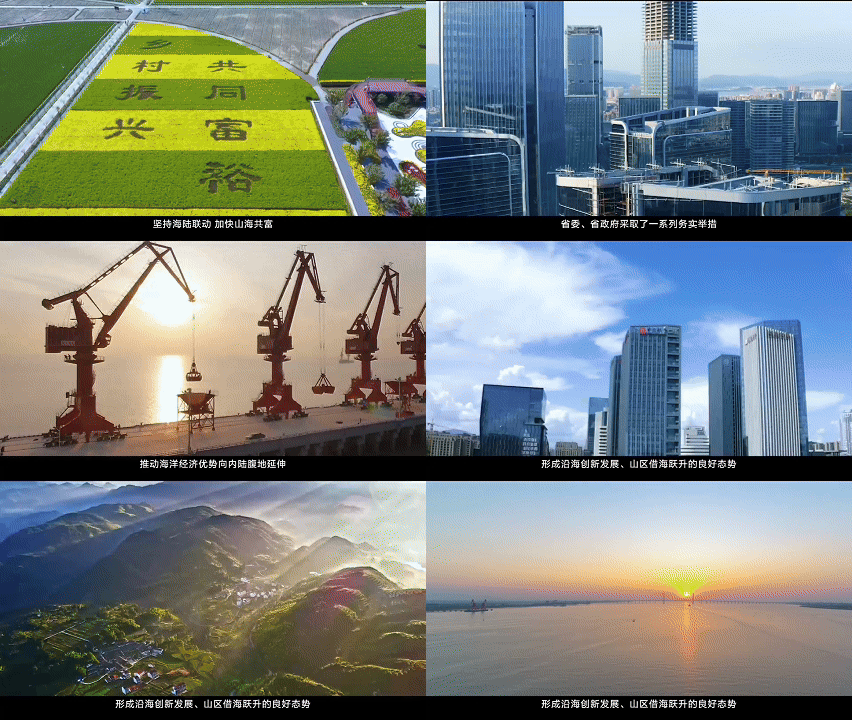
Core Viewpoint - Zhejiang is leveraging its unique geographical advantages and rich marine resources to build a strong marine province, focusing on high-quality development during the "14th Five-Year Plan" period [1]. Group 1: Marine Resource Management - Zhejiang is implementing integrated innovation in marine management systems to enhance the efficient use of marine resources and improve approval efficiency for marine usage [3][5]. - The province has introduced 12 supportive measures to promote high-quality development of the marine economy, focusing on planning, optimization of approval services, and regulatory protection [3]. Group 2: Industrial Development - From 2021 to 2024, Zhejiang is set to secure over 50,000 acres for project marine usage, contributing to the construction of a common prosperity demonstration zone [7]. - The successful online transaction of marine usage rights marks a significant step towards market-oriented allocation of marine resources [7]. Group 3: Ecological Protection - Zhejiang is enhancing marine ecological safety through comprehensive monitoring and regulatory systems, including the establishment of a multi-source monitoring network [15][19]. - The province has initiated 280 coastal monitoring stations to assess marine ecological conditions, showing a stable improvement in ecological status [16]. Group 4: Carbon Neutrality Initiatives - Zhejiang is exploring marine carbon sink initiatives, aiming to establish a "Zhejiang model" for marine carbon sink development, and has conducted extensive research on blue carbon ecosystems [22]. Group 5: Infrastructure and Investment - The province is actively revitalizing existing marine construction usage and has identified 20 projects that have mobilized investments of 8.5 billion yuan [13].