
消费REITs

Search documents
行业周报:消费REITs单周表现优异,发行市场保持活跃-20260111
KAIYUAN SECURITIES· 2026-01-11 15:21
Investment Rating - The industry maintains a "positive" investment rating [3][8][57] Core Insights - In the second week of 2026, the CSI REITs (closing) index was 793.05, down 3.22% year-on-year but up 1.86% month-on-month. The CSI REITs total return index was 1028.93, up 4.17% year-on-year and 1.89% month-on-month. The trading volume of the REITs market reached 835 million shares, a year-on-year decrease of 6.39%, while the transaction amount was 3.551 billion yuan, a year-on-year increase of 0.68% [3][5][20][27] - The report highlights that under the downward pressure of bond market interest rates, the "asset shortage" logic is expected to continue, making REITs, as high-dividend and low-risk assets, more attractive for allocation, especially with the expectation of increased market participation from social security and pension funds [3][5][20] Market Performance - The weekly performance of various REITs sectors showed fluctuations: affordable housing, environmental protection, highways, industrial parks, warehousing and logistics, energy, and consumer REITs had weekly changes of -0.24%, +0.85%, +1.23%, +3.14%, +3.79%, +1.59%, and +1.89% respectively. The monthly changes were -1.67%, -0.51%, -4.03%, +3.85%, +4.50%, -2.32%, and +0.85% respectively [3][37][54] - The report notes that 17 REITs funds are awaiting listing, indicating an active issuance market [6][57] Weekly Tracking - The REITs market's trading volume for the week was 835 million shares, down 6.39% year-on-year, with a transaction amount of 3.551 billion yuan, up 0.68% year-on-year. The turnover rate was 3.01%, down 2.43 percentage points year-on-year [27][30][32]
春华秋实,消费REITs投资知多少
2025-12-11 02:16
Summary of the Conference Call on Consumer REITs Industry Overview - The conference call focuses on the **Consumer REITs** sector, which has shown strong performance in 2025, with year-to-date gains exceeding **30%** compared to the overall market's single-digit growth [2][15]. Key Points and Arguments Performance and Growth Factors - The strong performance of Consumer REITs in 2025 is attributed to: - Lower valuations and distribution rates at the time of issuance in 2024 due to a pessimistic market outlook, which set a solid foundation for growth in 2025 [2][3]. - Resilient operational performance in 2025, attracting significant capital inflow into the sector [2][3]. Policy Changes Impacting Consumer REITs - Important policy changes include: - The **911 document** issued by the National Development and Reform Commission on December 1, 2025, which expands the scope of consumer infrastructure to include sports venues and commercial tourism projects [3][4]. - The China Securities Regulatory Commission has initiated pilot programs for commercial real estate REITs, allowing more asset types to enter the REITs market [3][4]. Market Outlook for 2026 - The outlook for Consumer REITs in 2026 is positive, with expectations of steady improvement driven by: - Policies aimed at expanding domestic demand and consumer subsidies [5][16]. - Sufficient turnover of unlocked shares reducing price pressure, with ongoing adjustments in existing assets continuing to drive development [5][16]. Current Market Conditions - As of now, there are **12 listed Consumer REITs** in China, with a total market capitalization exceeding **41 billion yuan**, accounting for nearly **20%** of the entire REITs market [5][6]. - The valuation of Consumer REITs is at historical highs, with distribution rates ranging from **3.4% to 4.1%** and PBNAV between **1.24x and 1.71x** [3][17]. Revenue Models and Risk Characteristics - Different types of Consumer REITs exhibit varied revenue models and leasing structures: - Shopping centers primarily rely on leasing, while outlets focus on joint ventures, and community commerce and agricultural markets operate on pure leasing [7][11]. - Risk characteristics differ by type, with agricultural markets showing seasonal stability and outlets experiencing significant seasonal fluctuations [7][11]. Operational Management Models - Three main operational management models are identified: - Semi-contracting, where management bears partial costs. - Full administrative contracting, where management does not bear property management fees. - Light asset management, where a percentage of management fees is charged based on brand strength [10][11]. Challenges in the Retail Market - The retail real estate market faces challenges, including: - High vacancy rates, currently around **11%**, and a rental decline of approximately **5%** [15]. - An anticipated supply peak in 2026, with new supply expected to decrease from **8 million square meters** to around **6 million square meters** [15]. Future Trends and Investor Considerations - The future of Consumer REITs is viewed optimistically, with expectations for improved internal efficiencies and a focus on long-term growth [18]. - Investors are advised to exercise caution regarding current valuation levels and stay informed about new project developments [18]. Additional Important Insights - The definition of consumer infrastructure is broader than general retail properties, emphasizing compliance and public welfare [5][6]. - The analysis framework for Consumer REITs includes a **4x2 matrix** assessing macroeconomic conditions, market situations, asset specifics, and financial performance [8][9].
消费旺季助推市场升温 消费REITs年内平均涨幅达24%
Di Yi Cai Jing· 2025-11-09 07:12
Core Viewpoint - The consumer market has significantly improved due to the year-end shopping season, driving the performance of REITs related products higher [1][2]. Group 1: Market Performance - Since 2025, 18 public REITs have been listed, with 5 in the consumer infrastructure category, achieving an average first-day increase of 20%, much higher than the 1.5% for 8 similar products in 2024 [1]. - As of November 9, the 12 listed consumer REITs have an average annual increase of 24%, with notable performers like the Jiashi Wumei Consumer REIT exceeding 50% and the Huaxia Jinmao Commercial REIT over 40% [2]. - The total market capitalization of the 12 consumer REITs has surpassed 42 billion [2]. Group 2: Subscription and Demand - The recent subscription for consumer REITs has been robust, with the Huaxia Zhonghai Commercial REIT receiving nearly 160 billion in subscriptions before its listing on October 31 [4]. - The effective subscription multiples for the Huaxia Kaide Commercial REIT were 535.2 times for public investors and 252.6 times for institutional investors [4]. - The strong demand reflects market recognition of quality commercial assets and the scarcity of foreign brands in the public REITs sector [4]. Group 3: Financial Performance - In Q3 of this year, 9 disclosed consumer REITs generated a total revenue of 598 million, with a net profit of 20.11 million [5]. - The Huaxia Huayun Commercial REIT led in revenue with 197 million, followed by Huaxia Dayuecheng Commercial REIT and Zhongjin Yinli Consumer REIT [5]. - The income of consumer REITs primarily comes from rent, accounting for approximately 65% to 80% of total revenue [5]. Group 4: Operational Insights - The operational capabilities of shopping centers, including renovation and innovation, remain core competitive advantages for consumer REITs [6]. - The rental market is currently under pressure, with structural differences observed between first-tier and second-tier cities [5][6]. - Future performance will depend on the continuation of consumer policies and their actual implementation [5][6].

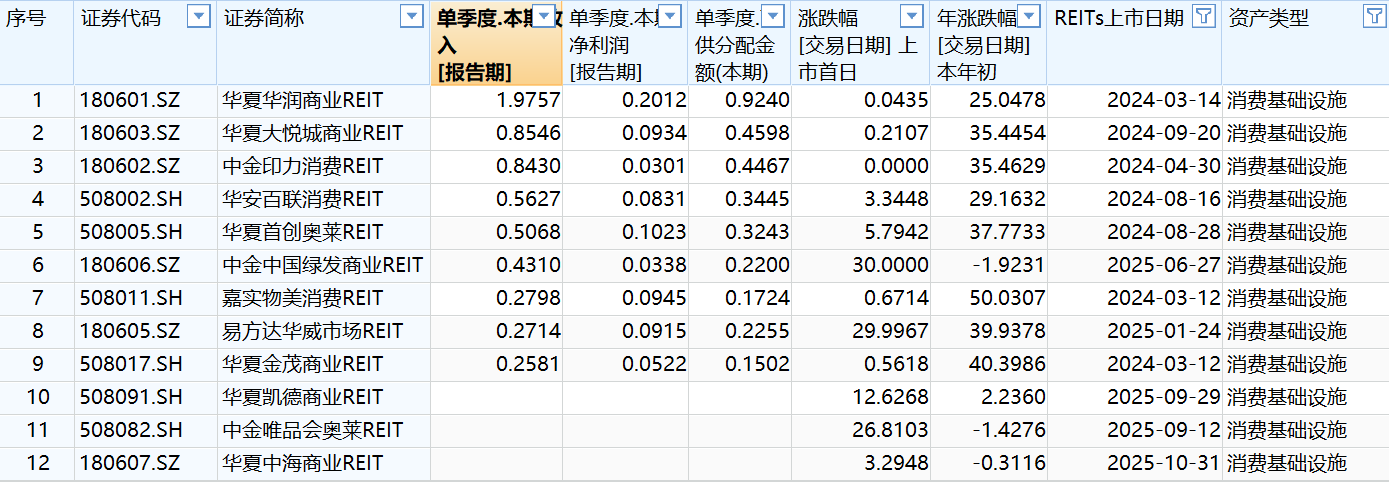
消费旺季助推市场升温,消费REITs年内平均涨幅达24%
Di Yi Cai Jing· 2025-11-09 07:10
Core Insights - The consumer market's heat has significantly boosted the REITs market, particularly in consumer infrastructure REITs, driven by the consumption peak during events like "Double Eleven" [1][2] - The overall public REITs market has shown strong performance this year, with consumer infrastructure REITs leading in growth due to consumption subsidy policies and improved market expectations [2][3] Group 1: Market Performance - As of November 9, the average increase for 12 listed consumer REITs this year is 24%, with notable performers like the Jiashi Wumei Consumer REIT exceeding 50% growth and Huaxia Jinmao Commercial REIT over 40% [3] - The total market capitalization of the 12 consumer REITs has surpassed 42 billion [3] Group 2: Investment Trends - The recent surge in consumer REITs has led to high subscription rates, with the Huaxia Zhonghai Commercial REIT receiving nearly 160 billion in subscriptions before its listing [5] - The demand reflects market recognition of quality commercial assets and the scarcity of foreign brands in the public REITs sector [5] Group 3: Performance Disparities - In Q3, consumer REITs collectively reported revenues of 598 million and net profits of 20.11 million, with Huaxia Huarun Commercial REIT leading in revenue [7] - There is a notable performance disparity among different REITs, with some achieving significantly higher revenues than others [7] Group 4: Future Outlook - The operational capabilities of shopping centers, including renovation and innovation, remain core competitive advantages for consumer REITs [8] - The macroeconomic environment and interest rates will continue to influence REIT pricing and investor returns [9]
2026年度REITs投资策略:REITs资产债性凸显,关注多元化趋势下板块分化机会
KAIYUAN SECURITIES· 2025-11-03 11:07
Core Insights - In the first half of 2025, the performance of the REITs sector significantly outperformed both stocks and bonds, with the CSI REITs total return increasing by 13.41%, compared to a 3.03% rise in the CSI 300 index and a 0.66% increase in the S&P China Bond Index. The strong performance was driven by policy support, interest rate environment, and capital allocation, with the consumption and rental housing sectors becoming market leaders, while industrial parks and environmental protection sectors showed increased differentiation [5][17][18] - Since the third quarter of 2025, the total return of CSI REITs has declined by 4.84%, while the CSI 300 index rose by 20.6%. The bond-like characteristics of REITs have become more pronounced, showing a strong positive correlation with the Shanghai Composite Index and the ten-year government bond yield [5][17][18] REITs Sector Differentiation - The differentiation within the REITs sector has become more evident in 2025. Consumer REITs, rental housing REITs, and logistics REITs have shown relatively high returns, particularly with gains exceeding 20% in the first half of the year. In contrast, environmental, highway, industrial park, and energy REITs have attracted less market attention, exhibiting lower volatility and limited elasticity [6][42][44] Future Development Trends - The National Development and Reform Commission has expanded the asset categories for REITs, including elderly care facilities, energy storage projects, and clean low-carbon initiatives. This expansion aims to accelerate the regular issuance of mature asset types and explore new asset types for issuance, enhancing the overall market landscape [7][54][57] - As of October 29, 2025, the public REITs market has issued a total of 77 funds, with a cumulative scale of 199.3 billion yuan, reflecting a 22.2% growth compared to the end of 2024 and over five times the scale at the end of 2021. The annual compound growth rate of the public REITs scale from Q3 2021 to Q3 2025 is 58.2%, indicating a sustained trend of expansion [58][60] Investment Recommendations - The investment strategy for 2025 focuses on two main lines: prioritizing the allocation of anti-cyclical consumer and rental housing REITs, and exploring new business opportunities under the diversified backdrop. The report suggests that REITs with stable cash flows and strong expansion capabilities should be favored, while being cautious of the impact of rising long-term interest rates and increased supply on market sentiment [8][66][67][68]
中金 • REITs | 春华秋实,消费REITs投资知多少
中金点睛· 2025-10-30 23:32
Core Viewpoint - The article discusses the development and valuation characteristics of consumer REITs in China, highlighting the supportive policies and the current market landscape for investment decisions [2][3]. Group 1: Consumer Infrastructure Definition - Consumer infrastructure encompasses a variety of retail formats, including shopping malls, commercial streets, farmers' markets, and community commerce, expanding beyond traditional retail properties [5]. - As of October 24, 2025, there are 11 consumer REITs in China with a total market value of 39.5 billion yuan, accounting for 18% of the C-REITs market [2][7]. Group 2: Fundamental Analysis of Consumer REITs - **Macroeconomic Factors**: The consumer subsidy policies are nearing their end, and the marginal effect on consumption may decrease. Continuous attention to policy direction and implementation is recommended [3][14]. - **Market Conditions**: Retail supply is declining, with future supply likely shifting towards non-core areas and lower-tier cities. Demand is slowly recovering, with a notable performance difference between first and second-tier cities [3][20]. - **Financial Performance**: Consumer REITs derive approximately 65%-80% of their income from rent, with an average EBITDA margin of 61% as of Q3 2025, indicating stable financial performance [3][38]. Group 3: Valuation Metrics for Consumer REITs - The distribution rates for listed consumer REITs range from 3.5% to 4.9%, with implied capitalization rates between 3.4% and 5.2%, reflecting a premium over the primary market [4][10]. - The valuation characteristics are influenced by liquidity premiums, asset scarcity, and investor structure, with expectations for price stabilization as more assets are listed [4][10]. Group 4: Market Supply and Demand Dynamics - **Supply Side**: The retail property supply is gradually retreating, with a projected decrease in new supply from 8 million square meters in 2025 to 6 million square meters in 2026 [20]. - **Demand Side**: Retail demand is recovering slowly, with significant performance disparities between first and second-tier cities. For instance, Fuzhou shows a 6.5% year-on-year growth, while Beijing is at -5.1% [24][25]. Group 5: Financial Structure of Consumer REITs - The income structure of consumer REITs is primarily rental-based, with management fees and other operational costs being complex. The average management fee is estimated to account for 16% of total revenue [38][43]. - The operational costs are divided into fixed management fees and variable management fees, with the latter being performance-based [42][43].

“十五五”规划引领转型 中国房地产市场迎格局重塑
Sou Hu Cai Jing· 2025-10-30 08:40
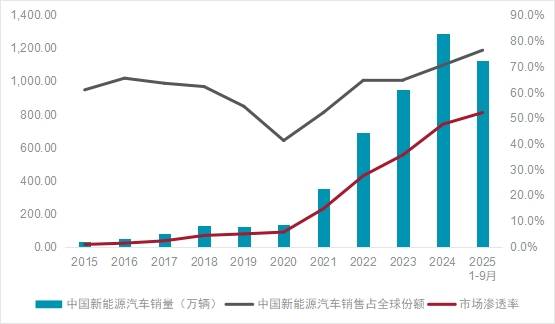
Core Insights - The "15th Five-Year Plan" (2026-2030) aims to reshape China's commercial real estate market through five core themes, addressing challenges such as high-quality development and global geopolitical shifts [1] - The plan emphasizes the construction of a modern industrial system, focusing on traditional industry optimization, emerging industry growth, and future industry layout [2] - The real estate sector is transitioning from a national economic pillar to a core of livelihood security, with a shift from "having a house" to "living well" [8] Group 1: Economic and Industrial Development - The "15th Five-Year Plan" prioritizes modern industrial system construction, which includes the growth of strategic emerging industries like new energy vehicles and biomedicine, with the latter expected to see significant growth in authorized transactions [2] - China's production of new energy vehicles is projected to reach 12.8 million units in 2024, with a compound annual growth rate of 72% [2] - The number of industrial robots installed in China has surpassed that of all other regions combined, with 276,300 units installed in 2023, making China the global leader [2] Group 2: Consumer and Retail Market Dynamics - The plan promotes a consumption-driven economy, shifting focus from material investment to human capital and social welfare, with policies aimed at stimulating consumer potential [4] - Consumer-focused REITs have gained traction, with existing products showing significant growth, indicating a robust market for retail properties [4] - The market is expected to see continued expansion of consumer REITs, driving retail properties to innovate and enhance consumer engagement [4] Group 3: Global Investment and Asset Appeal - China's commitment to high-level openness is enhancing the attractiveness of its assets, particularly in the context of global protectionism [5] - Panda bonds have seen cumulative issuance exceeding 1 trillion yuan, highlighting their appeal in the international market [5] - The expectation of increased foreign capital inflow into China's commercial real estate market is anticipated, particularly for quality assets like retail properties and logistics [5] Group 4: Real Estate Market Transformation - The real estate market is moving towards high-quality development, with a focus on improving living conditions and increasing the supply of affordable housing [8] - The proportion of real estate investment in GDP has decreased from nearly 15% in 2014 to 7.4% in 2024, indicating a reduced reliance on the sector [8] - The "15th Five-Year Plan" emphasizes green transformation, aiming for significant growth in the green industry and the establishment of zero-carbon parks [8] Group 5: Future Outlook for Commercial Real Estate - The upcoming five years are seen as a golden window for commercial real estate, driven by industrial expansion, consumer demand, and international capital interest [10] - The transition towards a demand-driven economy and the emphasis on sustainability are expected to reshape the value standards in commercial real estate [10] - The sector is poised for a new cycle of restructuring and potential release, guided by policy support and market dynamics [10]
公募REITs系列之四:消费REITs如何定价?
HUAXI Securities· 2025-10-29 11:14
1. Report Industry Investment Rating No relevant content provided. 2. Core Viewpoints of the Report - Despite a significant correction in the secondary market for REITs since July 2025, the primary - market subscription enthusiasm remains high. The pricing of newly issued REITs is becoming more challenging due to the widening of the inquiry price range. The report focuses on consumer REITs, using recent issues like CapitaLand Commercial REIT and China Overseas Commercial REIT as samples to build and predict pricing models [1][9]. - The key to pricing is to obtain a reasonable and accurate distributable cash - flow. Income - based valuation is the starting point, and the distributable amount is calculated by converting the operating net income (NOI) [13][16]. - When calculating the operating net income NOI, attention should be paid to the rationality of volume and price assumptions, including various income sources and cost items [21]. - The actual pricing needs to consider the trading sentiment in the primary and secondary markets. Based on the listing performance of similar REITs and industry valuations, the price range of individual bonds can be estimated [44]. - Continuous tracking of project operations is necessary to ensure pricing rationality and to note potential future growth [4]. 3. Summaries According to Relevant Catalogs 3.1 Pricing Key: Obtain Reasonable and Accurate Distributable Cash - flow - **Income - based valuation is the starting point**: China requires income - based valuation as the main method for infrastructure public REITs. The operating net income NOI obtained from this valuation is a key data for REITs pricing. The discount rate is usually calculated by the cumulative method, and the income period is determined by the shorter of the land use right and the remaining economic useful life [13]. - **Convert operating net income to distributable amount by proportion**: Refer to the distributable conversion rate in the "Distributable Amount Calculation Report" to convert the operating net income of subsequent years into the current distributable amount, and consider the situation of external borrowing for pricing [16][17]. 3.2 Operating Net Income NOI: Focus on the Rationality of Volume and Price Assumptions - **Rental income: The largest income source of consumer REITs**: Rental income accounts for about 60 - 70% of the total income. It is divided into fixed rental income and commission rental income for separate assumptions. Factors such as fixed rental unit price, rental growth rate, occupancy rate, rent - free period, and collection rate need to be considered [21][22]. - **Property management income: Accounting for about 15 - 20% of consumer REITs income**: Consumer REITs charge property management fees based on the leased area. The property management fee standard for specialty stores is generally between 50 - 90 yuan/square meter/month, and the growth rate of property management income during the forecast period is usually between 2 - 4% [32]. - **Other income: A beneficial supplement to project profitability**: Other income includes promotion fees, multi - business and advertising income, etc. It generally follows the growth rate assumption of fixed rental income [35]. - **Cost side of NOI: Mainly following income assumptions**: The cost side mainly includes operating costs, taxes and surcharges, and capital expenditures. The repayment of external loans will occupy the distributable amount [37][42]. 3.3 Combine Market Sentiment to Estimate the Price Range of Individual Bonds - **Actual pricing needs to consider the trading sentiment in the primary and secondary markets**: The stronger the new - issue sentiment in the primary market, the higher the first - day listing increase of REITs. The weaker the trading sentiment in the secondary market, the smaller the upward space for new bonds [44]. - **Estimate the price of individual bonds based on the listing performance of similar REITs and industry valuations**: By comparing the subscription multiples, the ratio of the issue price to the upper limit of the inquiry price range, and the first - day increase of similar listed REITs, the first - day increase of new bonds can be estimated. For example, the first - day increase of China Overseas Commercial REIT is estimated to be about 13 - 27%, corresponding to a closing price of 5.968 - 6.707 yuan/share on the first - day of listing. After the new - issue effect fades, the average pricing center of China Overseas Commercial REIT is 5.43 yuan/share [52][56]. 3.4 Continuously Track Project Operations and Note Future Growth Potential - **China Overseas Commercial REIT**: Pay attention to the stability of new - energy vehicle tenants [4]. - **CapitaLand Commercial REIT**: Note the adjustment of the main store area in projects in Changsha and Guangzhou [4].
消费REITs半年业绩出炉 谁是“实力C位”
3 6 Ke· 2025-09-19 03:09
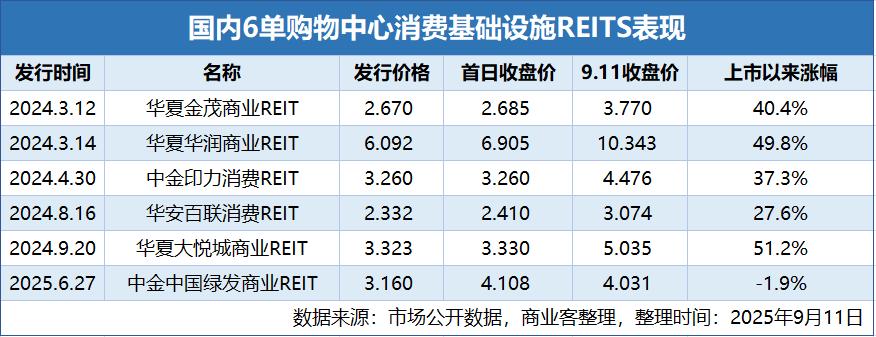
Core Viewpoint - The increasing focus on consumer REITs in the market, with 12 consumer REITs listed or preparing for listing since March 2024, indicates a growing interest and demand for these investment vehicles [1][3]. Group 1: Market Performance - The recent issuance of the Huaxia Kaide Commercial REIT saw an oversubscription of 252.6 times in the offline market, with public shares selling out quickly, achieving an effective subscription multiple of 535.2 times and total subscription funds of 309.17 billion yuan, which is 135.2 times the intended fundraising scale [1]. - The six consumer REITs currently in the market have shown a general upward trend in their secondary market prices, with the Huaxia Dayuecheng Commercial REIT experiencing the highest increase of over 50% [3][4]. Group 2: Asset Composition and Rental Rates - The underlying assets of the 12 consumer REITs include shopping centers, outlet malls, farmers' markets, and community commerce, with shopping centers being the dominant asset type, accounting for 7 out of the 12 products and a total estimated value of approximately 22.8 billion yuan [1]. - The occupancy rates of the five consumer REITs with disclosed data are all above 95%, with the highest rates being 99.03% for both Qingdao MixC and Changsha Lanshow City [5][6]. Group 3: Rental Price Changes - Rental prices for the underlying assets of the five consumer REITs have generally increased, except for a slight decline of 0.86% in the Chengdu Dayuecheng's rental price. The highest rental price is recorded at 419.71 yuan per square meter per month for Qingdao MixC, reflecting a 5.53% increase from the previous period [6][8]. - The rental contribution from the top five tenants significantly impacts the overall rental income stability, with the Huaxia Dayuecheng Commercial REIT showing a notable increase in the proportion of income from its top tenant [9][10]. Group 4: Operational Strategies - The consumer REITs have focused on brand diversification and marketing strategies to enhance customer traffic and sales conversion, with notable initiatives such as introducing new brands and hosting themed events [11][12]. - The Qingdao MixC reported a 12.9% year-on-year increase in foot traffic, while the Hangzhou Xixi Impression City achieved a sales growth of 17.78% [13]. Group 5: Financial Metrics - The expected annual cash distribution rates for the five consumer REITs range between 3% and 5%, with the Huaxia Baolian Consumer REIT having the highest rate at 4.28% [14][15]. - The financial performance of the five consumer REITs includes total revenues and distributable amounts, with Huaxia Huayun Commercial REIT reporting an operating income of 3.63 billion yuan and a distributable amount of 1.79 billion yuan [15].
消费REITs2025年中报综述:稳健运营,扩容在即
HTSC· 2025-09-10 09:48
Investment Rating - The report maintains an "Overweight" rating for the consumption REITs sector, indicating a positive outlook for investment opportunities in this area [7]. Core Insights - The consumption REITs have shown resilient operations in 2025, outperforming the broader market, with stable revenue and distribution targets being met as expected [1][3]. - The report highlights that consumption REITs are likely to benefit first from improvements in the macroeconomic environment, particularly in the context of property REITs [1]. - The overall retail market in China has experienced steady recovery, with a year-on-year growth of 5.0% in the first half of 2025, driven by both policy support and internal recovery [2][11]. - The supply of commercial real estate is under pressure but has shown signs of easing, with a 29% year-on-year decrease in the number of new openings for centralized commercial spaces [2][19]. - The average occupancy rate for consumption REITs remains high, exceeding 95%, with some leading projects achieving over 98% [3][25]. Summary by Sections Industry Overview - The retail market has seen a steady recovery, with a 5.0% year-on-year increase in social retail sales in H1 2025, up 1.3 percentage points from the previous year [2][11]. - The gap between offline and online retail growth rates is narrowing, indicating a reduced diversion of customers from physical stores to online platforms [2][11]. Operational Performance - Consumption REITs have demonstrated operational resilience, with an average revenue growth of 0.4% year-on-year in H1 2025 [3][27]. - The average occupancy rate for consumption REITs is reported at 97.13%, with most projects maintaining high occupancy levels [60][66]. - The EBITDA for consumption REITs has seen a slight year-on-year decline, but most are expected to meet their 2025 targets [74][81]. Market Performance - The average distributable amount for consumption REITs has increased by 3.5% year-on-year, indicating strong dividend intentions [4]. - Consumption REITs have significantly outperformed the REITs index this year, with dividend yields ranging from 3.5% to 6.3% [4][5]. Outlook - The consumption REITs sector is expected to continue expanding, with new projects entering the market and existing REITs planning to inject additional assets [5]. - The report notes a positive sentiment in the secondary market, with a valuation reassessment benefiting the primary market as well [5].