
玄武岩纤维

Search documents
政企携手 共建玄武岩产业创新研究院
Sou Hu Cai Jing· 2026-02-13 10:16
Core Viewpoint - The signing of the agreement between Hami City and Hangzhou Baishun Green Carbon Energy Management Partnership marks a significant step in establishing the Hami Basalt Industry Innovation Research Institute, aligning with national strategies for new materials and the Belt and Road Initiative [1] Group 1: Strategic Importance - The collaboration is a response to the requirements for building a "new materials industry cluster" in the autonomous region, leveraging Hami's rich basalt mineral resources alongside the capital and technological advantages of enterprises and research resources from the Yangtze River Delta [1] - The initiative aims to transform resource advantages into industrial advantages, addressing the development shortfalls in the high-end basalt fiber industry in Northwest China [1] Group 2: Research Institute Role - The establishment of the research institute is a critical component of the full industrial chain layout for Hami's basalt industry, serving as an important support for basalt industry projects and a core mechanism for promoting industrial upgrades through government-enterprise collaboration [1] - The research institute will facilitate the high-value utilization of Hami's basalt resources and ensure technological autonomy, while also creating a cross-regional innovation mechanism for "Xinjiang R&D - Yangtze River Delta transformation" [1] Group 3: Economic Transformation - The project will assist Hami in transitioning from "resource output" to "high value-added processing," propelling Xinjiang from a "resource-rich region" to an "industrial hub" and establishing a new materials industry support point in the core area of the Silk Road Economic Belt [1]
“12岁”的秦巴地区商品交易会迎来首个“主宾国” 秦巴好物携手闯世界
Si Chuan Ri Bao· 2025-12-29 07:04
Core Insights - The 12th Sichuan Dazhou Qinba Region Commodity Fair was held from December 18 to 21, showcasing over 316 enterprises and attracting significant participation from various provinces [6][10] - The fair achieved a total transaction amount of over 5 million yuan in the offline exhibition area, with 18 local enterprises reaching procurement agreements worth 21.1 million yuan [6][10] - Thailand was invited as the first guest country, featuring 9 Thai enterprises and becoming one of the most popular exhibition areas [11] Group 1: Event Overview - The fair was themed "Meeting in Qinba, Going Global" and was co-hosted by Dazhou and 20 cities from five provinces [6][10] - The event included a variety of products, such as agricultural specialties, traditional Chinese medicine, and industrial products, with a focus on enhancing Dazhou's external image [7][8] Group 2: Economic Impact - The offline exhibition area generated a transaction amount of over 5 million yuan, with international cooperation areas achieving nearly 500,000 yuan in transactions and 3.8 million yuan in intended orders [6][10] - The fair facilitated significant economic interactions, including a cooperation agreement between Dazhou's agricultural company and a Hebei enterprise, enhancing market coverage and brand influence [10] Group 3: Cultural Promotion - The fair featured a cultural tourism promotion event for the Ba Mountain Grand Canyon, aiming to create a national 5A scenic area and promote local cultural heritage [8] - Dazhou's cultural tourism bureau introduced themed travel routes, offering diverse options for visitors to explore local attractions [8] Group 4: International Collaboration - The establishment of an international cooperation exhibition area aimed to connect the Qinba region with global markets, featuring products from countries along the Belt and Road Initiative [11] - Over 70 Dazhou suppliers and 30 domestic and international buyers participated in face-to-face negotiations, resulting in intended procurement agreements worth 21.1 million yuan [11]

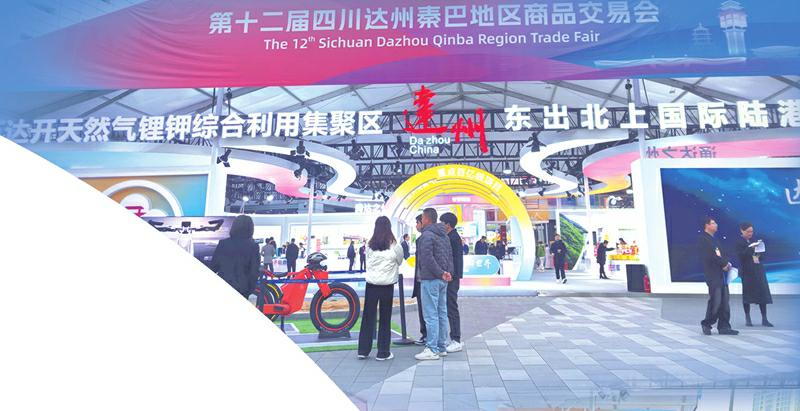
秦巴好物携手闯世界
Xin Lang Cai Jing· 2025-12-28 20:28
Core Insights - The 12th Sichuan Dazhou Qinba Region Trade Fair was held from December 18 to 21, showcasing over 1,000 products from 316 companies, with a total transaction amount exceeding 5 million yuan in the offline exhibition area [3][4] - The fair featured Thailand as the first guest country, attracting 8 foreign buyers and generating significant interest in Thai health and wellness products [8] Group 1: Trade Fair Overview - The trade fair was co-hosted by Dazhou and five provinces, including Sichuan, Chongqing, Hubei, Shaanxi, and Zhejiang, highlighting regional collaboration [6] - The event achieved a total intended procurement agreement amount of 21.1 million yuan, with 70 local suppliers and 30 domestic and international buyers participating in face-to-face negotiations [8] Group 2: Product Highlights - The exhibition included over 20 categories of products, such as agricultural specialties, traditional Chinese medicine, and agricultural machinery, with a focus on showcasing Dazhou's image [4] - Notable agricultural products included over 100 local specialties, such as Xuanhan peach blossom rice and Daxian rice noodles, which have high market demand [4] Group 3: Cultural and Tourism Promotion - The fair emphasized cultural tourism, promoting the Ba Mountain Grand Canyon as a potential national 5A scenic area, and introduced themed travel routes to explore Ba culture [5] - The event featured a cultural promotion session that highlighted the origins and values of Ba culture, aiming to attract more tourists [5] Group 4: International Cooperation - The establishment of an international cooperation exhibition area aimed to connect the Qinba region with global markets, featuring products from countries involved in the Belt and Road Initiative [8] - The fair's international focus was underscored by the participation of Thai companies, which brought various health and wellness products, enhancing the fair's global appeal [8]
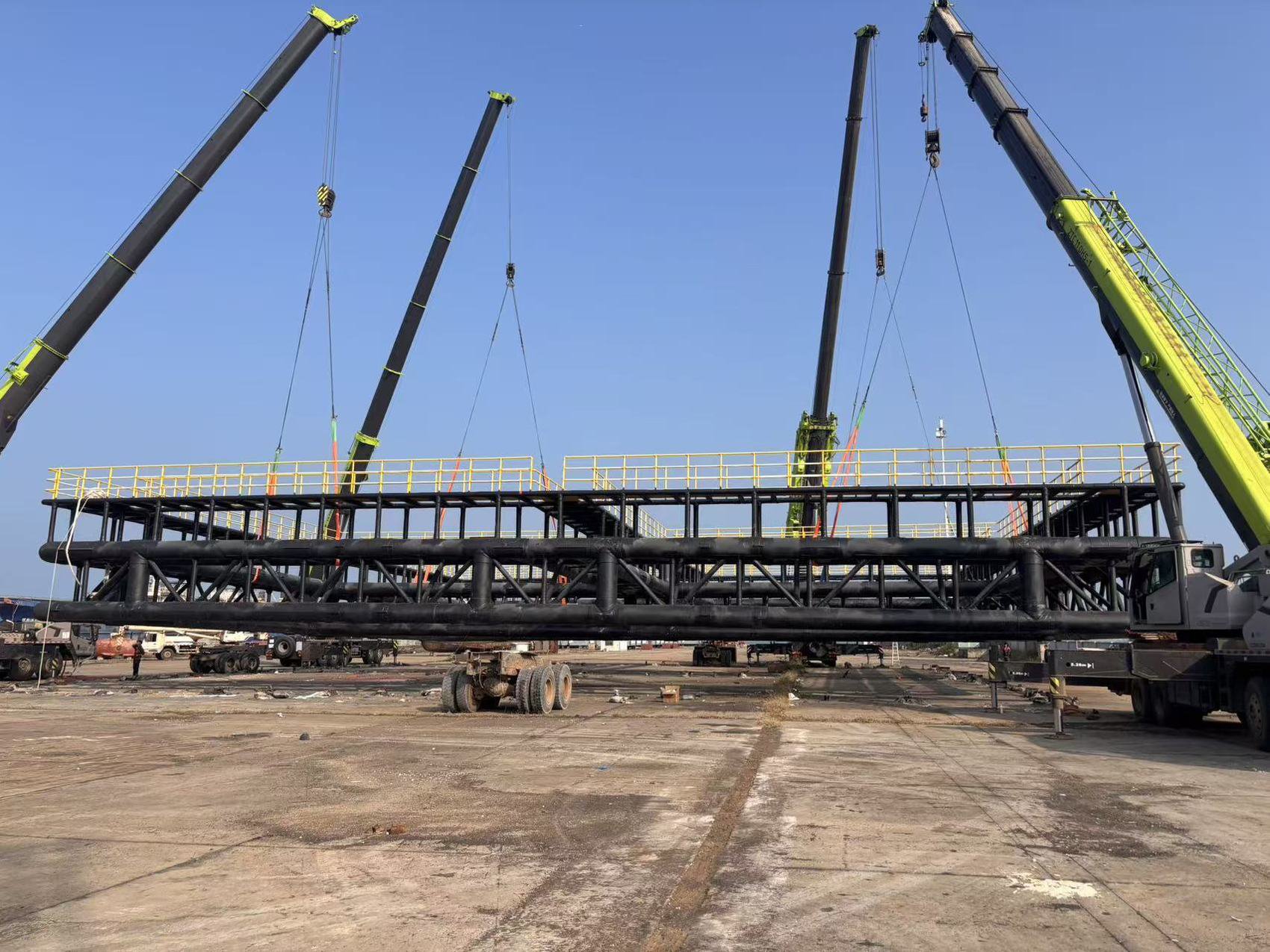
“华蓥造”全球首个大型玄武钢材料深海养殖浮体平台成功下水
Xin Lang Cai Jing· 2025-12-28 10:11
Core Viewpoint - The successful launch of the basalt fiber composite deep-sea aquaculture floating platform in Hainan marks a significant advancement in marine engineering, utilizing basalt fiber as a primary structural material for the first time globally [3]. Group 1: Product and Technology - The floating platform weighs approximately 50 tons, which is only one-third of the weight of traditional steel structures, and features a modular design that allows for prefabrication and assembly [3]. - The platform is designed to operate under extreme conditions, capable of withstanding super typhoon conditions (up to level 17) with a design lifespan exceeding 30 years and minimal maintenance required [3]. - The total volume of the floating platform for aquaculture exceeds 10,000 cubic meters, with an expected annual production of around 150 tons of aquatic products and the capacity to cultivate approximately 80 million high-quality seawater fish fry annually [3]. Group 2: Industry Context and Challenges - Current deep-sea aquaculture facilities predominantly use metal materials, which face severe corrosion issues due to prolonged exposure to high-salinity and high-humidity marine environments, leading to high operational and maintenance costs [4]. - The introduction of basalt fiber, a high-performance green material with excellent corrosion resistance, high strength, and durability, aims to address these challenges and reduce maintenance costs significantly [4]. - The company has developed over 40 related patents and continues to expand the application of basalt fiber composites in marine aquaculture, island bridges, and underwater infrastructure, aiming to establish a design and manufacturing capacity for high-end marine equipment in the future [4].
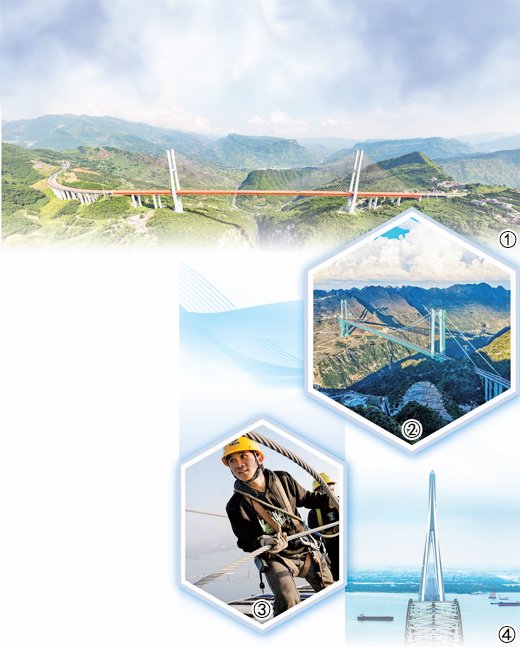
穿山越江又跨海!中国桥“上新”了哪些黑科技→
Xin Lang Cai Jing· 2025-12-20 00:32
Core Viewpoint - China's bridge construction technology has achieved world-leading standards, with recent projects continuously setting new records in terms of scale and innovation [3][5]. Group 1: Structural Innovation - The Hubei Yanjing Yangtze River Bridge employs a unique "four main cable system" to address challenges related to large spans and aviation height restrictions, showcasing advancements in bridge design [5]. - New breakthroughs in bridge structures focus on enhancing span, adapting to complex environments, and optimizing performance, with innovations in beam and arch bridge designs [5][6]. - The Jiangsu Changtai Yangtze River Bridge, set to open in September 2025, features a hybrid "steel-concrete" structure that sets a new world record for cable-stayed bridge spans [6]. Group 2: Material Innovation - Innovations in materials include lightweight saddle designs that improve performance by over 30%, high-strength cables that are corrosion-resistant, and green concrete that reduces costs by approximately 30 yuan per cubic meter [7]. - The use of high-performance composite materials and environmentally friendly materials is becoming essential to meet the demands of large-span and long-lifespan bridges [7][8]. - The Guizhou Huajiang Gorge Bridge incorporates advanced materials to enhance safety and durability, including basalt fiber for fire resistance [8]. Group 3: Equipment Innovation - The construction of modern bridges is increasingly reliant on advanced equipment, which drives industrialization, intelligence, and green transformation in bridge building [9][10]. - Innovations in construction equipment, such as integrated intelligent tower machines and modular bridge assembly systems, have significantly improved construction efficiency [10][11]. - Future trends in bridge equipment include the development of next-generation super equipment for extreme environments, deeper integration of AI and IoT technologies, and modular design for rapid assembly [11].
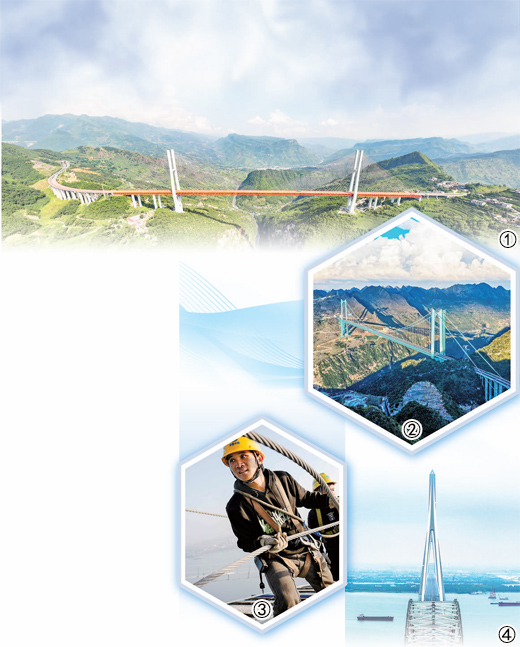
穿山越江又跨海,大桥“上新”黑科技(瞰前沿)
Ren Min Ri Bao· 2025-12-19 22:10
Core Viewpoint - China's bridge construction capabilities are rapidly advancing, with recent projects setting world records and showcasing innovative technologies that enhance structural performance and efficiency [2]. Group 1: Structural Innovation - The Hubei Yanjing Yangtze River Bridge employs a unique "different sag four main cable system" to address challenges related to large spans and aviation height restrictions, demonstrating significant structural innovation [4]. - New breakthroughs in bridge structures focus on enhancing span, adapting to complex environments, and optimizing load performance, with advancements in beam and arch bridge designs [4]. - The Jiangsu Changtai Yangtze River Bridge, set to open in September 2025, features a hybrid "steel-concrete" structure that sets a new world record for cable-stayed bridge spans [5]. Group 2: Material Innovation - Innovations in materials include lightweight saddle designs that improve performance by over 30%, high-strength cables that are corrosion-resistant, and green concrete that reduces costs by approximately 30 yuan per cubic meter [6]. - The use of high-performance composite materials and environmentally friendly materials is becoming essential for meeting the mechanical and durability requirements of large-span bridges [6]. - The Guizhou Huajiang Gorge Bridge incorporates advanced materials to achieve both lightweight and high strength, significantly enhancing its structural capabilities [6][7]. Group 3: Equipment Innovation - Modern bridge construction is increasingly reliant on advanced equipment, with innovations leading to industrialization, automation, and environmentally friendly practices [9]. - The use of integrated intelligent construction machines has doubled construction efficiency, while modular designs allow for rapid assembly and adaptability to various construction scenarios [10]. - Future trends in bridge equipment include the development of next-generation super equipment capable of withstanding extreme environmental conditions and the integration of AI and IoT technologies for automated control and real-time monitoring [10].
从“一黑一白”到“步步皆景”,华蓥采煤沉陷区实现破茧重生 “煤城”变“绿城” 激活新动能
Si Chuan Ri Bao· 2025-11-04 03:22
Core Viewpoint - The transformation of Huaying City from an industrial base reliant on coal and cement to a modern ecological and tourism-oriented economy showcases successful ecological restoration and industrial diversification efforts since 2018 [5][6]. Ecological Restoration and Tourism Development - Huaying City has implemented comprehensive ecological projects, including the restoration of mining scars and integrated management of natural resources, resulting in the addition of 100,000 acres of forest land and a forest coverage rate of 53.18% [4][6]. - The city has developed a 71,000-acre oil camellia base, generating an annual output value of 1,300 yuan per acre, and has established a provincial-level modern forestry park [4][5]. - The transformation of former coal mine sites into tourism landmarks, such as the "Hey Mine Panda" guesthouse, illustrates the integration of industrial heritage with tourism [5][6]. Industrial Transformation and Economic Growth - Huaying City has shifted its industrial focus by closing 63 outdated coal mines and small steel plants, promoting green and circular economy practices [8][9]. - The city has identified electronic information and basalt fiber as its two main industries, implementing supportive policies to foster high-quality industrial development [8][9]. - In 2024, 26 electronic information enterprises in Huaying are projected to achieve an output value of 2.205 billion yuan, accounting for 18.3% of the city's total industrial output [8][9].

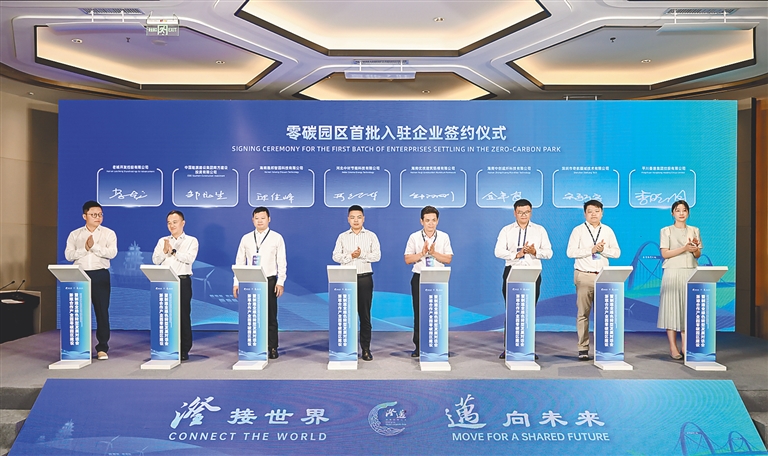
浙琼合作产业园零碳园区揭牌
Hai Nan Ri Bao· 2025-10-19 01:37
Core Insights - The Zhejiang-Hainan Cooperation Industrial Park Zero Carbon Park was officially inaugurated on October 18, 2023, during the 2025 China·Chengmai International Economic and Trade Fair [3] - The park is located in Hainan's Old Town Science and Technology New City, covering an area of approximately 2,613 acres, and aims to establish a green energy system integrating various clean energy sources [3][4] - The park is expected to produce 640 million kilowatt-hours of green electricity annually, with a clean energy consumption ratio of 96.2%, significantly exceeding national standards for zero carbon parks [3][4] Project Overview - The park has planned to introduce 20 key projects with a total investment of approximately 15.113 billion yuan, of which 6 projects have already signed agreements [4] - The core energy project, biomass cogeneration, is expected to commence construction by the end of 2025 and be operational by 2027 [4] - The park has reserved 500 acres for future industries, including energy storage devices, carbon management platforms, and marine renewable energy equipment [4] Industry Focus - The park will focus on three major green industry sectors: new energy, new materials, and high-end equipment manufacturing [4] - The new energy sector will concentrate on biomass power generation, green batteries, and distributed photovoltaics, aiming to create a complete green energy supply chain [4] - The new materials sector will develop low-carbon materials such as basalt fiber and green building materials, while the high-end equipment manufacturing sector will focus on electric vehicles and precision manufacturing [4][5] Technological Development - The park will increase investment in green low-carbon technology research and application, accelerating key technology breakthroughs and results transformation [5] - Digital empowerment through big data, IoT, and AI will enhance energy scheduling and efficiency within the park [5] - The goal is to establish Chengmai as a leading area for new productivity cultivation in Hainan, creating a zero-carbon "Hainan model" [5]
特种电子布跟踪系列:一线新反馈
2025-08-25 09:13
Summary of Conference Call Records Company and Industry Overview - **Company**: 中材科技 (China National Materials Group Corporation) - **Industry**: Specialty Electronic Fabrics and Glass Fiber Industry Key Points and Arguments Financial Performance - 中材科技 reported a revenue of 13.3 billion yuan for the first half of 2025, representing a year-on-year growth of 26.5% [5] - The net profit attributable to shareholders was 1 billion yuan, up 115% year-on-year, driven by strong performance in fiberglass and blade businesses, as well as rapid growth in specialty electronic fabrics and electronic yarns [5][6] Market Demand and Trends - The demand for CTE (Coefficient of Thermal Expansion) products has significantly increased since Q2, with expectations for demand to double in Q4 and potentially continue to double in 2026 [13][14] - The low dielectric electronic yarn (DJ) market is experiencing strong demand and rising prices, particularly for first-generation fabric products [28] - The wind power industry remains robust, with high demand for high-strength and high-modulus glass yarns, driven by applications in electric vehicles and unmanned aerial vehicles [2][35] Production Capacity and Expansion Plans - 中材科技 plans to expand its production capacity from 300 weaving machines to 400-500 by the end of the year and to 800 by mid-2026, aiming to meet the growing market demand [16] - The company has completed small sample tests for 2.8 mm CTE products, with plans for larger-scale testing in the coming months [14] Export and Market Challenges - The export volume of fiberglass has significantly declined, with a 15% drop in July compared to previous months, although the exit of overseas production capacity may benefit domestic companies [23] - The company anticipates that European tax policies may impact exports in the second half of the year, but the overall effect is expected to be minimal [6] Future Outlook - 中材科技 expects to maintain revenue and profit growth, with projected fiberglass sales of approximately 1.3 million tons for the year [6] - The company is optimistic about the market demand driven by domestic computing power improvements and is actively adjusting supply to meet this growth trend [18] Emerging Technologies and Product Development - The industry is seeing a shift towards new products and technologies, particularly in the fields of AI and renewable energy, which are expected to drive future growth [24][36] - New materials such as quartz fiber and basalt fiber are gaining attention, with potential applications in high-end manufacturing and construction [24] Industry Dynamics - The glass fiber industry is experiencing a trend towards larger production scales and increased automation, which is expected to reduce production costs and improve competitiveness [25] - The market is also witnessing a focus on energy efficiency and environmental compliance, particularly in light of stricter carbon emission regulations [26] Additional Important Insights - The specialty electronic fabric industry is seeing strong performance, particularly with the push from domestic computing power, which is expected to further drive demand in the coming months [3] - The company has achieved significant milestones in the CTE and QBU product lines, being the only domestic company capable of mass delivery in the CTE sector [20] - The overall market sentiment is positive, with expectations for continued growth in emerging sectors such as electronics, wind power, and new energy vehicles [36]

际华集团(601718.SH):上半年净亏损7903万元
Ge Long Hui A P P· 2025-08-22 11:12
Core Viewpoint - Jihua Group (601718.SH) reported a significant decline in both revenue and net profit for the first half of the year, primarily due to reduced product orders from key clients, leading to underutilization of capacity and increased fixed costs [1] Financial Performance - The company achieved operating revenue of 3.208 billion yuan, a year-on-year decrease of 38.36% [1] - The net profit attributable to shareholders was -79.03 million yuan, indicating a loss [1] Operational Challenges - The decline in revenue and profit was mainly attributed to a reduction in product orders from key clients, resulting in a substantial drop in operating income [1] - The decrease in order income led to insufficient capacity utilization and high fixed costs, which negatively impacted gross profit [1] Strategic Initiatives - Despite the overall revenue decline, the company is accelerating its layout in strategic emerging industries, focusing on the transformation of new materials such as high-strength nylon, basalt fiber, and waterproof breathable membranes [1] - The company is also developing new products in areas such as individual soldier equipment, camping gear, and firefighting equipment, aiming to promote the transformation and upgrading of traditional industries [1]
