甲醇燃料发动机

Search documents
航运脱碳的双轨突围:内河换电,远洋烧醇
Sou Hu Cai Jing· 2025-12-11 14:54
Core Viewpoint - The global shipping industry is undergoing a significant green energy transformation, with China leading the way in the new energy ship market, which is projected to reach a scale of 367.5 billion yuan by 2026 [6][10]. Group 1: Electric Vessels in Inland Waterways - The world's first 10,000-ton pure electric cargo ship, "Gezhouba," was launched in October 2025, featuring a battery capacity equivalent to 400 electric cars, enabling a range of 500 kilometers [2][5]. - As of the end of 2024, there are 485 pure electric vessels in China, primarily inland passenger ships, with over 1,000 new energy inland vessels in total, leading globally in application scale [2][5]. - The Ministry of Transport has issued guidelines to promote high-quality development in inland shipping, emphasizing the application of battery power, LNG, and methanol technologies [2][5]. Group 2: Methanol as a Sustainable Fuel for Ocean Shipping - In deep-sea shipping, methanol is considered an ideal sustainable fuel due to its ease of refueling and lower environmental impact compared to traditional fuels [3][12]. - The global fleet of methanol-fueled vessels is expanding, with 414 ships confirmed to use methanol, including 93 already in operation [12][13]. - The demand for methanol as a marine fuel is expected to increase significantly, with projections indicating a potential annual demand of 1,050,500 tons, driven by a surge in new orders [14]. Group 3: Challenges and Solutions in Electric Shipping - The transition to electric vessels faces three main challenges: energy supply anxiety, cost anxiety, and safety anxiety, with high initial investment and infrastructure costs being significant barriers [8][9]. - The "battery swap" model is being adopted to enhance operational efficiency, allowing for quick battery replacements that significantly reduce dock time [6][7]. - Government subsidies and local policies are being implemented to support the development of electric vessels and related infrastructure, with substantial financial backing for new energy ship construction [10][18]. Group 4: Industry Transformation and Policy Support - The green transition in shipping is prompting a broader industrial revolution, with a focus on integrating technology and sustainable practices in shipbuilding [15][16]. - China's domestic battery manufacturers, such as CATL, are gaining a significant share of the global market, providing power for approximately 900 vessels [16]. - Policies at both national and local levels are being established to encourage the adoption of new energy vessels, including technical standards and operational incentives [18][19].


全球新造船成交量预计大跌,替代燃料船舶订单仍在增长
第一财经· 2025-12-05 08:10
Core Viewpoint - The global new shipbuilding market is expected to see a significant decline in transaction volume this year, although new ship prices will remain relatively high historically [3]. Group 1: Market Trends - Since 2021, the global new shipbuilding market has experienced five years of continuous growth, leading to a tight shipbuilding capacity situation. Clarkson's statistics indicate that global new ship orders are expected to reach around 120 million deadweight tons, which is still at a historically good level [3]. - The anticipated decline in new ship transaction volume is attributed to idle shipbuilding capacity and global economic uncertainties. However, factors such as the dismantling of old ships, the release of demand for green ship updates, and the short-term inability to significantly expand quality shipbuilding capacity will continue to support new ship prices at relatively high historical levels [3]. Group 2: Green Transition - During the maritime exhibition, several shipbuilding companies showcased their main ship types, including the release of eight self-developed ship types by Guangzhou Shipyard International and the display of a model of a nuclear-powered container ship by Jiangnan Shipyard [5]. - The global cruise market currently holds 72 cruise ship orders, with mainstream shipbuilding companies securing large orders for cruise ships this year. Additionally, alternative fuel vessels are increasingly occupying a larger share of new ship orders, with new orders for alternative fuel vessels expected to grow by 78% in the first half of 2025 compared to the entire year of 2024 [5]. - The shipping industry is in the early stages of a significant transition towards net-zero emissions, with many shipping companies exploring various alternative fuel ship types, such as LNG and methanol-powered vessels, which are rapidly increasing in order volume [5]. Group 3: Digital Empowerment - The trend of digital empowerment in the shipping industry is becoming prominent, with global shipping giants actively promoting the development of digital technologies. For instance, Maersk is exploring autonomous driving technology and improvements in shipping supply chain efficiency [8]. - In China, since the 13th Five-Year Plan, the government has placed significant emphasis on the development of smart shipping, implementing a series of supportive policies. Companies like COSCO Shipping Group and China Merchants Group are actively practicing in the vertical modeling of shipping [8]. - During the maritime exhibition, COSCO Shipping (Hong Kong) Co., Ltd. launched an intelligent management solution for the entire lifecycle of ship services, significantly reducing inventory check times from one month to two hours [8]. Group 4: Challenges in Digitalization - Industry insiders have pointed out that the industrialization of new digital technologies in the shipping industry faces several challenges, including the need for a stronger digital technology standard system and a lack of data sharing and governance mechanisms [9]. - There are suggestions to accelerate the revision of digitalization-related standards in shipping and to establish unified data and standard specifications to promote data interconnectivity among port enterprises, shipping companies, and trade enterprises [9].

每年减碳量超5000吨 长江首艘纯甲醇动力船下水
Chang Jiang Ri Bao· 2025-08-03 00:45
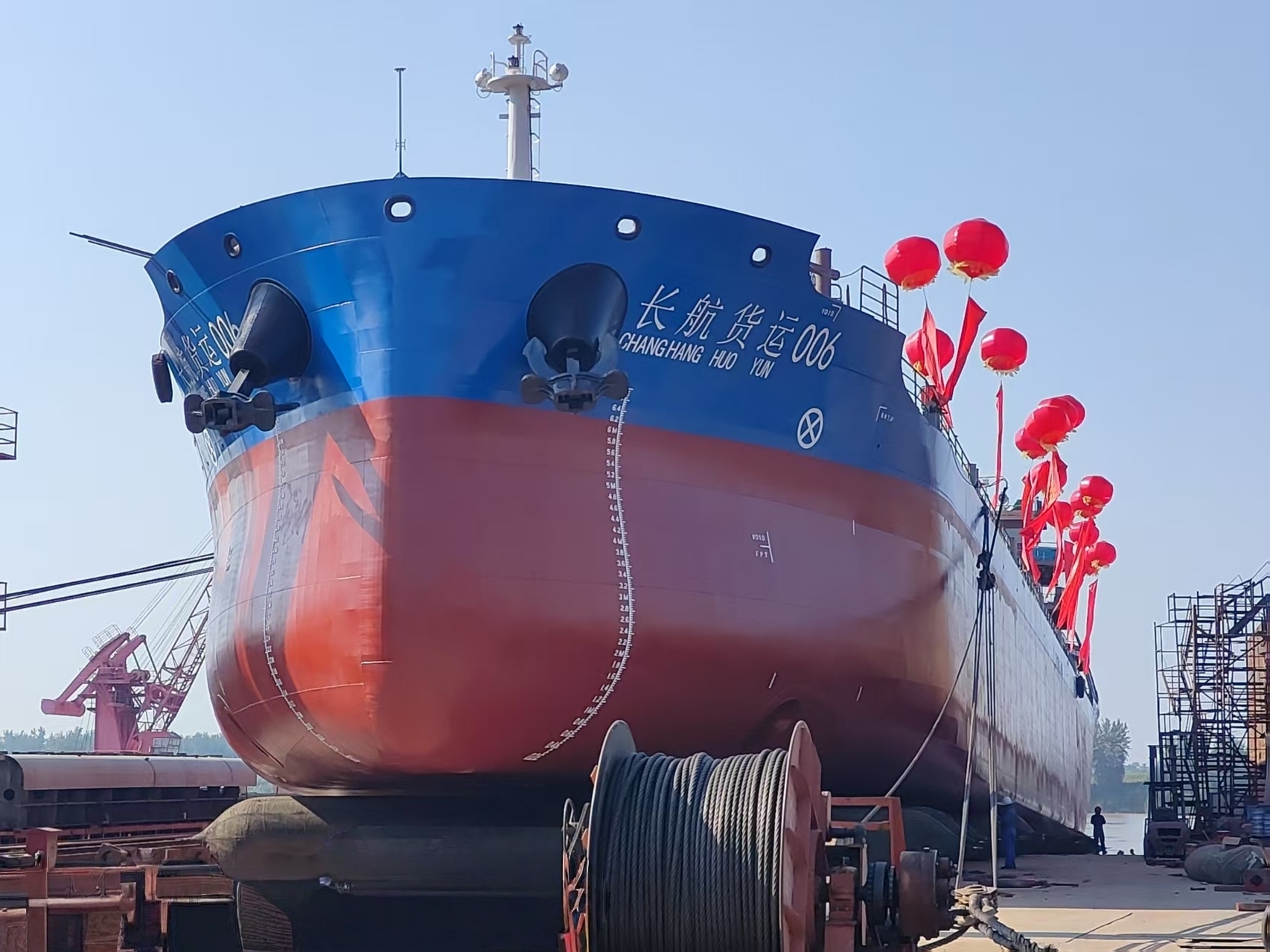
Core Viewpoint - The launch of the "Changhang Huoyun 006," the first pure methanol-powered cargo ship in the Yangtze River Basin, represents a significant advancement in green shipping technology and aims to reduce carbon emissions and fuel costs in the shipping industry [1][2]. Group 1: Ship Specifications and Features - The "Changhang Huoyun 006" is a 130-meter methanol-powered standard dry bulk carrier with a maximum cargo capacity of 9,600 tons and a range of 3,000 kilometers [1]. - It is equipped with a high-power methanol medium-speed engine developed by China Shipbuilding Group, featuring independent intellectual property rights, and can achieve a methanol replacement rate of up to 95% [1]. - The ship is designed with five intelligent functions, including navigation assistance, crew behavior monitoring, main and auxiliary engine health management, online energy consumption monitoring, and onboard data integration [1]. Group 2: Environmental Impact and Cost Efficiency - Utilizing green methanol can lead to a 95% reduction in carbon emissions, with each methanol fuel medium-speed engine capable of reducing over 5,000 tons of carbon annually [1]. - The ship can also reduce nitrogen oxide emissions by 60% and sulfur oxide emissions by up to 99% [1]. - Methanol fuel costs are only 30% to 40% of diesel prices, allowing the ship to save approximately 20% in annual fuel expenses compared to traditional powered vessels [2]. Group 3: Operational Plans - The "Changhang Huoyun 006" is expected to commence operations by the end of September 2023, serving the Shanghai to Chongqing route [3].
每年减碳量超5000吨,长江首艘纯甲醇动力智能船下水
Chang Jiang Ri Bao· 2025-08-01 01:46
Core Viewpoint - The launch of the "Changhang Freight 006" vessel marks a significant advancement in the use of methanol-powered ships in China's inland waterways, promoting green and intelligent shipping solutions [1][3]. Group 1: Vessel Specifications and Features - The "Changhang Freight 006" is the first methanol-powered bulk carrier in the Yangtze River basin, with a maximum cargo capacity of 9,600 tons and a range of 3,000 kilometers [1]. - It is designed as a green intelligent vessel, featuring five smart functions including navigation assistance, crew behavior monitoring, and energy consumption monitoring [2]. - The vessel's dual-fuel engine can automatically switch to pure diesel mode in emergencies, ensuring operational safety [2]. Group 2: Environmental Impact and Cost Efficiency - The methanol dual-fuel engine can achieve a methanol replacement rate of up to 95%, leading to a carbon reduction of over 5,000 tons annually per engine when using green methanol [2]. - The vessel can reduce nitrogen oxide emissions by 60% and sulfur oxide emissions by up to 99%, demonstrating its capability in fast-flowing inland river segments [2]. - Methanol fuel costs only 30% to 40% of diesel prices, allowing the vessel to save approximately 20% in annual fuel expenses compared to traditional powered ships [2]. Group 3: Industry Implications - The operation of the "Changhang Freight 006" will contribute to the sustainable commercial development of methanol fuel in China's inland and coastal shipping sectors [3]. - The introduction of this vessel increases the number of green vessels in the Changhang Freight fleet to over 50, supporting the transition to green and intelligent shipping in the industry [3]. - The vessel is expected to begin operations by the end of September 2023, serving the Shanghai to Chongqing route and providing high-quality green transportation services [2].