
电动自行车蓄电池

Search documents
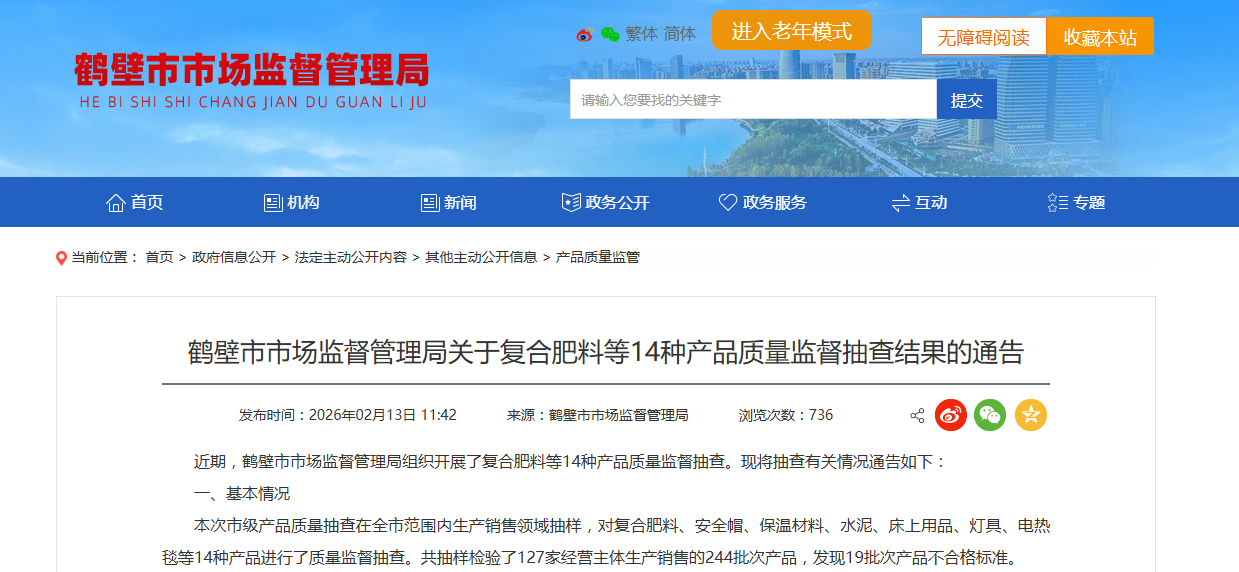
河南省 鹤壁市市场监督管理局发布复合肥料等14种产品质量监督抽查结果
Zhong Guo Zhi Liang Xin Wen Wang· 2026-02-24 08:03
Core Viewpoint - The quality supervision inspection conducted by the Hebi Market Supervision Administration revealed that out of 244 batches of 14 types of products, 19 batches were found to be non-compliant with standards, highlighting concerns regarding product quality in the region [1][2]. Group 1: Inspection Results - A total of 127 business entities were sampled, and 225 batches of products met the required standards, including safety helmets, cement, and electric bicycle batteries [1]. - The non-compliant products included composite fertilizers, insulation materials, and bedding products, indicating specific areas of quality concern [1]. Group 2: Regulatory Actions - The Hebi Market Supervision Administration has mandated local market regulatory departments to take strict legal actions against the identified issues, ensuring compliance with relevant laws and regulations [2]. Group 3: Consumer Guidance - Consumers are advised to purchase products from reputable and licensed physical stores or well-known e-commerce platforms to avoid substandard products [3]. - It is recommended that consumers check for complete product labeling, including manufacturer information and safety certifications, before making a purchase [4]. - Retaining purchase receipts is crucial for consumers to report any quality issues to market regulatory authorities [4].

《淄博市电动自行车消防安全管理办法》3月1日起施行
Qi Lu Wan Bao· 2026-02-10 10:33
Core Viewpoint - The introduction of the "Zibo City Electric Bicycle Fire Safety Management Measures" aims to enhance fire safety regulations for electric bicycles, addressing the increasing fire hazards associated with their use in Zibo City [1][2]. Legislative Background - The Zibo City government has developed the "Measures" based on extensive research and public consultation, ensuring that the legislation aligns with practical needs and has broad consensus [2]. Key Provisions of the Measures - The Measures consist of 23 articles, emphasizing a people-centered approach and a comprehensive fire safety responsibility system applicable throughout the city [3]. - Responsibilities are clearly defined for various government levels and departments, ensuring effective management and coordination in fire safety efforts [3]. - Quality management standards for electric bicycles and their components are established, prohibiting illegal modifications and ensuring compliance with national product quality laws [3]. Infrastructure and Charging Facilities - Regulations are set for the construction of centralized parking and charging facilities to address issues related to parking and charging difficulties [4]. - A transparent fee management system for centralized charging facilities is introduced to enhance affordability and utilization [4]. Fire Safety Management Measures - The Measures outline specific responsibilities for electric bicycle owners and users regarding safe parking and charging practices [5]. - Property management companies are tasked with enforcing compliance and preventing violations related to improper parking and charging [5]. Broader Scope of Management - The Measures extend to the management of electric bicycles used for commercial purposes, such as delivery services, ensuring comprehensive fire safety oversight [6]. - A regulatory mechanism is established to enhance coordination among various departments for effective enforcement of fire safety regulations [6]. Legal Accountability - The Measures incorporate a framework for legal accountability, focusing on educational approaches and minimal penalties for non-compliance, while adhering to existing laws for other violations [6].
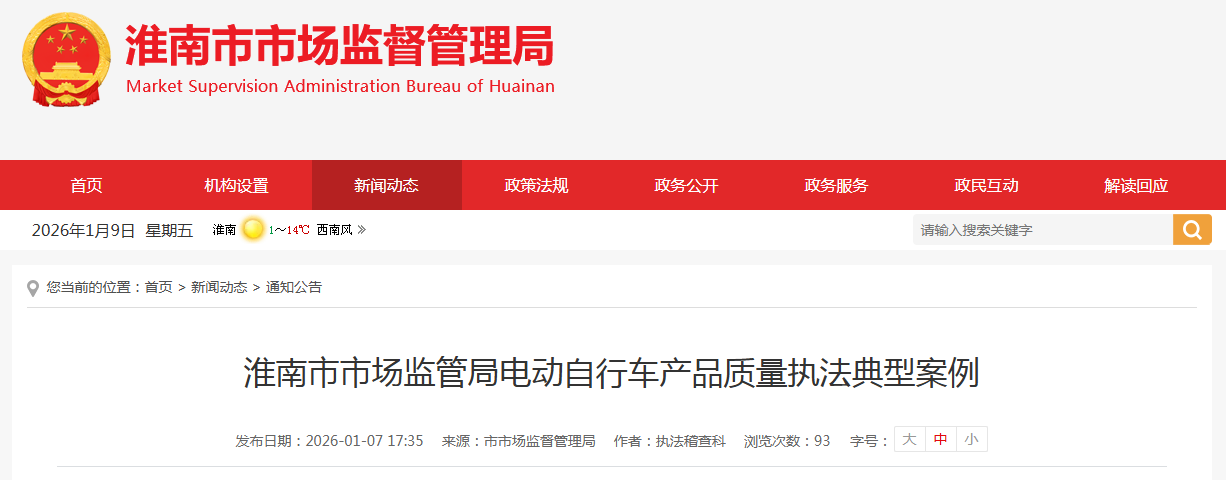
安徽省淮南市市场监管局电动自行车产品质量执法典型案例
Xin Lang Cai Jing· 2026-01-09 09:24
Core Viewpoint - The Huainan Market Supervision Administration is actively addressing safety hazards in electric bicycles by cracking down on illegal modifications and the sale of non-compliant products, with a total of 51 cases investigated since 2025 [1][2][3]. Group 1: Case Summaries - Case 1: The Huainan Fengtai County Market Supervision Bureau fined Wang Dianhu Electric Vehicle Business for illegally modifying an electric bicycle, imposing a penalty of 2,000 yuan for non-compliance with the Anhui Province Electric Bicycle Management Regulations [1]. - Case 2: The Huainan Shou County Market Supervision Bureau confiscated two non-compliant electric bicycles and imposed a fine of 7,480 yuan on Huiyou Electric Vehicle Business for selling electric bicycles with batteries that did not meet national standards [2]. - Case 3: The Huainan Datong District Market Supervision Bureau fined Jintian Electric Vehicle Store 3,200 yuan for modifying the battery of an electric bicycle, which did not match the specifications in the product certificate [3]. - Case 4: The Huainan Tianjia'an District Market Supervision Bureau imposed a fine of 2,200 yuan on Huainan Tupo Trading Co., Ltd. for illegally modifying electric bicycles [4]. - Case 5: The Huainan Xiejiaji District Market Supervision Bureau fined Zhuji Dao Lei Electric Vehicle Business 2,000 yuan for operating illegally modified electric bicycles [5].
铅价 下行空间有限
Qi Huo Ri Bao· 2025-12-05 02:21
Core Viewpoint - The lead market is experiencing a mixed situation with a decline in lead prices leading to improved downstream purchasing activity, while tight raw material supply continues to restrict smelter operations [1][4]. Group 1: Supply and Demand Dynamics - Lead ingot supply has gradually recovered since mid-November, but high lead prices have suppressed downstream purchasing, resulting in a price decline from previous highs [1]. - The lead concentrate market remains tight, with processing fees at historically low levels. Domestic smelters have begun winter stockpiling, but the import window for lead concentrate has not fully opened [2]. - Domestic lead concentrate resources are nearly sold out due to rising silver prices, leading to sparse market quotes and low processing fees. However, the arrival of previously contracted imports has alleviated some raw material shortages [2]. Group 2: Market Behavior and Trends - The willingness of traders to sell has improved as many domestic recycled lead smelters have shifted to a multi-raw material production model, reducing their reliance on waste batteries [3]. - Despite a decline in processing fees, the prices of by-products like sulfuric acid and silver remain high, keeping overall profits for smelters relatively strong [3]. - The downstream market for electric bicycle batteries is experiencing a downturn, while the automotive battery market is entering a peak replacement season, leading to increased production rates among larger enterprises [4]. Group 3: Future Outlook - The lead market is expected to see a regional tightening of supply as primary lead smelters enter maintenance phases, while recycled lead smelters maintain stable operating rates if raw material arrivals remain consistent [4]. - The recent decline in lead prices has led to a recovery in downstream purchasing enthusiasm, with lead ingot inventories decreasing [4]. - The tight supply of raw materials is unlikely to improve significantly, which will continue to restrict smelter operations and limit the downward potential for lead prices [4].
时有发生的电动自行车蓄电池起火事故 暴露出社区管理还需完善 电动自行车还需持续“排雷”
Jie Fang Ri Bao· 2025-08-13 01:35
Core Viewpoint - The article highlights the ongoing challenges and risks associated with the management of electric bicycle charging and parking in urban residential areas, emphasizing the need for improved infrastructure and community awareness to prevent accidents and enhance safety [1][2][3][4][5][6][7]. Group 1: Current Issues - A recent fire incident in Shanghai caused by an electric bicycle battery highlights the dangers of improper parking and charging practices in residential buildings [1]. - Many older residential complexes lack adequate charging infrastructure, leading residents to park and charge their electric bicycles indoors, which poses safety risks [2]. - The installation of charging facilities has been inconsistent and often poorly planned, resulting in inconvenient access for residents [3]. Group 2: Infrastructure Challenges - New charging facilities face opposition from residents due to concerns about noise and fire hazards, complicating the installation process [3][4]. - The high costs associated with installing safety features, such as sprinkler systems, create financial barriers for community management [4]. - The lack of standardized market entry criteria for charging service providers leads to varying quality and reliability of services [5][6]. Group 3: Recommendations for Improvement - There is a call for targeted public awareness campaigns to educate residents about the dangers of improper charging practices [7]. - Enhanced collaboration among community management, property management, and law enforcement is suggested to improve enforcement of safety regulations [7]. - Recommendations include better planning for charging infrastructure, transparent pricing models, and the introduction of flexible payment options to accommodate residents' needs [7].