
电阻

Search documents
中金 | MLCC周期复盘与展望:算力增长重构供需,结构性提价渐行渐近
中金点睛· 2026-03-10 23:35
Core Viewpoint - The report indicates that the MLCC (Multi-Layer Ceramic Capacitor) market is currently in a structural price increase window, driven by cost pressures and high demand for high-end products, particularly in the AI server segment [3][10]. Demand Analysis - The demand for MLCCs is expected to grow significantly, particularly in AI servers, with predictions of an 87% and 88% increase in demand for 2026 and 2027, respectively [26][30]. - The general server MLCC demand is projected to increase by 49% and 61% in the same years [30]. - The overall MLCC market is anticipated to see a modest growth of 2% and 8% in 2026 and 2027, respectively, with notable differentiation in demand across sectors [34]. Historical Price Trends - Historical price increases for MLCCs have been observed in cycles lasting 1.5 to 2 years, with significant profit margin expansions for manufacturers during these periods [6][17]. - Previous cycles saw price increases of 70% and 20% in 2017/2018 and 2020/2021, respectively, driven by supply-demand mismatches and cost pass-throughs [3][10]. Supply Dynamics - The supply of high-end MLCCs is currently tight, with major players like Murata and Samsung Electro-Mechanics operating at high capacity utilization rates of 90% or more [42][40]. - The competitive landscape is highly concentrated, with Japanese and Korean manufacturers dominating the high-end MLCC market, accounting for approximately 85% of the market share [40][41]. Price Increase Drivers - The current price increase is primarily driven by rising metal costs, particularly silver, which has seen price increases of over 100% [10][14]. - High-end MLCCs are experiencing demand-driven price increases due to robust orders from AI infrastructure and ASIC chip manufacturers [10][11]. Future Outlook - The report suggests that the current market is more likely to experience localized price increases rather than systemic ones, with domestic manufacturers potentially benefiting from cost pass-throughs [11][12]. - The expansion plans of major manufacturers focus on high-end MLCCs for AI servers and automotive applications, indicating a strategic shift towards high-value segments [43][44].


AI需求拉动 被动元器件全面涨价即将到来
Shang Hai Zheng Quan Bao· 2026-02-25 17:32
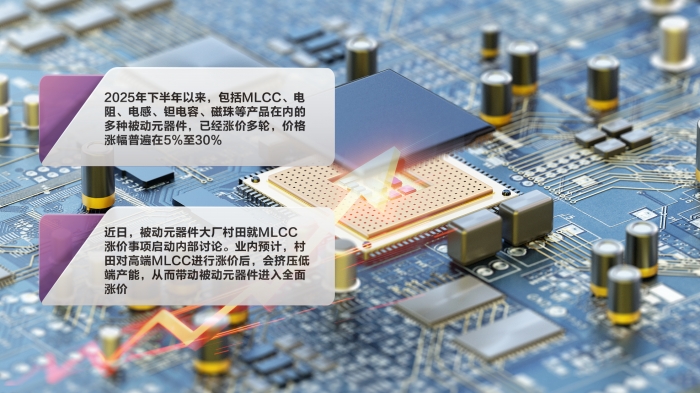
Group 1 - The core viewpoint of the articles indicates that the demand for passive components, particularly MLCCs, is set to increase significantly due to the rapid development of AI technology, leading to a confirmed price increase across the industry [2][3][5] - Murata, the largest MLCC supplier, is initiating discussions on price increases for MLCCs, with expectations to complete assessments of AI-driven demand by the end of Q1 2025 [3][5] - The price increase for passive components, including MLCCs, resistors, inductors, tantalum capacitors, and magnetic beads, is projected to range from 5% to 30% due to rising raw material costs and increased demand from AI and automotive sectors [2][5][6] Group 2 - The demand for high-end MLCCs is expected to grow significantly, with Murata's president stating that current orders for high-end MLCCs are double the company's production capacity, indicating a supply shortage that may persist for the next two years [3][4] - The passive components industry is entering a phase of multiple price increases across various regions and product categories, with several companies already announcing price hikes [5][6] - Analysts predict that the rapid advancement of AI technology will have a profound impact on the passive components industry, driving growth in high-end MLCCs and related materials [6]
MLCC专家交流
2026-02-25 04:13
Summary of the Conference Call on MLCC Industry Industry Overview - The conference focused on the MLCC (Multi-layer Ceramic Capacitor) industry, particularly the impact of AI and inflation on pricing and demand dynamics in the sector [2][3]. Key Points and Arguments 1. **Price Changes in MLCC Market**: - There was a notable shift in pricing from late last year to the Spring Festival, with major manufacturers like Murata and Samsung Electro-Mechanics indicating a change in their pricing stance [2][3]. - The current market has seen a price increase of 15-20% in the spot market for MLCCs, driven by supply chain disruptions due to natural disasters affecting production in Thailand, the Philippines, and Malaysia [3][4]. 2. **Impact of AI Demand**: - The demand for high-end MLCCs, particularly for AI applications, remains robust throughout the year, which is expected to squeeze the supply of mid to low-end products [2][3][11]. - AI-related applications, including high-performance servers and autonomous driving technologies, are significantly increasing the demand for high-capacity MLCCs [12][18]. 3. **Manufacturers' Pricing Strategies**: - Major manufacturers are expected to announce price increases through formal communications to distributors and direct customers, with anticipated increases of 20-30% for high-end products and 15-20% for mid-range products [9][10]. - Taiwanese manufacturers have expressed a strong desire to raise prices, influenced by rising raw material costs and increased demand for high-capacity products [11][12]. 4. **Market Dynamics and Competition**: - The competitive landscape includes major players like Samsung Electro-Mechanics, Murata, and TDK, with TDK expanding its production capacity for high-end MLCCs [23][24]. - Domestic manufacturers in China, such as Sanan Optoelectronics and Wuxi Huada, are also increasing their production of high-capacity MLCCs to meet rising demand [24][42]. 5. **Production Challenges**: - Transitioning production lines from mid to high-end MLCCs involves significant challenges, including the need for specialized equipment and materials, which are often tightly controlled by leading manufacturers [28][29]. - The production of high-capacity MLCCs requires advanced technology and materials with high purity levels, which are not easily accessible to all manufacturers [28][30]. 6. **Future Outlook**: - The current pricing trend is expected to persist for one to two years due to the slow pace of capacity expansion among manufacturers [39]. - The demand for high-capacity MLCCs is projected to grow, driven by advancements in AI applications and the increasing complexity of electronic devices [56][57]. Other Important Insights - The integration of AI in various sectors, including healthcare and automotive, is anticipated to further drive the demand for MLCCs, with projections indicating that over 50% of PCs may utilize AI technology by next year [55][56]. - The relationship between the pricing of resistors and MLCCs suggests that as resistor prices rise, there may be a corresponding increase in MLCC demand as manufacturers bundle purchases [49][50]. This summary encapsulates the key discussions and insights from the conference call regarding the MLCC industry, highlighting the interplay between pricing, demand, and technological advancements.
涨!涨!涨!半导体行业掀涨价风暴
Xin Lang Cai Jing· 2026-02-11 10:16
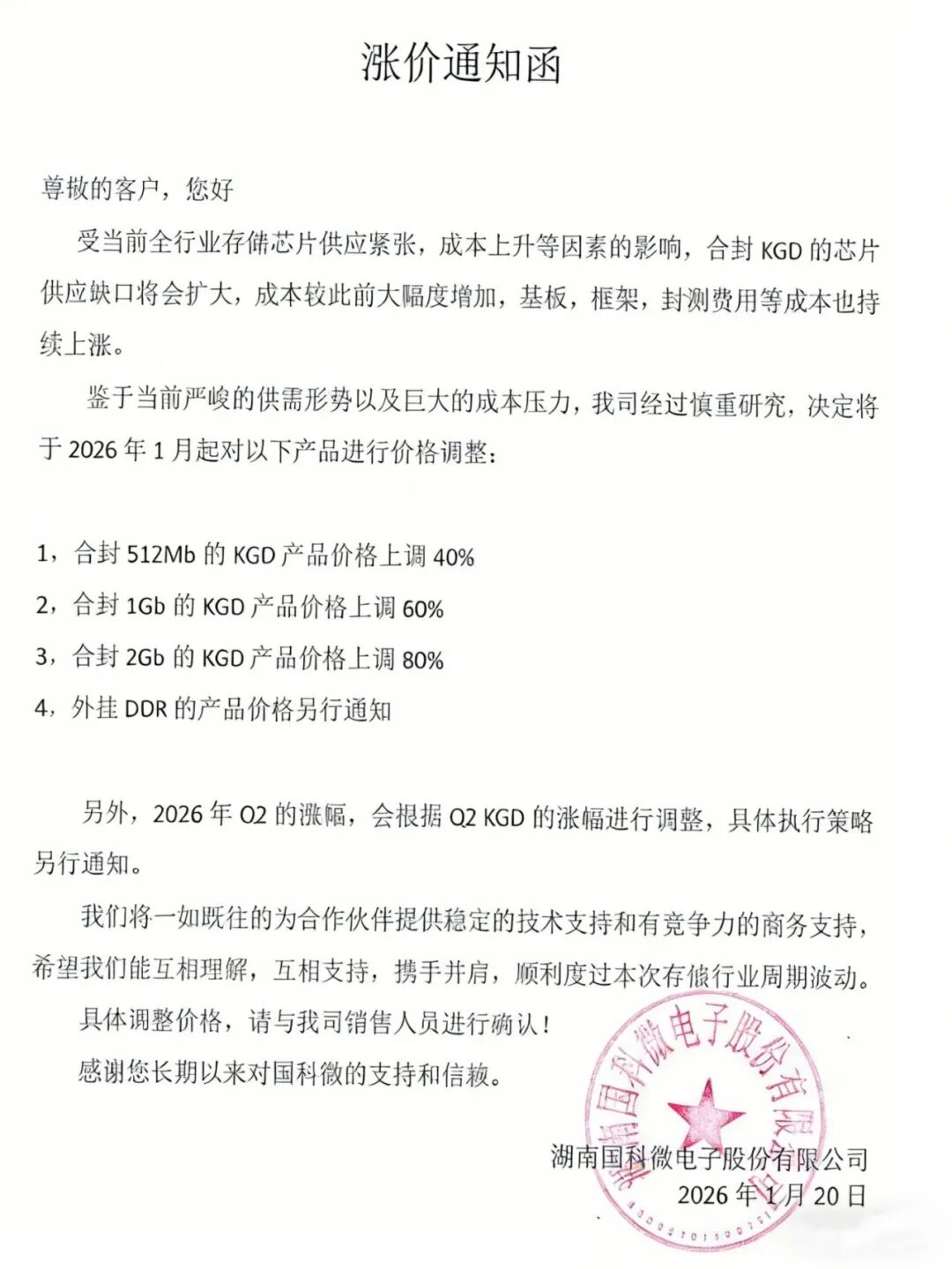
Core Viewpoint - The global semiconductor industry is experiencing a new wave of price increases across the entire supply chain, driven by surging AI demand and rising raw material costs [1][3][61]. Group 1: Price Increases in Domestic Semiconductor Companies - Over 20 semiconductor companies have officially announced price increases [2][62]. - Domestic chip manufacturers are significantly raising prices, with increases as high as 80% for certain products [4][63]. - Guokewai announced price hikes for its KGD storage products, with increases of 40% to 80% [6][66]. - Zhongwei Semiconductor is raising prices for MCU and NOR Flash products by 15% to 50% due to supply chain pressures [9][73]. - Biyiwei has also announced price increases across its entire product line, citing rising raw material costs [17][76]. Group 2: Price Increases in International Semiconductor Companies - International semiconductor giants are also raising prices, with ADI increasing prices by 15% to 30% starting February 1, 2026 [21][81]. - Infineon plans to raise prices for power switches and IC products due to increased demand from AI data centers [24][83]. - Texas Instruments is expected to raise prices by over 30% across nearly all categories due to rising costs [21][81]. Group 3: Price Increases in Wafer Foundry and Packaging - Wafer foundries are increasing prices, with TSMC raising advanced process prices by 3% to 10% [25][85]. - Packaging and testing services are seeing price increases of up to 30%, driven by high demand and capacity constraints [27][86]. Group 4: Impact of Raw Material Costs - The prices of precious metals like gold, silver, and copper are rising, significantly impacting chip manufacturing costs [57][116]. - The increase in raw material costs is leading to a ripple effect across the semiconductor supply chain, prompting many companies to raise their product prices [57][116]. Group 5: Effects on End Markets - The price increases in storage chips are affecting end markets, with PC manufacturers like Dell and Lenovo planning price hikes of 10% to 30% [59][118]. - In the smartphone sector, rising storage costs are pressuring new product pricing, particularly for low-end models [59][118]. - The automotive electronics sector is also feeling the impact, with companies like Xiaomi and NIO reporting cost pressures due to rising semiconductor prices [59][119].


中国银河证券:存储价格延续上涨 预计本轮涨价周期将延续至2026年中
智通财经网· 2026-02-10 07:55
Group 1 - The core viewpoint of the report indicates a significant price increase in memory chips, with NAND flash prices rising over 100% and DRAM prices increasing by 60%-70% in Q1, driven by surging demand from AI servers and data center capital expenditures [1] - The current memory chip price increase is expected to continue until mid-2026, marking a new cycle in the storage chip sector, with strong growth in AI server demand and domestic substitution creating investment opportunities in related listed companies [1] - The price hikes in memory chips are impacting downstream industries, with consumer electronics manufacturers facing cost pressures, leading to potential adjustments in product structure and pricing strategies [1] Group 2 - TSMC reported a record high revenue of $33.73 billion in Q4 2025, a year-on-year increase of 25.5%, exceeding previous guidance, with a net profit of approximately $16.3 billion, reflecting a 35% year-on-year growth [2] - The gross margin reached 62.3%, marking a 3.3 percentage point increase year-on-year, while the operating profit margin was 54%, and the net profit margin was 48.3%, all significantly surpassing market expectations [2] - Advanced process revenue accounted for 77% of total revenue, with 3nm process contributing 28%, indicating a strong growth engine for revenue [2] Group 3 - The passive components market is experiencing a new wave of price increases, with major manufacturers raising prices by 5%-30%, driven by rising raw material costs and increased demand from high-end sectors like AI servers and electric vehicles [3] - Price increases in passive components such as MLCCs, inductors, and resistors are expected to transmit to various downstream applications, influenced by rising wafer processing costs and strong demand in automotive and industrial sectors [3] Group 4 - Companies to watch include IC design firms such as Zhaoyi Innovation, Puran, Dongxin, Beijing Junzheng, and Lanke Technology, as well as storage module manufacturers like Demingli and Shannon Chip Creation [4] - AI-related PCB companies such as Shenghong Technology, Hudian Co., Jingwang Electronics, and Kexiang Technology are also recommended for attention [4]

被动元件,涨涨涨!
半导体行业观察· 2026-02-08 03:29
Core Viewpoint - The recent price hikes in passive components, driven by supply-demand imbalances and rising raw material costs, indicate a significant transformation in the market dynamics of the passive components industry [6][9][12]. Price Adjustments - Yageo announced a price increase of 15%-20% for certain resistor products starting February 1, reflecting its position as a market leader with an 18% global market share [2]. - Other companies, including Walsin Technology and Panasonic, have also announced price hikes for various passive components, with increases ranging from 15% to 30% [2][3]. - The price adjustments are widespread, with many small and medium-sized manufacturers in China also raising prices by 5%-20% across multiple product categories [3]. Supply Chain Dynamics - The price increases are primarily driven by rising costs of raw materials such as silver, copper, and aluminum, which have seen significant price surges, with silver prices increasing over 140% in 2025 [7][9]. - The production costs for passive components have risen by 20%-30% due to these raw material price increases, prompting manufacturers to pass on costs to customers [7][9]. - Capacity constraints are exacerbating the situation, as many Japanese manufacturers have shifted focus to high-end products, reducing supply in the mid-to-low-end market [8][9]. Demand Drivers - The demand for passive components is being driven by the rapid growth of AI and electric vehicle markets, with AI server motherboards requiring significantly more MLCCs than traditional servers [10][11]. - The demand for passive components in electric vehicles is also increasing, with the number of MLCCs used per vehicle rising dramatically compared to traditional vehicles [10][11]. - The overall market for passive components in China is projected to grow from 1237.65 billion yuan in 2023 to 2583.59 billion yuan by 2030, with a compound annual growth rate of 11.09% [12]. Market Structure Changes - The current price hikes reflect a structural change in the passive components market, with high-end products for AI servers and electric vehicles experiencing significant demand while traditional consumer electronics face challenges [14][17]. - Domestic manufacturers are beginning to capture more market share, with companies like Walsin Technology and Sunlord Electronics seeing increased orders and expanding their production capabilities [18][19]. - The shift towards high-end products presents opportunities for domestic manufacturers to enter the supply chains of larger companies, especially as global manufacturers face capacity and delivery challenges [22][23].


电子周期品涨价行情分析
2026-01-30 03:11
Summary of Conference Call on Electronic Cycle Products Price Trends Industry Overview - The analysis focuses on the electronic cycle products industry, particularly the semiconductor sector, which includes memory (NAND, DRAM, HBM) and CPUs, driven by AI technology and data center demands [1][2]. Core Insights and Arguments - **AI-Driven Demand**: AI technology has significantly increased demand, with data centers and AI servers accounting for approximately 40% of the demand for memory and CPUs. This demand is expected to grow further as AI transitions into large-scale application phases [1][5]. - **Supply Contraction**: Products like niche memory, analog chips, and power devices are experiencing price increases due to a tightening supply caused by competitive market dynamics and the exit of traditional 8-inch production lines. Domestic foundries, such as Huahong, are operating at near-capacity, exacerbating the effects of overseas capacity exits [1][7]. - **Cost-Pass-Through Products**: Products such as copper-clad laminates, resistors, and aluminum electrolytic capacitors are facing upward price pressures due to rising costs of upstream raw materials, particularly since the second half of 2025 [1][10]. - **Inventory Replenishment**: The market for products like MLCC (multi-layer ceramic capacitors) is seeing increased shipments and price hikes as manufacturers begin to replenish low inventory levels. However, this behavior is viewed as a short-term phenomenon lacking long-term sustainability [1][9]. Types of Electronic Product Manufacturers - Manufacturers can be categorized into four types based on their market logic: 1. **Demand-Driven**: Primarily influenced by demand from data centers and AI servers, leading to price increases for memory and CPUs [3][6]. 2. **Supply Contraction**: Driven by changes in supply, particularly in niche storage and power devices, where high-end market competition is strong [3][6]. 3. **Cost-Pass-Through**: Affected by rising upstream raw material costs, impacting products like copper-clad laminates and capacitors [3][8]. 4. **Inventory Replenishment**: Characterized by short-term price rebounds due to low inventory levels, as seen in the MLCC market [3][8]. Additional Important Insights - **Market Dynamics**: The semiconductor market is experiencing a historical price surge due to a combination of strong demand and limited supply, particularly in core categories like memory and CPUs [2][5]. - **Long-Term Sustainability Risks**: While AI-driven demand and supply constraints provide a strong basis for price increases, the sustainability of inventory replenishment-driven price hikes is questionable [4][10]. - **Design Companies**: Companies involved in the design of niche storage and power devices are also positioned to increase prices due to tight supply and rising costs, as evidenced by price increase notices from firms like Zhongwei Peninsula [4][9].
电子元器件,涨声一片!
是说芯语· 2026-01-29 06:47
Price Increases in Semiconductor and Electronic Components Industry - Resonac announced a price increase of 30% for copper-clad laminates and adhesive films starting March 1, 2026, due to tight supply and rising costs of raw materials and labor [3] - Nanya Plastics will raise prices for all CCL products and PP by 8% starting November 20, 2025, citing increases in international copper prices and raw material costs [7] - TrendForce predicts that the average capacity utilization rate of global 8-inch wafer foundries will rise to 85%-90% in 2026, leading to price increases of 5%-20% for wafer foundry services across the board [8] - TSMC plans to increase prices for advanced technology nodes (5nm, 4nm, 3nm, 2nm) by 8%-10%, with a 50% increase for 2nm wafers starting in 2026 [10] - SMIC has implemented a price increase of approximately 10% for certain capacities [11] - Several packaging and testing companies have begun raising prices, with increases nearing 30% due to high demand and full capacity utilization [13] Memory Chip Price Increases - Samsung has raised NAND flash prices by over 100% and plans to increase server DRAM prices by 60%-70% in Q1 2026 [15] - SK Hynix is also raising server DRAM prices by 60%-70% and has negotiated significant price increases for LPDDR memory used in iPhones, approaching 100% [16] - Micron has announced a general price increase of approximately 20% across its product lines [17] - NAND flash wafer prices increased by over 10% in December 2025, with SSD prices rising by 15%-20% [24] Passive Components Price Adjustments - Various passive component manufacturers, including Yageo and Panasonic, have announced price increases for capacitors and resistors ranging from 8% to 30% [26][31] - ROHM Semiconductor has raised prices for thick film resistors by 8%-20% [38] - Multiple manufacturers are adjusting prices due to rising raw material costs and supply chain pressures [47] Power Devices and Other Electronics - Huazhong Microelectronics confirmed price increases for certain IGBT products due to rising copper and raw material costs [48] - Several semiconductor companies, including Jiangxi Tianyi and Wuxi Zongxiang Technology, have raised prices for specific products by 10%-20% [82][83] CPU and GPU Price Trends - AMD and Intel are planning to increase server CPU prices by up to 15% due to high demand from large enterprises [62] - NVIDIA and AMD are expected to raise GPU prices in early 2026, with multiple price adjustments anticipated throughout the year [79]


白银狂奔,被AI“重新定价”的世界
3 6 Ke· 2026-01-28 10:33
Group 1 - Silver prices have surged, reaching over $110 per ounce, marking a historical high and doubling the previous peak from 46 years ago, indicating a significant shift in silver pricing dynamics [1] - The surge in silver prices is attributed to the increasing demand driven by artificial intelligence (AI), which is reshaping the metal's market dynamics [2][3] - Industrial demand, particularly from AI-related sectors such as data centers, solar energy, and electric vehicles, has overtaken investment demand as the primary driver of silver pricing [3] Group 2 - Silver's unique properties, including high electrical conductivity, excellent thermal conductivity, and corrosion resistance, make it essential for AI hardware and data centers [4] - The semiconductor industry is experiencing price increases due to rising costs of precious metals like silver, with companies like Yageo and Walsin announcing price hikes of 15% to 20% for certain products [5] - Despite the rising demand for silver in AI applications, alternatives like copper are being explored in some scenarios, indicating that silver is not irreplaceable in all applications [6][8] Group 3 - The projected silver usage in AI servers is expected to increase significantly, with estimates of 350-400 tons in 2024 and 550-650 tons in 2025, reflecting a growth rate of 55%-65% [6][7] - Even with this increase, the total silver consumption from electronic devices will still represent less than 4% of the global annual silver production, suggesting that the market remains oversupplied [7] - The long-term price dynamics of silver will ultimately depend on actual consumption levels and the availability of substitutes, rather than speculative narratives [8][16] Group 4 - The AI boom is not only impacting silver but is also leading to a reevaluation of other resources, particularly electricity and copper, which are becoming increasingly critical for AI infrastructure [9][14] - The demand for electricity to support AI data centers is growing rapidly, with significant investments needed to upgrade power systems to meet this demand [12][13] - Copper is being identified as a strategic resource for the AI era, with predictions of a 70% shortage by 2040, highlighting its essential role in data center construction and operation [14]
未知机构:国联民生电子电子板块的全面通胀领导好前期我们团队重点推荐-20260128
未知机构· 2026-01-28 02:00
Summary of Conference Call Notes Industry Overview - The focus is on the electronics sector, particularly the inflationary trends driven by AI in storage, devices, and packaging/testing segments [1][2]. Key Points and Arguments 1. **Price Increases Across Segments**: - Recent price hikes have been observed in various sub-segments: - Passive components: Resistors from Yageo increased by 15-20% - Power components: Multiple companies reported price increases of 10-20% - LED drivers: Richtek saw price increases of over 10% - MCU companies: Zhongwei Semiconductor's MCUs and NOR flash prices rose by 15-50% [2][2]. 2. **Drivers of Price Increases**: - Different segments have unique drivers for price increases: - Downstream demand turning point and inventory clearance in channels - Rising costs in packaging/testing and foundry services necessitating cost pass-through - Supply-side pressures combined with a demand-side inventory buildup cycle - Current valuations of related stocks are considered low, presenting an opportunity for investment [2][2]. 3. **Long-term Outlook**: - The AI industry wave presents transformative opportunities for power, passive, and MCU sectors: - For passive components, new demands arise in various AI applications: - SOFC (Solid Oxide Fuel Cell): Significant power shortages in North America create demand for high-capacity, high-voltage MLCCs - Vertical Power Delivery (VPD): Google’s adoption of VPD indicates a shift towards more efficient power solutions, increasing requirements for high-voltage film capacitors, high-frequency power inductors, and non-inductive resistors - The electronics sector is entering a significant inflationary period, with previous increases in storage, devices, and packaging/testing expected to be followed by a wave of price adjustments in other electronic components [2][2]. 4. **Investment Strategy**: - It is recommended to prioritize positions and select stocks that actively participate in industry transformations and embrace the AI wave [2][2]. Important but Overlooked Content - Specific companies mentioned in various segments: - MCU: Zhaoyi Innovation, Puran, Guomin Technology, Zhongwei Semiconductor - Power components: Xinjieneng, JieJie Microelectronics, Yangjie Technology - Passive components: Shunluo Electronics, Sanhuan Group - Lead frames: Kangqiang, Xinhenghui [3][3].