相控阵T/R芯片

Search documents
智驭波束——相控阵T/R芯片在军民融合与智能浪潮中的核心跃迁 头豹词条报告系列
Tou Bao Yan Jiu Yuan· 2026-03-27 14:24
Investment Rating - The report rates the phased array T/R chip industry as a strong growth sector with significant potential for investment, projecting a market size increase from 841 million RMB in 2020 to 2.48 billion RMB in 2025, and further to 4.48 billion RMB by 2030, indicating a compound annual growth rate (CAGR) of 24.15% from 2020 to 2025 and 12.96% from 2026 to 2030 [4][41]. Core Insights - The phased array T/R chip is a core component of phased array radar, crucial for radar antenna parameters and overall performance, with demand driven by military applications and the expansion of smart driving and 5G base stations [4][5]. - The industry is characterized by a wide range of applications, strong military strategic significance, and high profit margins, with companies like Chengchang Technology and Zhenlei Technology reporting gross margins of 66.1% and 93.2% respectively [10][12]. - The growth of the industry is supported by advancements in satellite internet and the rapid development of the smart driving industry, which are expected to further increase demand for phased array T/R chips [4][42]. Industry Definition - Phased array T/R chips are essential components of phased array radar, integrated within T/R modules to perform key functions such as signal transmission, reception, and amplitude-phase control [5]. Industry Classification - The phased array T/R chip industry can be classified into three categories based on functionality: amplifier chips, amplitude-phase control chips, and passive chips [6]. Industry Characteristics - The industry features broad application fields, significant military strategic importance, and generally high profit margins [10]. Development History - The phased array T/R chip technology began in the 1960s, with significant advancements made by Western companies, leading to the establishment of a competitive landscape that includes both military and satellite communication applications [13][14][16]. Industry Chain Analysis - The industry chain consists of upstream raw materials and equipment supply, midstream chip design and manufacturing, and downstream chip application [19]. - Upstream, the supply of wafers is critical, with domestic production capacity increasing and the price of polysilicon, a key raw material, showing significant fluctuations [20][27]. - Downstream applications are primarily in satellite internet and military defense, with the rapid expansion of satellite constellations driving demand for phased array T/R chips [21][39]. Market Size and Growth - The market size for phased array T/R chips is projected to grow significantly, driven by the expansion of smart driving technologies and the construction of 5G base stations [41][42]. - The demand for phased array T/R chips is expected to increase as the Chinese military continues to modernize its equipment and as satellite internet projects accelerate [39][40]. Future Trends - The report highlights that advancements in rocket technology will reduce satellite launch costs, facilitating faster deployment of satellite constellations and increasing demand for phased array T/R chips [46][47]. - The smart driving industry is also expected to grow, with the introduction of higher-level autonomous driving technologies leading to increased demand for 5G millimeter-wave technology and phased array T/R chips [48][49].





2025年相控阵T/R芯片行业词条报告
Tou Bao Yan Jiu Yuan· 2026-03-27 13:16
Investment Rating - The report rates the phased array T/R chip industry as a high-potential investment opportunity due to its rapid growth and strategic importance in both military and civilian applications [4]. Core Insights - The phased array T/R chip market is projected to grow from 841 million RMB in 2020 to 2.48 billion RMB in 2025, with a compound annual growth rate (CAGR) of 24.15%. It is expected to reach 4.48 billion RMB by 2030, with a CAGR of 12.96% [4][38]. - The growth is driven by the expansion of smart driving and 5G base station demands, as well as the acceleration of military-civilian integration [4][39]. - The industry features high profit margins, with companies like Chengchang Technology reporting a gross margin of 66.1% for their phased array T/R chip products [9]. Industry Definition - Phased array T/R chips are core components of phased array radars, responsible for signal transmission, reception, and phase control, directly influencing radar performance [5]. Industry Classification - The phased array T/R chip industry can be categorized into amplifier chips, phase control chips, and passive chips based on their functions [6]. Industry Characteristics - The industry is characterized by its wide application fields, strong military strategic significance, and generally high profit margins [7][8]. Development History - The phased array T/R chip technology began in the 1960s, with significant advancements made by Western companies, leading to the establishment of standards and performance improvements [10][12]. - Chinese private enterprises entered the market around 2010, achieving advanced levels in both passive and active phased array technologies [10][13]. Industry Chain Analysis - The upstream of the industry chain involves raw materials and equipment supply, with wafer procurement costs constituting over 91% of total costs for companies like Chengchang Technology [16][22]. - The domestic wafer production capacity is steadily increasing, with a projected global market share of 42% by 2028 [16][23]. - The downstream applications are primarily in satellite internet and military defense, with significant growth in satellite constellation projects driving demand for phased array T/R chips [18][20]. Market Size - The phased array T/R chip market is expected to grow significantly, driven by the increasing demand from smart driving technologies and the expansion of 5G base stations [39][40]. Future Market Changes - The satellite internet sector is anticipated to accelerate its constellation deployment, significantly increasing the demand for phased array T/R chips [43]. - The smart driving industry is also expected to grow, with the approval of higher-level autonomous driving technologies, further driving the demand for 5G millimeter-wave technology and phased array T/R chips [45][46].
2025年中国相控阵t、R芯片行业概览:开启军民两用新生态(精华版)
Tou Bao Yan Jiu Yuan· 2026-03-09 12:26
Investment Rating - The report does not explicitly provide an investment rating for the China Transmit/Receive Module (T/R) industry. Core Insights - The China T/R chip industry is experiencing rapid growth, with the market size projected to increase from approximately 8.4 billion yuan in 2020 to 22.9 billion yuan in 2024, reflecting a compound annual growth rate (CAGR) of 28.4% [26]. - The growth is driven by three main factors: the enhancement of domestic manufacturing capabilities due to military-civilian integration policies, the expansion of downstream application scenarios such as satellite internet and automotive intelligence, and the acceleration of military equipment upgrades in response to geopolitical pressures [26]. - The market is expected to continue growing, reaching 44.9 billion yuan by 2030, with a CAGR of 12.6% from 2025 to 2030 [24]. Industry Chain Summary - The T/R chip industry chain consists of three segments: upstream (raw materials and equipment supply), midstream (chip design and manufacturing), and downstream (chip applications) [5]. - Upstream focuses on the supply of semiconductor materials, with China increasing its production capacity and accelerating domestic substitution [5]. - Midstream is characterized by a growing market size and global share, with private enterprises entering the market and expected to become core players under policy and technological drivers [5]. - Downstream applications include satellite internet, defense, automotive intelligence, and 5G base stations, indicating a shift from a "basic construction period" to an "application explosion period" [5]. Market Size and Growth - The T/R chip market in China has shown explosive growth from 2020 to 2024, with a projected market size of 22.9 billion yuan in 2024, up from 8.4 billion yuan in 2020 [26]. - The market is expected to grow to 24.8 billion yuan by 2025 and further to 44.9 billion yuan by 2030, driven by the large-scale deployment of satellite internet constellations and the increasing penetration of advanced driving assistance systems (ADAS) in the automotive sector [24][26]. Competitive Landscape - The competitive landscape of the T/R chip industry in China is characterized by high market concentration, with state-owned and private enterprises leading the market [5]. - Leading players, referred to as the "national team," are making significant technological breakthroughs, particularly in the military sector, while private enterprises are focusing on civilian applications and solutions [5].
2025年中国相控阵T/R芯片行业概览:开启军民两用新生态(精华版)
Tou Bao Yan Jiu Yuan· 2026-03-09 12:24
Investment Rating - The report indicates a strong growth potential for the China Transmit/Receive Module (T/R Module) industry, with a projected market size increase from 2.48 billion CNY in 2025 to 4.49 billion CNY by 2030, reflecting a compound annual growth rate (CAGR) of 12.6% [24][26]. Core Insights - The China T/R Module industry is experiencing rapid growth, with the market size increasing from approximately 840 million CNY in 2020 to 2.29 billion CNY in 2024, achieving a CAGR of 28.4% during this period. This growth is driven by advancements in military-civilian integration policies, expanding application scenarios, and the modernization of military equipment [26]. - The industry is transitioning from a "basic construction period" to an "application explosion period," with future growth primarily driven by the acceleration of satellite internet constellation networking and the penetration of advanced intelligent driving in the new energy vehicle sector [5][26]. Industry Chain Summary - **Upstream**: The upstream of the T/R Module industry consists of raw materials and equipment supply, focusing on wafer and semiconductor materials. China is gradually expanding production capacity and accelerating domestic substitution [5]. - **Midstream**: The midstream involves chip design and manufacturing, where market size and global share are continuously increasing. A few private enterprises have entered this segment, expected to become core market players under policy and technological drivers [5]. - **Downstream**: The downstream application includes satellite internet, defense, automotive intelligent driving, and 5G base stations, representing the final outlet for value realization. The industry is witnessing a shift towards application-driven growth [5][12]. Market Size and Growth - The market for China’s T/R Module is projected to grow from 2.29 billion CNY in 2024 to 4.49 billion CNY by 2030, with a CAGR of 18.2% [24][26]. - The rapid growth is attributed to three main factors: improved domestic manufacturing capabilities, expanding application scenarios in satellite internet and automotive sectors, and military modernization efforts [26]. Competitive Landscape - The competitive landscape of the T/R Module industry in China is characterized by high market concentration, with state-owned and private enterprises jointly dominating the market. Leading players are accelerating breakthroughs in key technologies, particularly in the military sector, while private companies are focusing on civilian applications and solutions [5].
*ST铖昌2026年1月21日跌停分析
Xin Lang Cai Jing· 2026-01-21 02:37
Core Viewpoint - *ST Chengchang's stock hit the daily limit down, reflecting significant concerns regarding its operational stability and market confidence due to various risks including potential delisting and project delays [2] Group 1: Company Fundamentals - The company is under delisting risk as a *ST (Special Treatment) entity, raising doubts about its ongoing operational capability [2] - The new generation chip project has been delayed twice until 2026, indicating high R&D challenges and negatively impacting market confidence in the company's future [2] - The operating cash flow for the first three quarters was -106 million yuan, with accounts receivable increasing by 53.45%, highlighting cash flow pressures [2] Group 2: Market Environment and Valuation - The company operates in the phased array T/R chip sector, which has a first-mover advantage in the low-orbit satellite field, but faces a complex and volatile market environment [2] - The company's price-to-earnings ratio is 278 times (industry average 54 times) and price-to-book ratio is 17 times (industry average 5.5 times), indicating significant valuation pressure [2] - Recent performance in related concept sectors has been poor, with multiple stocks experiencing declines, which could further negatively impact *ST Chengchang's stock price [2] Group 3: Short-term Trends and Investor Behavior - The stock reached a historical high on January 16, 2026, before hitting the daily limit down, suggesting that the previous price surge may have led to profit-taking by investors [2] - The lack of fundamental support for the recent price increase may have triggered sell-offs from technical investors [2]
重磅信号!卫星互联网万亿市场开启,或将引爆四大黄金板块!
Jin Rong Jie· 2025-12-19 11:27
Core Insights - Since 2020, global rocket launches have reached record highs for three consecutive years, indicating unprecedented activity in the aerospace sector [1] - China's low Earth orbit (LEO) satellite construction is lagging behind high orbit high-throughput satellites, with the Tian Tong-1 satellite being a mature GEO satellite constellation widely used across various industries [1] - The formal networking of two major satellite constellations (GW and G60) in 2024 marks the beginning of a new era of regular satellite deployment, with expectations for a rapid increase in industry scale as domestic satellite internet construction progresses [1] Industry Analysis - **Satellite Manufacturing Sector**: The construction of LEO satellite constellations is entering a high-frequency launch phase, leading to a surge in orders for satellite platforms and payload manufacturers, with urgent capacity expansion needs [2] - **Rocket Launch Sector**: There is a significant increase in demand for commercial space launches, with low-cost and high-frequency launch capabilities becoming core competitive advantages, presenting development opportunities for private rocket companies [2] - **Ground Equipment Sector**: There is a growing demand for satellite terminals, base stations, and chips, with a broad market space for user-side equipment and an accelerated process of domestic substitution [2] - **Operational Services Sector**: Satellite communication operators are expected to obtain licenses and commence commercial services, potentially opening up incremental markets in maritime, aviation, and IoT sectors [2] Listed Companies Overview - **China Satellite (600118)**: A core listed platform under the Aerospace Science and Technology Corporation, with capabilities in the development and mass production of small and micro satellites, deeply involved in national satellite internet projects [3] - **Aerospace Electric (002025)**: A leading manufacturer of high-end electronic components, with products including connectors and relays widely used in satellite and rocket control systems [3] - **Chengchang Technology (001270)**: A core supplier of phased array T/R chips, which are essential components for satellite communication antennas, characterized by high technical barriers [3] - **Huali Chuantong (300045)**: An early player in satellite communication baseband chips and terminal products, successfully developed the "Tian Tong-1" satellite phone, and participated in multiple national projects [3] - **Mengsheng Electronics (688311)**: Focused on satellite navigation and communication terminal equipment, with applications in both defense and civilian sectors, showcasing strong technical capabilities [3] - **Beidou Xingtong (002151)**: Extends from Beidou chips to comprehensive satellite internet services, providing integrated solutions for high-precision positioning and communication [3]


谁是商业航天金矿中的“卖铲人”?丨每日研选
Shang Hai Zheng Quan Bao· 2025-12-16 02:23
Core Insights - The commercial aerospace sector is experiencing increasing momentum, with a notable rotation within the industry as national satellite constellations like StarNet (GW) and Qianfan (G60) enter a phase of intensive networking [1] - The investment logic is shifting towards satellite manufacturing, particularly focusing on high-barrier, high-value core component suppliers, as the technology for reusable rockets matures and costs decrease [1] Demand Certainty - The demand for satellite launches is expected to grow significantly, with an estimated average of 499 launches per year in China from 2026 to 2029, and potentially reaching thousands annually after 2030, compared to the current average of approximately 171 launches [1] - StarNet has recently achieved a rapid launch pace of "three times a week," indicating an acceleration in deployment [1] Transition to Mass Production - The satellite manufacturing sector is transitioning from "custom" to "mass production," benefiting companies that can provide standardized, reliable core components [2] - The most certain returns in the industry are expected to come from high-value, high-barrier satellite core components and payloads, with suppliers of standardized power, communication, and attitude control systems positioned as key players [2] Technological Breakthroughs and Policy Support - There is strong anticipation for technological breakthroughs in reusable rocket technology, despite it not being fully matured [2] - Commercial aerospace has been recognized as a strategic emerging industry, with numerous supportive policies being introduced at both central and local levels [2] Investment Focus - Investors are encouraged to focus on "high-barrier component suppliers," particularly core suppliers for satellite platforms and payloads, including: - Communication payloads and chips, which are essential for satellite operations, with relevant companies including Guobo Electronics, Zhenlei Technology, and Shanghai Hanyun [3] - Ground terminals and core network components, covering critical parts, chips, and testing instruments, with notable companies such as Huali Chuantong and Haige Communication [3]
太空圈地,中美万颗卫星竞速中的确定性机
Hu Xiu· 2025-12-14 12:14
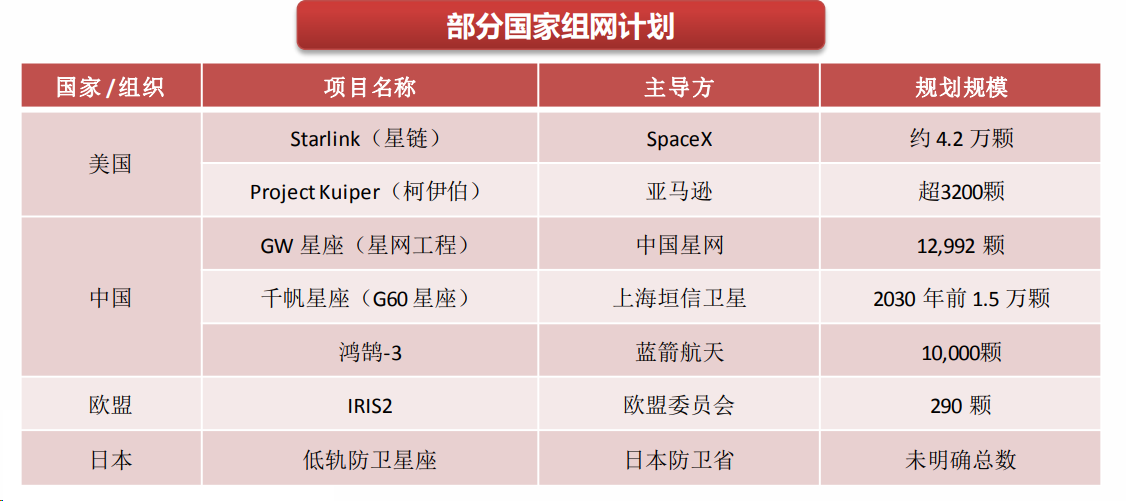
Core Insights - The Chinese commercial aerospace launch industry is transitioning from technology validation to large-scale application, with significant government support and strategic initiatives aimed at enhancing its global competitiveness [1][4]. Group 1: Government Initiatives and Strategic Plans - The 20th National Congress of the Communist Party of China elevated "aerospace power" to a national strategic level, alongside manufacturing and quality [1]. - The establishment of the Commercial Aerospace Department by the National Space Administration aims to streamline approval processes, reducing the launch permit processing time by 50% [1]. - The "Action Plan for Promoting High-Quality and Safe Development of Commercial Aerospace (2025-2027)" outlines 22 measures, including the establishment of a national commercial aerospace development fund and the unification of civil and commercial aerospace standards [1]. Group 2: Global Competition and Satellite Launches - The global satellite frequency and orbit resources are limited, with countries competing under the "first come, first served" principle [1]. - As of May 12, 2025, there are approximately 10,824 low Earth orbit (LEO) satellites in orbit, with a utilization rate of about 18% [1]. - In 2024, there were 263 global space launch missions, an 18% increase year-on-year, with the U.S. and China accounting for 86% of the total launches [2]. Group 3: Commercial Launch Achievements - In 2025, China completed a record 83 orbital launch missions, a 22% increase from 68 in 2024, with private commercial rocket companies achieving a success rate of 87% [4]. - December 2025 saw a record launch frequency, with three Long March rocket launches completed within 19 hours [4]. Group 4: Satellite Internet Initiatives - The "GW Constellation" and "Qianfan Constellation" are major satellite internet projects in China, with plans to deploy 12,992 and over 15,000 satellites, respectively [6]. - The satellite manufacturing sector is expected to see significant growth, with China Satellite (600118) projected to handle around 200 satellite orders in 2025, generating over 2 billion yuan in revenue [6]. Group 5: Technological Advancements and Market Opportunities - Shanghai Huanxun is positioned as a key player in the satellite internet sector, providing core communication payloads for the Qianfan Constellation [7]. - The demand for satellite communication chips is expected to exceed 300 million yuan in 2025, with the market projected to reach a scale of over 10 billion yuan by 2026 [6]. - The T/R chip market is anticipated to grow significantly, driven by the acceleration of low Earth orbit satellite networking [9]. Group 6: Financial Performance and Growth - Chengchang Technology reported a revenue of 306 million yuan in the first three quarters of 2025, a year-on-year increase of 204.78%, with a net profit of 90.36 million yuan [10][11]. - The company is expected to benefit from the increasing demand for satellite components and the normalization of delivery for remote sensing projects [11].

*ST铖昌(001270) - 001270*ST铖昌投资者关系管理信息20251024
2025-10-25 12:28
Group 1: Financial Performance - In Q3 2025, the company achieved a revenue of 30,609.58 million CNY, a significant increase of over 565.20% compared to the same period last year [2][3] - The net profit for Q3 2025 reached 9,035.86 million CNY, marking a successful turnaround from previous losses [2][3] - For the first three quarters of 2025, the company reported a total revenue of 30,609.58 million CNY and a net profit of 9,035.86 million CNY [2][5] Group 2: Market Demand and Project Progress - The growth in revenue is attributed to sustained demand in downstream markets and a steady increase in project orders [3][4] - Key projects in the T/R chip product line are progressing well, particularly in the traditional phased array radar and low Earth orbit satellite communication sectors [4][6] - The company is actively expanding into emerging application markets while maintaining a strong focus on core business areas [3][4] Group 3: Profitability and Cost Structure - The company's gross margin for the first three quarters of 2025 was 69.72%, indicating a stable and high profitability level [5][6] - Cost optimization has been achieved through improved R&D efficiency and production processes, contributing to the enhancement of gross margins [5][6] Group 4: Risk Management and Future Outlook - The company aims to lift the risk warning status by ensuring that the audited profit totals for 2025 are positive or that the revenue exceeds 300 million CNY [5] - The management has confidence in maintaining reasonable gross margins based on current project orders and production plans [5][6] - The company is positioned to capitalize on the growing demand for satellite internet and related technologies, which are expected to become new revenue growth points [6]
*ST铖昌前三季度营收突破3亿元,净利增长近4倍实现扭亏
Zheng Quan Shi Bao Wang· 2025-10-24 06:03
Core Insights - *ST Chengchang reported significant improvement in financial performance for the first three quarters of 2025, with revenue exceeding 300 million yuan and net profit increasing nearly fourfold, successfully reversing the loss from the same period last year [2] Financial Performance - For the period from January to September 2025, the company achieved revenue of 306 million yuan, representing a year-on-year growth of 204.78% [2] - The net profit attributable to shareholders reached 90.36 million yuan, with a year-on-year increase of 386.56% [2] - In the third quarter alone, the company generated revenue of 105 million yuan and net profit of 33.73 million yuan, reflecting year-on-year growth of 266.57% and 565.20% respectively [2] Operational Factors - The substantial performance improvement is attributed to the continuous recovery in downstream market demand, with ample orders across various business segments and key projects entering mass delivery phase [2] - The company has optimized its product structure and advanced refined management practices, effectively controlling costs and enhancing operational efficiency, leading to an increase in gross margin in the third quarter [2] Industry Position - As a chip design enterprise, *ST Chengchang holds a technological advantage in the phased array T/R chip sector [3] - In the context of a rising industry climate, the company is actively advancing capacity layout and accelerating R&D iterations, providing strong support for future performance growth [3] - Market expectations indicate that with the continuous release of orders, the company's profitability is likely to improve further [3]