碳排放配额

Search documents
ESG市场观察周报:我国《生态环境法典》正式通过,绿色发展法治框架进一步完善-20260316
CMS· 2026-03-16 09:43
- The report does not contain any quantitative models or factors related to financial engineering or quantitative analysis[1][2][3][4][5][6][7][9][10][11][12][13][14][15][16][17][18][19][20][21][22][23][24][25][26][28][29][30][31][33][34][35][36][37][38][39][41][42][43][44][45][46][47][48][49][50][51][52][53][54][55][56][57][58][59]
重点排放单位应积极融入碳市场
Zhong Guo Huan Jing Bao· 2026-02-11 05:31
Group 1 - A recent case in Ningxia highlights that some key emission units lack a deep understanding of the carbon emission trading market and the importance of timely and full compliance with carbon emission quota payments [1] - The national carbon emission trading market aims to achieve China's "dual carbon" goals by enforcing mandatory emission reduction responsibilities among key emission units, promoting greenhouse gas reduction at the lowest social cost [1] - Since its launch in 2021, the national carbon market has completed three compliance submissions, maintaining a high overall compliance rate, although some key emission units have failed to meet their quota obligations on time [1] Group 2 - The "Interim Regulations on Carbon Emission Trading Management," effective from May 1, 2024, impose fines on key emission units that fail to comply with quota payments, with penalties ranging from five to ten times the average market transaction price of the unpaid quotas [2] - The regulations also outline requirements for carbon emission data quality and the supervision of technical service institutions, clarifying the penalties for violations [2] - The carbon market currently includes 3,378 key emission units and aims to cover major industrial sectors by 2027, with ongoing efforts to enhance the market structure and combat data fraud [2] Group 3 - The recent carbon emission penalty case serves as a reminder for key emission units to continuously understand and adapt to the evolving rules of the carbon market, emphasizing the need for legal awareness and proactive compliance [3] - Companies are encouraged to improve their carbon emission and asset management capabilities to contribute to sustainable development and the green transformation of the economy and society [3]
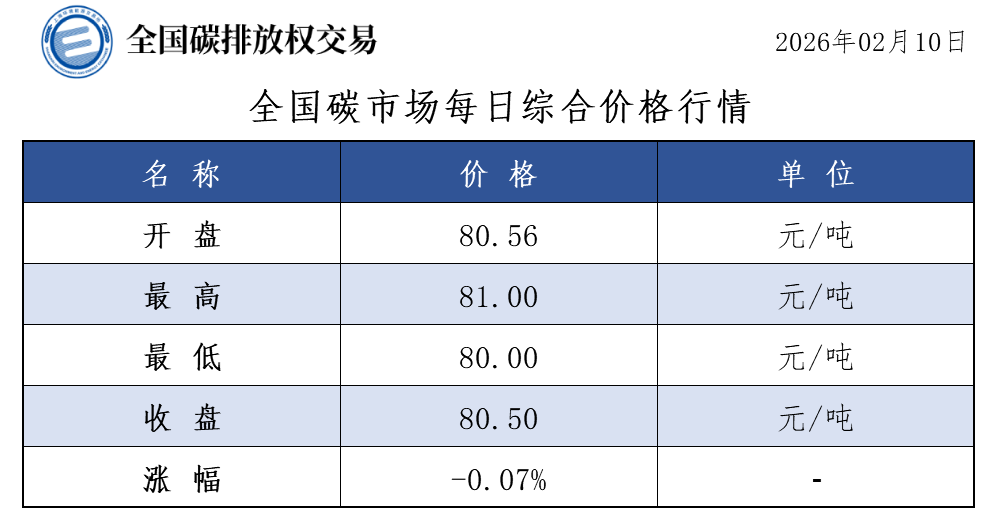
2月10日全国碳市场收盘价80.50元/吨 较前一日下跌0.07%
Xin Hua Cai Jing· 2026-02-10 08:05
Core Insights - The national carbon market in China reported a closing price of 80.50 yuan per ton on February 10, 2026, reflecting a decrease of 0.07% from the previous day [1][4]. Trading Data - The opening price was 80.56 yuan per ton, with a highest price of 81.00 yuan per ton and a lowest price of 80.00 yuan per ton [4]. - The total trading volume for carbon emission allowances today was 432,640 tons, with a total transaction value of 34,068,840.00 yuan [1]. - The volume for listed agreement trading was 32,640 tons, generating a transaction value of 2,628,840.00 yuan, while bulk agreement trading accounted for 400,000 tons and 31,440,000.00 yuan [1][5]. Cumulative Data - From January 1, 2026, to February 10, 2026, the total trading volume of carbon emission allowances reached 12,633,905 tons, with a cumulative transaction value of 928,560,251.80 yuan [1]. - As of February 10, 2026, the cumulative trading volume in the national carbon market stood at 877,500,425 tons, with a total transaction value of 58,591,178,483.37 yuan [1].

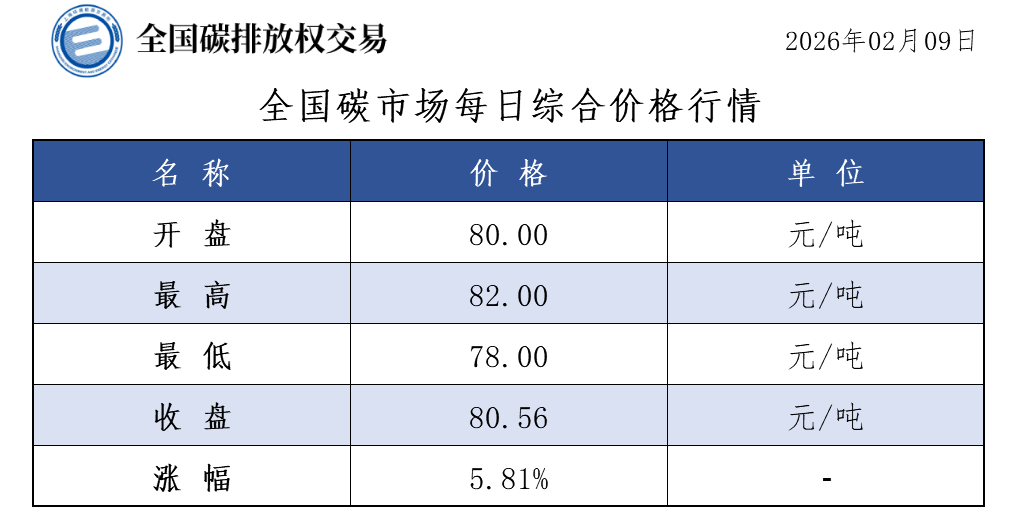
2月9日全国碳市场收盘价80.56元/吨 较前一日上涨5.81%
Xin Hua Cai Jing· 2026-02-09 08:52
Core Insights - The national carbon market in China saw a closing price of 80.56 yuan per ton on February 9, 2026, marking a 5.81% increase from the previous day [1][3]. Trading Data - The opening price was 80.00 yuan per ton, with a highest price of 82.00 yuan per ton and a lowest price of 78.00 yuan per ton [3]. - The total trading volume for the day was 531,676 tons, with a total transaction value of 42,055,756.00 yuan [1]. - The volume of carbon emission allowances traded from January 1, 2026, to February 9, 2026, reached 12,201,265 tons, with a total value of 894,491,411.80 yuan [1]. - Cumulatively, as of February 9, 2026, the total trading volume in the national carbon market was 877,067,785 tons, with a total transaction value of 58,557,109,643.37 yuan [1].
适当增强碳市场金融属性 进一步提升市场流动性
Xin Hua Cai Jing· 2026-02-09 08:12
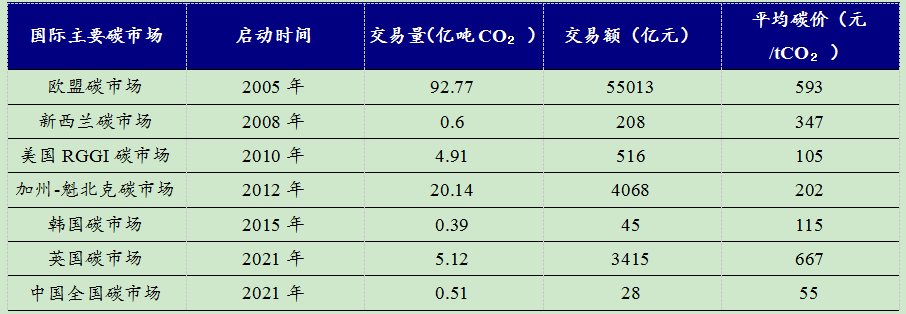
Core Viewpoint - The national carbon market in China, established in July 2021, has made significant progress but faces challenges such as insufficient market liquidity and pronounced tidal phenomena. The weak financial attributes of the market are identified as a key reason for this liquidity issue. The article suggests measures to enhance market liquidity and price discovery, including the introduction of financial institutions and carbon financial derivatives, drawing lessons from the EU carbon market experience [1][4][10]. Group 1: National Carbon Market Development - China has built the largest carbon market globally, covering approximately 4.5 billion tons of CO2 emissions from 2,162 key emission units in the power generation sector [3][4]. - The first administrative regulation in the carbon trading sector, the "Interim Regulations on Carbon Emission Trading," will take effect in May 2024, establishing the legal attributes and trading rules for carbon emissions [4]. - By March 2025, the national carbon market will include steel, cement, and aluminum industries, increasing the number of key emission units to about 3,700 and covering over 8 billion tons of CO2 emissions, accounting for more than 60% of China's total emissions [4]. Group 2: Market Liquidity Issues - The national carbon market's trading volume in 2023 was 2.12 million tons, with a turnover rate of approximately 3%, significantly lower than the EU carbon market's 93 billion tons and 417% turnover rate [4][5]. - The market exhibits tidal phenomena, with trading volumes concentrated in the fourth quarter, particularly near compliance deadlines, leading to low activity during non-compliance periods [4][8]. - The lack of financial attributes and the limited participation of financial institutions contribute to the market's low liquidity and price discovery issues [8][9]. Group 3: Recommendations for Improvement - Establish a collaborative regulatory mechanism between environmental and financial authorities to enhance the financial attributes of the carbon market, which could improve liquidity and price discovery [15]. - Gradually introduce financial institutions into the carbon market, starting with a few qualified entities to provide market-making services, followed by expanding the range of eligible investors as the market matures [16]. - Accelerate the development of standardized carbon financial derivatives, such as carbon futures, to improve market liquidity and reduce price volatility [17].
碳市场:迈向净零排放的变革性催化剂
科尔尼管理咨询· 2026-02-05 09:40
Core Insights - The carbon market is a trading platform that incentivizes organizations and individuals to offset their greenhouse gas emissions through the trading of carbon emission allowances or credits [1][3] - There are two main market mechanisms: compliance markets driven by government policies and voluntary markets for emission reductions [1][2] Group 1: Market Overview - As of the end of 2024, there are 36 operational carbon trading systems globally, with 14 under construction and 8 in planning stages, collectively regulating approximately 9.9 billion tons of CO2 equivalent, which accounts for 18% of global greenhouse gas emissions [3] - The growth of the global regulatory framework is expected to accelerate in the coming years due to factors such as ESG investment, new financial tools for market participation, and improved transparency in carbon credit quality [3][5] Group 2: Key Mechanisms - Cost-Optimal Emission Reduction: The carbon market enables countries to achieve emission reductions at the lowest cost by pricing carbon and allowing trading [6] - Cross-Border Coordination: Carbon markets facilitate international cooperation by connecting different jurisdictions' climate policies to meet emission targets [7] - Revenue Generation Mechanism: Governments can create revenue through the auctioning of emission allowances, which can be reinvested in climate action and clean energy projects, exemplified by the social climate fund under the EU carbon trading system [8] Group 3: Market Risks - Countries lacking effective carbon markets may face multiple risks, including trade barriers and investment losses, making participation in carbon markets crucial for companies to maintain compliance and financial stability [9] Group 4: Project Experience - The company has developed a comprehensive methodology for designing, developing, and implementing both types of carbon markets, with notable projects including establishing a joint venture for carbon credit approval in Gulf Cooperation Council countries and identifying opportunities for participation in the global carbon market for one of the largest trade areas [10]

今日全国碳市场收盘价较前一日上涨2.53%
Jin Rong Jie· 2026-02-02 08:33
Core Insights - The national carbon market's comprehensive price today opened at 81 yuan/ton, with a closing price of 81 yuan/ton, reflecting a 2.53% increase from the previous day [1] Trading Activity - Today's listed agreement trading volume was 19,010 tons, with a transaction value of 1.5398 million yuan; there were no large-scale agreement trades or unilateral bidding today [1] - The total trading volume of carbon emission allowances from January 1 to February 2, 2026, reached 10.954 million tons, with a total transaction value of 796 million yuan [1] - As of February 2, 2026, the cumulative trading volume of carbon emission allowances in the national carbon market was 876 million tons, with a cumulative transaction value of 58.459 billion yuan [1]
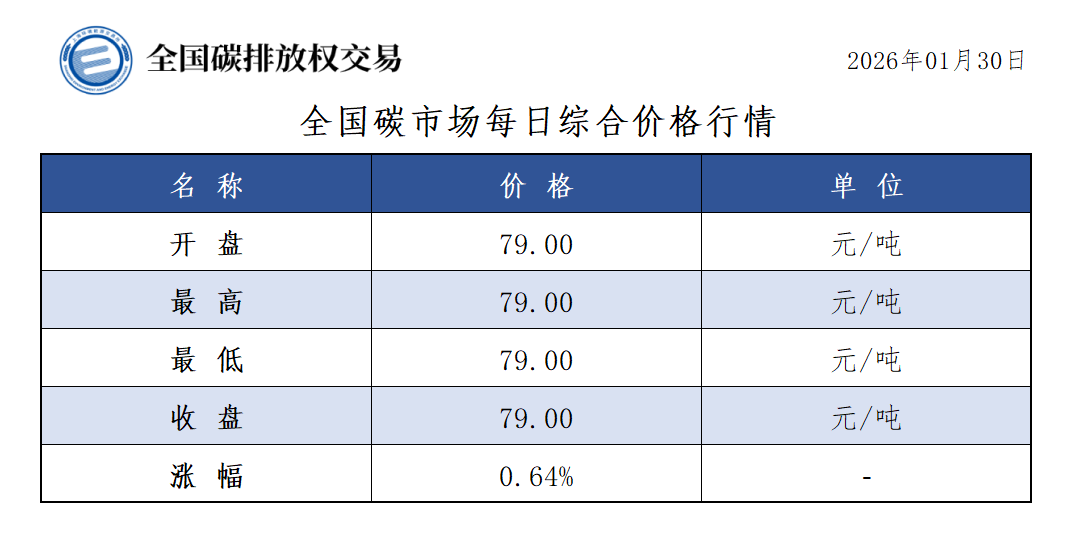
1月30日全国碳市场收盘价79.00元/吨 较前一日上涨0.64%
Xin Hua Cai Jing· 2026-01-30 08:38
Core Viewpoint - The national carbon market in China has shown a slight increase in trading prices, with the closing price on January 30 being 79.00 yuan per ton, reflecting a 0.64% rise from the previous day [1][4]. Trading Data Summary - The opening price for carbon emission allowances was 79.00 yuan per ton, with the highest and lowest prices also at 79.00 yuan per ton, and the closing price remaining the same [1][4]. - The total trading volume for the day was 100,100 tons, with a total transaction value of 8,047,900.00 yuan [1][5]. - The trading volume for the carbon emission allowances from January 1 to January 30, 2026, reached 10,935,009 tons, with a total transaction value of 794,730,241.80 yuan [1]. - Cumulatively, as of January 30, 2026, the total trading volume in the national carbon market was 875,801,529 tons, with a cumulative transaction value of 58,457,348,473.37 yuan [1].
三大改革破局 碳市场跑出绿色转型加速度
Jin Rong Shi Bao· 2026-01-21 02:06
Core Insights - The national carbon market in 2025 has shown significant growth, with 3,378 key emission units covering high-emission industries, achieving a total transaction volume of 865 million tons and a transaction value exceeding 57.6 billion yuan, marking a 24% year-on-year increase in trading volume [1] - The introduction of paid allocation has transformed emission reduction from a passive requirement to an active choice for enterprises, encouraging them to invest in technology upgrades and creating a positive feedback loop of reduction and profit [2] - Data quality management has become crucial for the carbon market, ensuring accurate tracking of emissions and enabling companies to identify reduction opportunities, thus enhancing market integrity and investor confidence [3] - Carbon finance has emerged as a vital support for green transformation, allowing companies to leverage carbon credits as tangible assets for financing, while also exploring innovative financial products to further facilitate emission reductions [4] Group 1: Market Performance - The national carbon market has recorded a total transaction volume of 865 million tons and a transaction value of over 57.6 billion yuan in 2025, with a 24% increase in trading volume year-on-year [1] - The compliance rate for carbon quota clearance reached 99.99%, indicating a robust operational status of the market [1] Group 2: Policy and Reform - The implementation of paid allocation has shifted the dynamics of the carbon market, compelling companies to actively engage in emission reductions to save costs [2] - The introduction of new methodologies and the registration of over 6,000 entities in the voluntary reduction market reflect ongoing reforms and innovations in the carbon market [1] Group 3: Data Management - The carbon market is advancing towards refined and intelligent data management, with monitoring systems achieving over 99% accuracy in emissions data [3] - The use of big data and blockchain technology in emission tracking enhances compliance and identifies key reduction points for companies [3] Group 4: Financial Support - Carbon finance allows companies to use carbon credits as collateral for loans, facilitating access to necessary funds for low-carbon technology investments [4] - The exploration of carbon futures and options is anticipated to further enhance financial mechanisms supporting emission reductions while ensuring regulatory safeguards against speculation [4]
绿色金融迈入“做强时代”:43.5万亿信贷、9千亿绿债背后的结构性转折
和讯· 2026-01-14 09:08
Core Viewpoint - China's green finance is undergoing a significant transition, shifting from a focus on quantity to efficiency and from policy-driven to mechanism-driven growth [2] Group 1: Green Credit - Green credit remains the core and stable pillar of China's green finance system, with a projected balance of approximately 43.5 trillion yuan by the end of Q3 2025, reflecting an 18.9% increase from 36.6 trillion yuan at the end of 2024 [3][6] - In the first three quarters of 2025, green loans contributed 6.47 trillion yuan to the total loan increment, accounting for 43.9% of the total loan growth, indicating a shift from a temporary policy tool to a normalized direction for bank lending [6] Group 2: Green Bonds - The green bond market has shown a significant recovery in 2025, with a cumulative issuance of approximately 914.9 billion yuan from January to November, surpassing the total of 681.4 billion yuan for 2024 and nearing the historical high of 2022 [7] - Financial institutions dominate the green bond issuance, with green financial bonds accounting for about 492.3 billion yuan, focusing on clean energy, green infrastructure, and low-carbon transition projects [7] Group 3: Carbon Market - As of November 2025, the cumulative transaction volume of the national carbon market reached 818 million tons, with a total transaction value of 54.575 billion yuan, reflecting a 23.81% year-on-year increase in transaction volume for 2025 [10] - The carbon market is characterized by stable transaction volumes but a downward trend in prices, indicating a "stable volume, weak price" market feature [10] Group 4: Strategic Transition - The period from 2024 to 2025 is identified as a critical transition point from "growth in quantity" to "optimization in structure" for green finance, with a shift in policy focus towards the quality of fund allocation, emission reduction performance, and risk constraints [13] - By 2026, green finance is expected to further establish its "infrastructure-type" position within the financial system, transitioning from thematic investments to long-term asset allocations [13]