
科技创新券

Search documents
发挥政策集成效应 全方位推动高质量发展
Xin Lang Cai Jing· 2026-01-27 23:08
Core Viewpoint - The report on the budget execution for 2025 and the draft budget for 2026 emphasizes the implementation of proactive fiscal policies to support economic recovery and development in Fujian Province. Fiscal Policy Effectiveness - In 2025, the local general public budget revenue is projected to be 372.335 billion yuan, an increase of 3%, while the general public budget expenditure is expected to reach 614.87 billion yuan, growing by 1.1% [2]. Investment and Consumption - The government plans to increase the new debt limit by 263.3 billion yuan, a 17% rise, to support major strategic implementations and infrastructure projects [3]. - A total of 98.5 million yuan will be allocated for consumer goods replacement programs, with an additional 17.38 million yuan in matching funds [3]. Financial Collaboration - The establishment of a 130 billion yuan government guidance fund matrix is underway, along with a 50 billion yuan social security innovation fund [4]. - The government aims to support 196,600 small and micro enterprises through a financing guarantee system [4]. Technological and Industrial Innovation - A total of 8.96 billion yuan will be allocated to support the operation of provincial innovation laboratories [5]. - Over 1 billion yuan is designated for the development of innovative pharmaceuticals and medical devices [5]. Social Welfare and Employment - Social welfare spending is prioritized, with 4.766 billion yuan allocated for public welfare, accounting for 77.5% of the general public budget expenditure [6]. - Employment policies will receive 975 million yuan to support various employment initiatives [7]. Rural and Urban Development - A total of 20.62 billion yuan is earmarked to consolidate poverty alleviation achievements and promote rural revitalization [9]. - Urban infrastructure projects will receive 15.15 billion yuan for affordable housing initiatives [9]. Environmental Protection - The budget includes 18.8 billion yuan for ecological protection and 13.4 billion yuan for pollution prevention initiatives [10]. - A focus on green low-carbon development is highlighted, with 1.38 billion yuan allocated for promoting green manufacturing [10]. Governance and Financial Management - The report emphasizes the need for improved governance and financial management, including the optimization of fiscal supervision and risk prevention [11]. 2026 Budget Overview - The total planned expenditure for 2026 is 508.934 billion yuan, with specific allocations for various budget categories [12]. Key Areas of Focus for 2026 - The budget will support the growth of the real economy, enhance domestic demand, and promote high-level openness and reform [13][14].
省政府系统承办省政协十三届三次会议提案全部办结
Shan Xi Ri Bao· 2026-01-25 00:24
Group 1: Proposal Handling and Government Response - A total of 801 proposals were submitted to the provincial government system, accounting for 94.1% of the total proposals filed since the third session of the 13th Provincial Political Consultative Conference [1] - The provincial government leaders supervised 15 proposals related to high-quality development, public interest, and social concerns, enhancing the effectiveness of proposal handling [1] - The government has standardized the processes of proposal handling, ensuring effective communication and implementation across various departments [1] Group 2: Economic Development Initiatives - Proposals aimed at improving the three-in-one education system in Shaanxi and accelerating technology transfer have led to the establishment of 1,013 transformation enterprises and a technical contract transaction volume exceeding 500 billion [2] - The signing of 215 technology innovation projects during key forums amounted to a total value of 16.743 billion, attracting well-known companies to collaborate in Shaanxi [2] Group 3: Social Welfare and Elderly Care - Measures to enhance community elderly care services have been implemented, including the establishment of over 16,000 elderly care institutions and facilities, and the construction of 4,591 elderly meal service points [2] - A "one-quarter-hour elderly service consumption circle" has been created to ensure quality services are accessible to the elderly [2] Group 4: Environmental Protection Efforts - The government has initiated a plan to protect the Qinling Mountains, allocating 350 million for projects aimed at safeguarding water sources and improving ecological quality [3] - A comprehensive monitoring system has been established to ensure the protection of the Qinling ecological environment through joint law enforcement actions [3] Group 5: Business Environment Optimization - The provincial government has introduced a 2025 action plan to enhance the business environment, focusing on legal and market-oriented reforms [4] - Measures to streamline administrative processes have resulted in an average optimization rate of 73.1% for business handling procedures [4]
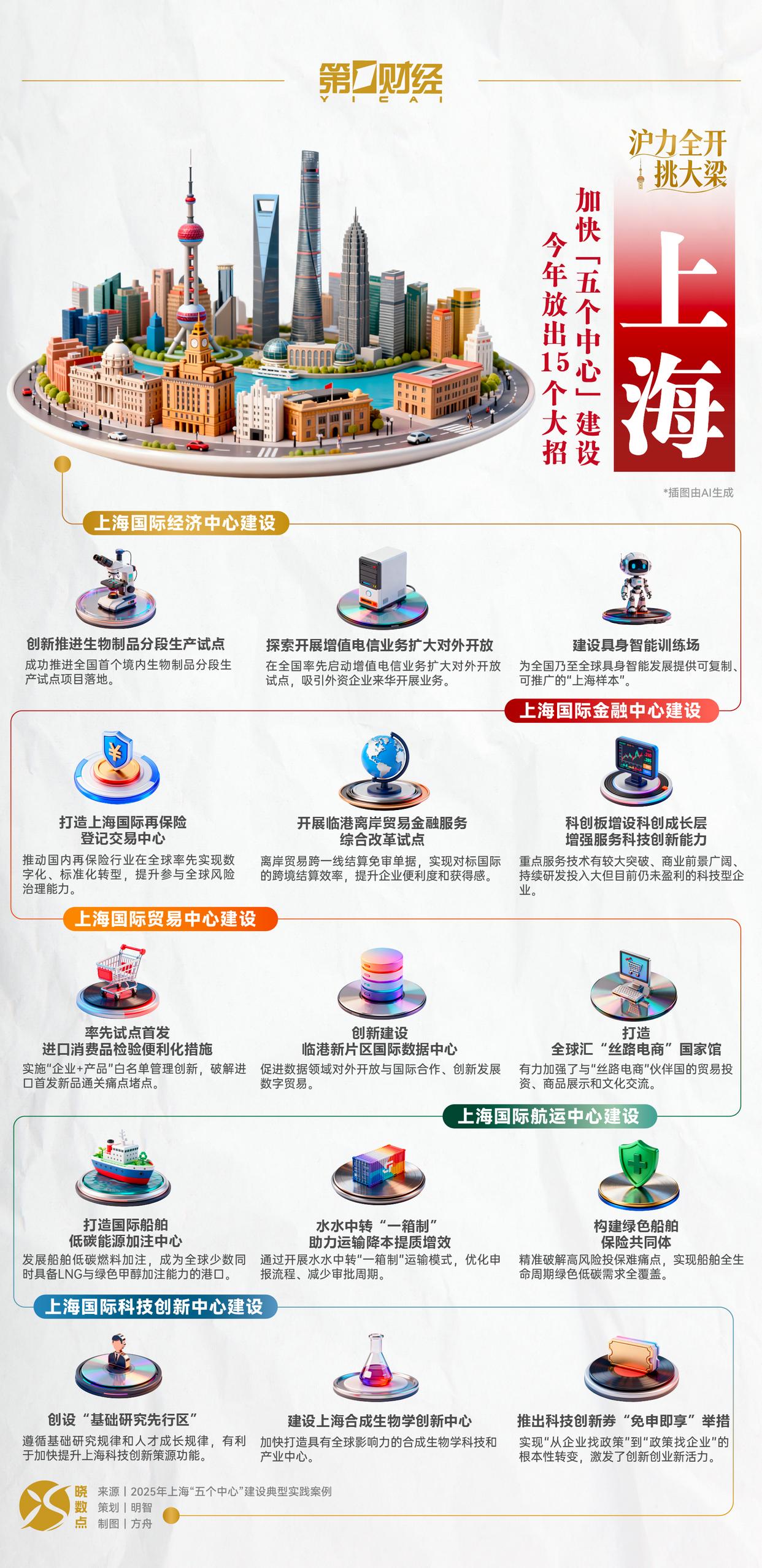
加快“五个中心”建设,上海今年放出15个大招
Di Yi Cai Jing· 2025-12-09 03:19
Group 1: Shanghai International Economic Center Development - The successful launch of China's first domestic segmented production pilot project for biological products [2] - Initiation of a pilot program for expanding value-added telecommunications services to attract foreign investment [2] - Establishment of a digital and standardized transformation in the domestic reinsurance industry to enhance global risk governance capabilities [2] Group 2: Shanghai International Trade Center Development - Implementation of a "white list" management innovation for the inspection of imported consumer goods to streamline customs clearance for new products [4] - Development of an international data center in the Lingang New Area to promote data openness and international cooperation in digital trade [4] - Creation of a low-carbon energy refueling center for ships, positioning Shanghai as one of the few ports capable of LNG and green methanol refueling [4] Group 3: Shanghai International Technology Innovation Center Development - Establishment of a "basic research pilot zone" to enhance Shanghai's technological innovation capabilities [5] - Development of a synthetic biology innovation center to create a globally influential technology and industry hub [5] - Introduction of innovation vouchers that shift the approach from "finding policies from enterprises" to "policies finding enterprises," stimulating innovation and entrepreneurship [5]

打通科技创新券落地“最后一米”
Sou Hu Cai Jing· 2025-11-21 20:37
Group 1 - The policy of technology innovation vouchers is being effectively implemented, providing financial support to enterprises for technological breakthroughs [1] - The innovation vouchers are issued by the municipal science and technology committee and the Zhongguancun management committee to eligible sci-tech enterprises, aimed at revitalizing technological resources and reducing research costs for small and micro enterprises [1] - Companies attending the event, from various sectors such as information technology, smart manufacturing, and green energy, expressed that they often miss out on subsidies due to a lack of understanding of the policies [1] Group 2 - The event was co-hosted by the Zhongguancun High-tech Industry Promotion Center and other organizations, focusing on breaking information asymmetry to ensure enterprises not only know about the innovation vouchers but also utilize them effectively [2] - The service port initiative aims to optimize the business environment and provide comprehensive lifecycle services to enterprises [2]
深入推进长三角一体化发展
Jing Ji Ri Bao· 2025-10-18 22:11
Core Insights - The Yangtze River Delta (YRD) region has seen continuous improvement in overall strength and competitiveness since the implementation of the integration development strategy, with a GDP of 33.1691 trillion yuan in 2024, reflecting a growth of 5.5% year-on-year [1][2][3]. Economic Performance - In 2024, the YRD's GDP reached 33.1691 trillion yuan, accounting for 24.6% of the national total, with a contribution rate of approximately 30% to national economic growth [2][3]. - The YRD's total import and export value was 16.01 trillion yuan in 2024, marking a year-on-year increase of 5.6%, contributing 52.3% to national export growth in the first eight months of the year [3][13]. Innovation and Industry Development - The YRD has strengthened its technological innovation and industrial collaboration, becoming a key driver of high-quality national economic development, with significant advancements in quantum computing, domestic aircraft, and industries like integrated circuits and biomedicine [3][4]. - The region has established a collaborative innovation system, focusing on key technology research and development in fields such as integrated circuits, biomedicine, and artificial intelligence [4][11]. Infrastructure and Platform Development - The YRD has implemented a series of institutional innovations through major functional platforms, enhancing systemic mechanisms and achieving significant breakthroughs in key areas [5][12]. - The Shanghai Free Trade Zone has seen an average GDP growth of 17.6% from 2019 to 2024, with industrial output value growing at an average of 28.4% [5]. Environmental Cooperation - The YRD has made progress in ecological environment cooperation, focusing on joint governance of air and water quality, with PM2.5 levels averaging 33.0 micrograms per cubic meter in 2024, a 31.4% decrease from 2017 [18][20]. - The region has established a collaborative ecological protection mechanism, promoting biodiversity and enhancing ecological system integrity [19][20]. Open Cooperation and Trade - The YRD has become a model for collaborative openness, achieving a total import and export value of 16.01 trillion yuan in 2024, which accounts for 36.5% of the national total [13][14]. - The region has actively participated in international trade, with exports to Belt and Road countries reaching 7.7 trillion yuan, representing 34.9% of the national total [15].
企业购买科技创新服务最高获20万元补贴
Liao Ning Ri Bao· 2025-08-23 00:22
Group 1 - The core viewpoint of the news is the introduction of the technology innovation voucher system in Liaoning Province, which aims to alleviate the funding challenges faced by small and medium-sized technology enterprises by providing government subsidies for purchasing technology services [1][2] - The newly implemented "Liaoning Province Technology Innovation Voucher Management Measures (Trial)" outlines the framework for the innovation voucher program, emphasizing its role in promoting open sharing of technology resources and reducing innovation costs for enterprises [1][3] Group 2 - Eligible enterprises for the innovation vouchers include technology-based companies registered in Liaoning Province with independent legal status, sound financial management, and no significant safety or quality incidents in the previous accounting year [2] - The innovation vouchers can be used for various technology innovation services, including research and development, technology transfer, testing, pilot verification, and sharing of large scientific research instruments [3] - The support amount for innovation vouchers is capped at 20,000 yuan per year per enterprise, covering up to 30% of the actual expenses incurred for purchasing technology innovation services, with a minimum application amount of 1,000 yuan [3]
全国政协常委周汉民:长三角G60科创走廊科技创新模式为区域协同提供了经验与借鉴
Zheng Quan Shi Bao Wang· 2025-08-19 05:20
Core Insights - The G60 Science and Technology Innovation Corridor serves as a model for regional collaborative development, positively impacting economic growth and providing valuable experiences for national and global technological innovation [1][2] Group 1: Institutional Innovation - The G60 Corridor breaks down administrative barriers and enhances resource sharing through innovative institutional mechanisms, such as the "central-local linkage, provincial and municipal support, and regional collaboration" model [2] - The establishment of a cross-regional knowledge property protection center exemplifies the innovative mechanisms that facilitate national collaborative development [2] Group 2: Economic Empowerment - The G60 Corridor enhances industrial competitiveness and innovation capabilities, focusing on strategic industries like aerospace, quantum communication, and artificial intelligence [3] - The region has accumulated 1,262 key laboratories and 36,500 high-tech enterprises, with companies listed on the Sci-Tech Innovation Board accounting for 20% of the national total, indicating a shift from "follower innovation" to "leading innovation" [3] Group 3: Social Contribution - The Corridor fosters a shared innovation ecosystem through talent mobility and public service sharing, establishing a talent integration development alliance [3] - The "1 + 365" technology achievement auction mechanism supports small and medium-sized enterprises with an annual transaction volume exceeding 30 billion [3] Group 4: Strategic Significance - The G60 Corridor acts as a core engine for the Yangtze River Delta integration, contributing 6.67% of the national GDP and 12.5% of the national import and export volume [4] - It provides a replicable collaborative path for national regional coordination development strategies [4] Group 5: Theoretical Practice - The G60 Corridor validates innovation ecosystem theories and explores the collaborative paradigm of "effective market + proactive government" [4] - It demonstrates the feasibility of "open innovation" theories at a regional scale through a comprehensive ecosystem from basic research to industrial collaboration [4] Group 6: Ecological Restructuring - The Corridor establishes a new paradigm of "innovation community" through efficient resource allocation and dynamic coupling of innovation and industrial chains [5] - It promotes the "on-demand flow" of technology, capital, and talent through cross-regional collaboration [5] Group 7: Industrial Upgrade - The G60 Corridor strengthens supply chain resilience and accelerates the transformation of old and new driving forces in strategic industries [6] - Traditional manufacturing is being digitally empowered to achieve comprehensive transformation [6] Group 8: Institutional Experimentation - The Corridor pioneers the "cross-regional technology innovation voucher" system, allowing enterprises to purchase technology services across cities [6] - It innovates governance models to avoid inefficiencies associated with administrative dominance [6] Group 9: Global Governance - The G60 Corridor promotes the internationalization of the innovation corridor model and enhances participation in global rule-making [6] - It has been referenced by regions in Southeast Asia and Africa, showcasing its global influence [6] Future Outlook - The G60 Corridor aims to upgrade to a "global innovation network hub," facilitating China's transition from a "world factory" to a "global innovation highland" [7] - Continued research and promotion of this model are recommended to unlock its potential for other regions [7]
长三角“握指成拳” 一体化立法促进科技创新协同发展
Shang Hai Zheng Quan Bao· 2025-08-01 18:50
Group 1 - The core viewpoint emphasizes the need for a collaborative mechanism to enhance the original innovation capabilities in the Yangtze River Delta, supported by national strategic technology forces and high-level innovation platforms [1][2] - The decision outlines the establishment of a joint fund for basic research in the Yangtze River Delta, promoting cross-regional and interdisciplinary collaboration for application-oriented research [2][3] - The initiative aims to strengthen financial support for innovation, introducing comprehensive financial services for technology enterprises throughout their lifecycle [3][4] Group 2 - The Yangtze River Delta region has seen significant growth in R&D investment intensity, projected to reach 3.33% by the end of 2024, with a notable increase in domestic invention patent cooperation applications [4] - Over 5,000 enterprises have applied for the Yangtze River Delta innovation vouchers, with total service amounts exceeding 550 million yuan and support amounts over 180 million yuan [4] - The G60 Science and Technology Innovation Corridor is committed to deepening the integration of technology innovation and industrial innovation, aiming to build a world-class industrial cluster and a top-tier innovation ecosystem [5]
辽宁试行科技创新券 企业每年最高可领20万元补贴
Sou Hu Cai Jing· 2025-07-12 00:30
Core Points - The Liaoning Provincial Science and Technology Department has issued the "Liaoning Province Science and Technology Innovation Voucher Management Measures (Trial)" to enhance the guiding role of innovation vouchers and optimize financial support for technology-driven enterprises [1] - The innovation vouchers are designed to support technology-based companies in purchasing innovation services from service institutions using provincial financial science and technology funds [1][2] - The program encourages local governments to establish their own innovation vouchers, promoting collaboration between provincial and municipal levels to support technological innovation [1] Summary by Categories - **Target Audience**: The innovation vouchers are aimed at technology-based enterprises registered in Liaoning Province that have independent legal status and relevant R&D capabilities [2] - **Eligibility Criteria**: Eligible companies include those listed in the "National Technology-based Small and Medium-sized Enterprises Information Database," provincial-level "Eagle," "Unicorn," and "Manufacturing Champion" enterprises, as well as other recognized innovative small and medium-sized enterprises [2] - **Support Scope**: The vouchers cover expenses related to R&D innovation projects, including purchasing services for research and development, technology transfer, testing, pilot verification, and sharing of large scientific research instruments [2] - **Funding Limits**: The support amount is capped at 30% of the actual expenses incurred for purchasing innovation services, with a minimum application amount of 1,000 yuan and a maximum annual support limit of 200,000 yuan per enterprise [1][2]
上海:优化财政科研经费和科技创新券支持方式,推动科技创新券扩围增类
news flash· 2025-05-22 06:08
Group 1 - The Shanghai Municipal Government Office released opinions on further deepening reform and innovation to accelerate the high-quality development of the technology service industry [1] - The initiative includes expanding the categories of technology innovation vouchers to include concept verification, technology insurance, patent agency, and technology consulting [1] - The government aims to accelerate the "no application, immediate enjoyment" and "direct access, quick enjoyment" reforms, establishing a mechanism for rewarding and penalizing to enhance the quality and efficiency of technology service institutions serving enterprises [1] Group 2 - Technology service enterprises will be included in the "Shanghai Science Special Loan" and "Shanghai Science Special Subsidy" support scope to reduce loan costs for enterprises [1] - The subsidy ratio for the "performance loan" insurance for technology service enterprises will be increased, guiding commercial banks to enhance medium- and long-term credit support for enterprises [1]