
第二代AION V

Search documents
中汽协:全年出口有望冲刺700万辆
Bei Jing Ri Bao Ke Hu Duan· 2025-12-11 16:20
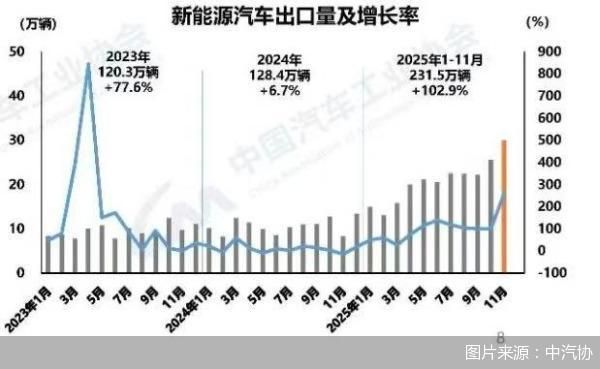
转自:北京日报客户端 新能源汽车是驱动市场增长的核心引擎,而出口则成为销量增长另一大亮点。12月11日,中国汽车工业 协会(以下简称"中汽协")发布的数据显示,今年前11个月汽车出口量达634.3万辆,同比增长18.7%。 其中,今年11月汽车出口72.8万辆,环比增长9.3%,同比增长48.5%,单月出口量首次超过70万辆。 崔东树表示,由于海外销售利润较高,"不出海就出局"的趋势明显,企业出口强势增长超预期。下半年 以来中国汽车出口局面持续向好,自主新能源的海外市场认可度不断提升,海外营销网络快速扩张,部 分海外市场增长良好。 车企出海速度明显加快之外,出口方式也正从单一的整车出口转向"本地化生产+全球化服务"的方向。 目前,包括上汽、长安、广汽、比亚迪等头部中国车企,都已有或计划建设海外生产基地,并同步在全 球建立了多个研发中心。 中汽协副秘书长陈士华表示,展望全年,汽车内需市场在政策组合效应推动下有效改善,新动能加快释 放,对外贸易呈现出较好韧性,汽车产销量全年有望再创历史新高。其中,今年汽车出口有望冲击700 万辆。 作为中国外贸商品"新三样"之一的新能源汽车,在汽车出口中的占比也在提升。今年前11 ...



月销首破70万辆,中汽协:全年出口有望冲刺700万辆
Bei Jing Shang Bao· 2025-12-11 14:41
车企出海速度明显加快之外,出口方式也正从单一的整车出口转向"本地化生产+全球化服务"的方向。 目前,包括上汽、长安、广汽、比亚迪等头部中国车企,都已有或计划建设海外生产基地,并同步在全 球建立了多个研发中心。 早在去年,广汽埃安宣布,泰国智能工厂正式竣工,旗下首款全球战略车型——第二代AION V也进行 全球同步下线。据悉,该智能工厂一期年产能5万辆,未来年产能将逐步升至10万辆,可实现第二代 AION V、AION Y Plus、昊铂HT等多款广汽埃安车型共线生产。 新能源汽车是驱动市场增长的核心引擎,而出口则成为销量增长另一大亮点。12月11日,中国汽车工业 协会(以下简称"中汽协")发布的数据显示,今年前11个月汽车出口量达634.3万辆,同比增长18.7%。 其中,今年11月汽车出口72.8万辆,环比增长9.3%,同比增长48.5%,单月出口量首次超过70万辆。 中汽协副秘书长陈士华表示,展望全年,汽车内需市场在政策组合效应推动下有效改善,新动能加快释 放,对外贸易呈现出较好韧性,汽车产销量全年有望再创历史新高。其中,今年汽车出口有望冲击700 万辆。 "插混和普混替代纯电动成为出口增长的新增长点,尤 ...

2025慕尼黑车展上的“中国主场”:从产品出口到生态出海
2 1 Shi Ji Jing Ji Bao Dao· 2025-09-15 13:09
Core Insights - Chinese automotive companies have significantly increased their presence at the 2025 Munich Auto Show, showcasing a larger and more active participation compared to previous years, effectively becoming the focal point of the event [1][2][5] Group 1: Participation and Exhibits - The 2025 Munich Auto Show featured 748 exhibitors, with 116 from China, accounting for nearly one-third of all overseas exhibitors, marking a 40% increase from 2023 [2] - Major Chinese automotive brands such as BYD, Xpeng, Changan, and others presented new models and technologies, positioning themselves as key players rather than mere participants [2][3] - Notable exhibits included BYD's new vehicles and fast-charging technology, Xpeng's advanced models and robotics, and Changan's new concept car, highlighting the innovation and competitiveness of Chinese brands [2][3] Group 2: Strategic Shifts - Chinese automotive companies are transitioning from simple product exports to localized production and ecosystem development in Europe, with five companies announcing plans to build factories in Europe by 2025, involving over €20 billion in investments [3][5] - Collaborations with major European automakers like Volkswagen and Stellantis are facilitating faster adaptation to local market demands for companies like Xpeng [3][4] Group 3: Supply Chain and Technology - Chinese supply chain companies are emerging as key technology providers, particularly in battery and smart technology sectors, with firms like CATL showcasing advanced battery solutions that meet significant European demand [4][5] - Innovations in smart technology were highlighted by companies such as Horizon Robotics and Heisai Technology, which presented cutting-edge products and established partnerships with global automakers [4][5] Group 4: Future Outlook - The shift towards localized production and ecosystem development is expected to enhance the long-term competitiveness of Chinese automotive companies in the global market, moving from product output to ecosystem output [5][6] - The competitive landscape between Chinese and German automotive companies is evolving, with a focus on strategic collaboration and understanding user needs as key to success in the future [6]
泰国电动车市场是蓝海还是红海
Zhong Guo Qi Che Bao Wang· 2025-06-09 03:41
Core Insights - The International Energy Agency's report recognizes China's leading position in the electric vehicle (EV) market and highlights the significant role of Chinese EV exports in expanding into emerging markets, particularly in Thailand, where Chinese products hold a 75% market share [4][5][8] - Despite the high production capacity of over 500,000 EVs planned in Thailand, the annual registration of EVs is only around 70,000, indicating a potential oversupply issue for Chinese automakers in the Thai market [4][8][9] Industry Overview - Thailand is solidifying its status as a major EV manufacturing hub in Southeast Asia, with production capacity exceeding 500,000 units, largely due to the active investments of Chinese automakers [5][6] - The Thai government has implemented various incentives, including the EV 3.0 policy, which reduces import tariffs by up to 40% to encourage local production and aims for 30% of vehicle production to be electric by 2030 [5][6] Company Developments - Several Chinese automakers, including BYD, Neta, GAC Aion, Changan, and Great Wall, have established manufacturing facilities in Thailand, with planned capacities exceeding 600,000 units [5][6][7] - BYD's factory in Thailand is set to produce 150,000 units, primarily the Dolphin model, while GAC Aion's facility will start with a capacity of 50,000 units, expanding to 100,000 [6][7] - Changan's factory has an initial capacity of 100,000 units, with plans to increase to 200,000, and it will also produce various models including hybrids and fuel vehicles [6][7] Market Challenges - The Thai automotive market is experiencing a decline, with a projected 2024 vehicle sales drop of 26.09% to 572,700 units, and a 20% decrease in production, marking a four-year low [8][9] - The electric vehicle registration in Thailand is expected to decline by 8.1% in 2024, marking the first drop since 2020, despite the strong performance of Chinese brands like BYD [8][9] Future Outlook - Industry experts warn of a potential oversupply crisis in the Thai EV market, with production capacity expected to exceed market demand by over 60% [9][10] - However, there is optimism regarding the long-term potential of the Thai and Southeast Asian markets, with predictions of a 1.5% to 2.5% growth in automotive production and sales in 2024 [9][11] - Chinese automakers are encouraged to deepen localization efforts beyond just establishing factories, focusing on long-term strategies that include product planning and supply chain development [11][12]
