算网大脑

Search documents
国资委发声!涉及新央企、重组整合、人工智能
21世纪经济报道· 2026-01-28 10:42
Core Viewpoint - The article highlights the ambitious goals set for central enterprises in China by 2025, focusing on asset growth, profit generation, fixed asset investment, and tax contributions, while emphasizing the importance of technological innovation and strategic investments in emerging industries [1][2]. Group 1: Economic Goals and Performance - By the end of 2025, central enterprises are expected to achieve total assets exceeding 95 trillion yuan, with profits reaching 2.5 trillion yuan, fixed asset investments of 5.1 trillion yuan, and tax contributions of 2.5 trillion yuan [1]. - Central enterprises will invest 1.1 trillion yuan in R&D by 2025, maintaining over 1 trillion yuan in annual R&D spending for four consecutive years [1]. - Strategic investments in emerging industries will total 2.5 trillion yuan, accounting for 41.8% of total investments by 2025 [1]. Group 2: Industry Development and Innovation - The focus is on building new pillar industries through market-oriented platforms, particularly in sectors like renewable energy, new materials, aerospace, and quantum technology [2]. - The development of strategic emerging industries is crucial for enhancing national security and global competitiveness, with central enterprises playing a key role in technological innovation and industry control [2][8]. - Central enterprises are expected to generate over 12 trillion yuan in revenue from strategic emerging industries by 2025, achieving an annual growth of 1 trillion yuan [7]. Group 3: Restructuring and Integration - The restructuring of central enterprises is a priority, with efforts to form new enterprises and strategically reorganize existing ones to enhance competitiveness in key sectors [4][5]. - Professional integration will be promoted to support strong innovative companies in consolidating similar businesses and optimizing supply chains [5]. - The government aims to facilitate high-quality mergers and acquisitions to acquire core resources and accelerate the development of strategic emerging industries [5]. Group 4: AI and Technological Advancements - Central enterprises are focusing on artificial intelligence as a key area for development, with significant progress in application scenarios and computing power [9]. - The government plans to enhance AI initiatives, including the establishment of an AI industry community and optimizing data supply for various sectors [10]. - By 2026, the focus will be on implementing the "15th Five-Year Plan" to accelerate the layout of emerging industries and seize competitive advantages [10]. Group 5: Strategic Focus for 2026 - The central enterprises will emphasize quality improvement and efficiency, aiming for sustained value growth and alignment with national GDP growth [12]. - There will be a strong focus on technological innovation, optimizing layouts, and enhancing risk management to support high-quality development [13][14]. - The government will continue to push for reforms to stimulate the vitality of central enterprises and ensure effective risk prevention mechanisms are in place [14].


国资委发声!涉及新央企、重组整合、人工智能
2 1 Shi Ji Jing Ji Bao Dao· 2026-01-28 09:36
Core Insights - By the end of 2025, central enterprises are projected to have total assets exceeding 95 trillion yuan, with total profits reaching 2.5 trillion yuan and fixed asset investments of 5.1 trillion yuan, contributing significantly to the economic and social development goals of China [1] - In terms of technological innovation, central enterprises are expected to invest 1.1 trillion yuan in R&D by 2025, maintaining over 1 trillion yuan in annual investment for four consecutive years, and adding 22 academicians, achieving a historical high [1] - The investment in strategic emerging industries by central enterprises is projected to reach 2.5 trillion yuan by 2025, accounting for 41.8% of total investments [1] Group 1: Industry Development and Strategic Focus - The restructuring and integration of central enterprises, along with the focus on "AI+" and emerging industries, are key themes highlighted in the recent press conference [2] - The main goal in building a modern industrial system is to create a number of emerging pillar industries, with a focus on sectors such as new energy, new energy vehicles, new materials, aerospace, and quantum technology [2][4] - The development of new industries is seen as crucial for enhancing global competitiveness and ensuring national development security [2] Group 2: Restructuring and Integration Efforts - The State-owned Assets Supervision and Administration Commission (SASAC) plans to advance the restructuring and integration of central enterprises, focusing on energy security and green development [4] - New central enterprises are being formed, such as the China Yajiang Group and China Chang'an Automobile Group, to reshape competition in the automotive industry and promote high-quality development in smart connected vehicles [4][6] - The SASAC aims to optimize the layout and structure of state-owned capital through strategic mergers and acquisitions, enhancing core competitiveness [6] Group 3: Investment in Emerging Industries - By 2025, revenue from strategic emerging industries of central enterprises is expected to exceed 12 trillion yuan, with a consistent annual growth of 1 trillion yuan [7] - Significant investments have been made in integrated circuits, biotechnology, and new energy vehicles, with a focus on maintaining advantages in high-end equipment manufacturing and new communication technologies [7] - The cumulative investment in strategic emerging industries has surpassed 10 trillion yuan, increasing their share of total investments from 22% to over 40% since the beginning of the 14th Five-Year Plan [7] Group 4: AI and Technological Advancements - Central enterprises are focusing on artificial intelligence as a key area for development, with over a thousand application scenarios created in collaboration with leading companies [9] - The establishment of computing power clusters and intelligent computing service platforms aims to support large model training and provide standardized computing services [9] - Future initiatives include the formation of an "AI+" industry community and the optimization of data supply in key sectors such as transportation, energy, and finance [9] Group 5: Goals for the 14th Five-Year Plan - The SASAC has outlined five key areas for strengthening the high-quality development of central enterprises, including enhancing efficiency, promoting technological innovation, optimizing layouts, advancing reforms, and strengthening risk prevention [12][14] - The focus will be on ensuring continuous growth in value added and aligning with national GDP growth, while also improving operational indicators [12] - Emphasis will be placed on strategic investments in key industries and public services, as well as fostering innovation and collaboration to drive economic growth [12][14]
直真科技:定增申请获审核通过 拟募资6.62亿元加码自智网络与算力网络布局
Sou Hu Cai Jing· 2025-12-12 11:59
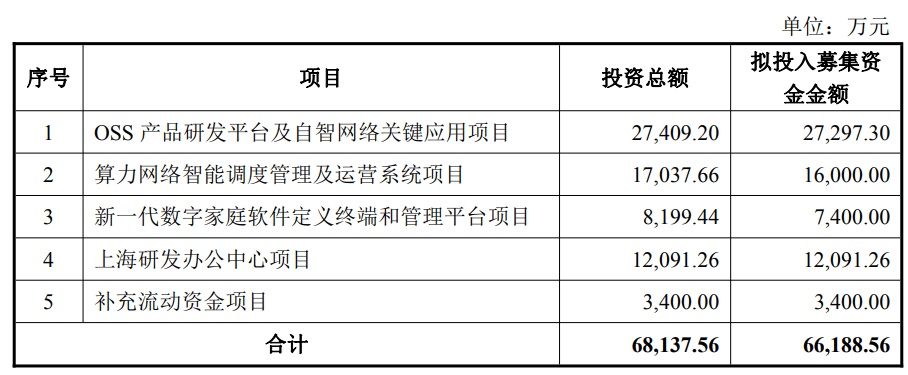
Core Viewpoint - The company plans to raise up to 662 million yuan through a targeted stock issuance, focusing on the development of OSS product platforms and intelligent network applications, aiming to strengthen its core business competitiveness and explore new growth opportunities in line with the digital transformation trend in the telecommunications industry [1]. Fundraising Details - The total investment amount for the projects is 6.813756 billion yuan, with the raised funds allocated as follows: 2.73 billion yuan for OSS product R&D and intelligent network applications, 1.6 billion yuan for intelligent scheduling management systems, 740 million yuan for next-generation digital home software-defined terminals, 1.21 billion yuan for the Shanghai R&D office center, and 340 million yuan for working capital [3][4]. - The issuance will target no more than 35 qualified investors, with a maximum of 31.2 million shares to be issued, accounting for 30% of the company's total share capital before issuance [3]. Project Allocation - 2.73 billion yuan will enhance 15 existing OSS products to improve automation and intelligence in network operations [4]. - 1.6 billion yuan will develop nine product modules, including a computing controller, to support the "East Data West Computing" strategy [4]. - 740 million yuan will introduce SDN technology for home gateway management, aiding telecom operators in upgrading their digital home services [4]. - 1.21 billion yuan will be used for the construction of the Shanghai R&D office center to improve the working environment and attract talent [4]. - 340 million yuan will optimize the capital structure and support business expansion [4]. Company Position - As a core supplier in the OSS field for telecom operators, the company has a strong foothold in the ICT management sector, serving major operators like China Mobile and China Telecom, with software development and technical services accounting for over 95% of revenue from January to September 2025 [4].

AI算力从“堆硬件”走向“拼效率” 产业链企业合力破解算网融合协同难题
Zheng Quan Ri Bao Zhi Sheng· 2025-05-28 16:42
Core Insights - The rapid expansion of AI computing power in China is highlighted, with the current capacity reaching 3000P for training and 1000P for inference, and over 250 innovative solutions developed across various sectors [1] - The integration of computing power and network technology, referred to as "算网融合" (computing-network integration), is identified as a critical path for addressing the growing demand for AI computing resources and enhancing computational efficiency [3][6] - The Chinese intelligent computing power market is projected to grow significantly, with estimates indicating a market size of $25.9 billion by 2025, reflecting a 36.2% increase from 2024 [2] Industry Growth and Trends - The intelligent computing power scale in China is expected to reach 1037.3 EFLOPS by 2025, representing a 43% increase from 2024, and is projected to double by 2026 [2] - The compound annual growth rate (CAGR) for China's intelligent computing scale from 2023 to 2028 is forecasted at 46.2%, indicating a strong trend towards large and super-large intelligent computing centers [2] - The demand for AI models is driving a significant increase in computing power requirements, with current needs exceeding hardware supply by over 200 times [3] Technological Developments - Companies are focusing on transforming data centers into intelligent computing centers, emphasizing the need for efficient, green, and high-performance solutions [4][5] - Huawei is leveraging advanced technologies such as zero-loss networking and intelligent computing network scheduling to enhance computing resource utilization from 40% to 75% [5] - The integration of distributed computing architecture, low-latency networks, and virtualization technologies is essential for achieving high-quality development in computing power [6] Market Dynamics - The competition among enterprises for intelligent computing resources is intensifying, with a focus on optimizing computing infrastructure and enhancing service capabilities [5] - The shift from hardware-centric approaches to efficiency-driven models in AI computing is becoming evident, necessitating a demand-oriented and benefit-oriented approach in intelligent computing center construction [6]

人工智能优化算力布局
Jing Ji Ri Bao· 2025-04-21 21:56
Core Insights - China Mobile has established the first nationwide computing power network integrating "general, intelligent, super, and quantum computing," with over 1 million servers and an intelligent computing capacity exceeding 43 EFLOPS, accounting for one-sixth of the national computing resources [2] - The demand for computing power is experiencing explosive growth, with projections indicating that by the end of 2024, China's total computing power will reach 280 EFLOPS, with intelligent computing power exceeding 90 EFLOPS, representing over 30% of the total [3] - The rapid development of artificial intelligence is driving a significant transformation in computing power demand and infrastructure, leading to new opportunities and requirements for computing networks [2][3] Group 1: Computing Power Expansion - The intelligent computing power in China is expected to grow by over 2.5 times in the next three years, with an annual compound growth rate of nearly 40% [5] - By 2025, China's intelligent computing power is projected to reach 1,037.3 EFLOPS, a 43% increase from 2024, and by 2026, it will double to 1,460.3 EFLOPS [3][5] - The structure of computing power is shifting, with inference computing power demand expected to surpass training computing power demand, indicating a new growth cycle for the industry [5][6] Group 2: Infrastructure Development - China Mobile has built 13 national and regional intelligent computing center nodes and is developing large-scale intelligent computing centers, including a national hub for integrated computing power scheduling [5][6] - The newly established "four-in-one" computing power scheduling platform can support over 100 million computing power calls daily, enhancing resource allocation efficiency [5][6] - The intelligent computing network aims to provide lower-cost computing services and create a new ecosystem for precise supply and demand matching [5][6] Group 3: Structural Optimization - The rapid advancement of artificial intelligence is prompting a reconfiguration of computing power layouts, focusing on large-scale clusters and optimizing resource allocation [6][7] - There is a growing consensus on the need for green and intelligent computing power solutions to maximize social computing applications and address current supply-side imbalances [6][7] - The shift from traditional resource-based services to task-based services and model-as-a-service (MaSS) is transforming the computing power service model [7] Group 4: Cost Reduction Strategies - Companies are advised to strategically plan their computing power needs to balance performance and cost, especially when deploying large AI models [8] - The selection of foundational models for AI applications is crucial, with recommendations for proprietary and private deployment to enhance data security and responsiveness [8] - The integration of various computing power types is essential for optimizing resource structures and improving utilization levels [8][9] Group 5: Policy and Future Directions - The National Data Bureau is committed to deepening the market-oriented allocation of data elements and reducing computing power costs for small and medium enterprises [9] - China Mobile plans to build large-scale "computing power factories" and expand intelligent computing centers significantly [9] - There is a focus on enhancing the quality of computing power supply and accelerating breakthroughs in core software and hardware technologies [9]