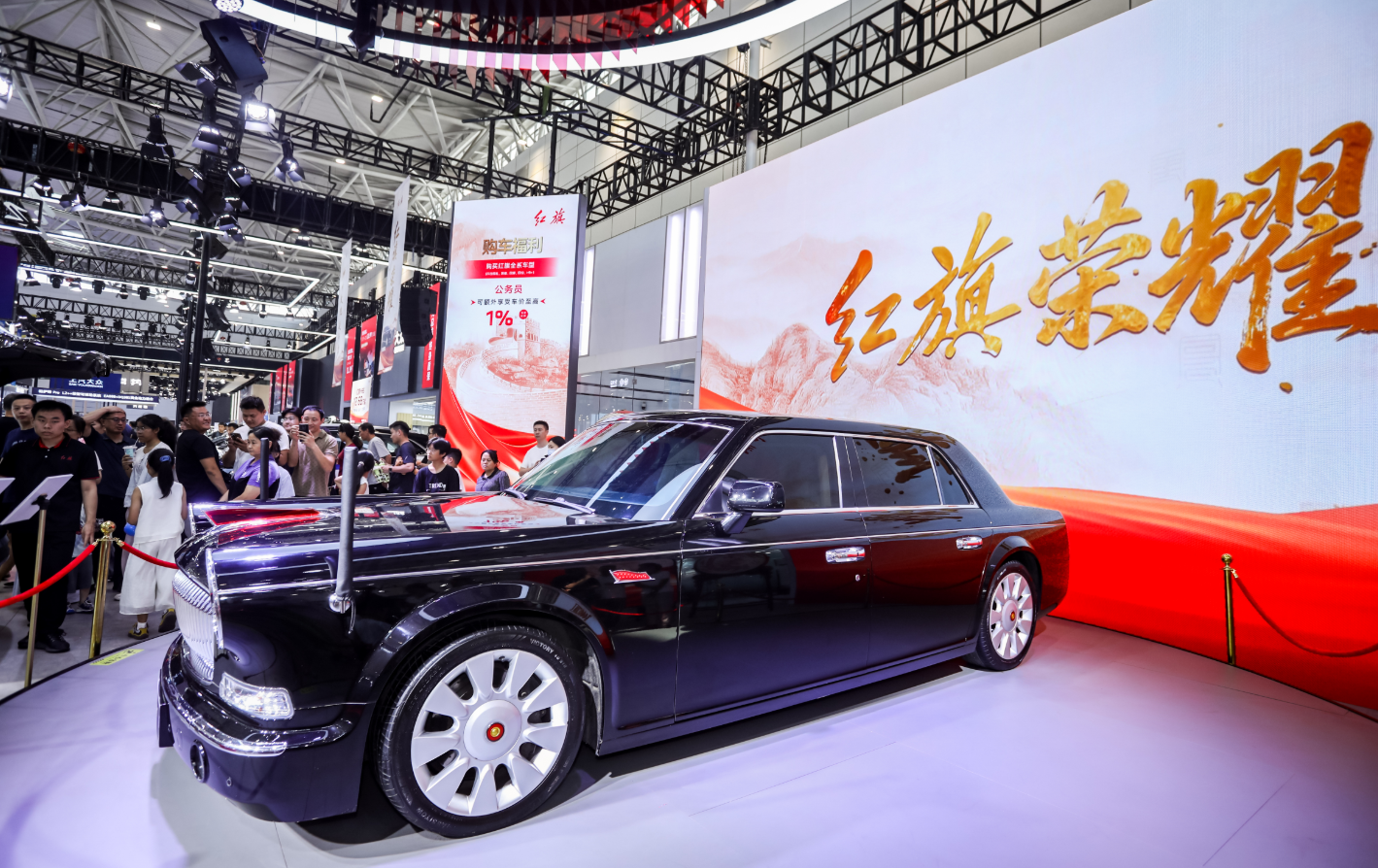
红旗L5

Search documents
德国总理默茨访华乘坐红旗L5
Zhong Guo Jing Ying Bao· 2026-02-27 06:25
Group 1 - German Chancellor Merz arrived in Hangzhou as the second stop of his visit to China [1] - The vehicle used by Merz was the Hongqi L5 model, which has been a choice for several foreign leaders during their visits to China [1] - The Hongqi L5 model was first publicly showcased in 2014 as a state vehicle for foreign dignitaries and has been featured in major international events, symbolizing China's manufacturing strength and cultural confidence [1]

从技术跟跑到全球留名,国产高端新能源车书写产业升级新篇章
Nan Fang Du Shi Bao· 2025-09-26 07:14
Core Insights - The article discusses the evolution of China's automotive industry, particularly focusing on the rise of domestic high-end brands like Geely and its subsidiaries, Lynk & Co and Zeekr, which are breaking the monopoly of foreign luxury brands [1][2][3] Historical Context - Geely's first model, the "Haoqing," launched in 1998, marked the entry of affordable cars into Chinese households, achieving over 150,000 sales from 2001 to 2003 [1] - The early Chinese automotive industry relied on reverse engineering, leading to a perception of low quality and imitation [1][4] - The entry of China into the WTO in 2001 significantly lowered tariffs and deregulated car prices, initiating the "year of the family car" in China [4][5] Market Dynamics - From 2001 to 2010, the average annual growth rate of car sales in China exceeded 20%, with total sales surpassing 18 million in 2010 [5] - The low-cost strategy of domestic brands forced foreign brands to adjust their pricing, leading to rapid market penetration [5][6] High-End Market Transition - The shift towards high-end markets became essential for survival and long-term growth, as companies sought to improve profit margins and challenge international perceptions of Chinese brands [5][6] - The launch of high-end models like the Hongqi L5 in 2013 marked the beginning of a serious push into the luxury segment [5][6] Technological Advancements - By 2025, China's automotive industry is expected to transition from "reverse development" to "technology export," with a focus on high-end electric vehicles [3][9] - The establishment of Zeekr as a luxury electric brand and its merger with Lynk & Co represents a significant milestone in China's high-end automotive sector [2][10] Global Expansion - By 2024, the penetration rate of new energy vehicles in China surpassed 50%, indicating a shift away from traditional fuel vehicles [15][16] - Zeekr and Lynk & Co have successfully entered global markets, with Zeekr009 becoming a top-selling luxury MPV in regions like Hong Kong and Thailand [16][17] Industry Collaboration - The integration of resources among Chinese brands has enhanced operational efficiency and product offerings, allowing for a more competitive stance in the global market [17] - The export of Chinese automobiles, particularly new energy vehicles, has seen significant growth, with 1.42 million units exported in 2025, marking a 41% increase year-on-year [16][17]

齐鲁车展的“反差时刻”
Qi Lu Wan Bao· 2025-09-08 00:03
Core Insights - The 2025 Qilu Autumn Auto Show serves as an important window to observe the Chinese automotive market, showcasing significant advancements in luxury attributes, intelligence levels, and core technology configurations of domestic brands [1][5] - Domestic brands, such as Hongqi and BYD, are proving their capabilities in both luxury and performance segments, marking a shift from following foreign brands to leading in high-end markets [2][3] Group 1: Domestic Brand Highlights - Hongqi's L5 model attracted significant attention, showcasing a blend of traditional Chinese aesthetics and modern technology, emphasizing its high-end positioning as a symbol of domestic luxury [1][2] - BYD's Yangwang U9 demonstrated key breakthroughs in the supercar segment with advanced features like independent four-motor drive technology, highlighting the brand's performance capabilities [2][3] Group 2: Exhibition Scale and Brand Strategy - The exhibition layout revealed a strong presence of domestic brands, with BYD occupying over 3,000 square meters, showcasing its five sub-brands and innovative outdoor experience areas [3] - Chery and Changan also demonstrated significant exhibition areas, emphasizing their technological advancements and brand integration strategies [3] Group 3: Intelligent Features - The integration of intelligent driving features has become a standard across various price segments, with brands like Chery and Geely offering advanced driver assistance systems in their mainstream models [4] - The trend of localizing intelligent driving technologies is evident, with joint venture brands like GAC Toyota introducing advanced systems at competitive price points [4]

车展观察丨齐鲁车展的“反差时刻”
Qi Lu Wan Bao· 2025-09-06 09:16
Core Insights - The 2025 Qilu Autumn Auto Show serves as an important window to observe the Chinese automotive market, showcasing significant advancements in luxury attributes, intelligence levels, and core technology configurations [1] - Chinese brands, particularly Hongqi and BYD, have emerged as the focal points of the show, indicating a shift in market dynamics where domestic brands are leading in high-end segments [2][6] Brand Highlights - Hongqi's L5 model attracted considerable attention, with long queues of consumers eager to engage with the vehicle, highlighting its status as a symbol of domestic luxury [2][4] - BYD's Yangwang U9 demonstrated impressive performance capabilities, showcasing features typically found in top-tier supercars, marking a significant breakthrough for domestic brands in the supercar segment [6] Exhibition Scale and Brand Presence - The exhibition layout revealed a clear trend of domestic brands occupying larger spaces, with BYD leading with over 3,000 square meters, followed by Chery and Changan, indicating a natural result of technological accumulation and brand development [7] - The significant increase in exhibition space for domestic brands reflects a shift in market power dynamics, with Chinese brands making substantial advancements in the new energy vehicle sector [9] Technological Innovations - The outdoor exhibition area transformed into an interactive "technology carnival," with BYD's smart driving experience area allowing attendees to engage with advanced driving technologies [10] - Various brands showcased intelligent driving systems, with Chery and Geely presenting comprehensive solutions across their model ranges, indicating a widespread adoption of smart driving technologies [12][13] Market Trends - The presence of intelligent features in vehicles is no longer limited to high-end models but has become a standard across various price segments, indicating a transformation in consumer expectations [10][15] - The acceleration of intelligent driving technology adoption among joint venture brands suggests a recognition of the leading position of Chinese smart driving solutions, adapting to local consumer needs [15]