纯电动商用车

Search documents
亮点抢鲜看!2026中国商用车论坛将于3月25日-27日在湖北十堰举办
中汽协会数据· 2026-01-28 09:02
Core Viewpoint - The 2026 China Commercial Vehicle Forum aims to address the new requirements and pathways for commercial vehicle development under the themes of "New Energy Transition" and "Digital Intelligence Empowerment" in the context of the 14th Five-Year Plan, emphasizing the importance of high-quality development in the commercial vehicle industry for the national economy [1][21]. Group 1: Forum Overview - The forum will take place from March 25 to 27, 2026, in Shiyan, Hubei Province, focusing on the commercial vehicle industry's role in ensuring supply chain stability and promoting green transformation [1][21]. - The event will adopt a "1+1+6+N" format, including one closed-door summit, one main forum, and six thematic sub-forums, along with related networking and exhibition activities [2][21]. Group 2: Thematic Sub-Forums - The six thematic sub-forums will cover topics such as breakthroughs in new energy vehicle technology under carbon neutrality goals, lifecycle quality management of commercial vehicles, market and policy development directions, commercialization of intelligent networking and autonomous driving, globalization strategies and opportunities for Chinese commercial vehicles, and supply chain security and collaborative innovation [2][21]. Group 3: Key Dates and Registration - Registration for the forum is available until March 10, 2026, with early bird pricing for members at 1,500 RMB and non-members at 2,500 RMB [3][26]. - The forum's schedule includes registration on March 24 and various sessions from March 25 to 27, including a closed-door summit and thematic discussions [4][21]. Group 4: Venue and Accommodation - The forum will be held at the Shiyan Century Baijun Wudang Yage International Hotel, with special accommodation rates for attendees [5][29]. - Transportation arrangements will be provided from Shiyan Wudangshan Airport and Shiyan East Station to the hotel on March 25 [6][31]. Group 5: Collaboration and Sponsorship - The forum offers opportunities for companies to showcase new products and technologies, advertise in the conference materials, and participate in speaking engagements [10][32]. - Companies are required to coordinate with the organizing committee for any promotional activities during the forum [10][32].

中国汽车流通协会:11月新能源商用车零售销量为9.21万辆 同比增长45.54%
智通财经网· 2025-12-23 08:05
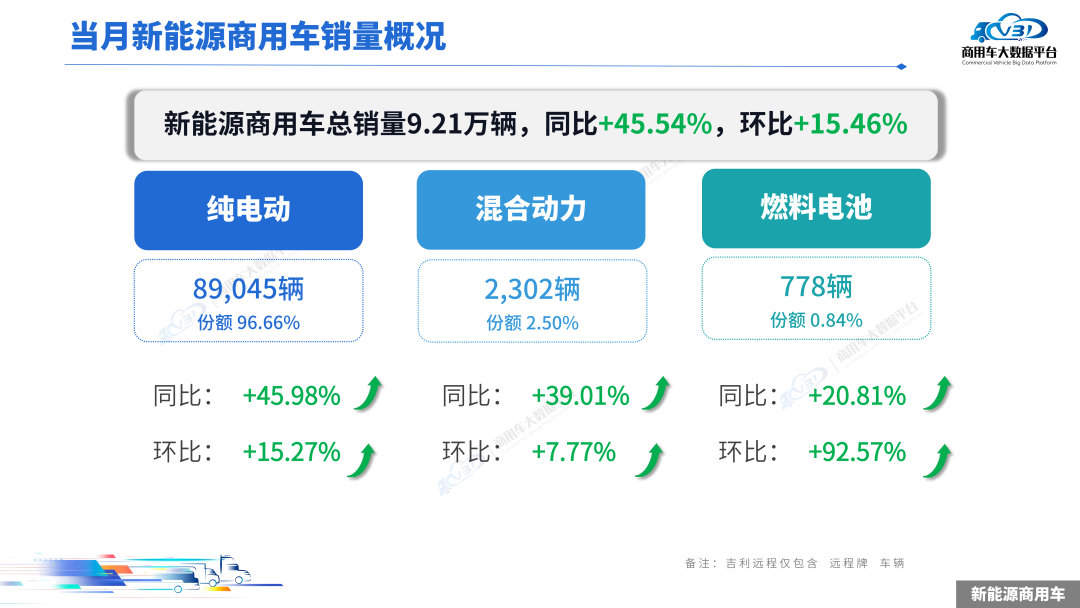
Group 1 - In November 2025, the retail sales of new energy commercial vehicles reached 92,100 units, representing a year-on-year increase of 45.54% and a month-on-month increase of 15.46% [2][1] - 96.66% of the sales were from pure electric commercial vehicles, totaling 89,000 units, which is a year-on-year increase of 45.98% [2] - The top five companies/brands accounted for 33.76% of the total sales, including Geely, Foton, XCMG, FAW Jiefang, and SAIC Wuling [4] Group 2 - From January to November 2025, the cumulative retail sales of new energy commercial vehicles reached 769,200 units, with a year-on-year growth of 54.31% [8] - 96.63% of the cumulative sales were from pure electric commercial vehicles, amounting to 743,200 units, which is a year-on-year increase of 55.14% [8] - The cumulative sales of new energy trucks were 475,400 units, accounting for 61.81% of total sales, with a year-on-year growth of 88.47% [10] - The cumulative sales of new energy buses were 293,700 units, representing 38.19% of total sales, with a year-on-year increase of 19.31% [10] - The top five companies/brands accounted for 36.84% of the cumulative sales, including Geely, Foton, SAIC Wuling, XCMG, and Shaanxi Automobile [13]

中国汽车流通协会:10月新能源商用车零售销量为7.98万辆 同比增长44.7%
Zhi Tong Cai Jing· 2025-11-20 10:45
Core Insights - The retail sales of new energy commercial vehicles in China reached 79,800 units in October 2025, representing a year-on-year increase of 44.7% but a month-on-month decrease of 15.45% [1] - From January to October 2025, the cumulative retail sales of new energy commercial vehicles totaled 677,000 units, marking a year-on-year growth of 55.59% [9] Sales Performance - In October 2025, 96.82% of the new energy commercial vehicle sales were from pure electric vehicles, amounting to 77,200 units, which is a year-on-year increase of 45.45% [1] - The sales of new energy trucks accounted for 58.47% of total sales, with 46,700 units sold, reflecting a year-on-year growth of 67.17% [3] - New energy buses represented 41.53% of total sales, with 33,100 units sold, showing a year-on-year increase of 21.67% [3] Brand Performance - The top five companies/brands accounted for 36.90% of the total sales in October 2025, including Geely, Foton, SAIC-GM-Wuling, XCMG, and Sinotruk [5] - From January to October 2025, the top five companies/brands held a cumulative sales share of 37.40%, which includes Geely, Foton, SAIC-GM-Wuling, XCMG, and Kaiyi [14]

中国汽车流通协会:1-9月新能源商用车累计零售销量为59.72万辆 同比增长57.17%
Zhi Tong Cai Jing· 2025-10-27 09:11
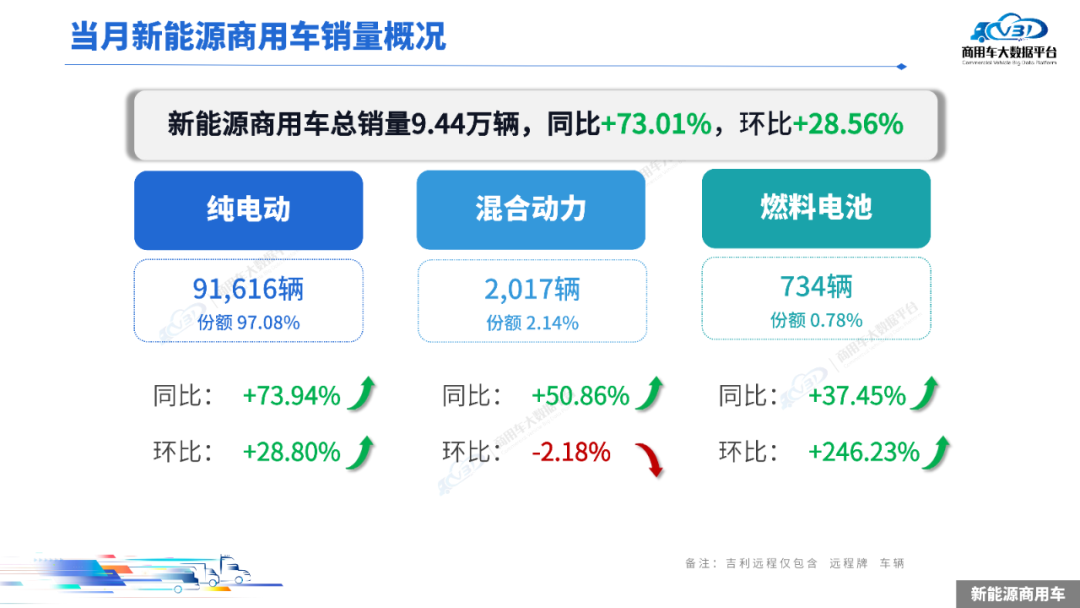
Core Insights - The retail sales of new energy commercial vehicles in September 2025 reached 94,400 units, marking a year-on-year increase of 73.01% and a month-on-month increase of 28.56% [1] - Pure electric commercial vehicles accounted for 97.08% of the total sales, with 91,600 units sold, reflecting a year-on-year growth of 73.94% [1] Sales Breakdown by Vehicle Type - New energy truck sales totaled 54,800 units, representing 58.12% of the total, with a year-on-year increase of 95.52% and a month-on-month increase of 16.03% [4] - New energy bus sales reached 39,500 units, accounting for 41.88% of the total, with a year-on-year increase of 49.18% and a month-on-month increase of 51.22% [4] Cumulative Sales Performance - From January to September 2025, cumulative retail sales of new energy commercial vehicles reached 597,200 units, a year-on-year increase of 57.17% [9] - Pure electric commercial vehicles contributed 96.60% of the cumulative sales, totaling 576,900 units, with a year-on-year growth of 58.09% [9] Cumulative Sales Breakdown by Vehicle Type - Cumulative sales of new energy trucks amounted to 371,900 units, making up 62.28% of the total, with a year-on-year increase of 96.66% [10] - Cumulative sales of new energy buses reached 225,300 units, accounting for 37.72% of the total, with a year-on-year increase of 18.04% [10] Brand Performance - The top five companies/brands accounted for 37.35% of the sales in September 2025, including Geely Yuanchen, Foton Motor, SAIC Wuling, XCMG, and FAW Jiefang [6] - From January to September 2025, the top five companies/brands maintained a cumulative sales share of 37.54%, comprising Geely Yuanchen, Foton Motor, SAIC Wuling, XCMG, and Kaiyue [14]

观车 · 论势 || 商用车企业是时候丢掉“旧思维”了
Zhong Guo Qi Che Bao Wang· 2025-10-10 01:24
Core Viewpoint - The introduction of the dual-track management model for the National VII emission standards in China represents a significant shift from traditional single-point control to a system-wide approach, aiming to address the imbalance in product structure within the commercial vehicle industry [1][6]. Group 1: New Emission Standards - The new standards will implement "single vehicle emission limits" alongside "average enterprise emission intensity," creating a dual constraint for manufacturers [2][3]. - This shift requires companies to achieve breakthroughs in engine efficiency and exhaust treatment systems, moving beyond minor adjustments to traditional technologies [2][4]. Group 2: Industry Impact - The dual-track model will necessitate adjustments across the entire commercial vehicle supply chain, affecting component suppliers, manufacturers, and sales/service sectors [3][4]. - Companies that can quickly adapt and innovate will emerge as industry leaders, while those that fail to meet the new standards may face significant challenges [3][6]. Group 3: Strategic Shifts for Companies - Companies must transition from a passive compliance approach to an active innovation strategy, focusing on zero-emission technologies such as electric and hydrogen fuel cell vehicles [4][6]. - A comprehensive carbon emission management system covering the entire product lifecycle is essential for companies to align with the new standards [4][6]. Group 4: Market Dynamics - The increase in compliance costs may lead to higher prices for new vehicles, potentially pushing smaller transport operators towards the second-hand market [5]. - The influx of older, high-emission vehicles into the second-hand market could create regulatory challenges and encourage illegal modifications if not properly managed [5]. Group 5: Policy and Regulatory Considerations - The successful implementation of the new standards requires a supportive ecosystem, including cost-sharing mechanisms and enhanced regulatory frameworks [5][6]. - Collaboration across departments and the use of advanced monitoring technologies will be crucial to ensure effective enforcement of the new emission regulations [5][6].
中国重汽发布ESG报告:创新驱动绿色未来 打造行业可持续发展范式
Ge Long Hui· 2025-04-29 11:54
Core Viewpoint - China National Heavy Duty Truck Group (China National Heavy Truck) emphasizes its commitment to sustainable development through comprehensive integration of ESG principles into its operations, focusing on innovation and green transformation [1][3]. Group 1: Innovation and R&D - The company is driving its transformation towards intelligent and green products, with a 2024 R&D investment of 2.9% of its revenue, amounting to 2.74 billion yuan [3][4]. - China National Heavy Truck is focusing on two main technological routes: pure electric and hydrogen fuel cell, with significant advancements in electric control systems and the development of over 10 hydrogen fuel cell models for various applications [3][4]. Group 2: Financial Performance - Revenue from new energy products increased by 67% year-on-year, with clean technology R&D expenses reaching 470 million yuan and 144 clean technology patents obtained [4]. Group 3: Environmental Initiatives - The company is actively integrating environmental protection into its strategy, investing 51.57 million yuan in 2024 for environmental facility upgrades and pollution control technologies, achieving over 10% reduction in wastewater and harmful waste emissions compared to 2021 [6][7]. - China National Heavy Truck aims to enhance energy efficiency through green technology upgrades and renewable energy applications, achieving a comprehensive energy consumption of 13 kg standard coal per 10,000 yuan of output, significantly below its target of 22 kg [7]. Group 4: Governance Structure - The company has established a robust ESG governance framework with a three-tier structure to ensure effective management of ESG matters, with the board of directors overseeing ESG strategies and performance [9][10].

凝“新”聚力 争创区域经济发展先锋——从进一步全面深化改革看玉林经开区发展质效
Zhong Guo Jin Rong Xin Xi Wang· 2025-03-24 08:13
Core Insights - The article highlights the development initiatives and reforms in the Yulin Economic and Technological Development Zone, aiming for high-quality economic growth and enhanced investment attraction in 2024 [1][2]. Group 1: Development Projects - Significant investments have been made in various projects, including a 5 billion yuan investment in Hewei New Energy wind turbine components, an 8.1 billion yuan low-altitude economy industrial park, a 16 billion yuan spice industrial park, and a 30 billion yuan safety emergency industrial park [1]. - The Yulin Economic Development Zone has achieved a total industrial output value of 28 billion yuan in 2024, marking a year-on-year growth of 5.42% [3]. Group 2: Management and Reform - The Yulin Economic Development Zone is restructuring its management mechanisms to enhance operational efficiency, including the establishment of a new committee and streamlining internal departments [2]. - The reform includes a shift from identity-based management to position-based management, allowing for a more flexible and performance-oriented compensation system [2]. Group 3: Investment and Economic Goals - In 2024, the zone aims to sign 12 new investment projects, with 5 projects exceeding 1 billion yuan, totaling an investment of 9.91 billion yuan, achieving 165.17% of its annual target of 60 billion yuan [5]. - The zone is targeting an industrial output value of over 30 billion yuan by 2025, with specific goals for fixed asset investment and tax revenue [9].