
聚氨酯产品

Search documents
一诺威(920261)披露2025年年度业绩快报公告,2月26日股价下跌2.51%
Sou Hu Cai Jing· 2026-02-26 14:58
Core Viewpoint - Shandong Yinuowei Polyurethane Co., Ltd. reported a revenue increase of 9.37% for the year 2025, driven by new product development and market strategy optimization [1] Financial Performance - The company achieved an operating revenue of 7,499,862,948.82 yuan for 2025, reflecting a year-on-year growth of 9.37% [1] - Net profit attributable to shareholders was 190,248,352.55 yuan, up 7.75% compared to the previous year [1] - The net profit after deducting non-recurring gains and losses was 170,963,824.15 yuan, representing a 5.16% increase [1] - Basic earnings per share reached 0.65 yuan, marking a 7.18% growth year-on-year [1] Asset and Equity Growth - Total assets at the end of the reporting period were 2,857,280,888.17 yuan, an increase of 13.60% from the beginning of the period [1] - Shareholders' equity attributable to the company was 1,648,625,778.10 yuan, showing a year-on-year growth of 7.09% [1] Strategic Initiatives - The growth in performance is attributed to the company's efforts in advancing new product research and development, expanding into new application areas, and optimizing sales strategies to enhance market share [1]
汇得科技:聚氨酯产业下游运用广泛、且产业链长
Zheng Quan Ri Bao Wang· 2026-02-02 11:41
Core Viewpoint - Huide Technology (603192) emphasizes its strong position in the polyurethane industry, highlighting its extensive applications and long supply chain, which encompasses multiple sectors [1] Company Overview - The company operates in the upper-middle segment of the polyurethane supply chain, producing both general-purpose products and customized polyurethane solutions based on client needs [1] - Huide Technology's products serve a diverse range of industries, including footwear, apparel, luggage, furniture, rail transportation, electronics, automotive, and new energy, indicating a broad market reach [1] Industry Insights - The polyurethane industry has a wide range of downstream applications, suggesting significant growth potential and opportunities for innovation within various sectors [1]

体育产业热潮奔涌 北交所上市公司竞逐新蓝海
Zhong Guo Zheng Quan Bao· 2025-12-28 21:08
Group 1 - The resurgence of winter sports is driving the growth of the ice and snow economy, creating significant opportunities in the sports industry [1] - Companies listed on the Beijing Stock Exchange are leveraging their unique advantages to strengthen their presence in the sports industry [1] - Kangbiter, a high-tech enterprise in the sports nutrition sector, has been recognized for its comprehensive production and service system, including advanced automated production lines [1][2] Group 2 - Huayang Racing has established a unique research and testing capability in off-road motorcycle development, contributing to its recognition in the industry [2] - In the chemical sector, Yinuowei has become a key player in the sports market, leveraging its competitive advantages in polyurethane products [2][3] - The sports industry in China is entering a new phase of high-quality development, supported by various national and local policies [3][4] Group 3 - Policies aimed at enhancing sports consumption are crucial for the high-quality development of the sports industry, with a projected market size of 7 trillion yuan [4] - The booming ice and snow economy is linked to the popularization of winter sports, with ambitious growth targets set for the industry by 2027 and 2030 [4][5] - The development of the ice and snow economy is supported by provincial policies, focusing on a comprehensive industry chain [5][6] Group 4 - New companies in the sports sector are seeking to list on the Beijing Stock Exchange to capitalize on the industry's growth potential [6] - Jin Smith is planning to issue stocks to the public and aims to list on the Beijing Stock Exchange, focusing on smart fitness equipment [6] - Aoxiang Sports is also advancing its listing efforts, specializing in sports flooring materials and construction [6]
国金证券:迎接2026,告别单一叙事
Xin Lang Cai Jing· 2025-12-21 09:36
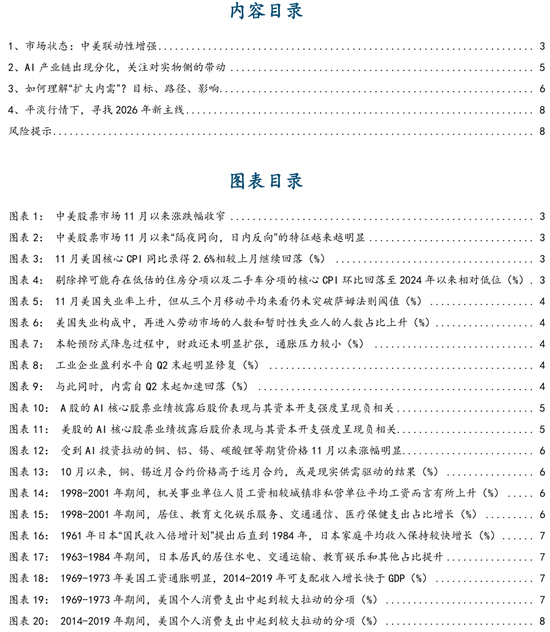
Group 1: Market Status - The correlation between A-shares and U.S. stocks has increased, with the 20-day rolling correlation of the CSI 300 and S&P 500 rising to over 90% since November, indicating a new norm of "overnight same direction, intraday reverse" [2][11][45] - Both the U.S. and Chinese economies are in a phase of "limited upward elasticity and reduced downward risk," with the U.S. core CPI falling to 2.6%, the lowest in three and a half years, and the unemployment rate rising to 4.6% primarily due to increased labor participation and temporary unemployment [2][13][47] - The Chinese economy shows signs of a bottom in corporate profits, while domestic demand is weakening, creating a favorable environment for subsequent policy support [2][13][47] Group 2: AI Industry Chain - The investment in the AI industry chain is showing two notable characteristics: first, "pan-AI" assets (copper, lithium, aluminum, energy storage, and electrical equipment) are performing better than core AI assets (computing chips, optical modules, PCB) [2][18][52] - Investors are becoming less tolerant of the contradiction between aggressive capital expenditures and the lack of revenue growth in companies within the AI industry chain, as evidenced by the negative correlation between stock performance and capital expenditure as a percentage of revenue [2][18][52] - Commodity prices for copper, aluminum, tin, and lithium carbonate have been rising since late October, driven by supply-demand dynamics, with near-term contracts for copper and tin outperforming longer-term contracts [2][19][53] Group 3: Understanding "Expanding Domestic Demand" - The articles published in "Qiushi" magazine emphasize the importance of consumer demand as a primary focus for expanding domestic demand, highlighting the need for a complete domestic demand system [3][24][58] - The strategy includes enhancing secondary distribution to increase residents' net transfer income and optimizing primary distribution to improve labor income, with potential reforms in state-owned enterprises to guide wage adjustments [3][25][58] - Historical examples from Japan and the U.S. show that periods of rising resident income lead to increased service and new-type consumption, indicating that the current "income increase plan" may boost demand for service consumption and technology-driven durable goods [3][27][58] Group 4: Preparing for 2026 - The current market conditions, characterized by limited macro elasticity and increased industry differentiation, suggest a shift in investment strategy towards "physical demand-driven" and "domestic demand policy dividends" as more certain avenues for growth [2][39][40] - Recommendations include focusing on industrial resource products (copper, aluminum, tin, lithium, crude oil, and oil transportation) that benefit from AI investment and global manufacturing recovery, as well as sectors like aviation, hotels, duty-free, and food and beverage that will benefit from increased consumer spending [2][32][39] - The non-bank financial sector (insurance, brokerage) is expected to benefit from capital market expansion and a bottoming out of long-term asset returns, alongside opportunities in China's equipment export chain and domestic manufacturing sectors [2][32][39]


长华化学,年产8万吨二氧化碳聚醚公示
DT新材料· 2025-10-16 16:05
Group 1 - The core viewpoint of the article highlights the strategic shift of Changhua Chemical towards producing high-performance, carbon-neutral, and recyclable polyurethane solutions through the development of a carbon dioxide polyether project, aiming to enhance customer loyalty and brand value [2] - The company plans to raise a total of 155 million yuan, with net proceeds allocated to the first phase of the carbon dioxide polyether project, which has a total investment of approximately 742.95 million yuan and aims to achieve an annual production capacity of 80,000 tons [2] - The overall demand for the polyether industry is expected to maintain a growth trend, with a compound annual growth rate (CAGR) of 15.15% from 2022 to 2024, driven by strong export growth and increasing demand for high-end products [2][3] Group 2 - The global chemical industry is increasingly focusing on "dual carbon" goals, with major international chemical companies accelerating their green transformation and circular economy initiatives, such as BASF's goal of achieving net-zero greenhouse gas emissions by 2050 [3] - The polyether industry has shown a slight recovery trend over the past five years, with an average growth rate of 6.38%, and exports have been a significant highlight, achieving a CAGR of 23.41% [3] - The demand for low-carbon and recyclable polyurethane products in the automotive sector is becoming increasingly important, particularly in relation to the growth of the new energy vehicle market [3] Group 3 - The production of carbon dioxide polyether involves a complex copolymerization reaction, which presents technical challenges due to the inert nature of carbon dioxide and the low efficiency of catalysts [4] - The company has signed a joint development and licensing agreement with Econic to utilize existing carbon dioxide polyether catalyst technology in China, aiming to develop new preparation technologies collaboratively [4] - Since 2022, the company has increased its R&D investment, resulting in a series of patent achievements that strengthen its technical foundation for the carbon dioxide polyether project [4]

生态环境部酝酿消耗臭氧层物质生产禁令,涉板材、喷涂等领域
Di Yi Cai Jing· 2025-07-03 00:28
Core Points - The new regulation aims to fulfill the Vienna Convention for the Protection of the Ozone Layer and the Montreal Protocol, targeting the elimination of HCFC-141b as a blowing agent in polyurethane products by January 1, 2026 [1][2] - The polyurethane foam industry is a major consumer of ozone-depleting substances, specifically HCFCs, with HCFC-141b being the most significant due to its high ozone depletion potential (ODP) of 0.11 [2] - China has already achieved the first and second phase elimination targets, freezing HCFC-141b consumption in the polyurethane foam industry at baseline levels in 2013 and reducing it by 80% by 2023 [2] Industry Overview - The polyurethane foam industry includes various sectors such as refrigerated containers, refrigerators, electric water heaters, insulation pipes, solar water heaters, and more [1][2] - The majority of companies in the board production sector are small to medium-sized enterprises, with around 250 companies primarily located in Jiangsu, Zhejiang, Shandong, and Henan [3] - Since 2011, multilateral fund grants have supported 21 board production companies in replacing HCFC-141b, resulting in the elimination of approximately 3,644 tons, which is 29.2% of the total HCFC-141b that needs to be phased out in this sector [3] Progress and Remaining Challenges - Additional estimates suggest that companies have transitioned or utilized their own funds to eliminate around 8,750 tons of HCFC-141b, leaving less than 50 tons remaining to be phased out in the board sector, which is less than 0.4% of the total [4] - The spray foam sector also consists mainly of small to medium-sized enterprises, with about 300 companies located in Shandong, Jiangsu, Beijing, and Hebei [4] - Since 2011, grants have supported four spray foam companies in eliminating approximately 226 tons of HCFC-141b, accounting for 2.5% of the total required elimination in this sector [4] Alternatives and Future Plans - There are various mature alternatives to HCFC-141b available in the polyurethane foam industry, including hydrocarbons, water, hydrofluorocarbons, and fluorinated olefins, which have been successfully applied for years [5] - The cost of hydrocarbons and water-based blowing agents is relatively low, while hydrofluorocarbons and fluorinated olefins are more expensive [5] - In 2025, multilateral fund grants will support 15 combination ether companies in technical upgrades to eliminate HCFC-141b and promote alternative products in the relevant sectors [5]
生态环境部征求意见:禁止生产以11-二氯-1-氟乙烷(HCFC-141b)为发泡剂的聚氨酯产品
news flash· 2025-07-02 08:23
Core Viewpoint - The Ministry of Ecology and Environment has proposed a ban on the production of polyurethane products using HCFC-141b as a foaming agent, effective from January 1, 2026, with specific exceptions for certain products [1] Group 1: Regulatory Changes - Starting January 1, 2026, the production of polyurethane products using HCFC-141b as a foaming agent will be prohibited, excluding spray polyurethane foam products [1] - For refrigerator, cold storage container, and electric water heater products, manufacturers must comply with the regulations outlined in the 2018 announcement regarding HCFC-141b [1] - The ban on spray polyurethane foam products using HCFC-141b will take effect on July 1, 2026 [1] Group 2: Product-Specific Regulations - The production of insulation pipe products and solar water heater products must adhere to the guidelines set forth in the 2023 announcement regarding HCFC-141b [1]