
居民增收计划

Search documents
通胀“四因素”
China Post Securities· 2026-03-24 08:50
1. Report Industry Investment Rating No information provided in the content. 2. Core View of the Report - The price level in 2026 is likely to continue to recover at a low level, with PPI recovering faster than CPI. The upward momentum of prices mainly comes from three aspects: the upward movement of oil prices provides phased support for upstream prices, the drag of pork prices on the CPI food item is expected to gradually converge, and the continuous implementation of the policy of increasing residents' income provides marginal support for service prices and core CPI. Overall, CPI will fluctuate at a low level throughout the year, while PPI is expected to turn positive and then stabilize [7][36]. 3. Summary According to Relevant Catalogs 3.1 Technical Factors: CPI Weight Adjustment Has Limited Impact on Inflation Readings - In 2026, the CPI base period was rotated, with updated statistical caliber and adjusted sub - item weights, which may affect the inflation expectation for the year. The dominant items of CPI are still concentrated in food and housing, but the importance of transportation and service - related items is increasing [13][14]. - The weight of pork in the middle - category sub - items may be reduced, while the weight of energy consumption may be increased. The impact of pork consumption on statistical readings may be weakened, but the influence cannot be ignored due to the large price elasticity of pork. The sensitivity of the transmission of international oil prices and travel costs to domestic inflation may be enhanced [15]. 3.2 Reversal Factors: The Pig Cycle and Pork Prices May Reverse - The decline in pork prices is still the main drag on current food inflation, but supply contraction signals are gradually accumulating. If capacity reduction continues and the year - on - year decline in pork prices significantly converges, the drag of the food item on CPI may gradually weaken, and the impact of pork prices on inflation is expected to shift from a negative to a phased positive one [18]. - The bottom characteristics of pork prices are gradually emerging. With the continuous implementation of regulatory policies, the supply side may experience further capacity reduction. Deep losses have become the core driving force for capacity reduction, and the downward space for pork prices is narrowing. The pig cycle has entered the bottom transition stage, and the probability of "low at the beginning and stable later" for pork prices in 2026 is high [20][22]. 3.3 Input Factors: The Transmission and Impact of Crude Oil Prices in Extreme Scenarios - Geopolitical tensions and market risk - preference fluctuations have jointly driven the recent rise in international oil prices. The interruption of the shipping channel in the Strait of Hormuz and the risk premium have pushed up oil prices. The domestic refined - oil price is directly linked to international oil prices, which exerts a certain input - type inflation pressure on CPI [25][26]. - The transmission of oil prices to PPI has started but has not fully unfolded. The intensity of this round of impact is expected to be weaker than the previous one. Geopolitical factors are the core variables determining the evolution of oil prices and inflation [29]. 3.4 Potential Factors: Pay Attention to the Intensity and Impact of the "Residents' Income - Increasing Plan" - Increasing residents' income has become an important measure to expand domestic demand. Policies are focusing on promoting wage - based, transfer, property, and business income. Income - improvement expectations are more likely to be reflected in the recovery of service consumption, which will support core CPI and service CPI more directly [30][34]. 3.5 Inflation Trading: Anticipatory Trading Has Been Conducted, but Real - World Data Is Difficult to Fulfill - It is expected that the price level will recover at a low level in 2026, with PPI recovering faster than CPI. CPI will show a pattern of "small fluctuations at a low level" throughout the year, while PPI may rise rapidly, turn positive, and then stabilize. The current inflation recovery is more phased and structural, and it is not enough to lead to a long - term return of inflation pressure and a significant upward risk in the bond market [36][39].
发改委重磅发声:正在研究制定居民增收计划
Wind万得· 2026-01-20 03:12
Group 1 - The core viewpoint emphasizes the importance of promoting price recovery as a key consideration in monetary policy, with a focus on implementing more proactive fiscal policies and moderately easing monetary policies to foster a positive interaction between economic growth and price recovery [4] - The National Development and Reform Commission (NDRC) plans to develop a strategy for expanding domestic demand from 2026 to 2030, aiming to strengthen the domestic circulation and adapt to the upgrading trend of demand structure [5] - A plan for increasing residents' income is under development, which aims to enhance consumer capacity and optimize consumption upgrades, with a focus on supporting the high-quality development of the service industry [6] Group 2 - The NDRC will address low-price disorderly competition among enterprises by refining local investment attraction and strengthening price regulation in key industries, promoting a market order of quality and price competition [7] - There will be efforts to standardize local economic promotion behaviors and enhance market dynamics by addressing "involution" competition, shifting from "price competition" to "value competition" [8] - The NDRC has announced the allocation of 625 billion yuan in special long-term bonds to optimize the support scope and implementation mechanisms of the "Two New" policies, aiming to lower investment thresholds for project applications and increase support for small and medium-sized enterprises [9][10] Group 3 - In the area of consumer goods, a program for "old-for-new" exchanges will be optimized, with a focus on establishing uniform subsidy standards nationwide for various categories of products [12] - The NDRC will develop regulations for the construction of a unified national market, ensuring legal protection and clarifying what local governments can and cannot do in promoting economic development [14]


新年两场国常会聚焦促消费 多部门部署居民增收计划
Di Yi Cai Jing· 2026-01-18 14:05
Group 1 - The core focus of the central economic work conference is to prioritize domestic demand and build a strong domestic market, with recent State Council meetings emphasizing policies to boost consumption [1][2] - The implementation of a systematic consumption growth mechanism is highlighted, linking the "15th Five-Year" consumption plan with income increase plans, indicating a shift from short-term stimulus to long-term structural reforms [2] - The National Development and Reform Commission and other departments are deploying measures to enhance consumption and stabilize employment, combining short-term policies with long-term structural reforms to strengthen the internal driving force of China's economic growth [1][4] Group 2 - The "15th Five-Year" consumption plan includes 30 key tasks aimed at increasing income and enhancing consumption capacity, with a focus on high-quality supply and optimizing the consumption environment [3] - Data shows that China's total retail sales of consumer goods are expected to exceed 50 trillion yuan for the first time, with service retail growth outpacing goods retail by 1.3 percentage points [3] - Despite a slowdown in consumption growth since May 2025, the government is committed to fostering new growth points in service consumption, particularly in sectors like transportation, housekeeping, and entertainment [4][5] Group 3 - The silver economy and winter sports economy are receiving significant policy support, with measures aimed at developing the elderly care service sector and promoting the silver economy, which is projected to exceed 30 trillion yuan by 2035 [6] - The People's Bank of China has established a 500 billion yuan loan program to support service consumption and elderly care, with plans to expand this to include the health industry [6] - The emphasis on increasing residents' income and improving consumption capacity is seen as a key driver for boosting domestic demand and economic growth [7][8] Group 4 - Recent policies aim to eliminate unreasonable restrictions in the consumption sector, which is crucial for optimizing the consumption environment and unleashing domestic demand potential [9][10] - Various regions are actively implementing measures to clear restrictions in sectors such as automotive and housing, enhancing consumer rights protection and promoting a more favorable consumption landscape [9][10] - The government is urged to allow the market to play a leading role in consumption, creating a conducive environment for economic circulation and growth [10]
10万亿消费潜力激活!涨工资不是口号,2026经济转轨改写收入格局
Sou Hu Cai Jing· 2026-01-06 05:43
Economic Policy Shift - The central economic work conference in December 2025 announced a shift from encouraging income growth to implementing a specific plan for increasing urban and rural residents' income, marking a significant policy change [1] - The new policy aims to address the long-standing issue of low resident income as a percentage of GDP, which has hindered economic growth [3] Investment and Consumption Trends - Fixed asset investment in China decreased by 2.6% in the first 11 months of 2025, with real estate development investment plummeting by 15.9%, indicating a shift in economic drivers from investment and exports to consumption [3] - The consumer spending rate in China stands at 39.9%, significantly lower than the average of 54% in developed countries, suggesting a substantial potential for consumption growth [5] Wage Increases and Employment Dynamics - Minimum wage standards in provinces like Shanxi and Sichuan were raised by 8% to 12%, while major companies like ByteDance and JD Technology implemented aggressive salary increases, with JD reporting an average salary hike of 20% [6] - The wage increase trend is skewed towards low-income workers and those with critical skills, while high-paying sectors like finance and real estate show little to no wage growth [8] Urban-Rural Income Disparity - The income disparity between urban and rural residents remains significant, with urban disposable income at 42,991 yuan compared to 17,686 yuan for rural residents, leading to a ratio of 2.43:1 [10] - Efforts to increase rural income through land reform and market access face challenges due to existing structural barriers [10] Consumer Behavior and Economic Stimulus - A high savings rate persists among residents, with 65% of new disposable income allocated to savings or debt repayment, and only 12% directed towards consumption [12] - Policy measures include lowering LPR rates to ease mortgage burdens and providing consumption and childbirth subsidies to stimulate spending [12] Geographic and Sectoral Disparities - The distribution of income growth is uneven, with significant differences in housing market dynamics between tier-3 cities and major urban centers like Shenzhen [14] - The survival of small and medium enterprises is under pressure due to rising social security costs and reduced funding, leading to potential market consolidation [14]

全员涨薪潮
36氪· 2025-12-29 13:45
Core Viewpoint - Major companies in China, including JD.com and ByteDance, are significantly increasing employee salaries and bonuses, reflecting a broader trend aimed at boosting consumer spending and addressing income inequality in the economy [6][7][20]. Group 1: Salary Increases and Bonuses - JD.com announced that 92% of its employees will receive full or exceeding year-end bonuses, with total bonus investment increasing by over 70% year-on-year for 2025 [6][11]. - ByteDance revealed a 35% increase in bonus investment and a 1.5 times increase in salary adjustment investment for 2025, aiming to attract and retain talent [7][12]. - Other major companies like BYD and CATL are also raising salaries, with CATL increasing basic wages for frontline workers by 150 yuan starting January 1, 2026 [16][19]. Group 2: Industry Trends and Economic Context - The central economic work conference emphasized the need for a plan to increase urban and rural residents' income, indicating a shift towards implementing concrete measures rather than just proposals [21][22]. - The increase in salaries by major companies is seen as a direct method to enhance consumer spending power, which is crucial for driving domestic demand [20][23]. - The overall trend of salary increases across various sectors, including technology, manufacturing, and pharmaceuticals, signals a collective effort to improve employee compensation and stimulate economic growth [19][24].





全民涨薪潮要来了?宁德、字节、比亚迪接连宣布
阿尔法工场研究院· 2025-12-26 03:33
Core Viewpoint - The recent wave of salary increases by major companies like BYD, CATL, and ByteDance is a strategic response to government policies aimed at boosting income for all urban and rural residents, marking a shift from previous years' focus on low-income groups to a more comprehensive approach [4][10][12]. Group 1: Salary Increases and Economic Context - The salary increases are not coincidental but a systematic response from leading enterprises to government initiatives [9]. - The Central Economic Work Conference emphasized the need for a "rural and urban resident income increase plan," indicating a shift from principle-based suggestions to actionable plans [10][12]. - The focus on increasing labor compensation in the initial distribution of income aims to directly enhance wealth for hardworking individuals [13]. Group 2: Implications for Major Companies - Major companies view salary increases as essential for attracting and retaining talent, especially in a competitive job market where demand for skilled workers is surging [20]. - BYD's overseas sales have significantly outpaced domestic sales, with nearly 910,000 units sold abroad in the first 11 months of 2025, highlighting the company's strong market position and profitability [27][29]. - The profit margins for BYD's overseas vehicles are substantially higher, with net profits per vehicle reaching 14,000 to 16,000 yuan, compared to 4,000 to 6,000 yuan domestically [29]. Group 3: Broader Economic Strategies - The government is implementing measures to support small and micro enterprises through tax reductions and financing support, indirectly facilitating salary increases [38]. - The increase in minimum wage standards across over 20 provinces since 2025 reflects a direct governmental push for higher wage levels [35]. - The government is also focusing on enhancing transfer income through pensions and subsidies, which can effectively supplement household income [39][40]. Group 4: Wealth Growth and Consumer Confidence - Stabilizing the real estate and stock markets is crucial for increasing residents' wealth, ensuring that asset values do not decline sharply [41]. - Providing safe and compliant investment options for the public can stimulate consumption more effectively than direct salary increases [42]. - The current wave of salary increases should evolve into a comprehensive income growth system that benefits all residents, rather than being limited to large corporations [43].

国金策略:单一产业叙事能够带来的收益已经越来越不稳定和难以把握 抓住行情的窄幅波动期布局2026年新主线
Sou Hu Cai Jing· 2025-12-21 12:44
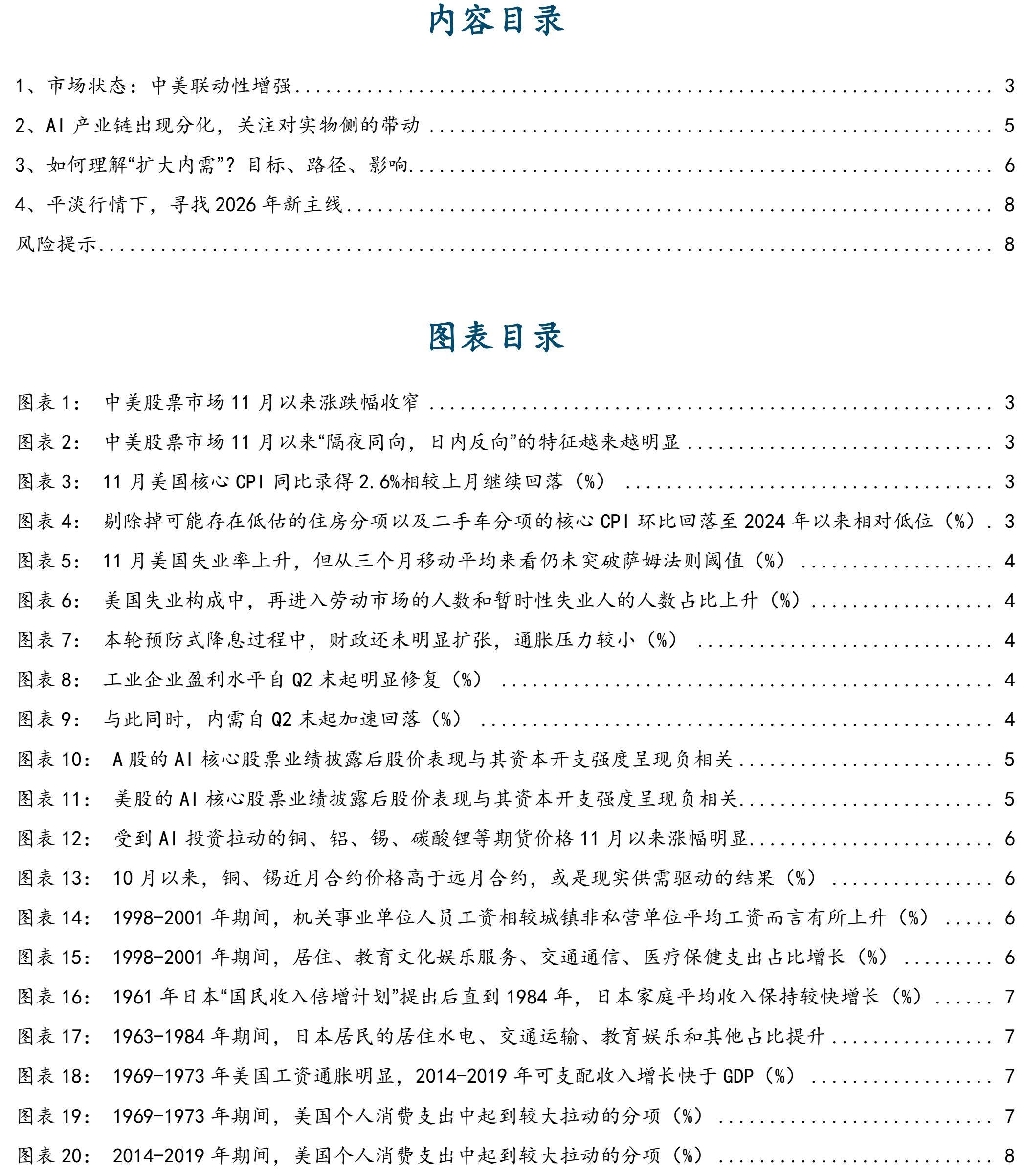
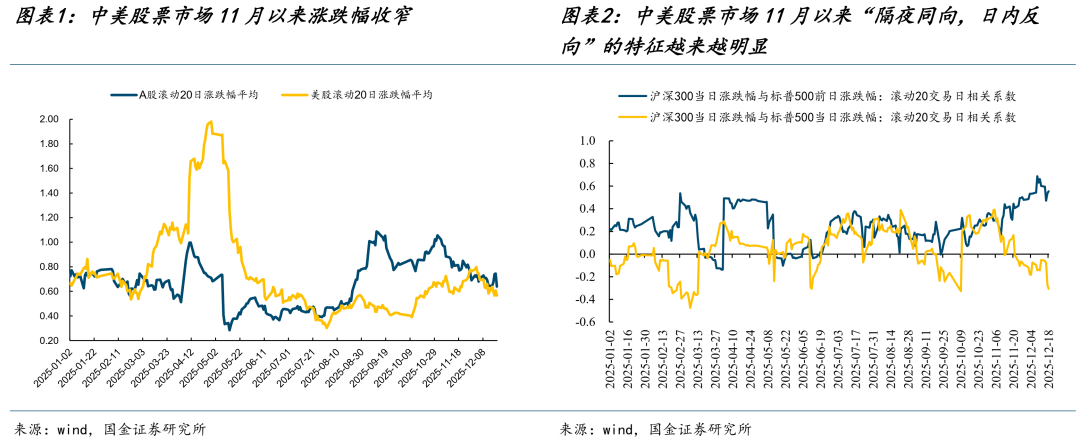
Group 1 - The market status indicates an increased correlation between the US and Chinese markets, with the 20-day rolling correlation of the CSI 300 and S&P 500 rising above the 90th percentile, reflecting a new normal of "overnight alignment and intraday reversal" [2][10][13] - The US core CPI has decreased to 2.6%, the lowest in three and a half years, while the unemployment rate has risen to 4.6%, primarily due to increased labor participation and temporary unemployment, indicating a stable economic environment without significant inflationary pressures [2][10][13] - China's economic fundamentals show a combination of corporate profit bottoming out and a decline in domestic demand, which opens a window for further policy support [2][10][13] Group 2 - The AI industry chain is experiencing a divergence, with broader AI-related assets (copper, lithium, aluminum, energy storage, and electrical equipment) performing better than core AI assets (computing chips, optical modules, PCB) [3][24][25] - Investors are becoming less tolerant of the contradiction between aggressive capital expenditures and the lack of revenue growth in companies within the AI industry chain, leading to a negative correlation between stock performance and capital expenditure as a percentage of revenue [3][24][25] - Commodity prices for copper, aluminum, tin, and lithium carbonate have been rising since late October, driven by demand from AI investments, with near-term contracts for copper and tin outperforming longer-term contracts [3][24][25] Group 3 - The concept of "expanding domestic demand" is emphasized as a strategic move, with a focus on increasing consumer demand supported by income growth and effective investment [4][31][32] - The government plans to enhance the second distribution of income by increasing minimum pension standards and implementing childcare subsidies, while future efforts may focus on optimizing the first distribution through wage reforms [4][31][32] - Historical examples from Japan and the US illustrate that income growth leads to increased service and new-type consumption, suggesting that China's current income growth initiatives could similarly boost consumer spending [4][31][32] Group 4 - The current market environment, characterized by limited macro elasticity and increased industry differentiation, suggests a shift in investment strategy towards tangible demand and domestic policy benefits as the new focus for 2026 [5][42][43] - Recommendations include investing in industrial resource products (copper, aluminum, tin, lithium, crude oil) that benefit from AI investment and global manufacturing recovery, as well as sectors poised for recovery in consumer spending (airlines, hotels, duty-free, food and beverages) [5][42][43] - Non-bank financial institutions (insurance, brokerage) are expected to benefit from capital market expansion and a rebound in long-term asset returns, alongside opportunities in China's equipment export chain and manufacturing sectors [5][42][43]
国金证券:迎接2026:告别单一叙事
Xuan Gu Bao· 2025-12-21 10:21
Group 1: Market Status - The correlation between A-shares and U.S. stocks has increased, with the 20-day rolling correlation of the CSI 300 and S&P 500 rising above the 90th percentile for the year, indicating a new normal of "overnight alignment, intraday reversal" [1][5][38] - Both the U.S. and China are in a phase characterized by limited upward elasticity and reduced downward risk, akin to a "Goldilocks" scenario, with the U.S. core CPI dropping to 2.6%, the lowest in three and a half years [1][8][9] - In China, corporate profitability has bottomed out, and the weakening of domestic demand creates a favorable environment for subsequent policy support [1][8] Group 2: AI Industry Chain - The investment in the AI industry chain is showing two key characteristics: broader macro effects benefiting "pan-AI" assets (copper, lithium, aluminum, energy storage, and electrical equipment) outperforming core AI assets (computing chips, optical modules, PCB) [2][17] - Investors are becoming less tolerant of the contradiction between aggressive capital expenditures and the lack of revenue growth in companies within the AI industry chain, leading to a negative correlation between stock performance and capital expenditure as a percentage of revenue [2][17][18] Group 3: Understanding "Expanding Domestic Demand" - The "income increase" plan aims to enhance net transfer payments to residents by 2025, with a focus on improving initial distribution through wage reforms, particularly in state-owned enterprises [3][25] - The expansion of consumption tax and adjustments in corporate income tax rates are expected to be seen in 2026, which may further stimulate domestic consumption [3][25][28] Group 4: Investment Strategy for 2026 - The current market conditions suggest a shift from a single industry narrative to a dual focus on "physical demand stimulation" and "domestic policy benefits," with recommendations to invest in industrial resource products (copper, aluminum, lithium, oil) and sectors benefiting from consumer recovery (airlines, hotels, food and beverages) [4][38] - Non-bank financial institutions (insurance, brokerage) are expected to benefit from capital market expansion and a bottoming out of long-term asset returns [4][38] - Opportunities are identified in China's equipment export chain and sectors showing signs of recovery in domestic manufacturing [4][38]

国金证券:迎接2026,告别单一叙事
Xin Lang Cai Jing· 2025-12-21 09:36
Group 1: Market Status - The correlation between A-shares and U.S. stocks has increased, with the 20-day rolling correlation of the CSI 300 and S&P 500 rising to over 90% since November, indicating a new norm of "overnight same direction, intraday reverse" [2][11][45] - Both the U.S. and Chinese economies are in a phase of "limited upward elasticity and reduced downward risk," with the U.S. core CPI falling to 2.6%, the lowest in three and a half years, and the unemployment rate rising to 4.6% primarily due to increased labor participation and temporary unemployment [2][13][47] - The Chinese economy shows signs of a bottom in corporate profits, while domestic demand is weakening, creating a favorable environment for subsequent policy support [2][13][47] Group 2: AI Industry Chain - The investment in the AI industry chain is showing two notable characteristics: first, "pan-AI" assets (copper, lithium, aluminum, energy storage, and electrical equipment) are performing better than core AI assets (computing chips, optical modules, PCB) [2][18][52] - Investors are becoming less tolerant of the contradiction between aggressive capital expenditures and the lack of revenue growth in companies within the AI industry chain, as evidenced by the negative correlation between stock performance and capital expenditure as a percentage of revenue [2][18][52] - Commodity prices for copper, aluminum, tin, and lithium carbonate have been rising since late October, driven by supply-demand dynamics, with near-term contracts for copper and tin outperforming longer-term contracts [2][19][53] Group 3: Understanding "Expanding Domestic Demand" - The articles published in "Qiushi" magazine emphasize the importance of consumer demand as a primary focus for expanding domestic demand, highlighting the need for a complete domestic demand system [3][24][58] - The strategy includes enhancing secondary distribution to increase residents' net transfer income and optimizing primary distribution to improve labor income, with potential reforms in state-owned enterprises to guide wage adjustments [3][25][58] - Historical examples from Japan and the U.S. show that periods of rising resident income lead to increased service and new-type consumption, indicating that the current "income increase plan" may boost demand for service consumption and technology-driven durable goods [3][27][58] Group 4: Preparing for 2026 - The current market conditions, characterized by limited macro elasticity and increased industry differentiation, suggest a shift in investment strategy towards "physical demand-driven" and "domestic demand policy dividends" as more certain avenues for growth [2][39][40] - Recommendations include focusing on industrial resource products (copper, aluminum, tin, lithium, crude oil, and oil transportation) that benefit from AI investment and global manufacturing recovery, as well as sectors like aviation, hotels, duty-free, and food and beverage that will benefit from increased consumer spending [2][32][39] - The non-bank financial sector (insurance, brokerage) is expected to benefit from capital market expansion and a bottoming out of long-term asset returns, alongside opportunities in China's equipment export chain and domestic manufacturing sectors [2][32][39]
内需主导,增收是关键
Bei Jing Shang Bao· 2025-12-14 15:39
Group 1 - The core focus of the recent Central Economic Work Conference is to prioritize domestic demand and establish a strong domestic market as the top task for 2026, with a specific emphasis on formulating and implementing a plan to increase income for urban and rural residents [1][2] - Expanding domestic demand and boosting consumption are identified as the main themes for China's economic work in 2025, with the government emphasizing the need to address the mismatch between strong supply and weak demand [2][5] - The shift from a focus on increasing income for low- and middle-income groups to a comprehensive income increase plan for all urban and rural residents reflects a move from general principles to specific operational strategies [2][5] Group 2 - To break the cycle of having income but lacking consumption willingness, it is crucial to enhance income expectations, as consumer willingness is significantly influenced by these expectations [3][4] - The current situation in China regarding domestic demand is complex, requiring a combination of short-term and long-term strategies, including government policies, corporate investments, and resident income support [5] - The transition from an investment and export-driven economy to one driven by consumption is evident, with consumption's share of GDP significantly increasing, making it essential to address the domestic supply-demand imbalance and respond to external challenges [5]