
股权投资基金

Search documents
江苏宁沪高速公路股份有限公司关于调整与江苏交通控股集团财务有限公司的金融服务关联交易额度的公告
Shang Hai Zheng Quan Bao· 2026-03-29 19:15
Group 1 - The company has adjusted the financial service transaction limit with Jiangsu Transportation Holding Group Financial Co., Ltd., reducing the daily maximum deposit balance from RMB 5 billion to RMB 4.5 billion, effective from March 27, 2026 [3][4] - The company aims to enhance its fund management efficiency and reduce the scale of monetary funds through this adjustment, which is expected to maximize fund utilization [4] - The financial service agreement includes a comprehensive credit limit of no less than RMB 50 billion, with loan interest rates not exceeding the People's Bank of China’s benchmark lending rate [2][3] Group 2 - The company’s wholly-owned subsidiary, Jiangsu Ninghu Investment Development Co., Ltd., has invested up to RMB 500 million in the Nanjing Lord Wisdom Equity Investment Partnership [7] - As of the announcement date, the subsidiary has contributed RMB 500 million to the fund and has recovered RMB 139.86 million, with the fund having invested in 10 projects, 4 of which have exited [9][10] - The fund has encountered operational risks with some partners, but has successfully secured shares in Xiamen International Bank valued at RMB 524.27 million through legal proceedings [10][11] Group 3 - The company plans to provide loans totaling up to RMB 4.3 billion to its subsidiaries, including Jiangsu Wufengshan Bridge Co., Ltd. and Jiangsu Guangjing Xicheng Highway Co., Ltd., to optimize debt management and reduce financing costs [16][19] - The loans will be used for various purposes, including replacing project loans and supplementing working capital, with a borrowing period of three years [19][20] - The interest rates for these loans will be based on the current rates of the company's financing products, ensuring that the financing costs are minimized [30][35] Group 4 - The company has engaged in daily related transactions with various subsidiaries, which do not require shareholder approval, as they are considered ordinary business terms [38] - The company has signed multiple framework agreements for services such as software maintenance and road network management with related parties [39][40] - The company’s independent directors have reviewed and approved these transactions, ensuring they align with the interests of all shareholders [47][48]

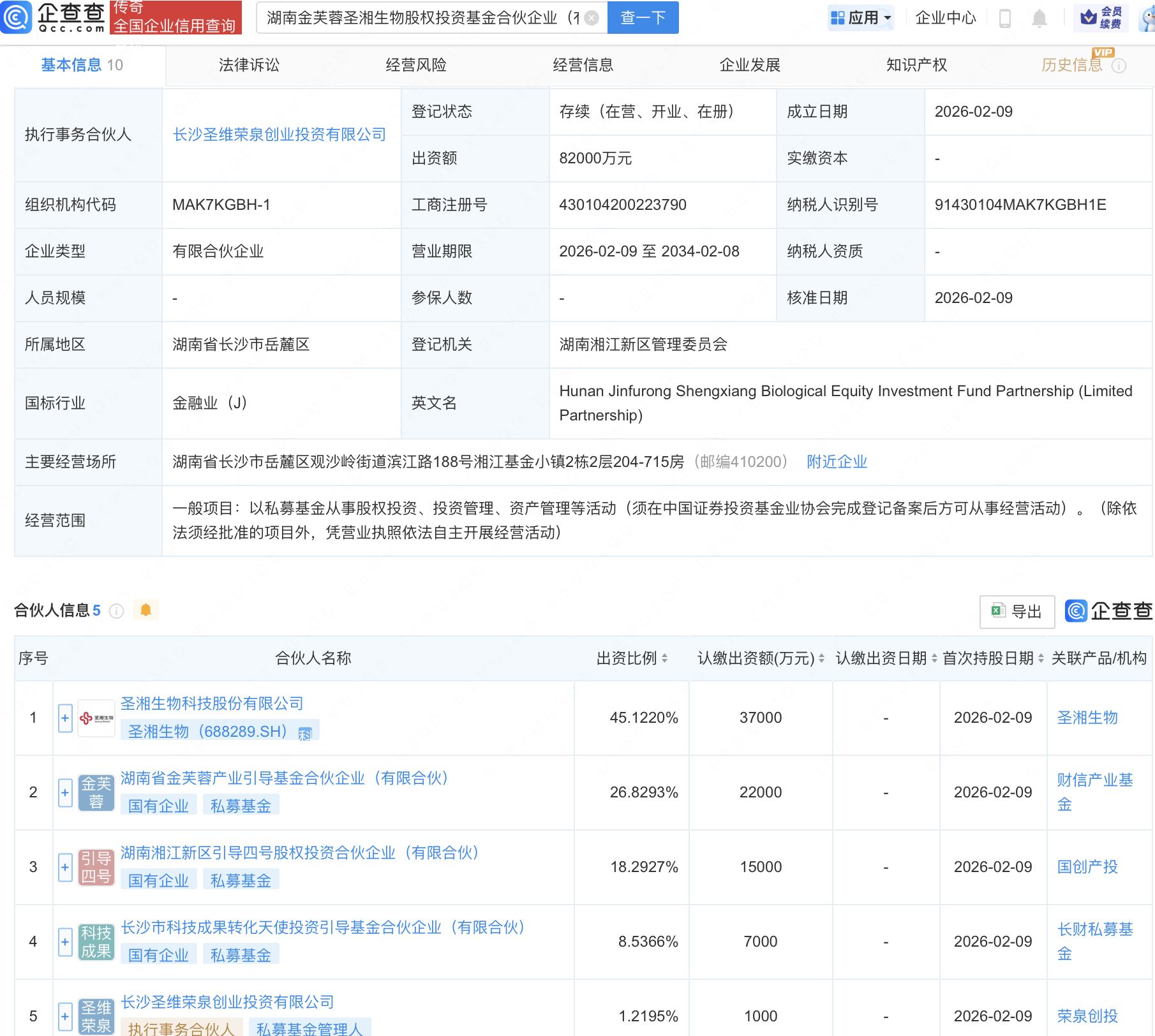
圣湘生物等在湖南新设股权投资基金,出资额8.2亿
Sou Hu Cai Jing· 2026-02-11 01:46
Core Insights - Hunan Jinfurong Shengxiang Biological Equity Investment Fund Partnership has been established with a total investment of 820 million yuan, focusing on private equity investment, investment management, and asset management activities [1][2]. Group 1: Company Overview - The fund is a limited partnership and is registered in Changsha, Hunan Province, with a business duration from February 9, 2026, to 2034 [2]. - The main operating location is at Jiangjiang Fund Town, Changsha, Hunan Province [2]. Group 2: Investment Structure - The fund's major partners include: - Shengxiang Biological Technology Co., Ltd. with a contribution ratio of 45.12% [3]. - Hunan Jinmeirong Industrial Guidance Fund Partnership with a contribution ratio of 26.83% [3]. - Hunan Xiangjiang New Area Guidance No. 4 Equity Investment Partnership with a contribution ratio of 18.29% [3]. - Changsha Technology Achievement Transformation Angel Investment Guidance Fund Partnership with a contribution ratio of 8.54% [3].


中国国新等在江西九江成立股权投资基金,?出资额5亿元
Qi Cha Cha· 2026-01-28 06:27
Core Viewpoint - A new equity investment fund named Jiujiang Dingcheng Qihang Equity Investment Fund Partnership (Limited Partnership) has been established in Jiujiang, with a total investment of 500 million yuan [1] Group 1: Fund Details - The fund's operating scope includes private equity investment, investment management, and asset management activities [1] - The total contribution to the fund amounts to 500 million yuan [1] Group 2: Contributors - The fund is jointly funded by Jiujiang Industrial Industry Investment Guidance Fund Partnership (Limited Partnership), Jiujiang Industrial Investment Operation Holding Group Co., Ltd., and Guoxin Guozheng Investment Management Co., Ltd., which is under China Guoxin [1]
形成四五十万亿股权基金!黄奇帆重磅提议
Sou Hu Cai Jing· 2026-01-14 13:39
Core Viewpoint - Huang Qifan emphasizes the need to increase direct financing through a dual approach, developing both the stock market and equity investment funds, suggesting the establishment of a guiding fund involving various financial sources [1][2]. Group 1: Funding Sources for Equity Investment - Huang Qifan estimates that if 3% of China's bank capital is allocated to equity investment, it could generate approximately 1 trillion yuan as a source for equity investment funds [1]. - The social security fund could potentially contribute around 2 trillion yuan if 30% of its assets are directed towards equity investment [1]. - Insurance funds, if allocated 30% for equity investment, could yield between 3 trillion to 4 trillion yuan for equity investment funds [1]. Group 2: Potential Scale of Equity Investment Funds - The aggregation of funds from banks, social security, insurance, and foreign exchange could create a guiding fund of over ten trillion yuan, potentially leading to a scale of 40 to 50 trillion yuan in equity investment funds to support corporate equity [2]. Group 3: Current Developments in Financial Asset Investment Companies (AIC) - As of 2024, the pilot program for financial asset investment companies has expanded to 18 cities, with signed agreements exceeding 350 billion yuan [3][4]. - The number of bank-affiliated AICs has grown to nine, with total signed amounts surpassing 3.8 billion yuan [5]. Group 4: Recent Initiatives and Fund Launches - The establishment of the Jianyuan Zhengxing Fund, with a scale of 7 billion yuan, marks the first instance of AICs participating in Shenzhen's strategic industry investments [6]. - China Bank has successfully launched a science and technology mother fund, expanding its scale to over 50 billion yuan, with a focus on long-term capital investment [6][7]. Group 5: Role of Social Security and Insurance Funds - Multiple social security science and technology funds have been launched in 2025, totaling 2.1 billion yuan, which will help attract more social capital to strategic industries [8]. - Since the policy shift in late 2020, insurance capital has increasingly invested in private equity, becoming a significant source of long-term capital for the VC/PE sector [9][10]. Group 6: Regulatory Changes and Future Expectations - The recent notification from the National Financial Supervision Administration allows insurance companies to invest up to 30% in single venture capital funds, enhancing support for the equity investment industry [9]. - The alignment of insurance capital with long-term investment characteristics is expected to facilitate a more stable investment environment in the equity investment sector [10][11].

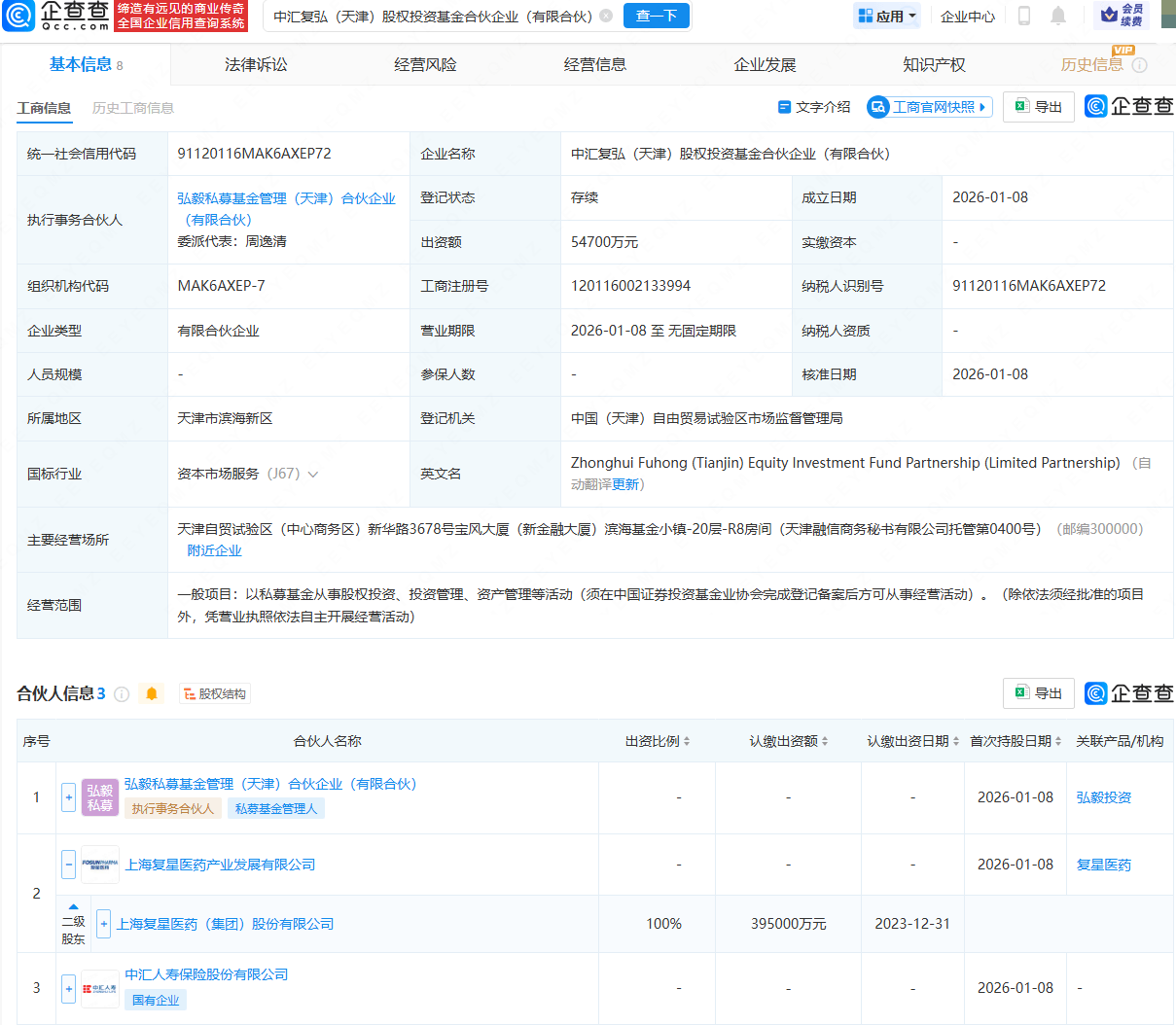
复星医药、中汇人寿等成立股权投资基金,出资额5.47亿元
Sou Hu Cai Jing· 2026-01-14 09:09
Group 1 - Zhonghui Fuhong (Tianjin) Equity Investment Fund Partnership (Limited Partnership) has been established with a capital contribution of 547 million yuan, focusing on private equity investment, investment management, and asset management activities [1] - The partnership is co-funded by Zhonghui Life Insurance Co., Ltd., Shanghai Fosun Pharmaceutical Industry Development Co., Ltd. (a wholly-owned subsidiary of Fosun Pharma), and Hongyi Private Equity Fund Management (Tianjin) Partnership (Limited Partnership) [1] - The registered office is located in the Tianjin Free Trade Zone, specifically in the Central Business District [2]
复星医药、中汇人寿等成立股权投资基金
Zheng Quan Shi Bao Wang· 2026-01-14 02:37
Group 1 - The core point of the article is the establishment of Zhonghui Fuhong (Tianjin) Equity Investment Fund Partnership (Limited Partnership) with a capital contribution of 547 million yuan, focusing on private equity investment, investment management, and asset management activities [1] - The partnership is jointly funded by Zhonghui Life Insurance Co., Ltd., a wholly-owned subsidiary of Fosun Pharma (600196) Shanghai Fosun Pharma Industry Development Co., Ltd., and Hongyi Private Equity Fund Management (Tianjin) Partnership (Limited Partnership) [1] - The establishment of this fund indicates a strategic move in the private equity investment sector, highlighting the collaboration between insurance and pharmaceutical companies [1]
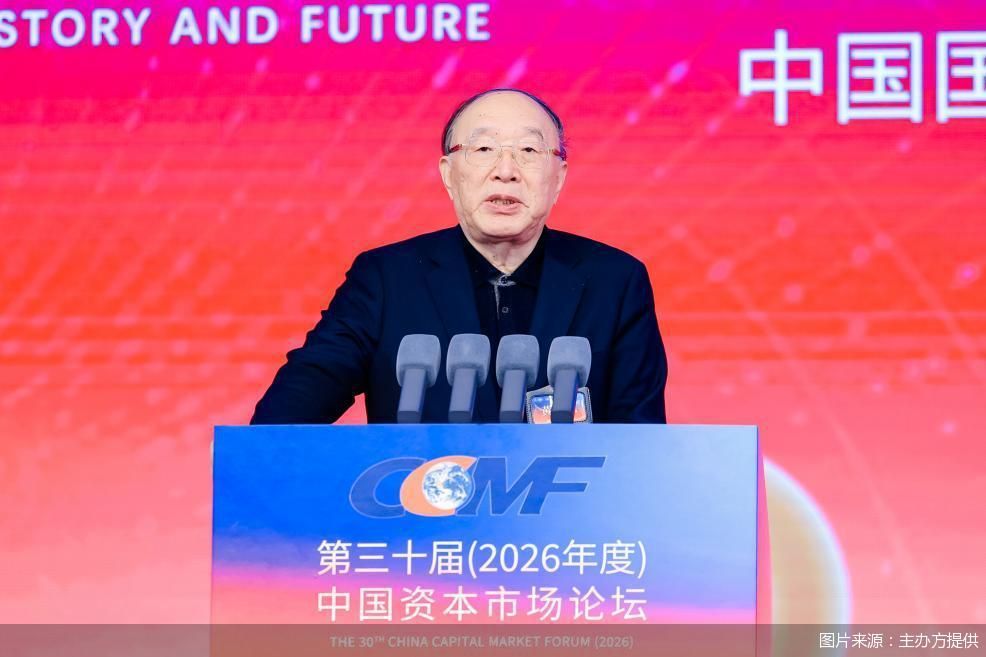
黄奇帆:以社保基金、外汇储备等“输血”企业股本,降低企业负债率
Bei Jing Shang Bao· 2026-01-11 10:23
Core Viewpoint - Huang Qifan emphasizes the need for reform in the capital formation mechanism of Chinese enterprises, advocating for a dual-driven capital market that includes both the stock market and a robust equity financing system for businesses [3][4]. Group 1: Capital Market Structure - A healthy capital market should function like a two-wheeled cart, with one wheel representing the stock market and the other representing the capital formation and supplementation mechanism for enterprises [3]. - Current discussions in China's capital market often focus on the stock market, neglecting the importance of a sustainable equity financing system that supports long-term corporate health [3]. Group 2: Historical Context and Current Challenges - Historical data shows that in the 1990s, measures like bankruptcy write-offs and the development of the stock market significantly improved corporate capital adequacy, with listed companies' capital accounting for over 70% and state-owned enterprises over 50% [3]. - Presently, high debt levels are a major concern for Chinese enterprises, reflecting their operational efficiency, risk, and vulnerability [3]. Group 3: Proposed Solutions for Capital Expansion - Huang Qifan identifies four types of "sleeping" capital that can be utilized: bank capital, social security funds, insurance funds, and foreign exchange reserves, which could collectively form over 10 trillion yuan in guiding funds [4]. - By leveraging these funds, it is possible to create a total equity investment fund system worth 40 to 50 trillion yuan, which could directly increase corporate equity and reduce debt ratios by 15-20 percentage points [4]. Group 4: Broader Implications - The proposed capital expansion could lead to improved financial health and risk resilience for enterprises, promote new productive forces, and facilitate industrial upgrades [4]. - Additionally, it could generate significant investment returns that could be used to bolster public finances and social security, while enhancing the influence of state-owned enterprises and improving the credit and efficiency of private enterprises [4].
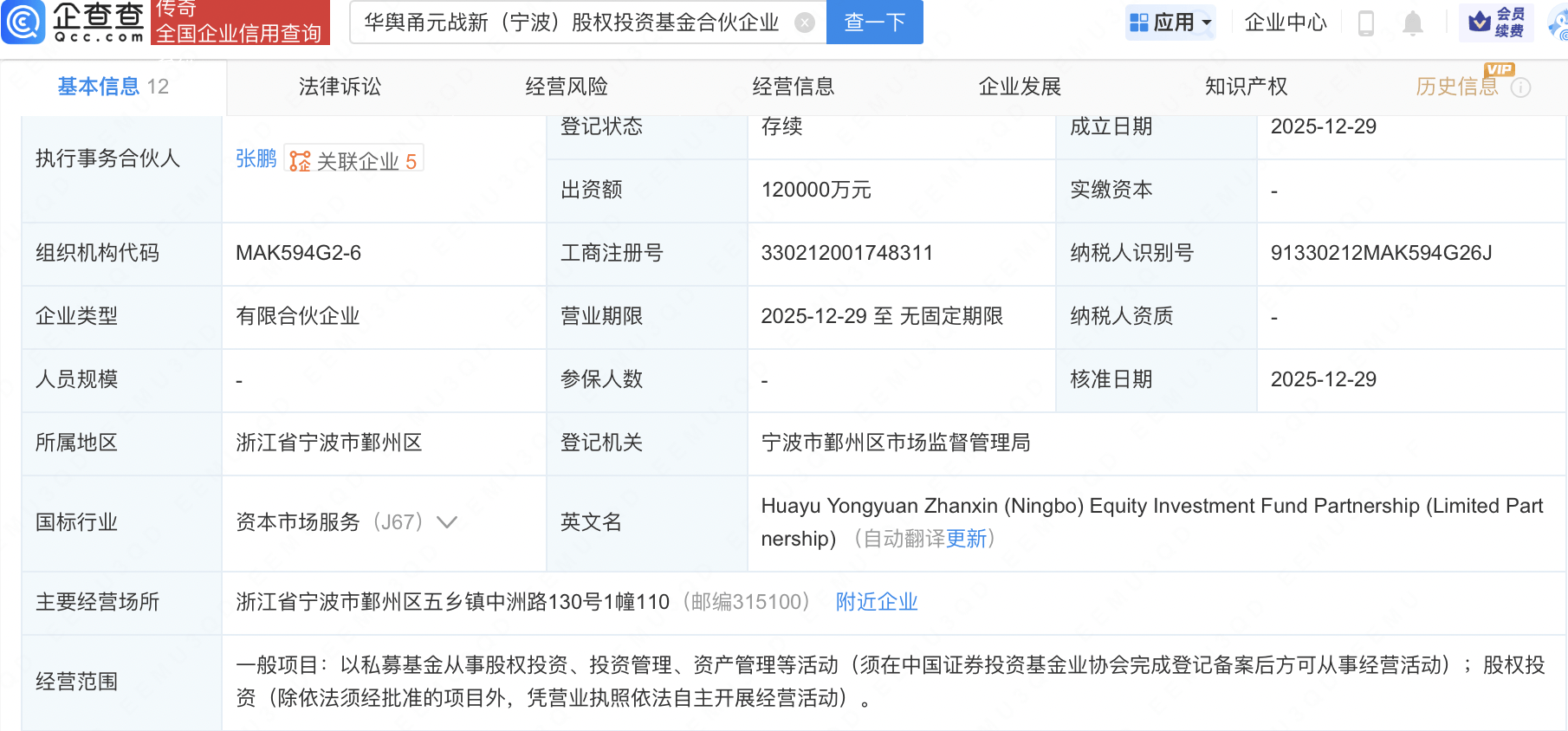
中国中车、宁波国资等新设股权投资基金,出资额12亿
Sou Hu Cai Jing· 2026-01-06 09:34
Core Insights - Huayu Yongyuan Zhanzheng (Ningbo) Equity Investment Fund Partnership has been established with a total investment of 1.2 billion yuan, focusing on private equity investment, investment management, and asset management activities [1][2]. Group 1: Company Overview - The fund is a limited partnership and is registered in Ningbo, Zhejiang Province, with a business duration until December 29, 2025 [2]. - The main operational location is at 130 Zhongzhou Road, Wuxiang Town, Ningbo, with a postal code of 315100 [2]. Group 2: Investment Structure - The fund is jointly funded by CRRC Capital Management Co., Ltd., Ningbo Yongyuan Investment Fund Co., Ltd., and Ningbo Metro Industry Engineering Co., Ltd. [1][3]. - CRRC Capital Management Co., Ltd. is a wholly-owned subsidiary of China CRRC Corporation Limited, which holds a 100% stake in the fund [3].

拓展业务边界 公募持续推进“集团化”布局
Shang Hai Zheng Quan Bao· 2025-12-28 13:28
Core Insights - The recent developments in the establishment of specialized subsidiaries by leading public funds like E Fund and GF Fund indicate a shift towards diversified and differentiated business models in the asset management industry [1][3] Group 1: Establishment of Subsidiaries - E Fund's wholly-owned subsidiary, E Fund Wealth Management Fund Sales (Guangzhou) Co., Ltd., has officially commenced operations after obtaining the necessary licenses, marking a significant milestone in its business expansion [1] - As of now, the total number of wealth management subsidiaries among public fund companies has reached 9, with notable players like Harvest Wealth and Huaxia Wealth leading in non-money fund asset retention [2] Group 2: Diversified Business Strategies - The public fund industry is witnessing a trend towards diversification in wealth management, private equity investment, and specialized operations, as evidenced by GF Fund's establishment of its wholly-owned subsidiary, Ruichen Private Equity Investment Fund Management (Guangdong) Co., Ltd. [3] - The establishment of private equity investment subsidiaries is not limited to GF Fund; other firms like Huaxia Fund have also received regulatory approval for similar ventures, indicating a growing interest in private equity within the public fund sector [3] - E Fund has also set up subsidiaries focusing on alternative asset allocation and asset securitization, alongside its overseas operations, reflecting a comprehensive approach to asset management [3] Group 3: Technological Integration - E Fund is actively integrating advanced AI technologies, including deep learning and machine learning, to enhance its investment research and advisory services, indicating a commitment to digital transformation in the asset management space [1]
晶科科技(601778.SH)拟出资1700万元参设股权投资基金
智通财经网· 2025-12-15 09:59
Group 1 - The core viewpoint of the article is that Jinko Technology (601778.SH) is advancing its strategic investment in the energy storage business by participating in the establishment of a new equity investment partnership [1] - The company plans to invest 17% of the total committed capital of the fund, amounting to 17 million yuan, to strengthen strategic cooperation within the industry chain and ecosystem [1] - The fund aims to invest in industrial and commercial energy storage projects through its holding platform [1]
