能源化工ETF建信

Search documents
四家顶级游资聚焦韶能股份, 量化资金、游资集体抢筹汉缆股份
摩尔投研精选· 2026-03-24 10:13
Core Viewpoint - The article highlights the trading activities in the Shanghai and Shenzhen stock markets, focusing on the top traded stocks, sector performances, and significant capital flows, indicating potential investment opportunities and trends in the market [1][2][5]. Trading Activities - The total trading volume of the Shanghai and Shenzhen Stock Connect reached 289.29 billion, with Zijin Mining and CATL leading in trading volume for Shanghai and Shenzhen respectively [1][2]. - The top ten stocks by trading volume on the Shanghai Stock Connect included Zijin Mining (3.70 billion), WuXi AppTec (1.95 billion), and Baidu Storage (1.25 billion) [2][3]. - On the Shenzhen Stock Connect, CATL topped the list with 4.49 billion, followed by NewEase (3.96 billion) and Zhongji Xuchuang (3.47 billion) [2][4]. Sector Performance - The non-ferrous metals sector saw the highest net inflow of capital, amounting to 6.32 billion, with a net inflow rate of 4.32% [6][7]. - Other sectors with significant net inflows included communications (3.68 billion) and industrial metals (2.84 billion) [6]. - Conversely, the power equipment sector experienced the largest net outflow, totaling -3.77 billion, with a net outflow rate of -3.38% [7][8]. Individual Stock Capital Flows - Zijin Mining led individual stock net inflows with 1.40 billion, followed by Demingli (1.10 billion) and Hanlan Co. (0.95 billion) [9]. - The stocks with the highest net outflows included Yangmi Power (-1.36 billion) and Huagong Technology (-0.75 billion) [10][11]. ETF Trading - The top traded ETF was the Energy Chemical ETF (159981) with a trading volume of 13.85 billion, followed by the Gold ETF (518880) at 13.72 billion [13]. - The Brazilian ETF from E Fund (520870) saw a remarkable increase in trading volume, growing by 190% compared to the previous trading day [14]. Market Sentiment and Activity - The article notes that the green energy concept stocks continued to show strength, with the popular stock Shaoneng Co. achieving a five-day four-board streak, attracting significant capital from top-tier funds [1][18]. - Hanlan Co. also saw a strong performance, hitting the daily limit, with substantial purchases from leading funds [1][18].




沪指盘中创近五个月新低,什么情况?
第一财经· 2026-03-23 12:22
Core Viewpoint - The A-share market experienced a significant adjustment, with major indices dropping over 3%, while energy sectors like coal and oil showed resilience, becoming a rare safe haven amidst the downturn [3][5][6]. Market Adjustment Analysis - The market's decline is attributed to external disturbances and heightened geopolitical tensions, leading to concentrated pricing of risk aversion. Core assets that had previously seen high gains became the focus of sell-offs [3][6]. - The technology sector, which thrived last year, is now facing substantial declines, with some funds down over 10% year-to-date. The performance gap among actively managed equity funds has widened to over 72 percentage points [3][7][9]. Sector Performance - On March 23, the A-share market saw the Shanghai Composite Index drop to a new low since October, closing at 3813.28 points, down 3.63%. Over 5100 stocks fell, with more than 130 hitting the daily limit down [5][6]. - Only the coal and oil sectors showed slight increases, with coal up 0.2% and oil and petrochemicals up 0.06%. Notable stocks included Yunmei Energy and Liaoning Energy, which hit the daily limit up [5][6]. Fund Performance Disparity - Despite the strong performance of energy and materials-themed products, the top-performing actively managed equity funds are still primarily in the technology sector. For instance, Guangfa Yuanjian Zhixuan A leads with a 49.22% return year-to-date [9][10]. - A significant number of actively managed funds are experiencing losses, with 171 funds down over 10% year-to-date, highlighting a stark performance disparity [9][10]. Investment Strategy Adjustments - In response to market volatility, institutions are shifting strategies from concentrated technology investments to exploring structural opportunities in energy and cyclical sectors, aiming to enhance portfolio defensiveness [11][12]. - The prevailing investment strategy is moving towards a balanced approach, focusing on high cash flow and low correlation sectors, while also considering growth opportunities in less crowded areas [12][13]. Future Outlook - Analysts suggest that the current market conditions may present structural opportunities in technology, particularly in domestic computing and robotics, while also advising caution regarding geopolitical tensions [12][13]. - The recommendation is to maintain a diversified investment strategy to mitigate risks, with an emphasis on balancing equity exposure with quality bonds, commodities, and alternative investments [13].

量化择时周报:耐心防御等缩量-20260322
ZHONGTAI SECURITIES· 2026-03-22 11:42
Core Insights - The report indicates that the market is currently in a consolidation phase, with a potential for further short-term adjustments as trading volume continues to decrease, but remains above critical thresholds [2][5][6] - The overall market (wind All A index) experienced a decline of 4.13% last week, with small-cap stocks (CSI 1000) dropping by 5.25% and mid-cap stocks (CSI 500) falling by 5.82% [6][7] - Key sectors showing resilience include telecommunications and banking, while materials such as non-ferrous metals and steel have underperformed significantly [6][7] Market Dynamics - The distance between the short-term (20-day) and long-term (120-day) moving averages has narrowed to 4.33%, indicating a bearish market sentiment with a negative profit effect of -4.35% [5][6][9] - The report highlights that the core variable to observe is the change in risk appetite, influenced by factors such as shifts in Federal Reserve interest rate expectations and ongoing geopolitical tensions in the Middle East [7][9] - A trading volume below 17 trillion is anticipated to signal a potential rebound in the market [5][7] Sector Allocation - The mid-term industry allocation model suggests focusing on sectors related to computing power, such as semiconductor equipment (ETF code 159516.SZ) and telecommunications (ETF code 515880.SH), as well as cyclical sectors like oil and gas (ETF code 159309.SZ) and energy chemicals (ETF code 159981.SH) [5][12] - In a defensive strategy, short-term attention should be given to banking ETFs and tourism ETFs [5][12] Valuation Metrics - The wind All A index's PE ratio is positioned around the 85th percentile, indicating a moderately high valuation level, while the PB ratio is at the 50th percentile, reflecting a medium valuation level [7][9] - Based on the current market conditions, a 50% allocation in absolute return products based on the wind All A index is recommended [5][7]
最高涨近35%!同叫化工ETF,为何收益差这么多?
市值风云· 2026-03-20 10:16
Core Viewpoint - The article discusses the varying performance of chemical ETFs in 2023, highlighting that despite all being labeled as "chemical," their returns differ significantly due to underlying factors such as the indices they track and market conditions [4][6]. Group 1: ETF Performance - The best-performing chemical ETF has nearly achieved a 35% return this year, while others have returned less than 5% [4]. - The leading ETF, the Energy Chemical ETF by Jianxin (159981.SZ), has shown a significant increase in performance, attributed to its tracking of a commodity futures index rather than a traditional stock index [7][11]. - The majority of chemical ETFs are equity-based, tracking the performance of chemical companies, which can be influenced by broader market sentiments [14][13]. Group 2: Index Tracking Differences - Jianxin's ETF tracks the Yisheng Energy Chemical A index, which is linked to commodity prices like thermal coal and PTA, making it more sensitive to commodity market fluctuations [11][13]. - Other mainstream chemical ETFs follow a segmented chemical index, which includes top-performing companies in the chemical sector, such as Wanhua Chemical and Salt Lake Potash [15][17]. - The largest ETF by assets is the Penghua Chemical ETF (159870.SZ), with a combined scale exceeding 28 billion [19]. Group 3: Full Return Index vs. Price Index - The Guotai Chemical ETF (516220.SH) tracks a "full return" index, which includes dividends in its calculations, potentially leading to higher long-term returns compared to standard price indices [24][25]. - The full return index captures the benefits of reinvested dividends, which can enhance returns over time, especially in a cyclical industry like chemicals [25]. Group 4: Investment Strategies - For traders focused on short-term trends in commodities like PTA and methanol, the Energy Chemical ETF by Jianxin is more suitable due to its futures-based nature [26]. - For long-term investors interested in core chemical assets and industry leaders, ETFs tracking stocks of leading companies in the chemical sector may be more appropriate [26].



量化择时周报:缩量之前防御为主-20260315
ZHONGTAI SECURITIES· 2026-03-15 07:43
Quantitative Models and Construction Methods 1. Model Name: Timing System Model - **Model Construction Idea**: The model uses the distance between the short-term moving average (20-day) and the long-term moving average (120-day) of the Wind All A Index to identify market trends and timing signals[2][7][12] - **Model Construction Process**: 1. Calculate the 20-day moving average and 120-day moving average of the Wind All A Index 2. Compute the distance between the two moving averages: $ Distance = \frac{MA_{20} - MA_{120}}{MA_{120}} $ 3. Define thresholds: If the absolute value of the distance is greater than 3%, it indicates a significant trend signal[7][12] 4. Incorporate additional metrics such as market trend line (6796 points) and profitability effect (-0.02%) to refine the signal[7][12] - **Model Evaluation**: The model effectively captures market oscillations and provides actionable timing signals during periods of market uncertainty[7][12] 2. Model Name: Mid-term Industry Allocation Model - **Model Construction Idea**: This model identifies industries with strong performance potential based on earnings trends and macroeconomic factors[6][8][13] - **Model Construction Process**: 1. Analyze earnings trends across industries to identify sectors with upward momentum 2. Incorporate macroeconomic indicators and policy drivers to refine sector selection 3. Highlight key sectors such as computing power (e.g., semiconductor equipment, communication), cyclical industries (e.g., oil and gas, energy chemicals), and agriculture[6][8][13] - **Model Evaluation**: The model provides a robust framework for sector rotation and aligns with defensive strategies during market uncertainty[6][8][13] --- Model Backtesting Results 1. Timing System Model - Moving average distance: 5.28% (greater than the 3% threshold)[7][12] - Market trend line: 6796 points[7][12] - Profitability effect: -0.02% (not yet positive)[7][12] 2. Mid-term Industry Allocation Model - Key sectors identified: - Computing power: Semiconductor equipment ETF (159516.SZ), Communication ETF (515880.SH) - Cyclical industries: Oil and gas ETF (159309.SZ), Energy chemicals ETF (159981.SH) - Agriculture: Agriculture ETF (562900.SH)[6][8][13] --- Quantitative Factors and Construction Methods 1. Factor Name: Moving Average Distance - **Factor Construction Idea**: Measures the relative distance between short-term and long-term moving averages to capture market momentum[7][12] - **Factor Construction Process**: 1. Calculate the 20-day and 120-day moving averages of the Wind All A Index 2. Compute the relative distance using the formula: $ Distance = \frac{MA_{20} - MA_{120}}{MA_{120}} $ 3. Use a threshold of 3% to determine significant signals[7][12] - **Factor Evaluation**: The factor is effective in identifying market trends and oscillations, providing a clear signal for timing decisions[7][12] --- Factor Backtesting Results 1. Moving Average Distance Factor - Current value: 5.28% (above the 3% threshold)[7][12]
ETF今日收评 | 影视、创业板人工智能相关ETF涨超6% 能源化工ETF建信跌幅居前
Mei Ri Jing Ji Xin Wen· 2026-02-09 07:53
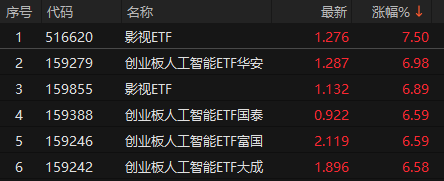
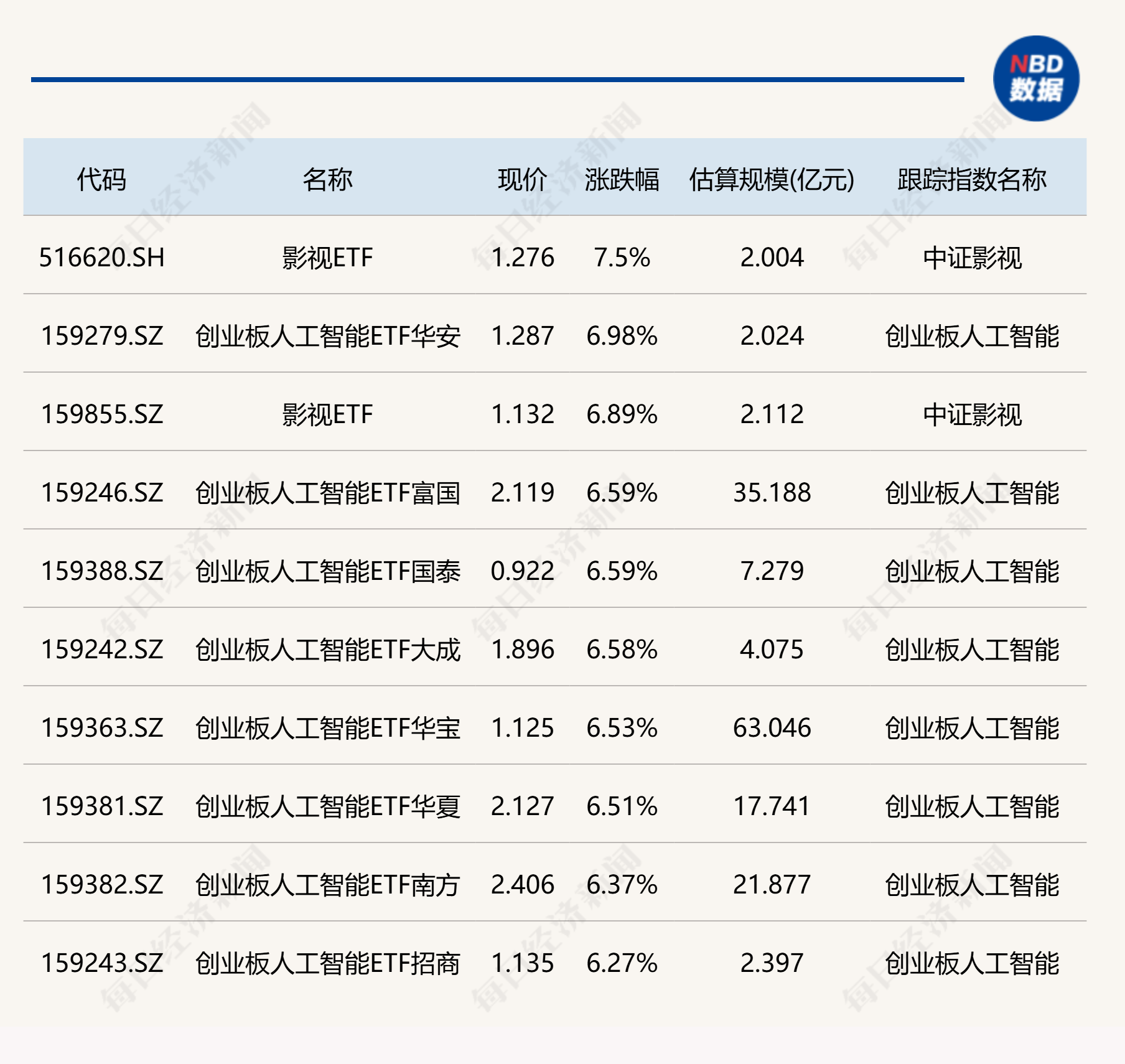
Market Overview - The market opened high with the Shanghai Composite Index rising over 1% and the Shenzhen Component Index increasing over 2% [1] - AI application sectors continued to rise, with active performances in chemical and photovoltaic concepts, and a collective strength in computing hardware concepts, while commercial aerospace concepts also saw gains [1] ETF Performance - The film and entrepreneurial AI-related ETFs saw significant gains, with the film ETF rising by 7.5% and several entrepreneurial AI ETFs increasing by approximately 6% to 7% [2][4] - The energy and chemical ETF from Jianxin experienced a decline, with a drop of 0.08% [4] Industry Insights - Analysts suggest that the upcoming Spring Festival will catalyze the film sector, with multiple films already scheduled for release in 2026, indicating a rich variety of themes and strong star lineups [3] - Seasonal demand for entertainment consumption during the Spring Festival is expected to positively impact market sentiment in the film sector [3] - The artificial intelligence industry is in a rapid development phase, with continuous technological innovation and expanding application scenarios [3] - Increased policy support and market demand are anticipated to create new development opportunities in the AI industry, particularly in upstream foundational technology areas such as chips and algorithm frameworks, which are seen as key investment directions [3]

ETF收盘:影视ETF涨7.5% 能源化工ETF建信跌0.08%
Sou Hu Cai Jing· 2026-02-09 07:16
Group 1 - The overall performance of ETFs on February 9 showed mixed results, with the film ETFs leading the gains and energy-related ETFs experiencing slight declines [1][2] - The top-performing ETF was the film ETF (516620), which increased by 7.50%, followed by the Huashan AI ETF (159279) with a rise of 6.98% [1][2] - Other notable gainers included another film ETF (159855) with a 6.89% increase, while the worst performers were the energy chemical ETF (159981) down by 0.08%, and the fundamental ETF (159916) down by 0.07% [1][2] Group 2 - The detailed performance of the top gainers included: - Film ETF (516620) at 1.276 with a 7.50% increase - Huashan AI ETF (159279) at 1.287 with a 6.98% increase - Another film ETF (159865) at 1.132 with a 6.89% increase [2] - The detailed performance of the top losers included: - Energy chemical ETF (159981) at 1.279 with a decrease of 0.08% - Fundamental ETF (159916) at 5.386 with a decrease of 0.07% - Sci-tech bond ETF (159200) at 100.444 with a decrease of 0.05% [2]