药

Search documents
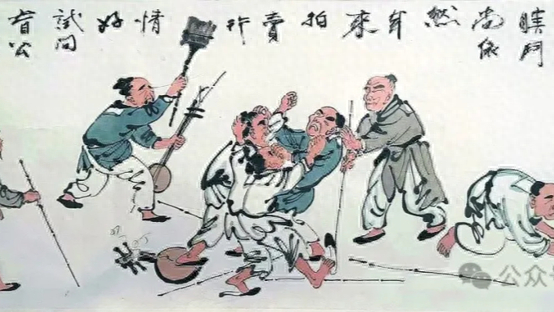
磨墨隆隆然——和小学生们谈《口技》
Xin Lang Cai Jing· 2026-02-20 04:11
Group 1 - The article discusses a traditional Chinese storytelling technique known as "kouji," which involves sound effects and voice manipulation to create an immersive experience for the audience [6][12][16] - The narrative centers around a female character who sells medicine and uses the art of "kouji" to deceive villagers into believing in her healing abilities [4][7][10] - The setting is crucial for the performance, as it creates an atmosphere conducive to the audience's suspension of disbelief, allowing them to be captivated by the auditory experience [6][8][9] Group 2 - The use of sound effects in the performance, such as the grinding of ink and the rustling of paper, enhances the storytelling and engages the audience's imagination [12][15][16] - The article highlights the psychological aspects of the performance, where the audience's anticipation and fear contribute to the effectiveness of the deception [4][7][10] - The character's ability to manipulate sounds and create a vivid auditory scene reflects the broader cultural significance of oral traditions in Chinese storytelling [6][12][16]

特朗普调侃马克龙戴墨镜并称已施压马克龙提高药价
Xin Jing Bao· 2026-01-28 04:11
Core Viewpoint - Trump criticized Macron for wearing sunglasses at various events and claimed he pressured Macron to raise drug prices, which Macron denied, labeling it as "fake news" [1] Group 1: Economic Pressure - Trump stated he demanded Macron to increase drug prices, but Macron refused [1] - Trump threatened to impose a 25% tariff on French goods sold in the U.S. if drug prices were not raised [1] Group 2: Public Perception - Macron's appearance with sunglasses at the World Economic Forum sparked discussions due to his eye discomfort [1] - The French presidential office refuted Trump's claims, emphasizing the inaccuracy of his statements [1]
视频|特朗普当众嘲讽马克龙:他不同意上调药价,但我威胁要给法国加关税,他立刻同意了,前后转变就3分钟
Xin Lang Cai Jing· 2026-01-22 05:07
Core Viewpoint - The article discusses the recent developments in the investment banking sector, highlighting key trends and potential opportunities for growth in the market [1] Group 1 - The investment banking industry is experiencing a significant shift due to increased demand for advisory services and capital raising [1] - Major firms are focusing on expanding their digital capabilities to enhance client services and operational efficiency [1] - There is a notable rise in mergers and acquisitions activity, driven by favorable market conditions and strategic realignments among companies [1] Group 2 - Regulatory changes are impacting the investment banking landscape, necessitating firms to adapt their compliance strategies [1] - The competition among investment banks is intensifying, with firms seeking to differentiate themselves through innovative solutions and client engagement [1] - Economic indicators suggest a positive outlook for the investment banking sector, with projections of growth in deal volumes and advisory fees [1]
坚持全面深化改革和扩大高水平对外开放
Xin Lang Cai Jing· 2025-12-28 19:25
Core Viewpoint - The article emphasizes the importance of comprehensive reform and high-level opening-up in driving the high-quality development of Guiyang and Guian, aligning with the spirit of the 20th National Congress of the Communist Party of China [1] Economic Development - During the 14th Five-Year Plan period, Guiyang and Guian are seizing strategic opportunities from the Western Development and the Yangtze River Economic Belt, leading to significant economic improvements [1] - The contribution rate of the industrial sector to economic growth increased from 21.9% in 2020 to 31.1% in 2024 [1] - Total tourism revenue is projected to grow by 37.9% from 2020 to 2024 [1] - The total economic output of Guiyang is expected to rise from 450.523 billion yuan at the end of the 13th Five-Year Plan to 577.741 billion yuan by 2024 [1] Social Reforms - The implementation of a people-centered new urbanization strategy and a three-year action plan to increase residents' income has resulted in an average annual growth of disposable income of 5.8% for urban residents and 7.9% for rural residents [1] Urban Development - Continuous improvements in urban functions include the renovation of back streets and alleys, upgrades to underground utility networks, and the completion of major infrastructure projects like metro lines 2 and 3 [1] Challenges and Opportunities - Guiyang and Guian face challenges such as low industrial capacity, significant urban-rural development gaps, and insufficient levels of open platforms [3] - The need to transition from a resource-dependent model to an innovation-driven model is highlighted, along with the importance of breaking down barriers to factor mobility and enhancing regional cooperation [3][4] Reform Initiatives - The focus on systemic and integrated reforms is essential for overcoming obstacles to high-quality development, including market-oriented reforms in data elements and collaborative industrial reforms [4] - Establishing cross-regional industrial funds in sectors like new energy batteries and aerospace is proposed to enhance resource sharing [4] Global Engagement - Guiyang and Guian aim to enhance their global engagement by expanding institutional openness and participating in international cooperation, particularly in digital economy and ecological tourism [5] - The development of open platforms and regional collaboration with areas like Chengdu-Chongqing and Guangdong-Hong Kong-Macau is emphasized to break down regional barriers [5] Governance and Public Welfare - The integration of reform and governance is crucial for ensuring that development benefits are equitably shared among the population [6] - Initiatives to improve public service delivery and promote social equity are outlined, including the use of technology to enhance urban management and ensure access to quality education and healthcare [6]
动静医生|服药“一日三次”≠跟着三餐吃!服药时间别踩坑
Xin Lang Cai Jing· 2025-12-21 03:17
Group 1 - The article emphasizes the importance of adhering to medication schedules, specifically the recommendation to take medications three times a day, ideally spaced evenly over waking hours [1] - It suggests that taking medications strictly according to meal times is not necessary, and that the focus should be on maintaining appropriate intervals between doses [1] - The article provides an example of a medication that should be taken every 6 hours, highlighting the need to adjust the timing if nighttime dosing is impractical [1] Group 2 - It discusses scenarios where patients forget to take their medication, advising that if the time exceeds twice the normal dosing interval, they should skip the missed dose [2] - For medications that are taken once daily, if a dose is missed in the morning, it is recommended to wait until the next scheduled dose rather than trying to make up for the missed dose [2] - The article concludes by stressing the importance of not increasing the dosage if a dose is missed, prioritizing medication safety [3]

鲁南制药跻身全国民营企业研发投入、发明专利双榜单百强
Qi Lu Wan Bao Wang· 2025-09-28 02:47
Group 1 - The 2025 Private Economy Innovation Development Conference was held in Xi'an, focusing on promoting the development of private enterprises through technological innovation [1] - Lunan Pharmaceutical ranked 176th in national private enterprise R&D investment and 84th in invention patents [1] - The conference aimed to align national strategies with local development needs, enhancing the high-quality development of the economy and society [1] Group 2 - Lunan Pharmaceutical emphasizes "platform empowerment for innovation" and has established a deep integration of production, learning, research, and application [2] - The company invests over 10% of its revenue annually in R&D, focusing on biopharmaceuticals, innovative drugs, and high-end formulations [1][2] - Lunan Pharmaceutical aims to contribute significantly to the Healthy China strategy and the high-quality development of Shandong [2]
请回答「Knock Knock 世界」NO. 250720
声动活泼· 2025-07-20 03:19
Core Viewpoint - The article discusses various observations and questions raised by young readers regarding societal norms, consumer behavior, and the impact of advertising and sponsorship on businesses [1][2][3]. Group 1: Consumer Behavior - Young readers express curiosity about why certain products, like popcorn and fries, are more expensive in cinemas compared to supermarkets, questioning the pricing strategies of businesses [1]. - There is a discussion on the urgency of delivery riders, such as those from Meituan and Ele.me, highlighting the perception that "time is money" in the delivery industry [2]. - The article raises questions about the profitability of shared bicycles, especially when they are often found unused and stacked together [2]. Group 2: Advertising and Sponsorship - The article explores how sponsorships, advertisements, and promotional sales work, questioning whether sponsors incur losses and the effectiveness of influencers in driving product sales [3]. - It mentions the role of short video bloggers in advertising, questioning the rationale behind paying them when their followers may not purchase the advertised products [3]. Group 3: Health and Safety Concerns - A young reader expresses concern over food safety following a poisoning incident, leading to questions about artificial coloring in food and its potential health risks [3]. - The article discusses the differences between industrial and edible food colorings, emphasizing the importance of understanding food safety [3]. Group 4: Cultural Observations - The article notes the differences in cleanliness and quietness observed in Japan, attributing it to lower population density [3]. - It highlights the artistic transformation of school entrance barriers in Shunde, contrasting it with the lack of similar changes in Guangzhou, prompting questions about community engagement and aesthetics [3]. Group 5: Podcast Promotion - The article promotes the "Knock Knock World" podcast, which aims to engage young audiences with global events and fresh perspectives, indicating a growing trend in educational audio content [4][5][6].

从《大宅门》到《大染坊》的投资启示 | 螺丝钉带你读书
银行螺丝钉· 2025-05-24 13:43
Core Viewpoint - The article discusses the complexities and challenges of investing in different industries, using examples from classic dramas to illustrate the differences in business models and profitability [3][45]. Group 1: Industry Comparison - The textile industry is portrayed as difficult to profit from due to high competition and low barriers to entry, leading to price wars and thin margins [18][39]. - In contrast, the pharmaceutical industry benefits from strong brand loyalty and a more stable profit margin, as consumers tend to prefer established brands even if the products are similar [31][32]. Group 2: Business Models - Light asset models, such as those in the pharmaceutical industry, allow for higher net profits with lower initial investments, but have limitations in scalability [8][9]. - Heavy asset models, like those in the textile industry, require significant upfront investment in machinery and technology, which can lead to long payback periods and increased financial risk [22][23]. Group 3: Competitive Landscape - The presence of numerous competitors in an industry increases the difficulty of maintaining stable profits, as seen in the textile industry where new entrants often resort to price cuts [45][36]. - A strong competitive advantage, or "moat," is essential for long-term profitability, particularly in the pharmaceutical sector where brand recognition plays a crucial role [29][30].