西德克萨斯中质油(WTI)

Search documents
日元在中东紧张局面下缘何未获买入?
日经中文网· 2026-03-04 02:35
"有事时买入日元"已成为过去 "在霍尔木兹海峡被封锁导致油价上涨令人担忧的情况下,没有积极买入日元的氛围",外汇经纪人这样 解释本周初以后外汇市场的气氛。日元此前一直被视为地缘政治风险等导致市场紧张加强之后容易被买 入的"安全货币"。但以2022年为转折点,情况发生变化…… 随着中东局势紧张,日元贬值正在加剧。由于担心原油价格走高导致日本贸易收支逆差扩大,曾经 的"有事时买入日元"的现象已不复存在。市场关注的是俄罗斯入侵乌克兰导致的"2022年型日元贬值"的 情形。越来越多观点认为,非常时期买入美元和能源价格的上涨将加速日元的抛售。 "在霍尔木兹海峡被封锁导致油价上涨令人担忧的情况下,没有积极买入日元的氛围",日本国内银行的 外汇经纪人这样解释本周初以后外汇市场的气氛。 俄乌冲突爆发的2022年成为转折点。当时,地缘政治风险的加剧导致"有事时买入美元",同时欧美对产 油国俄罗斯实施经济制裁,导致能源价格上涨。 作为国际原油价格指标的西德克萨斯中质油(WTI)的近期合约在2022年3月一度达到每桶130美元,比 上年底上涨70%,之后也徘徊在100美元附近的高位区间。出口减去进口的日本贸易收支在2022年度出 ...

油市出现双面赌局:看空者不敢直接做空
Jin Shi Shu Ju· 2025-11-26 03:53
Core Viewpoint - Traders are increasingly adopting safer strategies in response to anticipated oversupply in the oil market, shifting towards spread trading and options trading to mitigate risks associated with geopolitical uncertainties and potential supply disruptions [2][3]. Group 1: Market Dynamics - The oil market is experiencing a tug-of-war between supply risks from oil-rich countries like Russia and Venezuela and the growing supply from OPEC+ and beyond, with the International Energy Agency (IEA) predicting record oversupply by 2026 [4]. - Over 1 billion barrels of oil are currently in transit globally, awaiting final destinations, indicating significant market activity and uncertainty [4]. - The market sentiment is described as "confused," with traders caught between bullish and bearish positions, as evidenced by the balanced open interest in call and put options for Brent and WTI crude [5]. Group 2: Trading Strategies - Traders are increasingly betting on short-term price declines through calendar spread options, reflecting a growing expectation of falling oil prices amid ongoing negotiations between Ukraine and Russia [4][5]. - The increase in positions betting on WTI crude's near-month contract being lower than the far-month contract indicates a cautious approach, while significant open interest also exists for positions anticipating a rise in price spreads [5]. - The latest sanctions against Russian oil companies are altering trade flows, with Russian oil prices hitting a two-and-a-half-year low, yet these discounts have not attracted Asian buyers [7]. Group 3: Future Outlook - Analysts at JPMorgan expect oil prices to gradually decline, suggesting strategies such as Brent crude put spreads and ratio put spreads to navigate the market [8].

贺博生:5.8黄金原油震荡回落最新行情走势分析及今日独家操作建议
Sou Hu Cai Jing· 2025-05-08 00:06
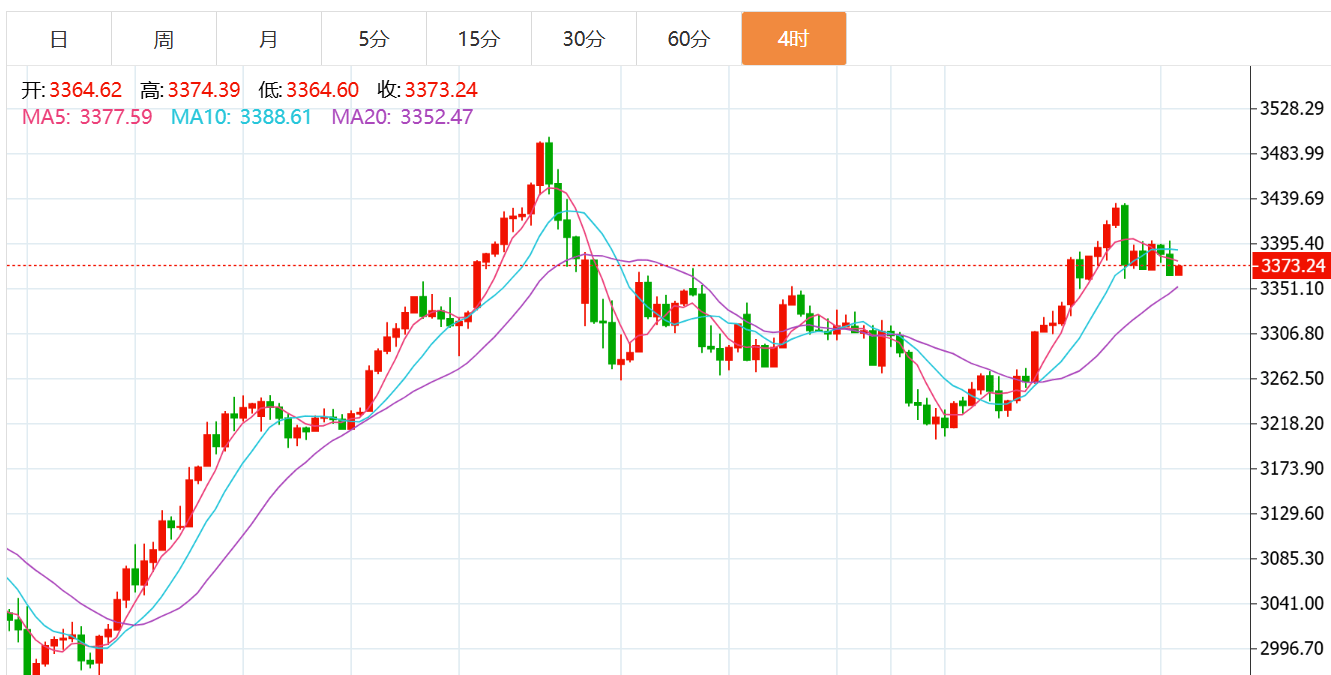
Group 1: Gold Market Analysis - Gold prices fell over 1% during the U.S. trading session on May 7, reflecting a retreat from recent highs due to optimistic sentiment surrounding U.S.-China trade negotiations and expectations regarding the Federal Reserve's policy statement [2] - Market participants are awaiting the Federal Reserve's decision, which is expected to maintain interest rates unchanged; dovish signals from Powell could boost gold prices, while hawkish tones may exert downward pressure [2][3] - Despite the short-term pullback in gold prices, the broader outlook remains neutral to bullish, supported by potential rate cuts and geopolitical instability that could revive buying interest [2] Group 2: Technical Analysis of Gold - The daily chart indicates a potential adjustment phase following three consecutive bullish days, with a possibility of a significant decline below 3300 if a bearish engulfing pattern occurs [3] - Short-term support is identified at 3355; if this level holds, there may be opportunities to go long, targeting 3400, with a further potential rise to 3430 if conditions allow [5] - The current trading range is between 3400 and 3360, with a focus on the 3360 support level; a break below this could indicate a shift in short-term trend [5] Group 3: Oil Market Analysis - Brent crude oil prices rebounded to $63 per barrel, while WTI approached $60, reflecting over a 3% increase due to easing trade concerns and optimistic global economic recovery expectations [6] - The rise in oil prices is attributed to a combination of improved trade sentiment and declining U.S. inventory levels, with technical indicators suggesting a bullish short-term outlook [6] - Long-term stability in the global energy market relies on supply-demand balance and economic recovery rather than isolated events; a breakthrough above $62 could signal a new upward trend [6] Group 4: Technical Analysis of Oil - The mid-term trend for oil prices is downward, with potential further declines towards the 50 level, while short-term movements show a rebound towards 60 [7] - The MACD indicator suggests that bullish momentum is present, although the strength of this momentum is lacking; the expectation is for continued upward movement in the short term [7] - Today's trading strategy recommends focusing on buying on dips while considering selling on rebounds, with key resistance at 59.7-60.2 and support at 56.5-56.0 [7]
暂停美国油气进口,特朗普背后金主受挫,问起中国损失,只有四字
Sou Hu Cai Jing· 2025-05-02 19:26
Core Insights - The article discusses China's resilience against U.S. energy import restrictions and highlights its strategic energy policies that mitigate risks from reliance on a single supplier [1][4][6]. Energy Import Strategy - In February, China imposed tariffs on U.S. crude oil and natural gas, initially between 10% and 15%, which escalated to 145% by April, effectively blocking U.S. energy exports to China [3][4]. - Despite these tariffs, China's energy supply remained stable, with officials stating there was "no impact" on domestic energy availability [3][4]. - China has diversified its energy suppliers globally, relying on countries like Saudi Arabia, Russia, Qatar, and Australia, which allows it to easily replace U.S. imports [4][6]. Impact on U.S. Energy Sector - The cessation of Chinese imports has significantly reduced orders for U.S. natural gas companies, leading to increased inventory pressures [12]. - U.S. energy giants, such as ExxonMobil and Chevron, which supported Trump's campaign, are facing profit losses due to the decline in exports to China [13]. - The volatility in WTI crude oil prices during the tariff conflict has created challenges for U.S. exporters [12]. Long-term Energy Strategy - China views energy security as a top priority, developing a multi-faceted energy supply system that includes renewables like wind and solar power [18][20]. - In the first quarter, China added 74.33 million kilowatts of wind and solar capacity, maintaining an energy self-sufficiency rate above 80% [18]. - By 2025, China's installed capacity for solar and wind energy is expected to exceed 1 billion kilowatts, positioning it as a leader in the global clean energy transition [20]. Political and Economic Context - The article suggests that Trump's tariff policies have led to domestic economic instability, with rising prices and stock market declines, while China's countermeasures have been effective and targeted [15][24]. - The U.S. administration's attempts to negotiate with China appear ineffective, as China's strategic planning continues to focus on long-term growth and stability [22][24].