途胜

Search documents
半年亏1500亿!车圈恒大浮现,全球第四大车企暴雷
Xin Lang Cai Jing· 2026-02-10 01:49
Core Viewpoint - Stellantis, the world's fourth-largest automotive manufacturer, experienced a significant stock price drop due to strategic misjudgments in its electric vehicle (EV) business, leading to substantial financial losses [2][3][6]. Group 1: Stock Performance and Market Position - On February 6, Stellantis' stock fell by over 26% during trading, closing down 23.79%, marking its highest single-day drop ever [2]. - The company's shares had already been under pressure, with a 33% decline in 2024 and an 18% drop in 2025, followed by a 12% decrease in January 2026 [2]. - Stellantis sold 5.417 million vehicles in 2025, a 9% increase year-on-year, but still lagged behind Toyota, Volkswagen, and Hyundai, maintaining its position as the fourth-largest automotive group globally [3][8]. Group 2: Financial Losses and Strategic Adjustments - Stellantis anticipates a net loss of €19 billion to €21 billion (approximately ¥155 billion to ¥172 billion) in the second half of 2025, with an annual operating profit margin projected to be in the low single digits [6]. - The company plans to suspend its 2026 dividend and raise up to €5 billion through hybrid bond issuance to support its balance sheet [6]. - Stellantis announced a €22 billion (approximately ¥180 billion) charge related to adjustments in its EV strategy, significantly exceeding analyst expectations [6][7]. Group 3: Changes in Electric Vehicle Strategy - The majority of the write-downs (€14.7 billion) are allocated to adjusting product plans to align with customer preferences and new U.S. emission regulations [6][7]. - Stellantis is exiting its joint venture with LG Energy Solution in Canada, where LG will acquire Stellantis' 49% stake [9]. - The company is discontinuing several electric vehicle models, including the RAM 1500 electric pickup in the U.S. and delaying the Alfa Romeo EV project in Europe, contrasting sharply with previous aggressive targets set by former CEO Carlos Tavares [9].

2025年全球十大车企出炉
Di Yi Cai Jing· 2026-02-06 11:11
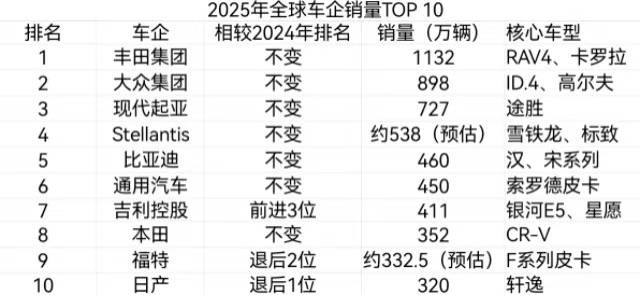
Core Insights - By 2025, the penetration rate of electric vehicles in China is expected to exceed 50%, leading to a shift in global automotive sales rankings, with Chinese automakers rising in prominence [1] Group 1: Global Automotive Sales Rankings - The top three global automakers in 2025 remain Toyota, Volkswagen, and Hyundai-Kia, with sales of approximately 11.32 million, 8.98 million, and 7.27 million units respectively [2] - BYD ranks fifth globally with sales of 4.6 million units, surpassing General Motors and Ford [2][4] - Geely's ranking improves from 10th in 2024 to 7th in 2025, with annual sales exceeding 4 million units for the first time [2][5] Group 2: Performance of Chinese Automakers - BYD's sales growth is primarily driven by its electric vehicle segment, achieving 460,000 units sold in 2025, a year-on-year increase of 7.73% [4] - BYD's overseas sales exceed 1.049 million units, marking a significant growth of 145%, with Mexico and Brazil being the top export markets [4] - Geely's electric vehicle sales reach 2.29 million units, a nearly 60% increase, with an overall penetration rate of 56% for new energy vehicles [5] Group 3: Challenges for Japanese Automakers - Toyota maintains its leading position with a 4.6% increase in sales to 11.32 million units, while Honda and Nissan face declines [7] - Honda's global sales drop to 3.52 million units, a decrease of 7.56%, with significant declines in European and Chinese markets [7] - Nissan's sales fall to 3.2 million units, a 4.4% decline, marking its seventh consecutive year of sales drop in China [3][8]


2025年全球十大车企出炉:比亚迪、吉利力压两大日系巨头
Di Yi Cai Jing· 2026-02-06 10:00
Core Insights - The global automotive sales ranking has shifted, with Chinese automakers rising in prominence as the penetration rate of new energy vehicles (NEVs) in China surpasses 50% by 2025 [1] Group 1: Global Sales Rankings - The top three global automakers remain Toyota, Volkswagen, and Hyundai Kia, with sales of approximately 11.32 million, 8.98 million, and 7.27 million units respectively in 2025 [2] - BYD maintains its position as the fifth-largest automaker globally with sales of 4.6 million units, surpassing General Motors and Ford [2][4] - Geely's ranking improved from 10th in 2024 to 7th in 2025, with annual sales exceeding 4 million units for the first time [2][5] Group 2: Performance of Chinese Automakers - BYD's NEV sales reached 4.6 million units in 2025, marking a year-on-year growth of 7.73%, driven largely by overseas markets [4] - Geely's total sales surpassed 4 million units, with NEV sales reaching 2.29 million units, reflecting a nearly 60% year-on-year increase and a NEV penetration rate of 56% [5][6] Group 3: Challenges for Japanese Automakers - Toyota's sales increased by 4.6% to 11.32 million units, maintaining its lead in the global market [7] - Honda's global sales fell to 3.52 million units, a decrease of 7.56% compared to the previous year, with significant declines in Europe and China [7] - Nissan's sales dropped to 3.2 million units, down 4.4% from 2024, resulting in a decline in its global ranking to 10th place [3][8]

北京现代2025年销量达21万辆,未来两年进入新能源密集投放期
Jing Ji Guan Cha Wang· 2026-01-12 02:54
Core Insights - Beijing Hyundai achieved a total sales volume of 210,000 units in 2025, with domestic sales showing positive growth for six consecutive months [2] - The company’s performance is attributed to its strategic initiatives, business structure, and product quality, demonstrating resilience in a challenging automotive market [2] Strategic Initiatives - In November 2024, both shareholders of Beijing Hyundai jointly increased capital by 8 billion yuan to support the company's transformation [2] - The "Smart 2030 Plan," launched in October 2015, aims to introduce 20 new products and reach a sales target of 500,000 units within five years [2] Business Structure - Beijing Hyundai adopts a "dual fuel" strategy, maintaining a base of gasoline vehicles while launching electric vehicle products, including the EO Yiou, its first SUV based on the E-GMP electric platform [2] - The company has established a business structure focused on "domestic stability and export growth," accelerating the development of a "global export base" [2] Product Quality - The company emphasizes long-termism by implementing a comprehensive quality assurance system covering the entire lifecycle of its products, including supply chain management and user experience optimization [3] - The stable sales in 2025 set a positive precedent for advancing the "Smart 2030 Plan," with a focus on accelerating electrification and smart technology [3] Future Product Plans - From 2026 to 2027, Beijing Hyundai plans to intensively launch new energy products, including two new models under the IONIQ brand, with a focus on mid-size sedans and SUVs [3] - The company aims to cover a full range of technologies, including pure electric, hybrid, and extended-range vehicles, with electric ranges exceeding 600 kilometers [3] Intelligent Technology - By 2026, all products from Beijing Hyundai will be equipped with L2+ level intelligent driving assistance systems, upgrading to L2++ by 2027 [3] - The company is also advancing AI energy management and smart cockpit technologies [3] Global Expansion - Under the "In China, For China, To the World" strategy, Beijing Hyundai will continue to deepen the construction of its "global export base," targeting potential markets in Central and South America and Kazakhstan by 2026 [4] - The company plans to enhance brand marketing and service through digitalization and AI technology, aiming to restore its dealer network to over 380 by 2027 [4]
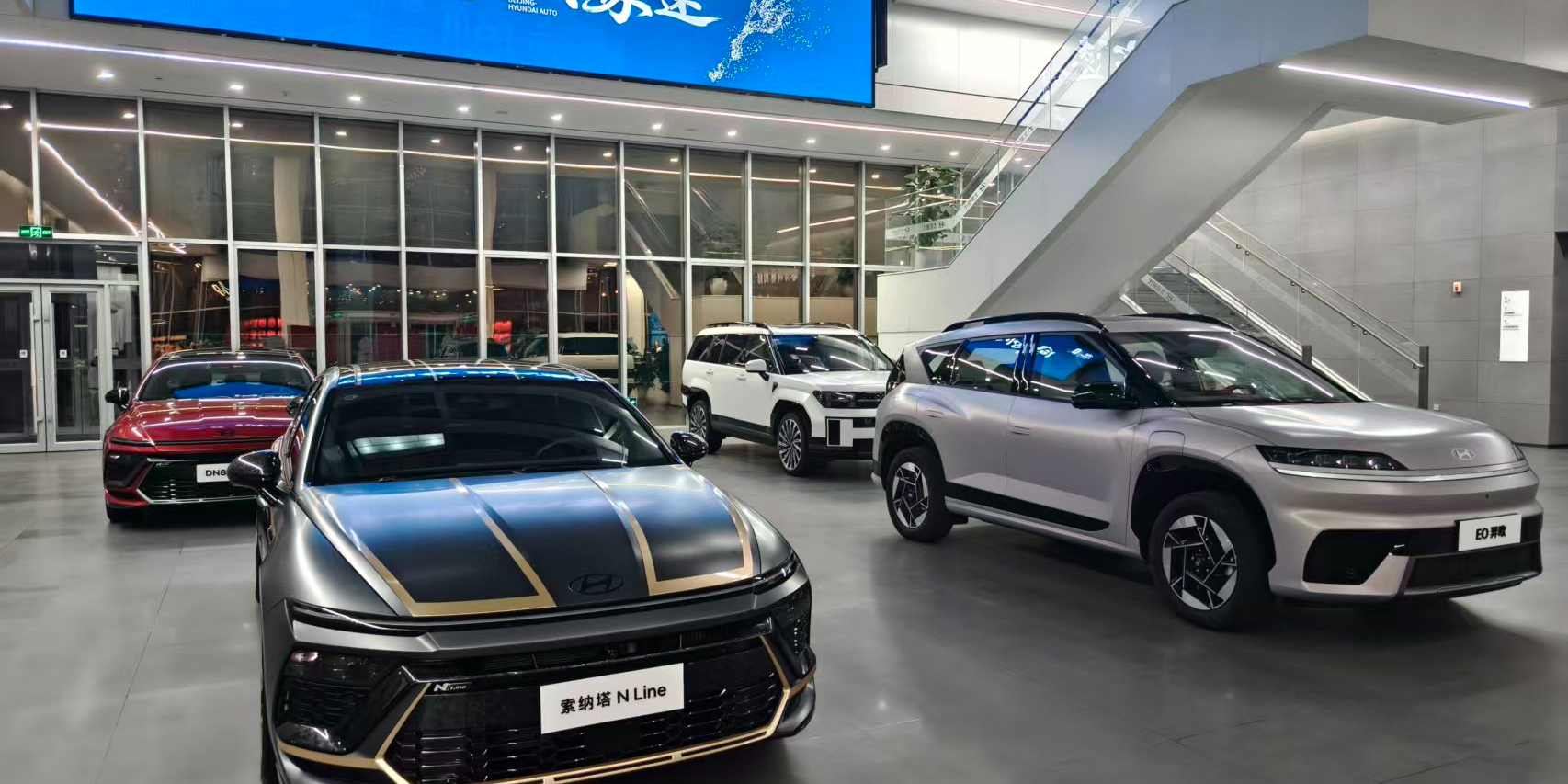
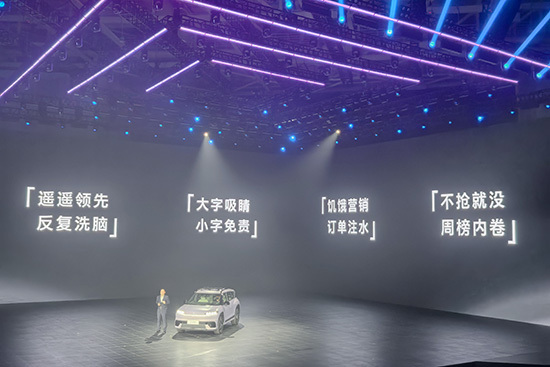
EO弈欧上市给的底气 北京现代发布会直指行业四大乱象
Zhong Guo Jing Ji Wang· 2025-10-31 03:38
Core Viewpoint - Beijing Hyundai is launching the "Smart Start 2030 Plan" to revitalize its brand and product lineup, aiming for significant sales and product development goals in the coming years [3][9][19] Group 1: Strategic Goals - The "Smart Start 2030 Plan" sets a target of selling 500,000 vehicles annually within five years, with 300,000 units in the domestic market and 200,000 for export [9] - The plan includes the launch of over 20 new models by 2030, with a focus on both fuel and electric vehicles [11] - The company aims to enhance local R&D capabilities and embrace AI technology to improve product development cycles by 30% [11][13] Group 2: Market Positioning - Beijing Hyundai acknowledges the competitive pressure from domestic brands in the SUV and new energy vehicle sectors, which are gaining market share through high cost-performance ratios [6][8] - The company emphasizes the importance of customer trust and product quality over aggressive marketing tactics, criticizing the current industry trend of misleading promotions [15][19] Group 3: Product Development - The first product under the new plan, the EO Yiyou, has undergone seven years of development and extensive testing, focusing on safety, durability, and technology [17][19] - The company plans to release 20 new products, including 7 fuel vehicles, to maintain competitiveness in the market [11] Group 4: Industry Context - The year 2025 is highlighted as a pivotal moment for joint venture brands in the new energy sector, marking a critical transition period [8][13] - Beijing Hyundai's approach is seen as a potential model for other companies in the industry, emphasizing a balance between global quality and local technology [19]