高尔夫

Search documents
欧洲车市“冰火两重天”:销量六连涨终结,电动车渗透率悄然攀升
Zhi Tong Cai Jing· 2026-02-24 07:05
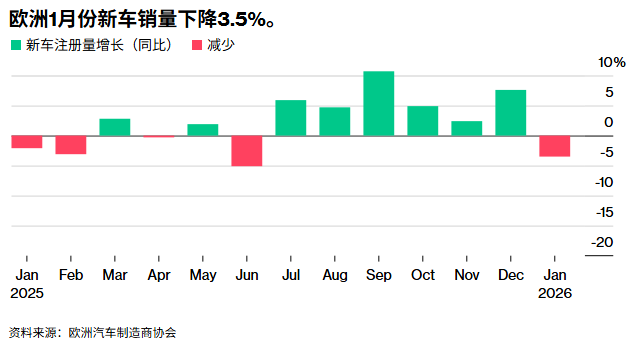
Group 1 - European car market sales declined in January, ending a six-month growth streak, with a total of 961,382 new car registrations, a month-on-month decrease of 3.5% [2] - Germany, which accounted for 22% of the European passenger car market last year, is experiencing a drop in sales due to high car prices and rising unemployment, leading consumers to hold off on purchases [2] - Despite the overall market weakness, demand for electric vehicles (EVs) remains strong, with a 14% increase in pure electric vehicle demand and nearly a one-third increase in plug-in hybrid vehicles [2] Group 2 - The German government announced a €3 billion (approximately $3.5 billion) EV subsidy plan aimed at low- to middle-income individuals, which is expected to boost demand for electric vehicles [3] - Chinese brands like BYD and MG have made significant progress in the European market, capturing nearly 11% of the electrified vehicle sales share [3] - Global automakers are continuously adjusting their strategies to cope with the volatility of the electric transition [4] Group 3 - Stellantis NV announced a €22.2 billion asset impairment due to insufficient profitability of its electric vehicle projects, leading to the cancellation of several planned electric vehicle models [8] - Porsche and its parent company Volkswagen have adjusted overly ambitious electrification plans, opting to increase the lineup of plug-in hybrid models [8] - Volkswagen plans to launch hybrid versions of the T-Roc SUV and Golf this fall, while Audi intends to release the entry-level electric hatchback A2 in the second half of this year [8]

半年亏1500亿!车圈恒大浮现,全球第四大车企暴雷
Xin Lang Cai Jing· 2026-02-10 01:49
Core Viewpoint - Stellantis, the world's fourth-largest automotive manufacturer, experienced a significant stock price drop due to strategic misjudgments in its electric vehicle (EV) business, leading to substantial financial losses [2][3][6]. Group 1: Stock Performance and Market Position - On February 6, Stellantis' stock fell by over 26% during trading, closing down 23.79%, marking its highest single-day drop ever [2]. - The company's shares had already been under pressure, with a 33% decline in 2024 and an 18% drop in 2025, followed by a 12% decrease in January 2026 [2]. - Stellantis sold 5.417 million vehicles in 2025, a 9% increase year-on-year, but still lagged behind Toyota, Volkswagen, and Hyundai, maintaining its position as the fourth-largest automotive group globally [3][8]. Group 2: Financial Losses and Strategic Adjustments - Stellantis anticipates a net loss of €19 billion to €21 billion (approximately ¥155 billion to ¥172 billion) in the second half of 2025, with an annual operating profit margin projected to be in the low single digits [6]. - The company plans to suspend its 2026 dividend and raise up to €5 billion through hybrid bond issuance to support its balance sheet [6]. - Stellantis announced a €22 billion (approximately ¥180 billion) charge related to adjustments in its EV strategy, significantly exceeding analyst expectations [6][7]. Group 3: Changes in Electric Vehicle Strategy - The majority of the write-downs (€14.7 billion) are allocated to adjusting product plans to align with customer preferences and new U.S. emission regulations [6][7]. - Stellantis is exiting its joint venture with LG Energy Solution in Canada, where LG will acquire Stellantis' 49% stake [9]. - The company is discontinuing several electric vehicle models, including the RAM 1500 electric pickup in the U.S. and delaying the Alfa Romeo EV project in Europe, contrasting sharply with previous aggressive targets set by former CEO Carlos Tavares [9].
2025年全球十大车企出炉
Di Yi Cai Jing· 2026-02-06 11:11
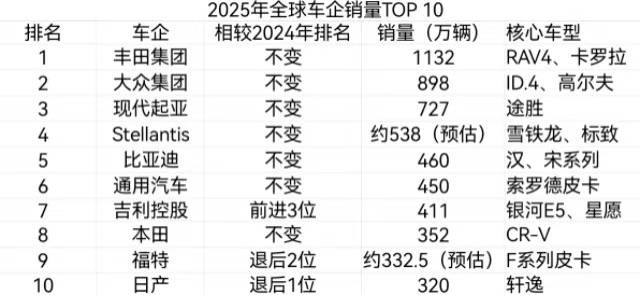
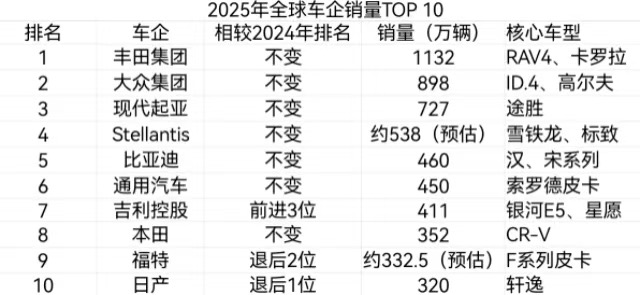
Core Insights - By 2025, the penetration rate of electric vehicles in China is expected to exceed 50%, leading to a shift in global automotive sales rankings, with Chinese automakers rising in prominence [1] Group 1: Global Automotive Sales Rankings - The top three global automakers in 2025 remain Toyota, Volkswagen, and Hyundai-Kia, with sales of approximately 11.32 million, 8.98 million, and 7.27 million units respectively [2] - BYD ranks fifth globally with sales of 4.6 million units, surpassing General Motors and Ford [2][4] - Geely's ranking improves from 10th in 2024 to 7th in 2025, with annual sales exceeding 4 million units for the first time [2][5] Group 2: Performance of Chinese Automakers - BYD's sales growth is primarily driven by its electric vehicle segment, achieving 460,000 units sold in 2025, a year-on-year increase of 7.73% [4] - BYD's overseas sales exceed 1.049 million units, marking a significant growth of 145%, with Mexico and Brazil being the top export markets [4] - Geely's electric vehicle sales reach 2.29 million units, a nearly 60% increase, with an overall penetration rate of 56% for new energy vehicles [5] Group 3: Challenges for Japanese Automakers - Toyota maintains its leading position with a 4.6% increase in sales to 11.32 million units, while Honda and Nissan face declines [7] - Honda's global sales drop to 3.52 million units, a decrease of 7.56%, with significant declines in European and Chinese markets [7] - Nissan's sales fall to 3.2 million units, a 4.4% decline, marking its seventh consecutive year of sales drop in China [3][8]


2025年全球十大车企出炉:比亚迪、吉利力压两大日系巨头
Di Yi Cai Jing· 2026-02-06 10:00
Core Insights - The global automotive sales ranking has shifted, with Chinese automakers rising in prominence as the penetration rate of new energy vehicles (NEVs) in China surpasses 50% by 2025 [1] Group 1: Global Sales Rankings - The top three global automakers remain Toyota, Volkswagen, and Hyundai Kia, with sales of approximately 11.32 million, 8.98 million, and 7.27 million units respectively in 2025 [2] - BYD maintains its position as the fifth-largest automaker globally with sales of 4.6 million units, surpassing General Motors and Ford [2][4] - Geely's ranking improved from 10th in 2024 to 7th in 2025, with annual sales exceeding 4 million units for the first time [2][5] Group 2: Performance of Chinese Automakers - BYD's NEV sales reached 4.6 million units in 2025, marking a year-on-year growth of 7.73%, driven largely by overseas markets [4] - Geely's total sales surpassed 4 million units, with NEV sales reaching 2.29 million units, reflecting a nearly 60% year-on-year increase and a NEV penetration rate of 56% [5][6] Group 3: Challenges for Japanese Automakers - Toyota's sales increased by 4.6% to 11.32 million units, maintaining its lead in the global market [7] - Honda's global sales fell to 3.52 million units, a decrease of 7.56% compared to the previous year, with significant declines in Europe and China [7] - Nissan's sales dropped to 3.2 million units, down 4.4% from 2024, resulting in a decline in its global ranking to 10th place [3][8]

燃油车市占率创历史新高 一汽-大众大众品牌2025年交出高质量答卷
Zhong Guo Jing Ying Bao· 2026-01-02 05:45
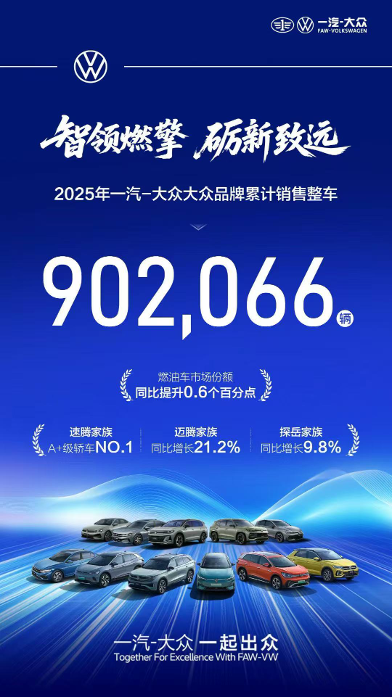
Core Insights - FAW-Volkswagen achieved a total vehicle sales of 1,587,065 units in 2025, maintaining its position as the top joint venture automaker and leading in fuel vehicle sales, with a market share increase of 0.9 percentage points year-on-year, reaching a historical high [1] Sales Performance - The Volkswagen brand sold 902,066 vehicles in 2025, with a year-on-year market share increase of 0.6 percentage points, solidifying its position in the domestic fuel vehicle market [1] - The A+ class sedan, the Sagitar family, sold 251,918 units, ranking first in the A+ class fuel sedan segment [2] - The Magotan family, a mid-to-high-end sedan, achieved sales of 215,861 units, reflecting a year-on-year increase of 21.2% [2] - The Golf, an A-class hatchback, sold 35,269 units, maintaining its champion status in the segment [2] - The high-end mid-size SUV, the Tayron family, sold 187,142 units, with a year-on-year growth of 9.8% [3] Product Innovation - New models such as the Tayron L and the new generation Sagitar L were launched, featuring advanced design, space, power, and intelligence, equipped with the IQ. Pilot enhanced driving assistance system [3][4] - The IQ. Pilot system was validated through a 24-hour endurance challenge, demonstrating its practicality and reliability [4] Customer Experience - The "Craftsmanship Service" brand was upgraded to enhance customer service and experience, establishing a comprehensive value service system [5] - A "Lifetime Warranty" policy was introduced for all fuel SUVs, ensuring peace of mind for customers [5] - The "Volkswagen Old Friends" customer brand was launched, focusing on customer engagement throughout the vehicle lifecycle [5] Marketing Strategy - Volkswagen implemented a dual evolution of marketing and channels, focusing on "customer-centric" and "product-driven" strategies [7] - The "AI digital + all-staff marketing" approach was adopted to create an agile and efficient market communication and customer flow operation system [7] - The "Hundred Stores Thousand Families" plan was executed to enhance channel coverage, especially in third and fourth-tier cities, with over 1,000 authorized dealers [7] Future Outlook - In 2026, Volkswagen plans to continue its "oil-electric hybrid" strategy, accelerating its transition towards intelligence and electrification, aiming for high-quality development and competitive product offerings [8]
燃油车市占率创历史新高 一汽-大众大众品牌全年交付超90万
Xin Jing Bao· 2026-01-02 03:52
Core Insights - FAW-Volkswagen achieved a total vehicle sales of over 1,587,065 units in 2025, securing the title of both joint venture and fuel vehicle sales champion, with a market share increase of 0.9 percentage points year-on-year, reaching a historical high [1] - The Volkswagen brand delivered 902,066 vehicles, with a year-on-year market share increase of 0.6 percentage points, maintaining its position among the top players in the domestic fuel vehicle market [1] Segment Performance - The Volkswagen brand's main models demonstrated strong competitiveness across various segments, with the A+ class sedan, the Sagitar family, selling 251,918 units, leading the A+ class fuel sedan market [3] - The Magotan family, a leader in the mid-to-high-end sedan segment, sold 215,861 units, reflecting a year-on-year increase of 21.2%, supported by the collaboration of the Magotan 3000 million selection and the 2026 Magotan [5] - The high-end mid-size SUV, the Tayron family, achieved sales of 187,142 units, a year-on-year growth of 9.8%, bolstered by the launch of the new Tayron L [5] Technological Advancements - The Volkswagen brand's core models, including the new Tayron L and the new generation Sagitar L, incorporated the IQ.Pilot enhanced driving assistance system, covering 95% of urban road conditions and 100% of highway scenarios in China [7] - The successful completion of the "world's first fuel vehicle high-speed NOA 24-hour endurance challenge" demonstrated the reliability and durability of the system, reinforcing Volkswagen's leading position in the fuel vehicle sector [7] Customer-Centric Strategies - Volkswagen implemented a comprehensive upgrade of its service system, introducing a "dual lifetime warranty" policy for its entire fuel SUV lineup, setting a new service benchmark [8] - The brand launched the "Volkswagen Old Friends" customer program, enhancing emotional connections with users through five major benefit areas and a customer care fund [8] - The marketing and organizational structure underwent a transformation to improve market responsiveness and customer operation efficiency [8] Market Positioning - The increase in fuel vehicle market share amidst rising penetration of new energy vehicles provides a solid case study for observing market dynamics, driven by the reputation and product strength of models like the Sagitar and Magotan [10] - The integration of the IQ.Pilot system into fuel vehicle offerings addresses consumer expectations for reliable quality and cutting-edge technology, showcasing the brand's ability to adapt in a competitive market [10] - Volkswagen's focus on high-value, high-quality travel solutions remains a cornerstone for success in the diverse Chinese automotive market [10]
大行评级丨花旗:相信申洲国际2026年销量可录高单位数增幅 评级“买入”
Ge Long Hui· 2025-12-19 08:05
Group 1 - The core viewpoint of the report indicates that Nike's management has provided a guidance for a low single-digit decline in sales for the third fiscal quarter, which is seen as slightly negative for ODM suppliers like Shenzhou International [1] - Despite the cautious outlook from Nike, Shenzhou is expected to gain more market share in new product areas such as running, golf, and basketball jerseys this year [1] - Shenzhou's management has also given a conservative forecast, expecting mid-single-digit sales growth in the second half of 2025, which is lower than previous high single-digit predictions, reflecting the impact of Nike's latest outlook [1] Group 2 - Citi predicts that Nike's sales orders for Shenzhou will remain flat rather than decline in 2026, and with visibility on orders from the top four clients, Shenzhou's sales are expected to achieve high single-digit growth in 2026 [1] - The report suggests that if Shenzhou's stock price experiences a pullback due to Nike's cautious outlook, it may present a buying opportunity, maintaining a "buy" rating for Shenzhou with a target price of HKD 94 [1]
裁员35000人,德国汽车龙头也扛不住了!
Xin Lang Cai Jing· 2025-12-16 14:03
Core Viewpoint - Volkswagen has closed its first domestic factory in Germany after 88 years, marking a significant shift in its manufacturing strategy amid increasing competition from Chinese electric vehicle manufacturers and declining profits [1][34][40]. Group 1: Factory Closure and Transition - The closure of the Dresden factory is a historic first for Volkswagen, which has been a symbol of German automotive engineering and production [1][34]. - The Dresden factory will no longer produce cars but will be transformed into a research park focused on artificial intelligence, robotics, and chip development, while also serving as a tourist attraction [39][40]. - The decision to close the factory reflects the low utilization rates, with annual production since 2022 falling below 200,000 units, significantly lower than the capacity of Volkswagen's main plant in Wolfsburg [42][40]. Group 2: Market Dynamics and Competition - Chinese automotive brands have seen substantial growth in Europe, with sales reaching 430,000 units from January to August 2025, a 74% increase year-on-year, and surpassing South Korean brands in market share [43][44]. - The overall European automotive market has only grown by 1.1%, highlighting the competitive pressure on traditional manufacturers like Volkswagen [44]. - The decline in Volkswagen's profits is attributed to multiple factors, including weak performance in the German automotive industry and the impact of U.S. tariff policies on sales in the American market [44][44]. Group 3: Financial Performance - Volkswagen's net profit for 2024 is projected to drop to €12.4 billion, a 30.6% decrease compared to the previous year, with a significant operating loss reported in the third quarter of 2025 [58][59]. - The company has announced plans to save €10 billion by 2026 and aims to increase its operating profit margin from 3.4% to 6.5% [33][69]. - The decline in sales in China, which accounted for 38% of Volkswagen's global sales in 2015, has become a critical factor affecting the company's overall profitability [56][57].

每日读画丨古画里的运动,同样精彩!
Ren Min Wang· 2025-11-09 07:08
Core Insights - The article highlights the connection between ancient sports depicted in traditional Chinese paintings and modern sports, showcasing how activities like cuju (an ancient form of football) and chuiwan (similar to golf) have evolved over time [2] Group 1 - The article discusses the 15th National Games of China, emphasizing the historical significance of sports in Chinese culture [2] - It draws parallels between ancient sports and their modern counterparts, suggesting that traditional games still resonate in contemporary athletic events [2] - The piece encourages readers to explore ancient artworks to discover more about the sports that have persisted through history [2]

游艇消费卡在哪?李迅雷呼吁放宽管控,激活万亿高端市场
Sou Hu Cai Jing· 2025-10-30 06:21
Core Viewpoint - The dialogue between the chief economists of Zhongtai Securities highlights the core issues of China's economic growth model, emphasizing the shift from debt-driven growth to structural optimization [1] Group 1: Debt-Driven Growth - The past few decades have seen China relying on a debt-driven growth model, which is easy to understand despite its technical terminology [1] - The investment returns have diminished as the economy has developed, leading to a shift from an early target of "maintaining 8% growth" to a current target of "maintaining 5%" [3] - To achieve growth targets, China relies on the "three drivers" of investment, consumption, and exports, with investment becoming the most direct choice due to the challenges in boosting consumption and the uncertainties in exports [4][6] Group 2: Debt Accumulation and Economic Impact - From 2019 to 2023, local government debt has increased at a rate three times that of GDP growth, indicating a concerning trade-off between debt and economic growth [6][8] - The macro leverage ratio has exceeded 300%, surpassing that of developed countries like the U.S., raising concerns about the sustainability of this debt-driven model [8] - Many infrastructure projects have been built, but their utility is questionable, as some areas do not generate sufficient traffic to justify the investments [10] Group 3: Consumer Income and Spending - Only 20% of every dollar invested translates into resident income, which limits the potential for consumption growth [11] - Despite a decent GDP growth in the first half of the year, consumption has not increased correspondingly, highlighting a fundamental issue in the economic structure [11] - Policies aimed at boosting consumption, such as trade-in programs, often fail to benefit lower-income groups and can lead to price increases by manufacturers [13] Group 4: Service Sector Potential - The service sector has significant potential for growth and employment, with the U.S. absorbing over 80% of its workforce in services, compared to less than 50% in China [16] - Easing restrictions on the service sector could stimulate consumption among wealthier individuals, which in turn could create jobs for lower-income groups, fostering a positive economic cycle [18] - Optimizing fiscal spending towards healthcare, education, and direct consumer vouchers may yield more tangible benefits than direct cash transfers [18] Group 5: Economic Transition - Relying on debt for infrastructure development is becoming increasingly unsustainable, necessitating a shift towards consumption-driven growth [19][21] - Adjusting the economic structure to make consumption the primary driver of growth is essential for sustainable development [21] - The ultimate goal of economic development is to improve the quality of life for citizens, which requires careful resource allocation and addressing various challenges in the transition process [22]