
银河E5

Search documents
汽车出海:低渗透率和油电价差市场受益
数说新能源· 2026-03-26 03:02
Group 1 - The article highlights the significant growth potential in the electric vehicle (EV) market, particularly in Southeast Asia and Australia, where low penetration rates (10-15%) and high oil-electricity price differentials (over 20% increase) create favorable conditions for EV adoption [2] - BYD aims for an overseas sales target of 1.6 million units by 2026, with production facilities set to launch in Indonesia and Hungary, contributing approximately 32 billion in profit, which accounts for about 70% of its core performance [2] - Geely plans to export 400,000 new energy vehicles by 2026, marking a 215% increase, with a profit contribution of 7.8 billion, representing over 35% of its earnings [3] Group 2 - Leap Motor is partnering with Stellantis to establish a factory in Spain, focusing on producing the B10 model to meet the demand for low-cost electric vehicles in overseas markets with low penetration rates [4] - The article emphasizes the importance of balancing performance and cost in battery cell procurement for manufacturers [11] - CATL is noted for its growth in the energy storage market, which is outpacing that of the power market [14]


吉利汽车20260318
2026-03-19 02:39
Summary of Geely Automobile Conference Call Company Overview - **Company**: Geely Automobile - **Industry**: Automotive, specifically focusing on electric vehicles (EVs) and smart technology Key Financial Performance - **Total Revenue**: 345.2 billion CNY (+25%) in 2025, marking a historical high [2][4] - **Core Net Profit**: 14.41 billion CNY (+36%), with a core net profit margin of 4.2% [2][4] - **Sales Volume**: 3.025 million vehicles (+39%), with a market share increase to 10.05% [4] - **Gross Margin**: Maintained at 16.6%, with a slight increase in the second half of 2025 [8][26] - **Cash Reserves**: Reached 68.2 billion CNY (+46%), a record high [9] Sales and Market Dynamics - **New Energy Vehicles (NEVs)**: Sales reached 1.688 million units (+90%), with a penetration rate of 55.8% [2][4] - **Brand Performance**: - **Galaxy Brand**: 1.236 million NEVs sold (+150%) [5] - **Lynk & Co**: 350,000 units sold (+23%), with NEV sales at 228,000 units (+36%) [5] - **Zeekr**: 224,000 units sold, with significant growth in the luxury segment [5] - **Export Performance**: Total exports reached 420,000 units, with NEV exports increasing by 240% [7] Strategic Initiatives - **Integration and Cost Reduction**: Completed integration of Lynk & Co and Zeekr, aiming for significant cost savings in 2026 [2][18] - **R&D Investment**: Increased to 21.9 billion CNY (+8.3%), with a focus on enhancing technology leadership [8] - **Smart Technology Development**: Plans to achieve L3 level autonomous driving and scale up Robotaxi operations by 2026 [2][14] Sustainability and ESG Efforts - **Carbon Reduction**: Exceeded 5-year carbon reduction goals, achieving a 25.5% reduction in lifecycle emissions compared to 2020 [10] - **Safety Initiatives**: Established the world's largest automotive safety center, emphasizing safety as a core value [16] Future Outlook - **2026 Sales Target**: Aiming for 3.45 million units, with specific targets for each brand [12] - **Export Goals**: Targeting 640,000 units in exports, with a focus on European and ASEAN markets [12][13] - **Technological Advancements**: Plans to enhance AI capabilities and smart driving technologies, with a goal to lead in the global smart vehicle market [14][27] Challenges and Market Conditions - **Geopolitical Risks**: Acknowledged potential impacts from geopolitical tensions and raw material price fluctuations [22] - **Market Competition**: Recognized the need to maintain competitive pricing and product quality amidst rising costs [22] Conclusion - **Investment Confidence**: Management expresses confidence in future growth and profitability, anticipating continued record-breaking performance in core net profit [31]

GEELY AUTO(00175) - 2025 Q4 - Earnings Call Transcript
2026-03-18 09:30
Financial Data and Key Metrics Changes - Geely's gross margin improved to 16.9% in Q4 2025, higher than the full-year average of 16.6% [60][62] - R&D expenses increased by CNY 1.5 billion quarter-on-quarter, reaching CNY 590 million in Q4 2025, with a target of maintaining around 40% utilization in 2026 [60][64] Business Line Data and Key Metrics Changes - Zeekr brand achieved annual sales of 224,000 units, with a record monthly delivery of over 30,000 units in December [1] - Lynk & Co sales volume reached 350,000 units, with new energy vehicles making up 65% of the mix [3] - Galaxy sales reached 1.236 million units, up by 150% [4] - Geely China Star ICE sales reached 1.214 million units, with Xingyue L ranked number one in China's ICE SUV segment [4] Market Data and Key Metrics Changes - Geely's export sales target for 2026 is 640,000 units, a 50% increase from 2025, with a focus on overseas markets [9][40] - New energy vehicle sales in overseas markets reached 124,000 units in 2025, growing by 240% [40][42] Company Strategy and Development Direction - Geely aims to become a global leader in smart vehicles, focusing on technology and globalization [5][10] - The company has set a five-year carbon reduction target to reduce vehicle lifecycle carbon emissions by 25.5% by the end of 2025 [5] - Geely plans to launch new models, including the Zeekr 8X and Lynk & Co zero seven wagon version, to enhance its product offerings [7][8] Management's Comments on Operating Environment and Future Outlook - Management expressed confidence in achieving higher sales volumes and net profits in 2026, building on the successes of 2025 [38] - The company highlighted the importance of safety and intelligence in vehicle development, establishing a global automotive safety center [15][16] - Geely's management acknowledged the competitive landscape and emphasized the need for continuous improvement in brand development and global market scale [34][35] Other Important Information - Geely has integrated Lynk & Co and Zeekr brands to enhance resource allocation and operational efficiency [49][50] - The company is focusing on diversifying energy inputs, covering ICE, hybrid, PHEV, and BEV technologies [29][30] Q&A Session Summary Question: What are the driving reasons for the gross margin improvement? - The gross margin improved due to higher sales of high-end products like Zeekr 9X, which accounted for a significant portion of total sales volume [60][62] Question: What is the outlook for R&D expenses in 2026? - R&D expenses are expected to maintain around 40% utilization, with a focus on improving the quality of profits [64] Question: How does Geely evaluate overseas markets and competitive edge? - Geely has laid a solid foundation for overseas markets in 2025, with plans to deepen production capabilities and focus on branding and technology export [39][40]

吉利磷酸铁锂布局落下关键一子
高工锂电· 2026-02-27 12:29
Core Viewpoint - Geely is moving beyond the competition of complete vehicle products and entering the competition at the industrial chain level [3] Group 1: Geely's New Energy Strategy - Jiangxi Yiyuan New Energy Technology Co., Ltd. has officially completed the production of its lithium iron phosphate cathode material project, with a total investment of 2.5 billion yuan and an annual recycling capacity of 40,000 tons of lithium iron phosphate batteries [4] - The successful production of Yiyuan New Energy marks a key breakthrough for Geely in the core material segment of power batteries, facilitating cost control and supporting technological self-iteration [5] - The establishment of the lithium iron phosphate factory signifies Geely's transition from vehicle competition to industrial chain competition [5] Group 2: Competitive Landscape - Geely is not the first automaker to invest in upstream cathode materials, with BYD being the most advanced competitor, having established a closed-loop system from lithium resources to complete vehicles [6] - BYD has invested in various upstream lithium resources and has built multiple battery production bases, creating a controllable system from raw materials to complete vehicles [7] - In 2025, Geely's annual sales are projected to reach 3.02 million vehicles, a significant increase of 39% year-on-year, while BYD's retail sales are expected to decline by 6.3%, narrowing the sales gap between the two companies [8] Group 3: Sales Performance and Product Strategy - In January 2026, Geely surpassed BYD in total sales, reclaiming the title of sales champion [9] - Among Geely's projected sales of 3.02 million vehicles in 2025, 1.687 million will be new energy vehicles, with the Galaxy series accounting for 73.5% of new energy sales [10] - The Galaxy series, particularly the Xingyuan model, is a key player in the market, with sales of 460,000 units, making it the best-selling passenger car in China for 2025 [10] Group 4: Supply Chain and Material Strategy - The launch of the Yiyuan New Energy lithium iron phosphate project is a strategic move by Geely to enhance its supply chain and address its shortcomings in cathode materials [11] - The project aims to achieve comprehensive utilization of 40,000 tons of waste lithium iron phosphate batteries annually, ensuring local supply of raw materials and improving supply chain stability [13] - Geely's battery business is structured into three core segments, with significant production capacity planned across various bases [14] Group 5: Resource Acquisition and Future Outlook - Geely has systematically laid out its lithium resource strategy through equity cooperation and strategic investments, securing key raw materials for lithium iron phosphate production [15] - The completion of the Yiyuan project allows Geely to continue upgrading its material strategies, particularly in lithium iron phosphate and manganese lithium phosphate [16] - Geely's vertical integration strategy from vehicle manufacturing to battery production and material sourcing aims to create a robust competitive advantage in the face of rising raw material costs [16]


半年亏1500亿!车圈恒大浮现,全球第四大车企暴雷
Xin Lang Cai Jing· 2026-02-10 01:49
Core Viewpoint - Stellantis, the world's fourth-largest automotive manufacturer, experienced a significant stock price drop due to strategic misjudgments in its electric vehicle (EV) business, leading to substantial financial losses [2][3][6]. Group 1: Stock Performance and Market Position - On February 6, Stellantis' stock fell by over 26% during trading, closing down 23.79%, marking its highest single-day drop ever [2]. - The company's shares had already been under pressure, with a 33% decline in 2024 and an 18% drop in 2025, followed by a 12% decrease in January 2026 [2]. - Stellantis sold 5.417 million vehicles in 2025, a 9% increase year-on-year, but still lagged behind Toyota, Volkswagen, and Hyundai, maintaining its position as the fourth-largest automotive group globally [3][8]. Group 2: Financial Losses and Strategic Adjustments - Stellantis anticipates a net loss of €19 billion to €21 billion (approximately ¥155 billion to ¥172 billion) in the second half of 2025, with an annual operating profit margin projected to be in the low single digits [6]. - The company plans to suspend its 2026 dividend and raise up to €5 billion through hybrid bond issuance to support its balance sheet [6]. - Stellantis announced a €22 billion (approximately ¥180 billion) charge related to adjustments in its EV strategy, significantly exceeding analyst expectations [6][7]. Group 3: Changes in Electric Vehicle Strategy - The majority of the write-downs (€14.7 billion) are allocated to adjusting product plans to align with customer preferences and new U.S. emission regulations [6][7]. - Stellantis is exiting its joint venture with LG Energy Solution in Canada, where LG will acquire Stellantis' 49% stake [9]. - The company is discontinuing several electric vehicle models, including the RAM 1500 electric pickup in the U.S. and delaying the Alfa Romeo EV project in Europe, contrasting sharply with previous aggressive targets set by former CEO Carlos Tavares [9].
2025年全球十大车企出炉
Di Yi Cai Jing· 2026-02-06 11:11
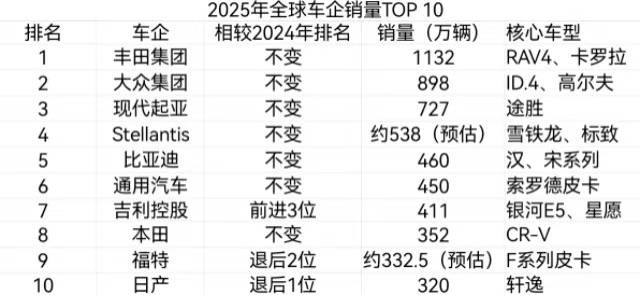
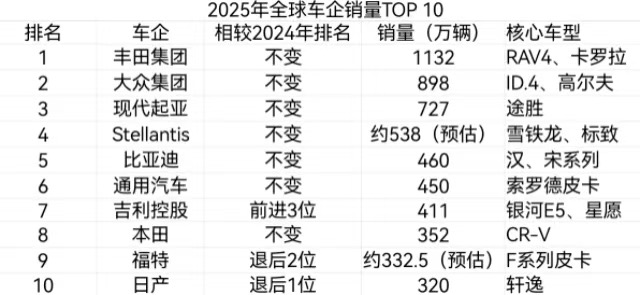
Core Insights - By 2025, the penetration rate of electric vehicles in China is expected to exceed 50%, leading to a shift in global automotive sales rankings, with Chinese automakers rising in prominence [1] Group 1: Global Automotive Sales Rankings - The top three global automakers in 2025 remain Toyota, Volkswagen, and Hyundai-Kia, with sales of approximately 11.32 million, 8.98 million, and 7.27 million units respectively [2] - BYD ranks fifth globally with sales of 4.6 million units, surpassing General Motors and Ford [2][4] - Geely's ranking improves from 10th in 2024 to 7th in 2025, with annual sales exceeding 4 million units for the first time [2][5] Group 2: Performance of Chinese Automakers - BYD's sales growth is primarily driven by its electric vehicle segment, achieving 460,000 units sold in 2025, a year-on-year increase of 7.73% [4] - BYD's overseas sales exceed 1.049 million units, marking a significant growth of 145%, with Mexico and Brazil being the top export markets [4] - Geely's electric vehicle sales reach 2.29 million units, a nearly 60% increase, with an overall penetration rate of 56% for new energy vehicles [5] Group 3: Challenges for Japanese Automakers - Toyota maintains its leading position with a 4.6% increase in sales to 11.32 million units, while Honda and Nissan face declines [7] - Honda's global sales drop to 3.52 million units, a decrease of 7.56%, with significant declines in European and Chinese markets [7] - Nissan's sales fall to 3.2 million units, a 4.4% decline, marking its seventh consecutive year of sales drop in China [3][8]
2025年全球十大车企出炉:比亚迪、吉利力压两大日系巨头
Di Yi Cai Jing· 2026-02-06 10:00
Core Insights - The global automotive sales ranking has shifted, with Chinese automakers rising in prominence as the penetration rate of new energy vehicles (NEVs) in China surpasses 50% by 2025 [1] Group 1: Global Sales Rankings - The top three global automakers remain Toyota, Volkswagen, and Hyundai Kia, with sales of approximately 11.32 million, 8.98 million, and 7.27 million units respectively in 2025 [2] - BYD maintains its position as the fifth-largest automaker globally with sales of 4.6 million units, surpassing General Motors and Ford [2][4] - Geely's ranking improved from 10th in 2024 to 7th in 2025, with annual sales exceeding 4 million units for the first time [2][5] Group 2: Performance of Chinese Automakers - BYD's NEV sales reached 4.6 million units in 2025, marking a year-on-year growth of 7.73%, driven largely by overseas markets [4] - Geely's total sales surpassed 4 million units, with NEV sales reaching 2.29 million units, reflecting a nearly 60% year-on-year increase and a NEV penetration rate of 56% [5][6] Group 3: Challenges for Japanese Automakers - Toyota's sales increased by 4.6% to 11.32 million units, maintaining its lead in the global market [7] - Honda's global sales fell to 3.52 million units, a decrease of 7.56% compared to the previous year, with significant declines in Europe and China [7] - Nissan's sales dropped to 3.2 million units, down 4.4% from 2024, resulting in a decline in its global ranking to 10th place [3][8]

“网红”电动车,谁能跨过“斩杀线”
创业邦· 2026-02-02 03:36
Core Viewpoint - The article discusses the evolving landscape of the electric vehicle (EV) market, emphasizing the need for sustainable sales strategies beyond initial hype and the importance of establishing a strong value proposition for long-term success [6][54]. Group 1: Market Dynamics - The EV market has seen a surge in new models, but success is often measured by initial sales figures and year-end rankings, which can be misleading [6][7]. - Traditional "internet celebrity cars" tend to follow a parabolic sales curve, peaking shortly after launch and then declining, relying on short-term marketing and product appeal [11][12]. - The article identifies three new models that have successfully navigated the market, showcasing different strategies for sustained sales [12]. Group 2: Case Studies of Successful Models - **Xiaomi SU7**: Achieved peak sales of nearly 30,000 units in March 2025, supported by Xiaomi's extensive user base and effective marketing. However, it faces the challenge of maintaining interest beyond initial hype [15][16]. - **Xpeng MONA M03**: Launched in August 2024, it quickly reached over 10,000 units in sales within three months and maintained monthly sales between 10,000 and 16,000 units, capitalizing on a key price segment and offering advanced features [18][20]. - **AITO M8**: Experienced a "deep squat and jump" sales pattern, stabilizing at over 20,000 units monthly by summer 2025, benefiting from Huawei's technology integration and brand recognition [23][24]. Group 3: Challenges and Market Positioning - The article highlights the importance of establishing a "value anchor" in consumers' minds to ensure long-term sales, as seen with models like Li Auto L6, which despite a decline, remains a top seller due to its defined market position [28][29]. - Models in the competitive 200,000 to 300,000 yuan price range face significant challenges, with many struggling to differentiate themselves in a crowded market [31][32]. - The **智界 R7** and **享界 S9** illustrate the difficulties faced by models that fail to establish a unique market position, leading to declining sales despite technological backing [34]. Group 4: The Importance of Sustainable Sales - The article emphasizes the existence of "low-profile long runners" that, while not flashy, maintain steady sales through balanced product offerings and precise market positioning [36][38]. - Models like **零跑 C10** and **腾势 D9** demonstrate the effectiveness of a stable sales strategy, contributing significantly to their brands' overall performance [41][43]. - The need for a healthy product matrix is highlighted, as brands that rely solely on a single "hit" model face increased risks in a competitive environment [51]. Group 5: Emerging Market Rules - The article outlines new market rules where "smart equality" becomes a baseline requirement, and the importance of a comprehensive product matrix is emphasized for risk mitigation [51][52]. - The concept of "value for money" has evolved to include total ownership costs, making it a critical factor in consumer decision-making [51]. - The success of models like AITO is attributed to deep collaboration between technology providers and manufacturers, contrasting with less effective loose partnerships [52].





【重磅深度】乘用车电动化复盘:拥抱变化
东吴汽车黄细里团队· 2026-01-07 12:21
Investment Highlights - The automotive market began to show an upward trend in 2020 despite the pandemic, primarily due to a year-on-year increase in industry sales and a significant turning point in the penetration rate of new energy vehicles (NEVs), which led to a notable increase in the market share of domestic brands [2][26] - The core turning point for NEV penetration was driven by the localization of Tesla, with the Model 3 quickly becoming a best-seller, and improvements in the economic viability of the supply chain leading to a diverse supply [2][36] Historical Index Trends - In May 2021, the electric vehicle logic remained strong with a penetration rate of about 10%, and demand did not weaken despite a chip shortage that began in early 2021. The market anticipated a gradual easing of supply issues by July-August [3][45] - By May 2022, the penetration rate had increased to approximately 25%, with the resumption of production in lockdown areas and the implementation of tax reduction policies, which contributed to an upward trend in the index [3][48] - In February 2024, a shift in supply-demand dynamics occurred, leading to a price war initiated by Tesla's significant price cuts. The market began to rebound, with BYD's price reduction strategy proving effective [4][51] Profitability and Valuation Changes - The profitability of the automotive sector under the NEV trend has not significantly improved compared to the traditional fuel vehicle era, as selling NEVs has not altered the industry's business model, which remains rooted in manufacturing logic [5][56] - The valuation center for the automotive sector has shifted upward, with the price-to-sales (PS) ratio moving from a maximum of 2x during the fuel vehicle era to a current center of 1x, driven by increased market share and high-end breakthroughs of domestic brands [5][57] Competitive Factors in the NEV Era - The competition among automotive companies is characterized by a focus on hard power in the early stages, with soft power becoming more relevant later. The core competitive factors have evolved through different phases, including supply chain integration, electric vehicle technology, and marketing capabilities [6][60] - The first phase (2021-2022) emphasized supply chain advantages, while the second phase (2023) shifted towards electric vehicle technology and product definition capabilities, leading to a price war [6][60] - By 2025, the growth rate of NEV penetration is expected to slow down, with the main competitive logic focusing on imitating and surpassing leading NEV companies [7][60] Stock Performance Review - A review of stock performance from 2020 to 2025 indicates that early in the NEV development phase, the market had high expectations for leading companies from the previous cycle, while later periods required identifying emerging players based on changing competitive factors [8][20] - Notable stock performances include Seres as a tenfold stock, Jianghuai with an eightfold increase, and BYD with a fivefold increase, highlighting the importance of recognizing industry trends and selecting the best-performing stocks [8][20]

吉利汽车(00175.HK):2025年销量超目标完成 首次明确2026年销量目标
Ge Long Hui· 2026-01-07 06:19
Company Performance - In 2025, the company achieved passenger car sales of 3,024,567 units, a year-on-year increase of 39%, exceeding the original target of 3 million units [1] - By brand, sales were 2,449,939 units for the main brand, 224,133 units for Zeekr, and 350,495 units for Lynk & Co, with year-on-year growth of 47%, 1%, and 23% respectively [1] - New energy vehicle sales increased by 90% to 1,687,767 units, accounting for 55.8% of total sales, up 15 percentage points [1] Future Sales Targets - The company set a sales target of 3.45 million units for 2026, representing a year-on-year increase of 14%, with new energy vehicle sales expected to rise by 32% to 2.22 million units [2] - Sales targets for 2026 by brand are 2.75 million units for Geely, 300,000 units for Zeekr, and 400,000 units for Lynk & Co [2] Product Strategy and Profitability - The company is expanding its product matrix, with new models such as the Galaxy E5, A7, and Xingyao 7 aimed at the mainstream market, and six-seat SUVs like Zeekr 9X and Lynk & Co 900 [2] - The integration of Geely, Zeekr, and Lynk & Co is expected to enhance production management synergies and improve profitability [2] Profit Forecast and Valuation - The net profit forecast for 2025 and 2026 has been raised by 3.2% and 8.9% to 17.5 billion yuan and 21.5 billion yuan respectively, with a new forecast for 2027 net profit at 24.9 billion yuan [2] - The current stock price corresponds to price-to-earnings ratios of 10.4x for 2025, 8.3x for 2026, and 7.0x for 2027, with a target price of 26.00 HKD, indicating a potential upside of 42.9% [2]