
量子计算测控系统

Search documents
国盾量子(688027):量子计算业务显著放量,量超融合打开AI算力新范式
NORTHEAST SECURITIES· 2026-03-25 08:45
Investment Rating - The report maintains a "Buy" rating for the company, indicating a positive outlook for the stock's performance over the next six months [6]. Core Insights - The company achieved a revenue of 310 million yuan in 2025, representing a year-on-year growth of 22.53%. The quantum computing business saw significant growth, with a year-on-year increase of 111.82%, driven by project deliveries [2][4]. - The company successfully turned a profit in 2025, with a net profit attributable to shareholders of 5.39 million yuan, although the adjusted net profit was negative at -43.55 million yuan due to high R&D expenses [2][4]. - The company is positioned as a rare provider of complete quantum computing solutions, focusing on key areas of the superconducting route and has made significant technological advancements, including the "Zu Chongzhi 3" superconducting quantum computer achieving a scale of 105 qubits [3][4]. - The national policy framework emphasizes the importance of quantum technology as a new economic growth point, which is expected to benefit the company through increased demand for quantum computing infrastructure and services [4]. Financial Summary - The company forecasts revenues of 588 million yuan, 1.104 billion yuan, and 1.989 billion yuan for 2026, 2027, and 2028, respectively, with net profits projected to reach 39 million yuan, 84 million yuan, and 262 million yuan in the same years [5][4]. - The gross margin is expected to improve, with projections of 51.4% in 2025 and 53.0% by 2028, indicating a positive trend in profitability [5][4]. - The company’s total assets are projected to grow from 3.626 billion yuan in 2025 to 4.698 billion yuan by 2028, reflecting a strong growth trajectory [5].

量子科技成热词 如何布局投资?
Shang Hai Zheng Quan Bao· 2026-01-19 14:33
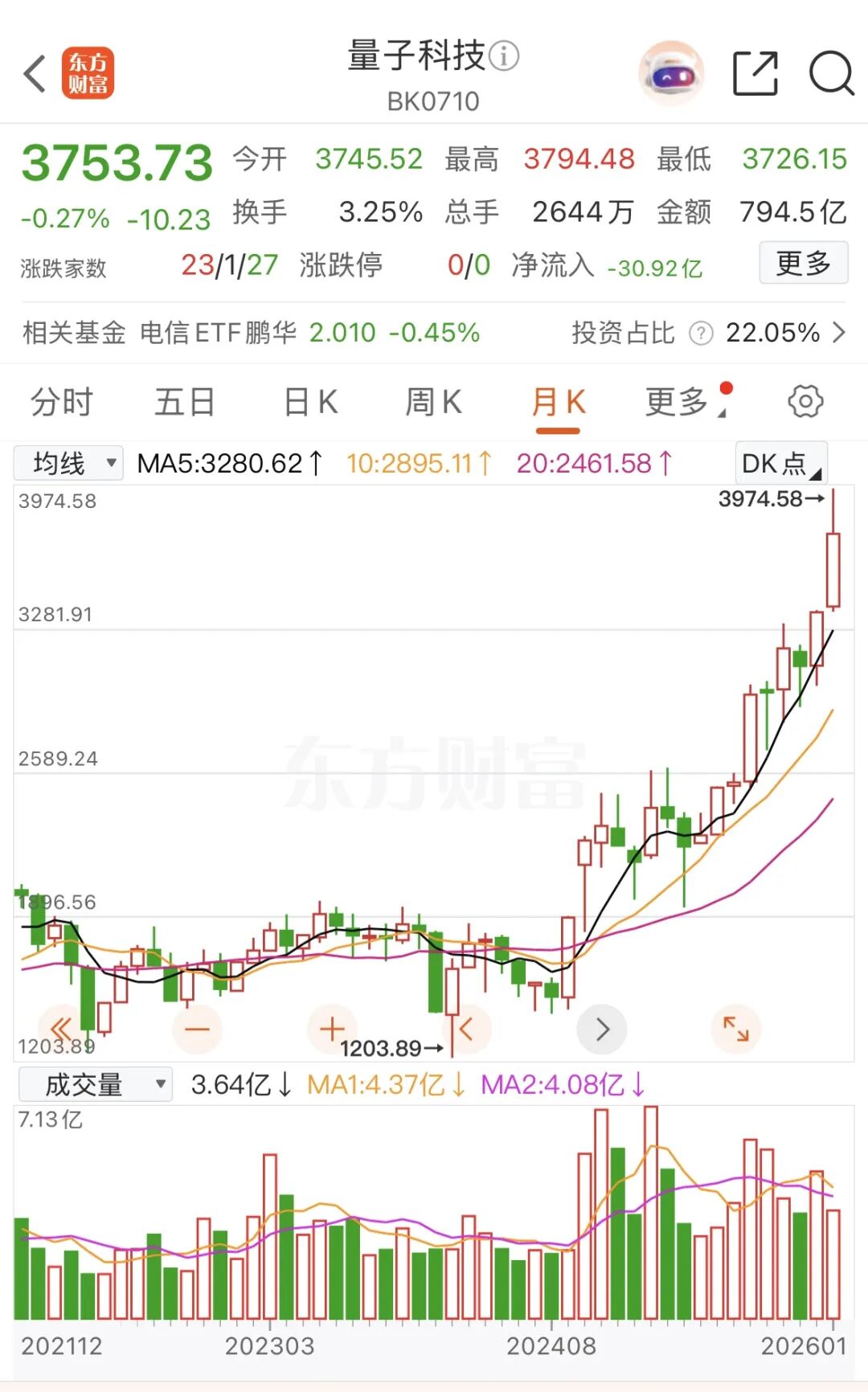
Core Insights - Quantum technology is prioritized in China's "14th Five-Year Plan," with significant emphasis on its development across various regions, including Shanghai and Anhui [1] - The A-share market has seen a resurgence in the quantum technology sector, with companies like Guandun Quantum and Keda Guokai gaining investor interest due to their strategic positioning in quantum technology [1] - Quantum computing is identified as the most promising area within quantum technology, transitioning from laboratory research to industrial application [1] Investment Trends - Capital is shifting from speculative investments to focused investments in the quantum technology supply chain, recognizing the importance of system capabilities in the competitive landscape [4] - The market potential for quantum computing is a primary driver for investment, with BCG predicting a profit of $850 billion by 2040 across key industries [4] - Investment in quantum technology is rapidly increasing, with a projected growth from $1.3 billion in 2023 to $2 billion in 2024, marking a 50% increase [4] Key Components of Quantum Computing - The "Three Hard and Three Soft" framework outlines six core components essential for the development of quantum computing: quantum chip systems, measurement and control systems, environmental support systems, quantum operating systems, quantum computing cloud platforms, and quantum application software [6][7][8] - Quantum chips are considered the "brain" of quantum computers, with significant investment potential in core materials and manufacturing processes [6] - Measurement and control systems are crucial for the stability of quantum computing, presenting extensive investment opportunities in core components and system integration [7] Ecosystem Development - The environmental support system is vital for the operation of quantum computers, with a focus on scaling production and operational capabilities of key equipment [8] - Quantum operating systems and software are essential for creating a robust ecosystem, with domestic systems like "Benyuan Sinan" being developed to integrate seamlessly with classical computing systems [8] - Investment in quantum cloud platforms is directed towards enhancing hybrid computing capabilities and integrating industry-specific applications [8] Long-term Strategic Value - The competition in quantum computing is fundamentally about the capabilities of the entire supply chain, with a focus on achieving self-sufficiency [9] - The next five years are critical for transitioning quantum computing technology from prototypes to market applications, with entities achieving full supply chain control likely to lead in global competition [9] - Recognizing the long-term value of quantum computing investments aligns with national strategic technology goals, as highlighted by industry leaders [10]

量子计算测控系统:精准操控的“神经中枢”
Zhong Zheng Wang· 2026-01-13 04:55
Core Insights - Quantum computing measurement and control systems are a critical component of quantum computers, acting as the "nerve center" that determines the performance and effective output of quantum chips [1][2] - The global quantum computing industry is advancing towards a thousand-bit scale, placing unprecedented demands on the integration, scalability, stability, and automation of measurement and control systems [1] - China has made significant strides in this field, achieving a key leap from breaking monopolies to leading in engineering, with the "Benyuan Tianji 4.0" system supporting over 500 quantum bits [2] Industry Developments - The measurement and control system is essential for signal generation, acquisition, and control in quantum chips, with its precision and stability directly impacting chip performance [1] - The U.S. has classified quantum measurement and control systems as a key emerging technology, while companies like Zurich Instruments and NVIDIA are exploring hybrid computing architectures [1] - China's "Benyuan Tianji" series has demonstrated scalable production capabilities, supporting various quantum computing tasks for over 37 million users across 163 countries [2] Challenges and Opportunities - Despite advancements, China faces challenges in high-precision control technology and the absence of industry standards, indicating significant potential for technological progress and investment [2] - Experts suggest a focus on "top-down design and integrated soft-hard breakthroughs" to enhance control technology and establish modular, open architecture standards [2] - Continuous innovation in measurement and control systems is expected to drive the overall computational power of quantum computers and attract long-term capital to core technology breakthroughs and ecosystem standardization [2]
开展“科创天府·智汇蓉城”活动 打造城市科创品牌 四川成都:科技成果转化新机制赋能城市高质量发展
Ren Min Ri Bao· 2025-11-25 22:16
Core Insights - The "Science and Technology Innovation Tianfu · Smart Chengdu" initiative has successfully facilitated over 300 technology achievement matching events in the past year, involving more than 9,000 enterprises and resulting in over 400 collaborations between industry, academia, and research institutions [1][2][3] Group 1: Mechanism and Structure - Chengdu has established a regular mechanism for technology achievement matching, focusing on high-level supply-demand alignment through government-led initiatives and multi-party collaboration [2] - The city has created a specialized activity system for technology supply-demand matching, including three categories: technology seeking, market seeking, and funding seeking, to ensure frequent and precise interactions [2][4] Group 2: Innovation and Brand Development - The initiative has attracted over 9,000 enterprises, enabling them to efficiently secure orders and find partners, thereby enhancing the innovation capacity of local businesses [3] - Chengdu is actively building a nationally influential urban innovation brand, expanding its innovation network to regions such as the Chengdu-Chongqing area, Yangtze River Delta, and Greater Bay Area, as well as international collaborations [3] Group 3: Ecosystem and Support Services - Chengdu has developed a comprehensive service system to support sustainable innovation ecosystems, including specialized teams for technology transfer and industry chain collaboration [4][5] - The city has implemented an online and offline innovation transformation service system, helping over 2,153 technology-based SMEs secure bank loans totaling 11.755 billion yuan [5]
量子计算:信息处理的新型计算范式产业赛道与主题投资风向标
Tianfeng Securities· 2025-10-28 09:42
Group 1 - Quantum computing is viewed as a significant direction for future technological development, utilizing principles of quantum mechanics for information processing, enabling ultra-fast parallel computing and exponential speedup for specific problems [2][10] - The global quantum industry is expected to grow at an average annual growth rate (CAGR) of 44.8% from 2023 to 2028, reaching a market size of $10.54 billion by 2027 and potentially $811.7 billion by 2035 [17][14] - The quantum computing industry chain includes upstream components like measurement and control systems, low-temperature devices, and software development tools, midstream quantum computer manufacturing, and downstream applications across various fields [17][16] Group 2 - China has made significant strides in quantum computing, with the first research group established in 2003 and the first domestically produced quantum computer prototype released in 2020, with the "Zu Chongzhi III" superconducting quantum computer expected to be unveiled in 2025 [11][10] - The quantum computing measurement and control system is crucial for the operation of quantum computers, with advancements in automation and integration expected in the future [27][20] - The quantum computing software system is still in its early stages, characterized by fragmentation and diversity, with over 100 global quantum software startups, while China has only a few teams capable of providing real quantum computing services [33][40] Group 3 - The downstream of the quantum computing industry connects technology with market needs, primarily consisting of quantum computing cloud service providers and industry application parties, facilitating the early cultivation of the industry ecosystem [36][40] - Current applications of quantum computing are focused on quantum simulation, quantum combinatorial optimization, and quantum linear algebra, with successful applications in various sectors including scientific research, chemical engineering, national defense, and finance [40][36] - The quantum chip is the core hardware of quantum computers, with various types including superconducting, silicon spin, NV center, trapped ions, neutral atoms, and photonic technologies, with superconducting technology being the most mature [20][18]
量子计算专题:下一代计算革命,关注核心设备环节 | 投研报告
Zhong Guo Neng Yuan Wang· 2025-08-29 01:33
Core Viewpoint - The quantum computing industry is expected to grow significantly, with a projected increase from $5.04 billion in 2024 to $21.998 billion by 2030, reflecting a CAGR of 87.64% [1][3]. Industry Overview - Quantum computing is poised to break through computational bottlenecks, attracting major companies like Google and IBM, which are investing heavily to enhance quantum bit counts to millions by around 2030 [2]. - The mainstream technology route for quantum computing is superconducting technology, which is favored for its ease of device integration and scalability, currently holding a 36% market share [2]. Market Dynamics - The quantum computing sector is entering a critical application demonstration phase, with leading products achieving hundreds of quantum bits, indicating readiness for specific applications [3]. - The market is currently divided among the US, China, and Europe, with respective market shares of 29.7%, 28.8%, and 25.3% [3]. Supply Chain Insights - The upstream segment of the quantum computing industry, which includes key hardware components, accounts for 40% of the total market size [5]. - Key components such as dilution refrigerators and measurement control systems are critical for quantum computing, with domestic manufacturers making significant strides in performance and capability [5]. Company Performance - Core companies in the quantum computing sector, such as Liangxi Technology and Guoshun Quantum, have reported rapid revenue growth, with increases of 284% and nearing previous year's total revenue, respectively [5]. - The shift in major shareholder of Guoshun Quantum to China Telecom Quantum Group is expected to accelerate the commercialization of quantum computing in China [1][3]. Investment Recommendations - The ongoing US-China competition, policy support, and strategic partnerships are expected to drive the growth of China's quantum computing industry, with a focus on upstream core equipment like dilution refrigerators and measurement control systems [6].