铝锂合金

Search documents
商业航天新材料合集|10+篇硬核解析:降本革命与千亿赛道机遇(附多份报告)
材料汇· 2026-01-24 15:44
Core Insights - The article provides a comprehensive overview of the opportunities and investment logic in the commercial aerospace new materials sector, highlighting the critical materials used in aerospace applications and their domestic production progress [3][4]. Material Categories - **Metal Materials**: - Aluminum-lithium alloys (e.g., 2195, 2099) reduce weight by 10-15% compared to traditional aluminum alloys and enhance strength by 20% [3]. - Titanium alloys (e.g., Ti-6Al-4V) are used in engine components and have a density of 4.5g/cm³, withstanding temperatures up to 600°C [3]. - Stainless steel and high-temperature alloys are fully domestically produced, with stainless steel being low-cost and capable of withstanding temperatures up to 1400°C [3]. - **Composite Materials**: - Carbon fiber reinforced polymers (CFRP) are lightweight (1/5 the weight of steel) and have a strength 5-7 times that of steel, with T300-T800 grades fully produced domestically [3]. - Basalt fiber composites offer a cost advantage (1/3 the cost of carbon fiber) while achieving comparable strength [3]. - **Ceramic and Thermal Protection Materials**: - Ceramic matrix composites (CMC) are highlighted for their high-temperature resistance, with applications in rocket nozzles and thermal protection systems [4]. - Various thermal insulation materials are fully domestically produced, enhancing the performance of reusable rockets [4]. Investment Opportunities - The article emphasizes the growing market for ceramic matrix composites (CMC) in aerospace, with significant potential for domestic companies to capture market share as the technology matures [11]. - Investment in companies producing high-temperature alloys and stainless steel is encouraged due to the increasing demand for these materials in the aerospace sector [16]. Cost Analysis and Trends - The cost breakdown of satellite core systems indicates that structural materials like aluminum honeycomb panels are critical, with prices ranging from 1.5-4 million yuan per square meter depending on specifications [8]. - The article notes a trend towards reducing costs in satellite manufacturing through advancements in materials and production techniques, which is essential for the scalability of low Earth orbit satellite deployments [21]. Conclusion - The commercial aerospace sector is poised for growth, driven by advancements in material science and domestic production capabilities, presenting numerous investment opportunities for stakeholders in the industry [3][11][21].


商业航天概念股逆势领涨,有色ETF华宝(159876)新高后首回调!获资金净申购4860万份!
Xin Lang Cai Jing· 2025-12-25 11:48
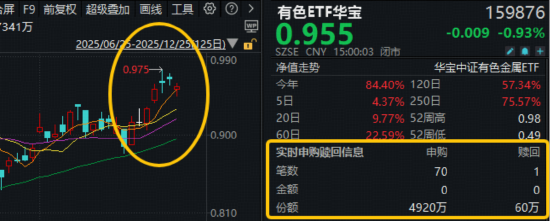
Core Viewpoint - The non-ferrous metal sector experienced its first pullback after four consecutive days of gains, with the largest non-ferrous ETF, Huabao (159876), seeing a price drop of nearly 2% at one point, ultimately closing down 0.93% [1][8] Fund Performance - Huabao ETF (159876) recorded a net subscription of 48.6 million units today, following a previous day's inflow of 9.81 million yuan, indicating strong investor confidence in the non-ferrous metal sector's future performance [1][8] - The ETF has shown significant growth over various periods, with a 52-week high of 0.98 and a 250-day increase of 75.57% [1][9] Market Dynamics - The pullback in the ETF is attributed to two main factors: lower-than-expected initial jobless claims in the U.S. reducing the likelihood of a Fed rate cut in January, and the holiday season causing major commodity futures markets to close, leading to a lack of positive news to boost market confidence [10] - The commercial aerospace sector is driving demand for materials such as titanium, high-temperature alloys, and aluminum, which are essential for rockets and engines, thus reshaping the growth attributes of non-ferrous stocks [3][10] Investment Outlook - Industry experts suggest that the duration of the super cycle for non-ferrous metals will depend on three conditions: the recovery of U.S. dollar credit, the progress of strategic reserves, and the effectiveness of "anti-involution" policies. The super cycle is likely to continue until 2026 [3][10] - The Huabao ETF and its associated funds provide a diversified investment approach across various non-ferrous metals, making them suitable for inclusion in investment portfolios to mitigate risks [5][11]
航天局印发重磅文件,国内首款可回收火箭也将首飞
Xuan Gu Bao· 2025-11-25 23:14
Group 1: Industry Developments - The National Space Administration has issued an action plan for the high-quality and safe development of commercial space from 2025 to 2027, encouraging the strengthening of satellite and rocket manufacturing, expanding application services, and enhancing measurement and control operations [1] - The Beijing Blue Arrow Aerospace's Zhuque-3 rocket is set for its maiden flight on November 29, 2023, marking a significant milestone in commercial space endeavors [1] - Zhuque-3 is the world's first all-stainless steel liquid oxygen-methane rocket, designed for reusability and future scalability, with capabilities comparable to SpaceX's Falcon 9 [1] Group 2: Company Insights - Parker New Materials is focusing on developing new generation lightweight alloys such as aluminum-lithium and magnesium alloys to significantly reduce structural weight and enhance rocket reusability, with Blue Arrow Aerospace as a key client [2] - Aerospace Morning Light has developed metal hoses for critical fuel delivery systems in rockets, with Blue Arrow Aerospace also being one of its clients; the company has recently completed assembly of the largest domestic nuclear fusion test device's key component [2]
我国铝产业第一大省:氧化铝年产量2960万吨,超全球五分之一!
Sou Hu Cai Jing· 2025-10-04 12:08
Core Viewpoint - Shandong province is a dominant player in China's aluminum industry, with a projected alumina production of 29.6 million tons in 2024, accounting for over 20% of global output, supported by a well-established industrial chain and strategic resource management [1][6][8]. Group 1: Production and Capacity - In 2024, Shandong's alumina production is expected to reach 29.6 million tons, significantly surpassing Shanxi's 20.33 million tons, solidifying its leading position in China [6]. - Shandong's aluminum material production is projected at 14.69 million tons, with electrolytic aluminum at 9 million tons, representing over 20% of the national total of 67.83 million tons [3][6]. - The province's electrolytic aluminum capacity is being optimized, with a reduction from approximately 12 million tons in 2018 to an expected 4 million tons by 2025, allowing for a focus on high-end production [3][6]. Group 2: Resource Management - Shandong relies heavily on imported bauxite, with Yantai Port expected to import over 50 million tons in 2024, maintaining its status as the world's largest importer [4][14]. - The efficiency of Yantai Port is highlighted by its record of unloading 290,000 tons per ship, ensuring a steady supply of raw materials for local production [4][14]. Group 3: Industry Structure and Key Players - The industry is characterized by three major players: Weiqiao, Xinfeng, and Nanshan, collectively accounting for over 50% of national production [10][12]. - Weiqiao, with a projected revenue of 73.5 billion yuan and a net profit of 10 billion yuan in 2024, has established itself as a global aluminum giant through a full industrial chain approach [10][12]. - Nanshan focuses on high-end products, supplying major aerospace companies and achieving a net profit of 1.7 billion yuan in Q1 2024, reflecting significant growth [10][12]. Group 4: Environmental and Policy Initiatives - Shandong is actively responding to national energy-saving and emission reduction policies, with a target of 25% clean energy usage in electrolytic aluminum production by 2025 [6][15]. - The province is also focusing on optimizing existing production capacity rather than adding new capacity, with a significant portion of production now meeting energy efficiency benchmarks [6][15]. Group 5: Global Influence and Future Outlook - Shandong's aluminum industry is not only significant in domestic production but also plays a crucial role in global supply chains, with alumina exports and bauxite imports facilitating international trade [8][15]. - The province is expected to maintain a tight balance between supply and demand, with a target of 130 million tons of aluminum capacity by 2025, positioning itself as a benchmark in the global aluminum market [17].