长链二元酸

Search documents
合成生物学赋能化工,4大趋势值得关注
合成生物学与绿色生物制造· 2026-03-25 07:52
Core Viewpoint - The article emphasizes the transformative potential of synthetic biology in the chemical industry, highlighting its ability to produce a wide range of chemical products sustainably and efficiently, with a projected economic impact of $100 billion by 2025 [2]. Group 1: Differences Between Synthetic Biology and Chemical Synthesis - Chemical synthesis involves a series of reactions to produce one or more products without the necessity of biological organisms, often resulting in significant pollution and CO2 emissions [4]. - Synthetic biology manufacturing utilizes renewable carbon resources like sugars and CO2, leading to cleaner and more efficient production processes that minimize environmental impact [4]. - Synthetic biology offers new pathways for the sustainable production of bulk chemicals, renewable chemicals, polymers, fine chemicals, and agricultural products, addressing the challenges of traditional chemical synthesis [4]. Group 2: Applications of Synthetic Biology in Chemical Production - Synthetic biology enables the industrialization of various bio-based products, including bio-based succinic acid, ethanol, and artemisinin, with the potential for all organic chemicals to be produced through synthetic biology [6]. - The integration of synthetic biology with AI and big data is expected to enhance the production of bio-based products, contributing to a sustainable bio-economy [6]. Group 3: Innovations in Materials and Enzyme Processes - Synthetic biology presents significant innovation potential for new materials, surpassing traditional petrochemical innovations, with over 3 million new molecules and materials available for exploration [8]. - Enzyme catalysis, a method within synthetic biology, improves production processes in pharmaceuticals and other sectors by offering higher yields, purity, and reduced by-products compared to traditional fermentation methods [10]. Group 4: Biomass as a Substitute for Fossil Resources - Biomass can replace fossil resources for essential fuels and materials, significantly reducing CO2 emissions, with bio-based materials showing lower greenhouse gas emissions compared to petrochemical materials [11]. - The potential for greenhouse gas reduction from bio-based materials is substantial, with estimates suggesting reductions of up to 2.9 billion tons per year if fully adopted in the U.S. [11]. Group 5: Advantages of Synthetic Biology in the Chemical Sector - Synthetic biology utilizes renewable raw materials, aligning with carbon neutrality goals, and promotes a closed carbon cycle through the use of biomass [14]. - The production processes in synthetic biology are energy-efficient, with potential energy savings of 30%-50% compared to traditional methods, and future potential reaching 50%-70% [15]. - Cost advantages are evident, with some bio-based chemicals produced at lower costs than their petrochemical counterparts, such as a 20% cost reduction for bio-based succinic acid [16]. - Higher selectivity and efficiency in producing complex molecules are achieved through synthetic biology, simplifying processes and reducing impurities [17].


真金白银! 最高5000万! 黑龙江生物制造政策,支持生物医药、生物化工、生物农业
合成生物学与绿色生物制造· 2026-02-26 12:54
Core Viewpoint - The article discusses the recent policies released by the Heilongjiang Provincial Government to support the high-quality development of the biomanufacturing industry, focusing on enhancing technological innovation, promoting industrial expansion and quality improvement, supporting key areas, and increasing resource guarantees [2]. Group 1: Enhancing Technological Innovation - Support for the construction of innovation platforms in biomanufacturing, including collaboration with universities and research institutions [3]. - Financial support for key technology research projects in biomanufacturing, with provincial funding for approved projects [3]. - Encouragement for enterprises to increase R&D investment, with subsidies for qualifying investments over 500,000 yuan [3]. - Support for the establishment of pilot testing platforms, with potential subsidies based on performance evaluations [3]. - Promotion of technology transfer activities, providing funding for contracts over 1 million yuan [3]. Group 2: Promoting Industrial Expansion and Quality Improvement - Financial support for new biomanufacturing projects with fixed asset investments over 20 million yuan, offering up to 50 million yuan in subsidies [4]. - Assistance for equipment upgrades in biomanufacturing enterprises to enhance production efficiency [4]. - Support for digital transformation using AI and big data, with subsidies for recognized digital workshops and smart factories [4]. - Encouragement for leading biomanufacturing enterprises to form innovation alliances to enhance collaboration and market expansion [4]. Group 3: Supporting Key Areas of Development - Financial incentives for new drug and high-end medical device development, with support based on clinical trial phases [5]. - Encouragement for the development of new food products, with rewards for approved new food materials [5]. - Support for the development of high-value biochemicals, with financial rewards for significant sales achievements [5]. Group 4: Increasing Resource Guarantees - Support for the construction of biomanufacturing parks and infrastructure, with potential bond funding [6]. - Assurance of key resource guarantees for biomanufacturing projects, including energy and land use [6]. - Strengthening financial support for biomanufacturing enterprises, including assistance for listing and innovative financing products [6]. - Enhancement of intellectual property protection for biomanufacturing innovations [7]. Group 5: Strengthening Talent Development - Encouragement for universities to develop relevant programs and facilitate talent acquisition in biomanufacturing [7]. - Support for research personnel to engage in innovation and technology transfer activities [7].

大力发展生物基化学品和材料!黑龙江发布生物制造产业政策措施!(附通知全文)
synbio新材料· 2026-02-26 06:58
Core Viewpoint - The article discusses the policies implemented by the Heilongjiang Provincial Government to support the high-quality development of the biomanufacturing industry, emphasizing the promotion of biochemicals and materials with high technological content and added value [2][5]. Group 1: Enhancing Technological Innovation Capabilities - Support for the construction of innovation platforms in biomanufacturing, encouraging collaboration between enterprises and research institutions [6]. - Financial support for key technology research projects in biomanufacturing, including innovative drugs and biochemicals [6]. - Incentives for enterprises to increase R&D investment, with subsidies based on the amount invested [6]. - Support for the establishment of pilot testing platforms to facilitate the connection between R&D and production [6]. - Encouragement of technology transfer activities, with financial assistance for contracts exceeding 1 million yuan [6]. Group 2: Promoting Industry Expansion and Quality Improvement - Financial support for new biomanufacturing projects with fixed asset investments of 20 million yuan or more, providing up to 5 million yuan in subsidies [7]. - Support for equipment upgrades in biomanufacturing enterprises to enhance production efficiency [7]. - Encouragement for enterprises to adopt digital technologies, with financial incentives for recognized digital workshops and smart factories [7]. - Promotion of industry collaboration through the establishment of innovation alliances and research institutes [7]. Group 3: Supporting Key Sector Development - Focus on strengthening the biopharmaceutical sector with financial support for new drugs and high-end medical devices at various clinical trial stages [8]. - Encouragement for the development of new food products, providing rewards for approved new food ingredients [8]. - Promotion of biochemicals, with incentives for products achieving significant sales [8]. Group 4: Increasing Resource Assurance - Support for the construction of biomanufacturing parks and infrastructure improvements [9]. - Assurance of key resources for biomanufacturing projects, including energy and land [10]. - Strengthening financial services for biomanufacturing enterprises, including support for listing and innovative financing products [10]. - Enhancement of intellectual property protection for biomanufacturing innovations [10]. - Development of talent in the biomanufacturing sector through educational initiatives and support for high-level talent recruitment [10].

黑龙江:大力发展生物化工,推动生物基产品在塑料包装、日化消费、交通物流、环保建材等领域应用
Xin Lang Cai Jing· 2026-02-15 01:08
Core Viewpoint - The Heilongjiang Provincial Government has issued policies to support the high-quality development of the bio-manufacturing industry, emphasizing the promotion of bio-based chemicals and materials [1] Group 1: Policy Measures - The government aims to vigorously develop bio-chemicals, encouraging the development of high-tech, high-value bio-based chemicals and materials such as polyols, long-chain dicarboxylic acids, polylactic acid, polyesters, and bio-based nylon [1] - The policies promote the application of bio-based products in various sectors, including plastic packaging, daily chemical consumption, transportation logistics, and environmentally friendly building materials [1] Group 2: Financial Incentives - For provincial key new products with annual single product sales revenue exceeding 2 million yuan, the government will provide a reward of 5% of the actual annual transaction amount to the developing enterprises, with a maximum reward of 500,000 yuan per single product [1] - Each enterprise can receive a cumulative maximum reward of 3 million yuan per year [1]
关于印发《黑龙江省支持生物制造产业高质量发展若干政策措施》的通知
Xin Lang Cai Jing· 2026-02-15 01:02
Core Viewpoint - The Heilongjiang Provincial Government has issued a set of policy measures to support the high-quality development of the biomanufacturing industry, aiming to enhance technological innovation, promote industrial expansion, and ensure resource allocation to create competitive advantages and seize future development opportunities [2][7]. Group 1: Enhancing Technological Innovation - Support for the construction of innovation platforms in biomanufacturing through collaboration between enterprises and research institutions, with financial rewards for approved national and provincial platforms [3][8]. - Encouragement for tackling core technological challenges in biomanufacturing, with provincial financial support for approved key research projects [3][8]. - Incentives for enterprises to increase R&D investment, with subsidies for qualifying expenditures exceeding 500,000 yuan, matched by provincial and municipal funding [3][8]. - Support for the establishment of pilot testing and verification platforms, with potential subsidies of up to 1 million yuan based on performance evaluations [3][8]. - Promotion of technology transfer activities, providing funding for contracts exceeding 1 million yuan for technology purchases from research institutions [3][8]. Group 2: Promoting Industrial Expansion and Quality Improvement - Financial support for new biomanufacturing projects in key sectors, with subsidies of up to 5 million yuan for fixed asset investments of 20 million yuan or more [4][9]. - Assistance for equipment upgrades in biomanufacturing enterprises to enhance production efficiency and reduce costs [4][9]. - Support for digital transformation using AI, big data, and IoT technologies, with subsidies for recognized digital workshops and smart factories [4][9]. Group 3: Supporting Key Sector Development - Focus on strengthening the biopharmaceutical sector with financial support for clinical trials and production of new drugs and high-end medical devices, with potential rewards of up to 1.5 million yuan [4][9]. - Encouragement for the development of new food products, with one-time rewards for approved new food materials and additives [4][9]. - Promotion of biochemicals with high added value, providing rewards for significant sales achievements in new products [4][9]. Group 4: Resource Allocation and Financial Support - Support for the construction of biomanufacturing parks and infrastructure, with potential bond funding for qualifying projects [5][10]. - Inclusion of biomanufacturing enterprises in key resource allocation for utilities, ensuring priority in energy supply [5][10]. - Financial services support for biomanufacturing enterprises to facilitate listing and access to capital markets, including innovative loan products [5][10]. Group 5: Intellectual Property and Talent Development - Strengthening intellectual property protection for biomanufacturing innovations, with services to expedite patent applications [10][11]. - Encouragement for educational institutions to develop relevant programs and attract high-level talent to the biomanufacturing sector [10][11]. Implementation Timeline - The policy measures are effective from the date of issuance until December 31, 2028, with provisions for adjustments based on national and provincial policy changes [10].

生物制造的底层逻辑与产业链分析(附100佳核心企业)
材料汇· 2026-01-13 11:56
Core Viewpoint - Biomanufacturing is identified as a key future industry in China's 14th Five-Year Plan, expected to create a market worth trillions in the next decade, driven by advancements in technology and policy support [2][5]. Group 1: Industry Overview - The biomanufacturing industry in China is nearing a total scale of 1 trillion yuan, with fermentation capacity accounting for over 70% of the global total [2][4]. - Shenzhen has become a hub for biomanufacturing, with 40% of newly established companies in this sector located there in the past three years, showcasing a significant industry clustering effect [4]. - The industry is supported by a comprehensive system of policy, funding, and technological advancements as outlined in the 14th Five-Year Plan [5]. Group 2: Key Enterprises - The article identifies 100 core enterprises in biomanufacturing, spanning the entire industry chain from upstream technology development to downstream commercial applications [7]. - Notable companies include: - Huada Technology, a leader in gene sequencing technology [17]. - Kaisa Biotech, which has achieved over 80% market share in the global long-chain dicarboxylic acid market [21]. - WuXi Biologics, representing China's capabilities in the global biopharmaceutical industry [27]. Group 3: Upstream Innovations - The upstream sector focuses on providing essential tools and technologies for research and production, with a shift towards domestic innovation and smart integration [16]. - Key trends include the localization of critical tools and the rise of AI-driven platform companies that enhance research efficiency [16][17]. - Over 75% of the 20 identified upstream enterprises are private, indicating a vibrant innovation landscape [16]. Group 4: Midstream Developments - The midstream sector is characterized by a dual structure of "upgraders" and "disruptors," with companies like Meihua Biotech and Chuaning Biotech leading in traditional fermentation while others like Kaisa Biotech innovate with new bioproducts [20][21]. - This segment contains the highest number of enterprises, with 40 out of the 100 identified companies, emphasizing the importance of production capacity and cost control [20]. Group 5: Downstream Applications - The downstream sector serves as a critical market for biomanufacturing, focusing on medical, consumer, and agricultural applications [25]. - Companies like Muyuan Foods exemplify the cost-saving potential of biomanufacturing in agriculture, while WuXi Biologics and Kelaiying represent the pharmaceutical sector's output capabilities [26][27]. - Future trends indicate a broadening of applications into new areas such as biobased textiles and environmental remediation [27].


政策加力 激发民间投资新活力(新年谈“新”·五位民营企业家和金融界人士谈民间投资)
Ren Min Ri Bao· 2026-01-04 22:28
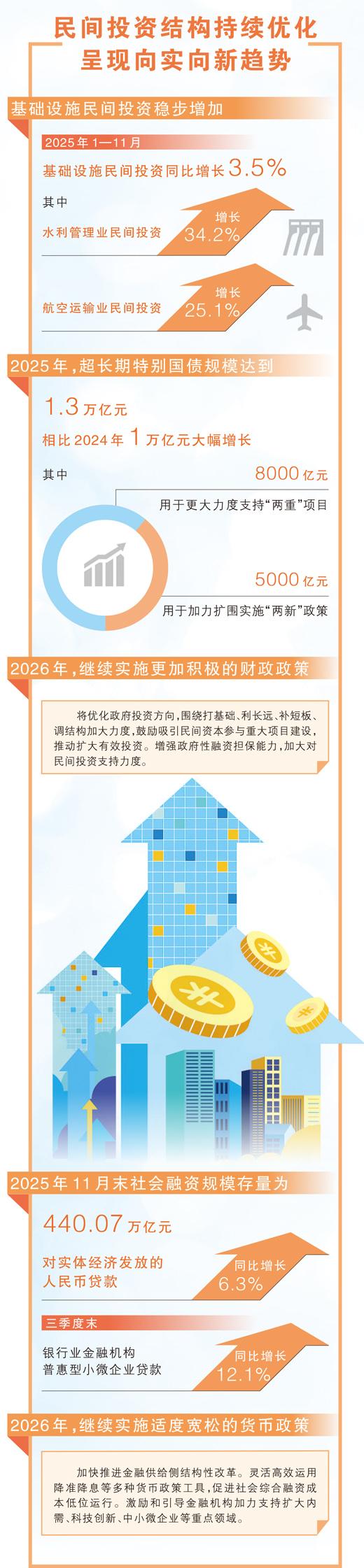
Group 1 - The core viewpoint of the articles emphasizes the continuous optimization of private investment structure, showcasing a trend towards practical and innovative investments, particularly in infrastructure [1][3] - Private investment in infrastructure is steadily increasing, with a year-on-year growth of 3.5% from January to November 2025, particularly notable in the water management sector (34.2% growth) and the aviation transport sector (25.1% growth) [1] - The scale of special long-term government bonds is projected to reach 1.3 trillion yuan in 2025, a significant increase of 800 billion yuan compared to 2024, with funds allocated to support major projects and policies [1] Group 2 - By the end of November 2025, the total social financing scale reached 440.07 trillion yuan, with a year-on-year increase of 6.3% in loans to the real economy [2] - The banking sector has seen a 2.1% year-on-year increase in loans to small and micro enterprises, indicating a supportive financial environment for private investment [2] Group 3 - Private investment is recognized as a crucial support for stabilizing growth, adjusting structure, and promoting employment, with expectations for more proactive macro policies to stimulate private investment in 2026 [3][5] - The financial support mechanisms for small and micro enterprises have been enhanced, with significant loan disbursements and a focus on understanding the real financing needs of these businesses [5][6] Group 4 - Companies are increasingly leveraging favorable policies to enhance their investment capabilities, as seen in the case of a motorcycle export company that successfully expanded its market presence and production capacity through tailored financial services [4][10] - The importance of timely and precise financing support is highlighted, as it stabilizes expectations and boosts confidence among business operators, leading to increased investment [5][18] Group 5 - The articles illustrate the proactive measures taken by financial institutions to support private enterprises, including customized financing solutions and long-term stable funding to help businesses focus on quality control and growth [16][17] - The collaboration between government, financial institutions, and enterprises is emphasized as essential for fostering a conducive environment for private investment and innovation [15][19]
乌苏市工业经济活力四射
Zhong Guo Xin Wen Wang· 2025-12-29 10:58
Core Viewpoint - Uusu City is strategically positioning itself as an "Industrial Strong City" by leveraging its advantages in the Silk Road Economic Belt and developing a modern industrial system that includes synthetic biology manufacturing, intelligent equipment manufacturing, and cotton textile and apparel industries [1][2]. Synthetic Biology Manufacturing - Uusu has established a synthetic biology manufacturing industrial cluster covering 9,439 acres, with the Uusu Industrial Park as the core [3]. - Key player in this sector is Kasei Biotech (Uusu) Co., Ltd., which has developed production lines for long-chain dicarboxylic acids and bio-based polyamides, achieving an output value of 1.097 billion yuan in 2024 [3]. - The goal is to reach a synthetic biology manufacturing output value of 10 billion yuan during the 14th Five-Year Plan period, establishing Uusu as a future demonstration zone for synthetic biology manufacturing in Western China [3]. Intelligent Equipment Manufacturing - Uusu's intelligent equipment manufacturing sector is gaining recognition, with products like large cotton-picking machines being exported to multiple international markets [4]. - The North New Science and Technology Co., Ltd. has transitioned from providing a few products to covering over ten sectors, achieving a production value of 20 million yuan and tax contributions of 2.02 million yuan in 2025 [5]. - The Uusu Industrial Park has been recognized as a high-tech industrial development zone, with plans to add 21 new high-tech enterprises by 2025, bringing the total to 36 [5][6]. Textile and Apparel Industry - Uusu is enhancing its textile and apparel industry by upgrading to high-end, intelligent, and full-industry chain production [6][7]. - The introduction of advanced production lines has increased yarn spinning efficiency by nearly 50%, and the company has initiated a project to produce high-end blended yarns [6]. - The establishment of a complete silk production chain has diversified the industry, transitioning from cotton to silk, thus increasing the added value of products [7]. Logistics Hub Development - Uusu is evolving from a geographical transportation node to a modern logistics hub, supported by a comprehensive transportation network [8]. - The city has been integrated into the international railway transport system, significantly reducing transportation costs and time for goods to Central Asia [8][9]. - A planned 13.67 square kilometer commercial logistics park aims to enhance trade and logistics capabilities, facilitating a dual open pattern of foreign and domestic trade [9].
又一生物基尼龙企业IPO首发获批!
Sou Hu Cai Jing· 2025-12-23 00:59
Core Viewpoint - Changyu Group's IPO approval marks a significant milestone for the company and signals positive developments for the bio-based nylon industry chain [2][14]. Group 1: Company Overview - Changyu Group has received approval for its IPO application on the Shanghai Stock Exchange, with the meeting held on December 19, 2025 [2]. - The company was established in April 2019, with a registered capital of 366.875231 million yuan, and is controlled by Liu Qiyong and Liu Ce [5]. - The main products of the company include zirconium oxychloride, zirconium carbonate, zirconium oxide, nano-composite zirconium oxide, specialty nylon, long-chain dicarboxylic acids (bio-based), long-chain diols, and long-chain dimethyl esters [5]. Group 2: Investment Projects - The project for producing 10,000 tons of high-performance nylon elastomer products has a total investment of 248 million yuan, with 240 million yuan to be raised through the IPO, accounting for 34% of the total fundraising [3]. - The company has established R&D and production capabilities from long-chain dicarboxylic acids to downstream specialty nylon and modified products [5]. Group 3: Financial Performance - From 2022 to the first half of 2025, the company's revenue figures were 1.6694774 billion yuan, 1.6080036 billion yuan, 1.6376778 billion yuan, and 896286.1 million yuan, respectively [11]. - The net profit attributable to the parent company for the same period was 263.2768 million yuan, 195.4148 million yuan, 212.1245 million yuan, and 112.6974 million yuan [11]. - The gross profit margin for the main business was 28.35%, 23.27%, 23.83%, and 23.54% for the respective years [11]. Group 4: Product Development - The specialty nylon products have an annual polymerization capacity of 15,000 tons, covering over 50 grades, and are widely used in various industries such as machinery manufacturing, automotive, mobile phones, 3D printing, special clothing, and food packaging [7]. - The company is currently in the small-scale testing phase for bio-based transparent polyamide, aiming for a bio-based carbon content of over 45% [9][10]. Group 5: Market Position and Industry Impact - The successful IPO and capacity expansion plans of Changyu Group are expected to increase market demand for upstream raw material suppliers, particularly for long-chain dicarboxylic acids [15]. - The production of specialty nylon relies heavily on long-chain dicarboxylic acids, with key suppliers like Kasei Bio providing essential materials for the production of various polyamides [15].
凯赛生物,大涨51%!长链二元酸放量,持续布局生物基复合材料
DT新材料· 2025-11-02 14:42
Core Viewpoint - 凯赛生物's Q3 2025 report shows overall growth in revenue and profit, driven by the increasing sales of long-chain dicarboxylic acid products [2][4]. Financial Performance - For the first three quarters, the company achieved total revenue of 2.545 billion yuan, a year-on-year increase of 14.90% [2][3]. - The net profit attributable to shareholders reached 451 million yuan, up 30.56% year-on-year [2][3]. - The net profit excluding non-recurring gains and losses was 429 million yuan, reflecting a 27.83% increase [2][3]. - The total profit for the period was 161 million yuan, showing a significant increase of 51.46% [3]. - Basic and diluted earnings per share were both 0.20 yuan, a rise of 17.65% [3]. Product and Market Development - 凯赛生物 is a leading company in long-chain dicarboxylic acids, with its DC11-DC18 products dominating the global market [4]. - The company utilizes biomanufacturing methods to produce various products, which have gained customer acceptance due to superior quality, pricing, and carbon reduction effects [4]. - The introduction of innovative compounds like pentamethylenediamine and the development of bio-based polyamides and composites are expected to create a second growth curve for the company [4]. Green Composite Materials - 凯赛生物 has launched the world's first bio-based composite cold storage container, marking a significant step in its green composite materials strategy [4]. - The company’s bio-based composite materials have penetrated six major sectors, including new energy vehicles, clean energy, rail transportation, construction, electronics, and consumer goods [4]. - The shift towards green composite materials is driven by high carbon emissions from traditional petroleum-based composites, aligning with dual carbon policies [5]. Industry Trends - The green composite materials market is poised for growth as companies like 凯赛生物 innovate to meet sustainability goals while maintaining product performance [5]. - The upcoming "2025 (Fourth) Green Composite Materials Forum" will focus on technological breakthroughs and industry integration in the green composite sector [6].