高端DRAM

Search documents
2026 全球投资展望:AI 阶跃引发算力通胀,中国半导体逆势突围
Sou Hu Cai Jing· 2026-01-28 00:54
Core Insights - The global market is experiencing a dual storm of "AI leap" and "geopolitical restructuring" as it enters 2026, with Morgan Stanley predicting extreme volatility and Omdia forecasting a 31.26% growth in China's semiconductor market, reaching $546.5 billion [1] Group 1: Computing Power Dominance - The demand for computing power is expected to grow exponentially, driven by advancements in large language models (LLMs) and the adoption of "smart factory" models by LLM developers [1] - In China, the "edge AI era" is officially beginning, with digital terminals capable of edge inference (such as smartphones and vehicles) becoming the main drivers of semiconductor expansion [1] - Domestic AI chip suppliers in China are expected to capture a larger share of the market due to increased pressure from import bans [1] Group 2: Storage Chip Supercycle - The demand for high-performance storage (HBM) is surging as global AI infrastructure expands, leading to a significant upward revision of the storage market forecast by Omdia, which is now up by 62.8% [1] - China's reliance on Samsung and SK Hynix for 90% of its high-end storage results in low self-sufficiency and weak bargaining power, keeping average selling prices (ASP) of storage chips high [1] - A global shortage of storage chips is expected to persist until 2027-2028, which will be a major constraint on the shipment volumes of terminal devices [1] Group 3: Manufacturing Landscape in a Multipolar World - The U.S. is expected to see a resurgence in high-end manufacturing due to policies aimed at securing critical mineral and energy supplies, with automation technologies reducing the advantage of low-cost labor [1] - China aims to expand its market share in global tech manufacturing by leveraging its mature processes and vertical industry capabilities, despite facing external regulations [1] - In 2026, China is anticipated to achieve diversified breakthroughs in AI infrastructure through deep collaboration between computing power and AI ecosystems [1] Group 4: Energy and Deflationary Pressures - Energy costs are projected to become a critical factor in AI expansion, with AI giants moving towards "off-grid" strategies to control infrastructure directly [1] - By the second half of 2026, AI-driven cost reduction effects are expected to lead to rapid declines in the prices of certain goods, while the valuation of scarce assets that cannot be replicated by AI may rise [1]


中国半导体,预计增长31.26%
半导体芯闻· 2026-01-27 10:19
Core Insights - The article highlights the rapid deployment of AI application models across various verticals in China, marking the arrival of the edge AI era. The semiconductor market in China is projected to grow significantly, with a forecasted increase of 31.26% in 2026, reaching a market size of $546.5 billion [3]. Semiconductor Market Growth - The semiconductor market in China is expected to grow by 16.17% in 2025 and 13.63% in 2026, with an updated forecast predicting growth of 21.63% in 2025 and 31.26% in 2026 [3]. - The storage market forecast has been significantly revised upwards, with predictions for 2026 storage market growth increased by 62.8%, 53% for 2027, 36% for 2028, and 25.8% for 2029 [5]. AI and Storage Demand - The demand for high-performance storage chips (HBM) is surging due to the global AI infrastructure boom, leading to a supply-demand imbalance that is expected to persist until 2027-2028 [5]. - China's self-sufficiency in high-end storage chips remains low, with approximately 90% of supply dependent on Samsung and SK Hynix, resulting in weak market bargaining power and high storage chip prices [5]. Application Trends - The "Computing and Data Storage" category shows a more pronounced growth trend, with data for 2026 and 2027 revised upwards by over 20% compared to previous forecasts, driven by increased usage and prices of high-end storage chips [8]. - The "Wireless Communication" category also shows significant growth, primarily due to supply-demand imbalances leading to increased average selling prices (ASP) of storage chips, rather than an increase in market demand for wireless terminals [8]. Local AI Chip Market - Due to the ban on NVIDIA's AI chips in China, local AI chip suppliers are expected to gain market share, with edge AI presenting significant growth opportunities for inference AI chips in 2026 [9]. - The penetration of AI in terminal devices is anticipated to increase, necessitating wireless device connectivity to meet low-latency network demands, with hybrid expert model architectures being key for accelerating development [9].

韩厂减产 NAND催动价格飙涨 群联、点序、威刚等受惠
Jing Ji Ri Bao· 2026-01-20 23:11
Group 1 - Samsung and SK Hynix are significantly reducing NAND chip production to focus on high-end DRAM and high bandwidth memory (HBM), leading to a structural supply shortage in the global NAND chip market, with prices expected to rise further [1][2] - Samsung's NAND chip production is projected to decrease from 4.9 million units last year to 4.68 million units this year, a reduction of approximately 4.5%, while SK Hynix's production is expected to drop from 1.9 million units to 1.7 million units, a decrease of 10.5% [1] - The combined NAND chip output from both companies is anticipated to fall from 6.8 million units last year to about 6.38 million units this year, representing a year-on-year decline of approximately 6.2% [1] Group 2 - The current tight supply of NAND chips and the booming high-end storage market are driving prices higher, as NAND chip and DRAM production capacities can be interchanged, with both companies prioritizing high-end DRAM production for better profitability [2] - The demand for enterprise-level SSDs and storage capacity from cloud service providers is experiencing structural growth, with a supply gap of over 10% that is unlikely to ease in the short term [2] - Phison, a company specializing in NAND controller chips, is benefiting from the rising prices, which is enhancing its operational momentum [3]
野村:AI芯片热潮助推房价起飞!韩国经济迎来"芯片+地产双重超级周期"
美股IPO· 2025-11-21 08:55
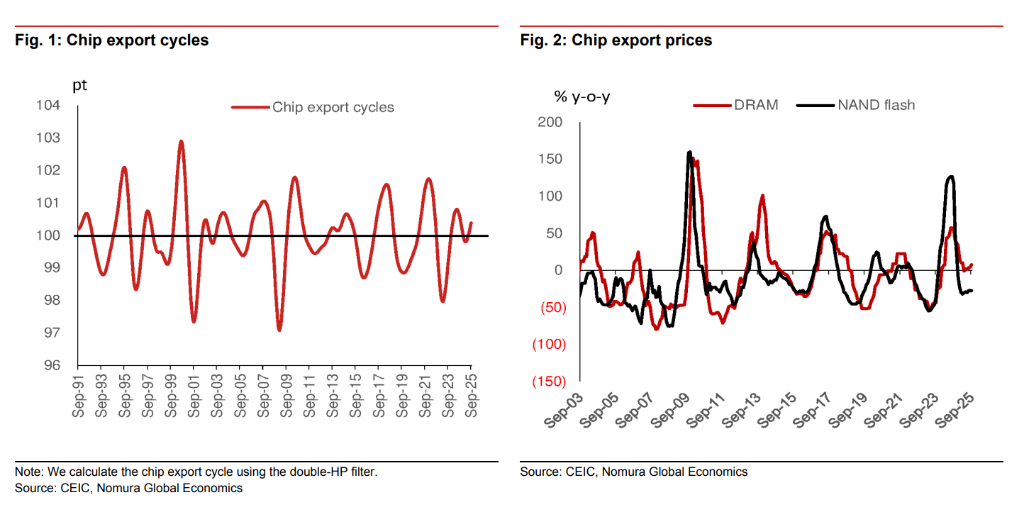
Core Insights - South Korea is experiencing a "dual super cycle" driven by the AI chip boom and a structural shortage in real estate, leading to significant economic implications [1][2][5] Semiconductor Super Cycle - The global semiconductor industry is entering a structural upturn driven by AI computing and cloud infrastructure, with HBM and high-end DRAM supply constraints supporting prices and extending the cycle [4][10] - The semiconductor export surge is expected to result in a current account surplus of $164 billion by 2026, accounting for 7.6% of GDP, which is a historical high [18][23] Real Estate Market Dynamics - The real estate market in Seoul is entering a new super cycle, with apartment prices rising 7.2% year-to-date, significantly outpacing the national average of 0.5% [11][14] - A drastic decline of nearly 40% in new housing starts since 2022 has created a supply cliff, contributing to panic buying in the real estate market [12][13] Economic Growth Projections - Nomura has raised its GDP growth forecast for South Korea from 1.9% to 2.3% for 2026, driven by the wealth effect from rising asset prices [6][23] - The liquidity influx from semiconductor exports is translating into asset price inflation across various categories [6][18] Investment Strategies - The Bank of Korea (BOK) is expected to maintain the policy rate at 2.50%, limiting further rate cuts despite strong economic growth and rising asset prices [3][23] - Investment strategies include focusing on capital-intensive tech stocks, particularly in the semiconductor sector, and benefiting from the consumer recovery in the automotive sector due to recent tariff agreements [20][22]

AI芯片热潮助推房价起飞!韩国经济迎来"芯片+地产双重超级周期"
Hua Er Jie Jian Wen· 2025-11-21 06:28
Core Insights - South Korea is experiencing a macroeconomic feast driven by AI, which generates dollars through exports, converting them into domestic liquidity that is ultimately absorbed by the real estate and stock markets [1] Semiconductor Supercycle - The global semiconductor industry is entering a structural uptrend driven by AI computing and cloud infrastructure, marking a significant departure from the cyclical rebounds seen in previous years [1][3] - Nomura forecasts that chip export growth will surge from approximately 25% in 2025 to 50-60% in 2026, indicating a robust demand environment [1][4] Economic Predictions - Nomura maintains a non-consensus view that the Bank of Korea will keep the terminal interest rate at 2.50% for an extended period, dismissing further rate cuts [3][21] - The GDP growth forecast for South Korea has been raised from 1.9% to 2.3% for 2026, surpassing market consensus due to the wealth effect from rising asset prices [3][13] - A significant trade surplus from chip exports is expected to lead to a surge in M1 money supply, resulting in price increases across various asset classes [3][15] Real Estate Supercycle - The real estate market in South Korea is entering a new supercycle, with the Seoul apartment price index surpassing previous highs, driven by low borrowing costs and accumulated savings [7][10] - Despite high nominal prices, the low actual borrowing costs are sustaining the market, as buyers are entering the market due to fear of missing out (FOMO) [10][11] Liquidity and Wealth Effects - The report highlights a self-reinforcing macroeconomic cycle where the global AI narrative translates into domestic asset stories, contributing to the upward pressure on asset prices [11][19] - The expected current account surplus from semiconductor trade could exceed $120 billion in 2026, significantly impacting domestic liquidity [4][15] Investment Strategies - Nomura suggests a bullish stance on capital-intensive tech stocks, particularly in the semiconductor sector and the AI value chain, while recommending a bearish outlook on interest rate cut expectations [14][21] - The automotive sector is expected to benefit from consumer recovery and recent tariff agreements between the U.S. and South Korea [21]