
鸭翅

Search documents
绝味食品首亏 卤味产品缘何卖不动了?
凤凰网财经· 2026-02-07 10:57
Core Viewpoint - The article highlights that 2025 marks a critical turning point for the Chinese marinated food industry, with leading companies like Juewei Foods facing significant challenges, including their first annual loss since going public, indicating a shift from rapid growth to a competitive market focused on existing resources [4][9]. Group 1: Performance of Listed Companies - Juewei Foods has reported a significant decline in performance, with a net reduction of over 4,000 stores from 14,969 in mid-2024 to approximately 10,713 by January 2026, reflecting a substantial contraction [5][6]. - Other leading companies like Zhou Hei Ya and Huang Shang Huang are also closing stores, but they are doing so strategically to optimize operations and improve efficiency, with Zhou Hei Ya closing nearly 600 stores in the first half of 2025 [8][9]. - Huang Shang Huang is projected to achieve a net profit of 70 million to 90 million yuan in 2025, representing a year-on-year increase of 73.57% to 123.16%, attributed to diversifying its product offerings [8]. Group 2: Market Trends and Challenges - The marinated food market is expected to grow only slightly, with a projected market size of 1,620 billion yuan in 2025, reflecting a growth rate of less than 3%, a significant drop from previous years [4][9]. - The industry is experiencing increased competition from pre-packaged meat snacks and other food categories, which are capturing market share from traditional marinated food chains like Juewei [4][12]. - The lack of product innovation and high prices are major factors contributing to declining sales, with Juewei's products being perceived as expensive compared to community marinated food shops [11][12]. Group 3: Strategic Responses and Future Directions - Companies are responding to market pressures by introducing lower-priced meal packages to attract consumers, with Juewei offering options like a 28 yuan meal set [11]. - The industry is urged to consider international expansion and tap into underdeveloped markets in lower-tier cities, as there remains significant potential for consumer growth [13]. - There is a growing trend towards diversification in product offerings to meet the varied demands of consumers, including targeting specific demographics and occasions [13].


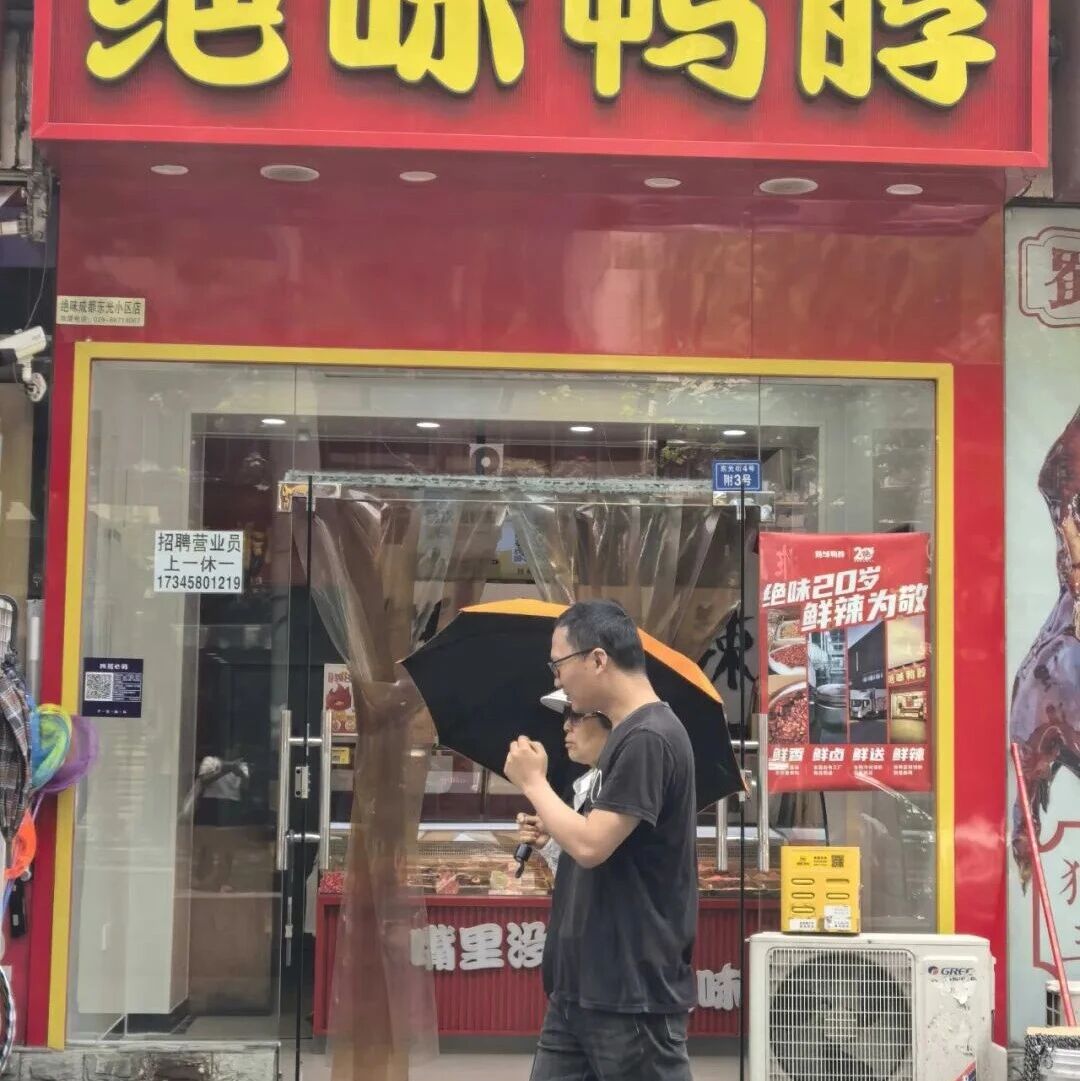
卤味巨头,集体关店
Di Yi Cai Jing· 2026-02-02 23:00
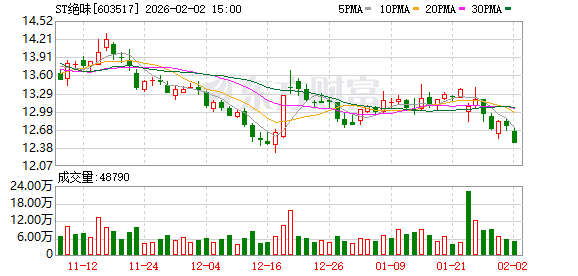
Core Viewpoint - The "luwei" industry is undergoing significant differentiation and deep adjustment, with major players showing contrasting performance signals amid a backdrop of slowing growth, store reductions, and intensified competition [1] Performance Divergence - ST Juewei (603517.SH) has announced a projected revenue of 5.3 billion to 5.5 billion yuan for 2025, representing a year-on-year decline of 12.09% to 15.29%, and expects its first annual loss of 160 million to 220 million yuan [2] - In contrast, Huangshanghuang (002695.SZ) anticipates a net profit of 70 million to 90 million yuan for 2025, reflecting a year-on-year increase of 73.57% to 123.16% [2][3] Store Count Reduction - Despite the increase in net profit for Huangshanghuang and Zhou Hei Ya (1458.HK), both companies are reducing their store counts. Zhou Hei Ya reported a decrease of 167 stores, bringing the total to 2,864 [4] - Huangshanghuang had 2,898 stores as of June 2025, down from 3,660 at the end of 2024 [5] - ST Juewei has seen a net reduction of over 4,000 stores in a year and a half, with approximately 10,713 stores remaining as of February 2026 [5] Industry Challenges - The "luwei" industry is facing severe operational pressures, with a significant slowdown in growth. The compound annual growth rate (CAGR) from 2018 to 2023 was 6.42%, with a market size of approximately 318 billion yuan in 2023 [6] - Key challenges include high prices, reduced consumer willingness, and competition from snacks and ready-to-eat meals, which are impacting the industry's growth [6] - The industry is also experiencing product homogeneity, with 80% of products from the top 10 brands overlapping, leading to concerns about value perception among consumers [6]

卤味巨头业绩分化:绝味首次年度亏损 煌上煌盈利增加但门店减少
Di Yi Cai Jing· 2026-02-02 13:41
Core Viewpoint - The "luwei" industry is undergoing significant differentiation and deep adjustments, with major players showing contrasting performance signals amid a backdrop of slowing growth and intensified competition [2] Performance Divergence - ST Juewei (603517.SH) has announced an expected revenue of 5.3 billion to 5.5 billion yuan for 2025, representing a year-on-year decline of 12.09% to 15.29%, and anticipates its first annual loss since its listing, estimating a loss of 160 million to 220 million yuan [3] - In contrast, Huangshanghuang (002695.SZ) forecasts a net profit of 70 million to 90 million yuan for 2025, reflecting a year-on-year increase of 73.57% to 123.16% [4] Store Count Reduction - Despite the increase in net profit for Huangshanghuang and ST Juewei, both companies are reducing their store counts. Huangshanghuang had 2,898 stores in June 2025, down from 3,660 at the end of 2024 [6] - ST Juewei has seen a net reduction of over 4,000 stores in a year and a half, with approximately 10,713 stores remaining as of February 2026 [6] Industry Challenges - The overall "luwei" industry is facing challenges such as product homogenization, high prices, and changing consumer willingness, leading to the closure of inefficient stores and a search for transformation among leading companies [2][7] - The industry growth has slowed significantly, with a CAGR of 6.42% from 2018 to 2023, and the market size reaching approximately 318 billion yuan in 2023 [6] Competitive Landscape - The industry is experiencing threats from alternative products, including snacks and hot pot brands, which are encroaching on the "luwei" market [7] - There is a high degree of product overlap among the top 10 brands, with 80% of their offerings being similar, leading to concerns about pricing and consumer value perception [7]
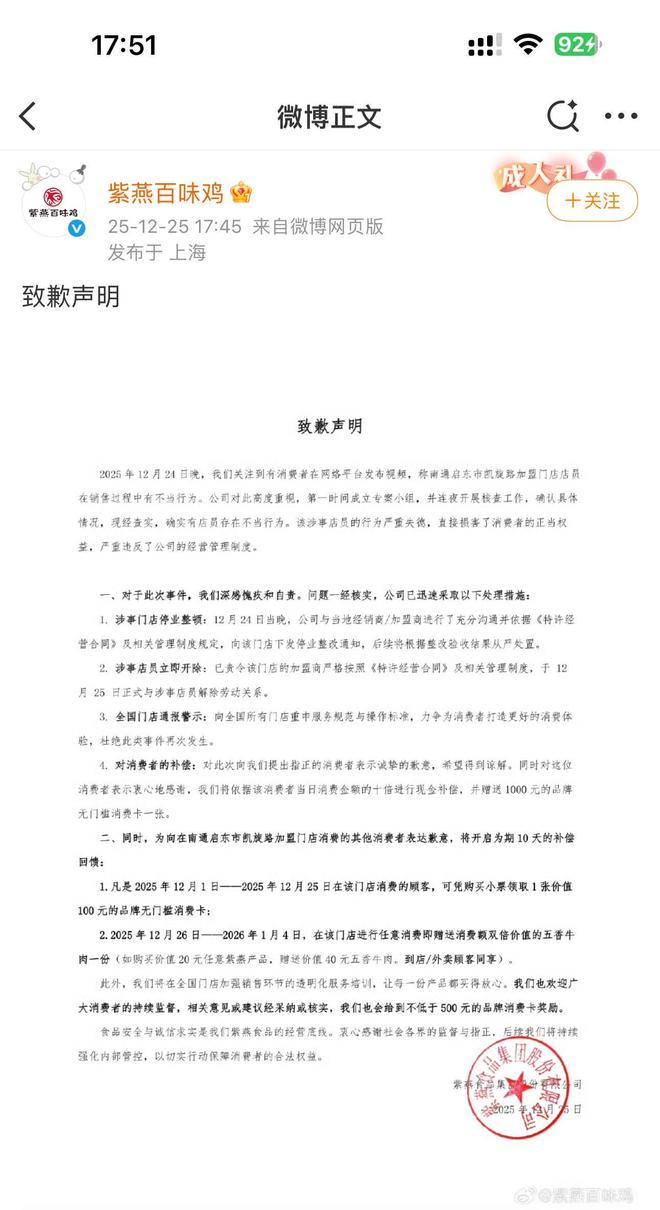
店员偷拿顾客牛肉!紫燕食品致歉,将补偿期间到该店消费顾客
Nan Fang Du Shi Bao· 2025-12-25 10:26
Core Viewpoint - The company, Ziyan Food, issued an apology statement on December 25, 2025, addressing an incident where a store employee was caught taking beef after weighing it for a customer, which violated company policies and harmed consumer rights [4][9]. Group 1: Incident Details - On December 24, 2025, a consumer posted a video on social media alleging that an employee at the Ziyan Bawei Chicken store in Nantong City engaged in improper behavior during a sale [7]. - The company took the allegations seriously and formed a special task force to investigate the claims, confirming that the employee's actions were indeed inappropriate [4][9]. Group 2: Company Response - The company expressed deep regret and self-blame regarding the incident and implemented several immediate measures: 1. The involved store was temporarily closed for rectification, with a notice issued to the franchisee based on the franchise agreement [5][9]. 2. The employee involved was immediately terminated from their position [5][9]. 3. A nationwide alert was issued to all stores to reinforce service standards and operational protocols [5][9]. 4. The company offered compensation to the affected consumer, promising ten times the amount of their purchase as cash compensation and a 1,000 yuan brand gift card [5][9]. Group 3: Compensation and Customer Engagement - To further express apologies to other customers who shopped at the Nantong store, the company initiated a 10-day compensation campaign: 1. Customers who made purchases between December 1 and December 25, 2025, could redeem a 100 yuan no-threshold gift card with their receipt [9]. 2. From December 26, 2025, to January 4, 2026, customers making any purchase at the store would receive double the value of their purchase in five-spice beef [9]. Group 4: Company Background and Financial Performance - Ziyan Food, the parent company of Ziyan Bawei Chicken, was listed on the Shanghai Stock Exchange on September 26, 2022, and specializes in various marinated products [10]. - As of June 30, 2024, the company operated 6,308 stores in China, with 29 being directly operated [10]. - The latest financial report indicated a 6.43% year-on-year decline in revenue to 2.514 billion yuan and a 44.21% drop in net profit to 248 million yuan for the first three quarters of the year [10].

年轻人不吃鸭脖,门店一年关5600家,消费习惯大变了
Sou Hu Cai Jing· 2025-11-09 21:27
Core Insights - The article discusses the decline of the duck neck snack industry, highlighting the closure of 5,600 stores and the loss of consumer interest among young people [1] - Major brands like Juewei, Zhou Hei Ya, and Huang Shang Huang are facing significant challenges, including store closures, financial losses, and a drop in consumer trust [1][6] Group 1: Industry Overview - The duck neck snack was once a staple of nightlife, with brands rapidly expanding and attracting franchisees due to perceived profitability [1][3] - By 2019, the market began to saturate, leading to a decline in single-store revenue as competition increased [3] - In the first half of 2025, Zhou Hei Ya reported revenue of 1.223 billion, a decrease of 2.9% year-on-year, while Huang Shang Huang's revenue was 984 million, down 7.19% year-on-year [1] Group 2: Business Model Challenges - The franchise model initially appeared profitable due to upfront fees and bundled services, but market saturation led to diminishing returns for franchisees [3][8] - Zhou Hei Ya's focus on high-end locations resulted in high rental costs, making its business model vulnerable during economic downturns [3][6] - The number of franchise stores for Zhou Hei Ya decreased to 1,291 by the first half of 2025, indicating a contraction in its business [3] Group 3: Consumer Behavior and Market Trends - The menu offerings of these brands have remained stagnant, failing to innovate and attract younger consumers who prefer trendy and novel options [4][8] - Price increases have alienated consumers, as the cost of duck neck snacks has approached that of full meals, leading to a perception of reduced value [6][8] - The combination of quality control issues, lack of product innovation, and rising prices has contributed to a significant decline in brand loyalty and consumer interest [6][8] Group 4: Financial Impact - The combined revenue of the three major brands decreased by nearly 1 billion in the first half of 2025, reflecting a systemic contraction in the industry [8] - Juewei has faced severe financial issues, leading to its designation as ST (special treatment) in the capital market, with its market value evaporating by 80% from its peak [1][6] - Zhou Hei Ya has been forced to make layoffs and internal adjustments due to declining revenue and increased operational costs [6]

周黑鸭“请大学生免费吃鸭”活动圆满收官
Zheng Quan Ri Bao Wang· 2025-10-24 06:41
Core Insights - The "Free Duck for College Students" campaign initiated by Zhou Hei Ya International Holdings Limited successfully concluded, distributing 300,000 products and registering over 120,000 student members, with total online exposure exceeding 140 million [1][3]. Group 1 - The campaign allowed college students to receive a free product by adding Zhou Hei Ya's welfare officer and completing student verification, with an investment of over 4 million yuan during the back-to-school season [3]. - Zhou Hei Ya's marketing strategy included both online and offline approaches, reaching over 3.2 million students across more than 250 universities in nine major cities [3][4]. - The campaign not only provided products but also resonated emotionally with young consumers, establishing a long-term brand association of "Zhou Hei Ya = Youth Memory" [3][4]. Group 2 - By focusing on college students, Zhou Hei Ya achieved widespread product experience and planted the emotional seed of "Sweet and Spicy Youth" in the minds of Generation Z, successfully transforming a short-term campaign into a long-term brand asset [4]. - The founder of Zhou Hei Ya expressed a commitment to infusing youthful energy into "Chinese flavors" through a blend of unwavering craftsmanship and passionate innovation [4].

周黑鸭请大学生免费吃鸭活动圆满收官 甜辣滋味成青春记忆符号
Zheng Quan Shi Bao Wang· 2025-10-24 03:37
Core Insights - The "Free Duck for College Students" campaign initiated by Zhou Hei Ya has become a phenomenon among Generation Z, generating significant engagement and brand awareness [1][3][4] Group 1: Campaign Overview - The campaign ran from July 20 to October 15, distributing a total of 300,000 products and registering over 120,000 college student members [1][3] - The campaign achieved over 140 million online exposures, successfully resonating with the youth demographic [1][3] Group 2: Engagement Strategy - College students could receive free products by adding Zhou Hei Ya's welfare officer and completing student verification, with over 400,000 yuan invested during the back-to-school season [3][4] - The campaign utilized both online and offline strategies, reaching over 3.2 million students across more than 250 universities in nine major cities [3][4] Group 3: Brand Positioning - Zhou Hei Ya effectively linked its spicy and sweet product flavors with youthful vitality, establishing a long-term mental association of "Zhou Hei Ya = Youth Memory" [4][5] - The campaign not only expanded product experience but also planted the emotional seed of "Sweet and Spicy Youth" in the minds of Generation Z [4][5] Group 4: Industry Impact - The campaign serves as a breakthrough model for addressing the marketing challenges faced by the snack industry in engaging Generation Z, emphasizing emotional connection over mere traffic [5] - It redefined the communication logic between consumer brands and young audiences, integrating product, emotion, and scenario to deepen brand-user connections [5]

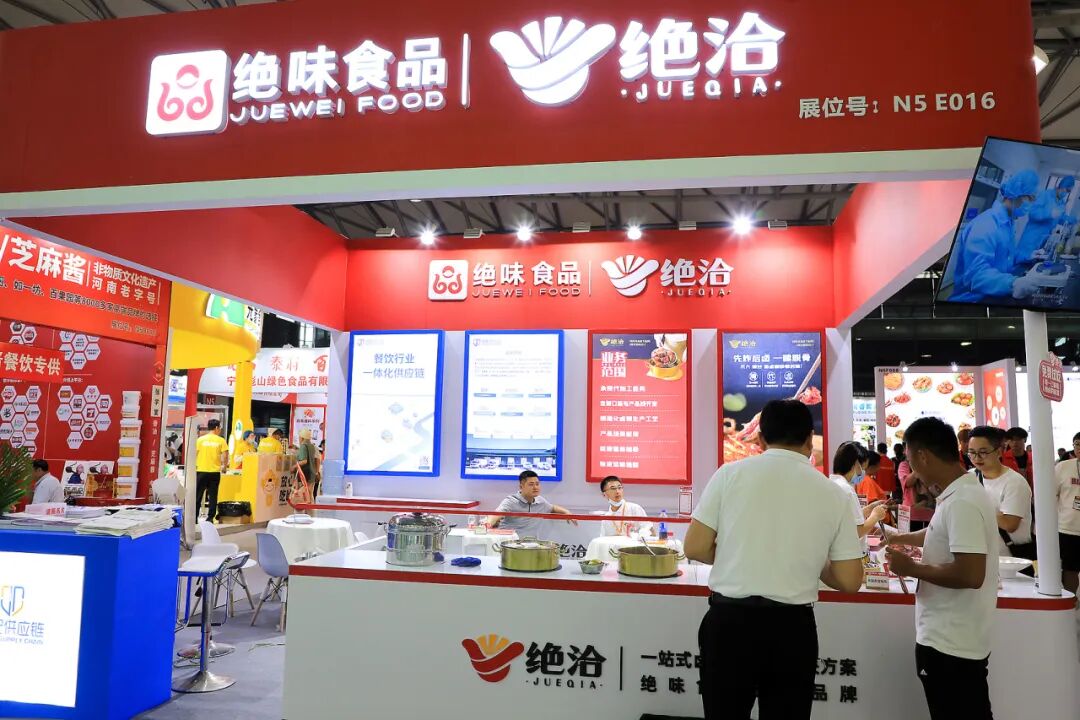
绝味食品营收5年少计7.24亿被ST 公司及戴文军等合计被罚850万
Chang Jiang Shang Bao· 2025-09-23 06:06
Core Viewpoint - Juewei Foods (603517.SH) has been penalized for information disclosure violations, leading to a warning label on its stock and a significant fine for the company and its executives [1][10]. Financial Violations - Juewei Foods failed to recognize revenue from franchise store renovation services from 2017 to 2021, resulting in an understated total revenue of 724 million yuan over five years [6][4]. - The annual revenue underreporting percentages for the respective years were 5.48%, 3.79%, 2.20%, 2.39%, and 1.64% [4][6]. - The company reported annual revenues of 3.85 billion yuan, 4.37 billion yuan, 5.17 billion yuan, 5.28 billion yuan, and 6.55 billion yuan for the years 2017 to 2021 [5][6]. Regulatory Actions - The China Securities Regulatory Commission (CSRC) issued a warning and a total fine of 8.5 million yuan against Juewei Foods and its executives, including 2 million yuan for Chairman Dai Wenjun [9][8]. - The company is required to correct its financial statements and improve internal controls, with the potential to apply for the removal of the warning label after a year [12]. Stock Market Impact - Following the announcement, Juewei Foods' stock was suspended on September 22 and will resume trading under the name "ST Juewei" with a daily price fluctuation limit of 5% [11][10]. Business Performance - Juewei Foods has experienced declining performance, with a 15.57% drop in revenue in the first half of 2025 compared to the previous year [17]. - The company reported a revenue of 6.26 billion yuan in 2023, a 9.64% increase year-on-year, but still fell short of its growth targets [15][14]. - The number of stores decreased significantly, with a net closure of nearly 1,000 stores in the first half of 2024, bringing the total to 14,969 stores [24][23]. Future Outlook - Juewei Foods has ambitious revenue targets for 2023 to 2025, aiming for 7.79 billion yuan, 9.10 billion yuan, and 10.94 billion yuan respectively, but achieving these targets appears challenging given the current performance trends [14][18].
卤味三巨头 最近“不太香”
Shen Zhen Shang Bao· 2025-09-22 05:56
Core Insights - The three major brands in the marinated food industry, namely Juewei, Huangshanghuang, and Zhouheiya, have reported a decline in revenue for the first half of 2025, indicating a challenging market environment [2][3] Group 1: Revenue Performance - Juewei Foods achieved a revenue of 2.82 billion yuan, a year-on-year decrease of 15.57%, with a net profit of 175 million yuan, down 40.71% [2] - Huangshanghuang reported a revenue of 984 million yuan, a decline of 7.19%, but its net profit increased by 26.9% to 76.92 million yuan [2] - Zhouheiya's revenue was 1.22 billion yuan, down 2.9%, while its net profit surged by 228% to 108 million yuan [2] Group 2: Market Challenges - Juewei is facing growth slowdown due to market saturation after previously relying on a nationwide store network and diverse product lines [2] - Huangshanghuang is experiencing challenges from a reduction in store numbers and declining single-store revenue despite profit growth [2] - Zhouheiya has optimized its operations by closing inefficient stores, leading to a decrease in total revenue but an increase in average single-store sales and net profit [2] Group 3: Emerging Competitors - New brands such as Wang Xiaolu and others are gaining market share, leveraging innovative marketing and extending consumption scenarios [3] - The rise of "hot marinated" products is attracting consumers with fresh, made-to-order experiences, contrasting with traditional "cold marinated" offerings [3] Group 4: Strategic Responses - Juewei is focusing on expanding consumption scenarios and appealing to younger consumers through frequent new product launches [4] - Huangshanghuang is seeking growth through cross-industry expansion, including acquiring a stake in a freeze-dried food company [4] - Zhouheiya is enhancing operational efficiency and service across all time periods, aiming to create a conversion loop from content marketing to in-store visits [4] Group 5: Market Outlook - The marinated food industry in China is projected to grow at a compound annual growth rate of 5.93%, reaching a market size of 356.96 billion yuan by 2024 [4] - The competition in the marinated food market is intensifying, signaling a critical point for industry restructuring and growth opportunities [4]
卤味没有以前好卖了!上半年营收均下滑的三巨头 靠卖椰子水能否逆袭
Di Yi Cai Jing· 2025-09-13 13:19
Core Viewpoint - The "three giants" of the marinated food industry are collectively facing revenue decline in the first half of 2025, indicating overall industry pressure. Despite efforts to stabilize profits through store reductions and cost control, the main business growth remains weak [1] Group 1: Revenue and Profit Trends - The marinated food market showed signs of weakness in the first half of this year, with major players like Juewei Food experiencing a 15.57% year-on-year decline in revenue to 2.82 billion yuan and a 40.71% drop in net profit to 175 million yuan [2] - Huangshanghuang reported a 7.19% decline in revenue to 984 million yuan, while net profit increased by 26.9% to 76.92 million yuan, attributed to cost-cutting measures despite a decline in main business segments [2] - Zhou Hei Ya's revenue decreased by 2.9% to 1.22 billion yuan, but net profit surged by 228% to 108 million yuan, driven by improved single-store operational efficiency [3] Group 2: Cost Control Measures - The decline in raw material prices has helped some marinated food companies maintain net profit levels. Huangshanghuang noted that the prices of key raw materials remained low, leading to a decrease in production costs and a 2.23 percentage point increase in gross profit margin for its marinated meat products [4] - The overall market dynamics indicate that the marinated food industry faces significant challenges due to decreased consumer willingness and confidence, alongside high prices and insufficient cost-performance ratios [4] Group 3: Strategic Shifts and New Ventures - The three giants are exploring new business avenues to sustain performance, with Zhou Hei Ya launching a coconut water brand and entering into partnerships for compound seasoning and convenience food products [5] - Huangshanghuang is investing 495 million yuan to acquire a 51% stake in a freeze-dried food company, aiming to enter the freeze-dried food market [5][6] - Juewei Food has opened a new "Juewei Plus" store in Changsha, venturing into the casual dining sector with a diverse product offering [7]