黄天鹅鸡蛋

Search documents
想不明白黄天鹅招惹媒体干嘛?
东京烘焙职业人· 2026-03-29 08:32
Core Viewpoint - The article discusses the misguided public relations strategy of a consumer brand, Huang Tian E, which is engaging in a legal battle with the media instead of managing the situation more effectively. This approach is deemed detrimental to the brand's reputation and financial health in the long run [4][6][20]. Group 1: Media Relations and Brand Image - Huang Tian E's strong response to media allegations, including a formal statement and a lawyer's letter, is seen as a reckless public relations move that could harm the brand [4][6]. - Engaging in a lawsuit against the media can lead to prolonged public scrutiny, which may overshadow the brand's positive attributes and lead to a loss of consumer memory regarding the brand [7][8]. - Historical examples, such as the case of Bawang shampoo, illustrate that winning a legal battle does not guarantee the preservation of brand image, as the brand suffered significant market losses during the litigation period [12][14]. Group 2: Business Model Vulnerability - The agricultural sector, particularly in the egg supply chain, operates on thin profit margins, making it crucial for brands like Huang Tian E to maintain a high price premium based on perceived quality [16]. - The business model relies on rapid cash flow, and any disruption, such as negative media coverage, can lead to immediate financial strain, as retailers may choose to delist products or demand price reductions [17][18]. - Investors in high-premium brands are typically impatient and may withdraw support if the brand's reputation is damaged, leading to potential liquidity crises [18][20]. Group 3: Recommended Strategies - The article suggests that a more prudent approach for brands facing media scrutiny is to avoid confrontation and instead seek private resolution, thereby protecting their fragile business model [18][20]. - Maintaining a low profile and managing disputes quietly can help preserve brand integrity and financial stability in the face of public challenges [18][20].

315第一枪打向胖东来,最新回应来了
商业洞察· 2026-03-18 09:24
Core Viewpoint - The article discusses the recent controversy surrounding the company "胖东来" (Pang Dong Lai) and its owner 于东来 (Yu Donglai), particularly focusing on the allegations of artificial coloring in their eggs, which has led to a trust crisis despite the company's reputation for quality [2][13][20]. Group 1: Controversy and Public Reaction - On March 15, a topic regarding "胖东来鸡蛋被指人工色素超标" (Pang Dong Lai eggs accused of excessive artificial coloring) quickly became a trending topic [2]. - The initial reaction from the public was confusion, as many thought it was a report from CCTV, but it was actually a claim made by a professional whistleblower, 王海 (Wang Hai) [4][6]. - The term "角黄素" (canthaxanthin), which was detected in the eggs, is a naturally occurring carotenoid and not a harmful industrial dye, leading to a misunderstanding among consumers [14][19]. Group 2: Company Response and Consumer Perception - Both the brand "黄天鹅" (Huang Tian E) and "胖东来" issued statements clarifying that detection does not equate to intentional addition of canthaxanthin, which can occur naturally in various foods [15][16]. - Despite scientific explanations regarding safety and compliance, the public's perception linked the detection of artificial coloring to fraud and safety concerns, highlighting a significant gap between scientific facts and consumer emotions [19][20]. Group 3: Ongoing Challenges and Internal Issues - The egg controversy is part of a series of "碰瓷" (picking a fight) incidents that "胖东来" has faced, indicating a pattern of scrutiny due to its high reputation [22][23]. - The company has previously dealt with similar accusations, such as a viral complaint about a product causing skin allergies, which was later proven unfounded [24][26]. - The founder 于东来 has faced backlash for his public statements, which have sometimes been misinterpreted, leading to a personal image crisis [32][44]. Group 4: Employee Welfare and Company Philosophy - Despite external controversies, 于东来 remains committed to employee welfare, recently distributing nearly 38 billion yuan in assets to employees, with an average of 200,000 yuan per employee [52][61]. - The company emphasizes a philosophy of "财散人聚" (wealth shared, people gathered), which has fostered loyalty among employees and positive customer experiences [61]. - The article suggests that the company's approach to business, focusing on integrity and employee satisfaction, stands in contrast to the prevailing negative perceptions in the commercial landscape [67][69].

一颗3元鸡蛋被检出「合成色素」,到底超标没?黄天鹅、胖东来纷纷「硬刚」打假人
36氪· 2026-03-18 00:20
Core Viewpoint - The article discusses a controversy surrounding high-end egg brands, particularly "Huang Tian E" and "Fat Dong Lai," which have been accused of using artificial colorants in their products, raising questions about consumer rights and product labeling [4][6][9]. Group 1: Incident Overview - The controversy began when Wang Hai's team reported that eggs sold by "Fat Dong Lai" tested positive for artificial colorant, specifically canthaxanthin, exceeding the national limit of 8 mg/kg with one sample showing 9.54 mg/kg [9][12]. - "Huang Tian E," known for its premium branding, faced significant backlash as the incident contradicted its claims of using natural feed and producing naturally golden yolks [4][17]. - Both "Huang Tian E" and "Fat Dong Lai" have initiated legal actions and further testing to defend their products and brand integrity [4][5]. Group 2: Brand Responses - "Huang Tian E" issued a statement claiming that their eggs do not contain artificial colorants and that the detected levels of canthaxanthin (0.399 mg/kg) are within natural background levels [14]. - "Fat Dong Lai" emphasized that their procurement processes are compliant with regulations and that they regularly conduct quality checks, asserting that their products meet national standards [14]. - The brands are currently in a back-and-forth dispute, each asserting their compliance with standards while questioning the validity of the other's claims [15]. Group 3: Consumer Rights and Regulatory Implications - The incident has shifted the focus of public discourse from product standards to consumer rights, with calls for clearer labeling and transparency regarding the use of colorants in egg production [6][12]. - Experts suggest that this controversy highlights the need for regulatory bodies to establish clear standards for colorant levels in eggs and other food products to protect consumer interests [19]. - The situation has raised awareness about the potential for natural sources of colorants in free-range eggs, prompting discussions on the safety and regulatory measures surrounding such practices [18][19].
8点1氪:宝宝巴士推送低俗广告被罚30万;山姆客服回应给三文鱼加不可生食标签;360回应“安全龙虾”私钥泄露
36氪· 2026-03-18 00:20
Group 1 - BabyBus (Fujian) Network Technology Co., Ltd. was fined 300,000 yuan for displaying vulgar advertisements on its app, with illegal gains of 3.68 yuan confiscated due to third-party advertising review oversights [2][3] - Users reported that the BabyBus app redirected to adult content, prompting the company to acknowledge the issue and commit to rectifying it [5] Group 2 - Sam's Club faced scrutiny for labeling imported salmon as "not for raw consumption," leading to consumer confusion as many purchased it for sashimi [5] - 360 Group responded to a security breach involving its "360 Safe Lobster" product, confirming the revocation of the compromised SSL certificate to prevent potential misuse [6] Group 3 - Elon Musk announced that if he wins his lawsuit against OpenAI, he will donate all legal proceeds to charity, emphasizing his commitment to the original non-profit vision of OpenAI [7] - Nvidia's CEO Huang Renxun expressed confidence in achieving over $1 trillion in revenue, driven by AI chip sales, with a significant increase in computing demand [8] Group 4 - Ant Group's acquisition of Yao Cai Securities has been approved, marking a strategic move to enhance its presence in Hong Kong's financial market [12] - Tencent Music reported a total revenue of 32.9 billion yuan for 2025, reflecting a year-on-year growth of 15.8%, with significant increases in both subscription and non-subscription revenues [21]
早报 | 伊朗总统证实拉里贾尼已遇难;苹果CEO否认退休传闻;王兴兴称今年机器人会跑的比博尔特快;特朗普称考虑退出北约
虎嗅APP· 2026-03-18 00:18
Group 1 - Trump expressed dissatisfaction with NATO and suggested considering a potential U.S. exit from the alliance, although he stated there are no specific plans at the moment [2] - Iranian President emphasized the significant loss of Ali Larijani, who was killed in a recent attack, and stated that Iran will continue its resistance strategy [3][4] - Reports indicate that Iran has designated multiple replacements for key government and military positions to ensure continuity in case of emergencies [6] Group 2 - OpenAI has signed a new agreement to sell its AI services to the U.S. government through Amazon Web Services, aimed at both classified and unclassified tasks [8][9] - Nvidia's CEO Huang Renxun expressed confidence in achieving over $1 trillion in revenue, driven by the demand for AI acceleration chips and new market expansions [12][13] - Microsoft is restructuring its AI department to simplify its Copilot product line, aiming to enhance competitiveness in the AI market [16] Group 3 - The National Development and Reform Commission of China announced a new batch of foreign investment projects with a planned investment of $13.4 billion, focusing on manufacturing sectors [14] - BMW has canceled its L3 autonomous driving system due to insufficient market demand, shifting to a lower-level system while continuing to develop advanced driving technologies [26][27]

专家称鸡蛋卖高价因为噱头多,不建议生食
第一财经· 2026-03-16 10:44
Core Viewpoint - The article discusses the controversy surrounding Huang Tian E eggs, which were found to contain trace amounts of canthaxanthin, raising questions about the company's claim of "no additives" in their feed [3][4]. Group 1: Company Response - Huang Tian E's parent company, Fengji Food Group, issued a statement denying the addition of "artificial synthetic pigments," asserting that canthaxanthin naturally occurs in foods like eggs and shrimp [3]. - The company emphasized that the detected level of 0.399 mg/kg of canthaxanthin is within the natural background level of eggs and not indicative of artificial addition [3]. - Fengji Food Group highlighted that their annual costs for sourcing natural plant extracts to ensure the egg yolk's natural color exceed tens of millions of yuan, suggesting no commercial incentive to add canthaxanthin [3]. Group 2: Market Context - The article notes a significant price disparity in the egg market, with Huang Tian E eggs priced at 2-3 yuan each, which is 3-5 times higher than ordinary eggs [4]. - The trend of marketing eggs as "additive-free" and "naturally nourished" has led to a rise in high-priced egg products, often perceived as luxury items [4]. Group 3: Expert Opinions - A clinical nutrition expert stated that eggs typically do not contain canthaxanthin, and trace amounts pose no harm, contrasting it with synthetic dyes like lemon yellow [5]. - The expert also mentioned that consumers cannot easily distinguish whether canthaxanthin in eggs is naturally occurring or added, but its molecular structure remains the same regardless of the source [5]. - Another food inspection expert expressed concerns about the potential for harmful industrial dyes and the exceeding of limits for banned substances in the food industry, rather than the specific case of canthaxanthin [5][6].

一颗3元鸡蛋被检出“合成色素”,到底超标没?黄天鹅、胖东来纷纷“硬刚”打假人
新浪财经· 2026-03-16 10:10
Core Viewpoint - The article discusses a controversy involving the detection of artificial colorants in eggs sold by brands such as Huangtiange, Pang Donglai, and Deqingyuan, raising questions about consumer rights and product standards [3][4][10]. Group 1: Incident Overview - Wang Hai's team reported that multiple egg brands sold at Pang Donglai were found to contain artificial colorant canthaxanthin, with one brand exceeding the national limit for feed additives [10][14]. - Huangtiange, known for its premium positioning, faced significant backlash as the incident contradicted its branding of "natural" and "no additives" [19][20]. - The controversy has led to legal actions from Huangtiange, which claims that the reports have severely harmed its reputation and that it will pursue legal accountability [3][4]. Group 2: Responses from Companies - Pang Donglai announced that it would conduct comprehensive retests of the eggs and emphasized compliance with procurement regulations [4][15]. - Huangtiange stated that its eggs do not contain artificial colorants and that the detected levels of canthaxanthin are within natural background levels [15][19]. - Deqingyuan also asserted that it adheres strictly to legal standards and does not exceed the allowed limits for additives [15]. Group 3: Consumer Rights and Standards - The core issue has shifted from product standards to consumer rights, with calls for transparency regarding the sources of colorants in eggs [14][21]. - Experts suggest that there is a need for regulatory standards regarding the levels of canthaxanthin in eggs and other products, highlighting the importance of consumer safety [21][22]. - The incident has prompted discussions about the potential for consumer deception in marketing claims related to "natural" products [19][20].
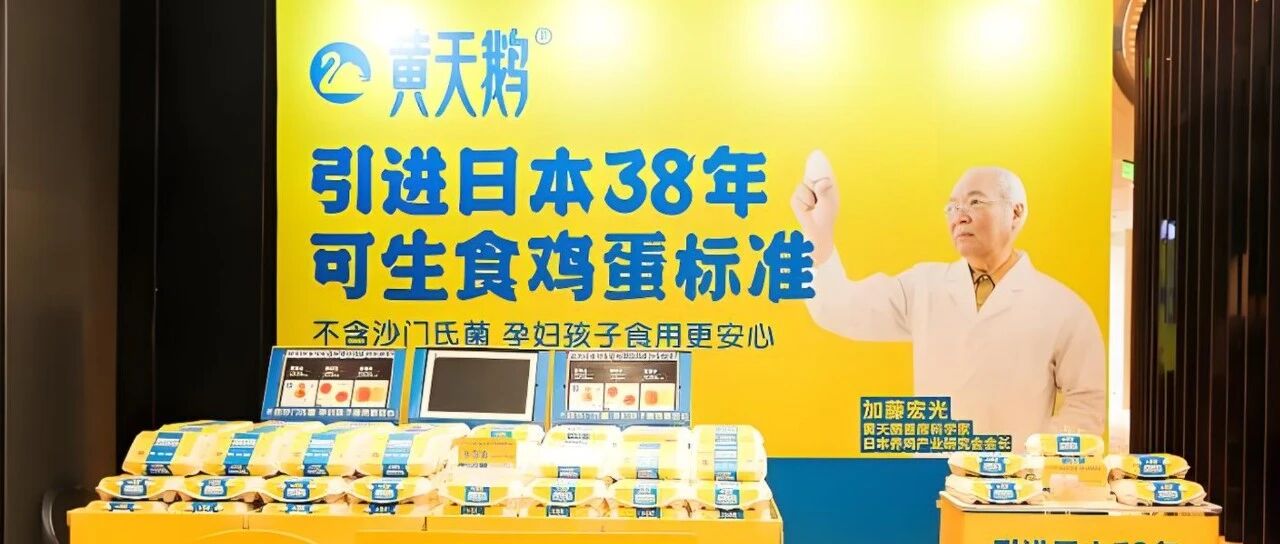
胖东来回应“鸡蛋被检出角黄素”!黄天鹅三问中国食品安全报社
Xin Lang Cai Jing· 2026-03-16 09:36
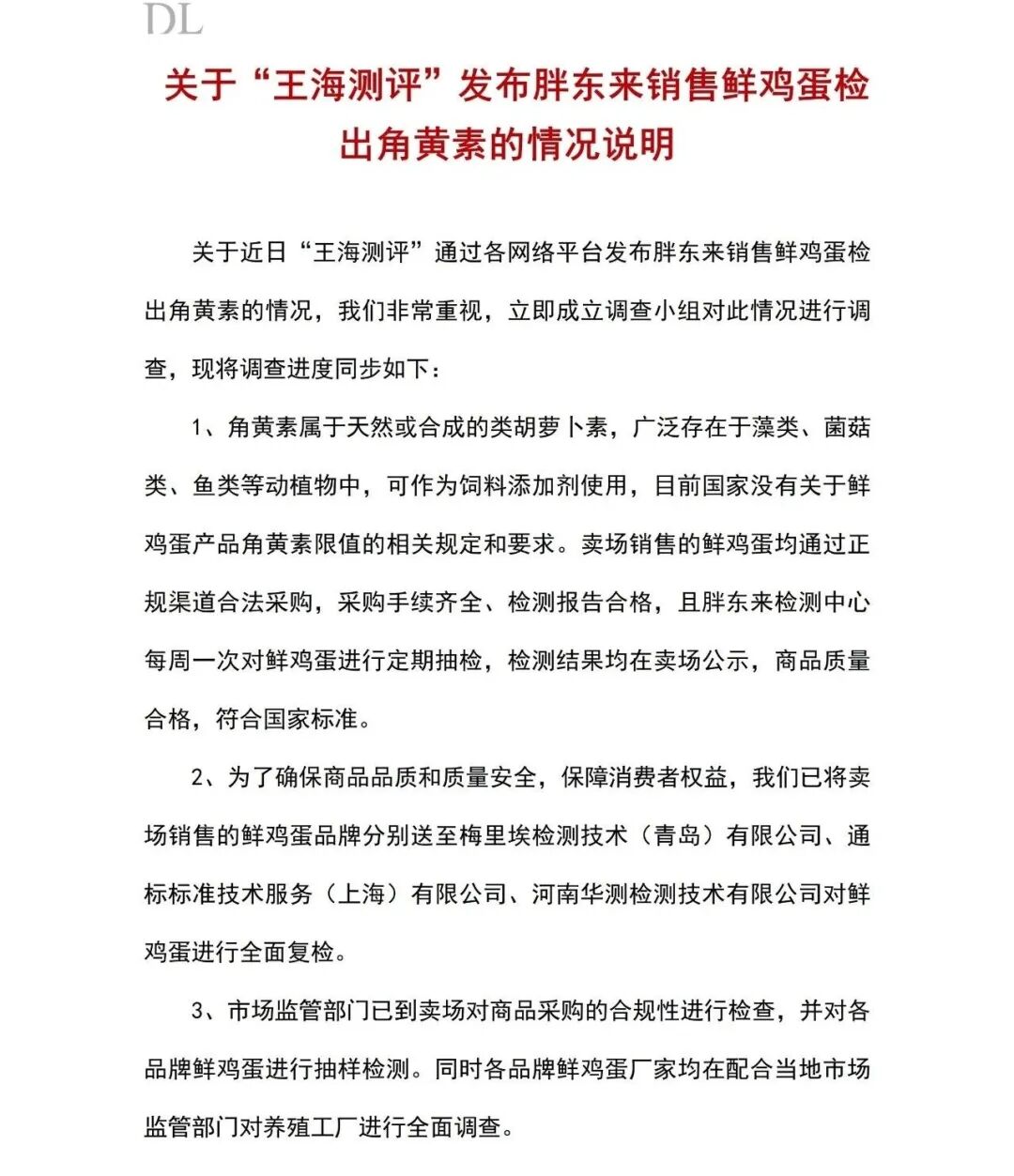
Core Viewpoint - The incident regarding the detection of canthaxanthin in eggs sold by Pang Donglai has raised significant public concern, prompting the company to conduct thorough investigations and clarify the situation regarding food safety standards and regulations [1][4][18]. Group 1: Company Response - Pang Donglai has established an investigation team to address the claims made by "Wang Hai Evaluation" regarding the detection of canthaxanthin in their eggs, emphasizing that there are currently no national regulations on canthaxanthin limits in fresh eggs [1]. - The company asserts that all eggs sold are sourced through legitimate channels with complete procurement documentation and pass regular inspections, with results publicly displayed [1]. - To ensure product quality and safety, Pang Donglai has sent samples of their eggs to multiple third-party testing companies for comprehensive retesting [1]. Group 2: Regulatory and Testing Actions - Market regulatory authorities have conducted compliance checks on the procurement of the eggs sold in stores and are performing random sampling tests on various brands of eggs [1]. - All egg manufacturers are cooperating with local regulatory bodies to conduct thorough investigations of their farming facilities [1]. Group 3: Clarifications from Competitors - Fengji Food Group, the parent company of Huang Tian E, has issued a statement clarifying that their eggs do not contain artificial colorants, asserting that canthaxanthin naturally occurs in various foods, including eggs and seafood [4][5]. - The detected level of canthaxanthin in Huang Tian E eggs is reported to be 0.399 mg/kg, which is considered to be within the natural background level and not indicative of artificial addition [5][7]. - Huang Tian E emphasizes their commitment to natural sourcing and has incurred significant costs for natural plant extracts, asserting that any artificial addition would be economically unfeasible [7][8]. Group 4: Legal Actions and Media Relations - Huang Tian E has sent a legal notice to media outlets regarding the dissemination of misleading information about their eggs, claiming that such reports have caused significant reputational damage and economic loss [10][12]. - The company has raised concerns about the media's lack of scientific rigor and ethical standards in reporting, particularly regarding the misinterpretation of canthaxanthin as solely an artificial additive [14][15][17]. - Huang Tian E has called for accountability from the media for spreading false information and has stated their intention to pursue legal action against those responsible for the misinformation [10][12][16].
胖东来、黄天鹅回应“鸡蛋被检出角黄素”
新华网财经· 2026-03-16 04:33
Core Viewpoint - The article discusses the controversy surrounding the detection of a substance called canthaxanthin in eggs sold by the company Pang Dong Lai, emphasizing the company's commitment to food safety and legal action against misinformation [1][3]. Group 1: Pang Dong Lai's Response - Pang Dong Lai stated that they are awaiting the results of investigations by market regulators and third-party testing regarding the canthaxanthin found in their eggs [1][2]. - The company clarified that canthaxanthin is a naturally occurring carotenoid and that there are no national regulations regarding its limits in fresh eggs [2][3]. - Pang Dong Lai conducts weekly inspections of their eggs, and all products are sourced legally with proper documentation [2][3]. Group 2: Third-Party Testing and Regulatory Actions - The company has sent their eggs for comprehensive retesting to multiple accredited laboratories to ensure product quality and safety [2][3]. - Market regulators have begun compliance checks on the sourcing of the eggs and are conducting sampling tests on various brands [2]. Group 3: Legal and Consumer Protection - Pang Dong Lai emphasized their commitment to consumer rights and stated that if the investigation reveals issues, they will promptly recall the products and take legal responsibility [1][3]. - Conversely, if the results are favorable, the company plans to pursue legal action against individuals and platforms spreading misinformation [1][3]. Group 4: Yellow Swan's Position - Yellow Swan, another egg producer, issued a statement asserting that their eggs do not contain artificial colorants and that the detected canthaxanthin levels are naturally occurring [4][5]. - The company highlighted that the detected level of canthaxanthin in their eggs is 0.399 mg/kg, which is below other reported values and within natural levels [6][7]. - Yellow Swan also mentioned that they invest significantly in natural colorant sources, making the addition of synthetic colorants economically unfeasible [6][7].

给AI投毒、漂白鸡爪......3·15晚会完整曝光;小米新一代SU7“靛石绿”实车进店;胖东来最新回应“鸡蛋人工色素超标”丨邦早报
创业邦· 2026-03-16 00:14
Group 1 - The 315 Gala highlighted various consumer rights violations, including food safety issues, fraudulent health claims, and misleading marketing practices [1][2][4] - Companies involved in food safety violations include Shufu Xiang, Mingyang Food, and Zengqiao Food, which were found using illegal substances in food processing [1] - The medical industry faces challenges with exosomes being misused in aesthetic treatments, leading to consumer harm, with companies like Haolin Biotechnology implicated [2] - Heightened complaints about height-increasing scams targeting youth and adults were reported, with companies like Deji Rui and Yingruike involved in deceptive practices [2] - Elderly consumers are being targeted by illegal marketing practices, with companies like Dahong International and Shengwei Cultural Media selling overpriced health products [2] - E-bike safety regulations are being violated, with companies like Hello Rent and Heiknight Tribe found to be renting out bikes exceeding speed limits [2] - The rise of AI manipulation in marketing was noted, with a software called GEO being used to artificially boost product visibility [2] - Financial technology firms are engaging in stock recommendation scams, with companies like Tianshun Investment and Xinbenke implicated [2] Group 2 - Pang Donglai responded to allegations of excessive levels of a feed additive in eggs, asserting compliance with safety standards and undergoing third-party testing [3] - Huang Tian'e denied claims of artificial additives in their eggs, stating that detected levels of carotenoids are naturally occurring and within acceptable limits [3] - The Ministry of Industry and Information Technology named Yipao Recruitment for misleading users into providing personal information [4] - Multiple apps, including Yipao Recruitment and others, were reported for violating user privacy by collecting personal data without consent [5] - Liu Wenxiang's hotpot chain faced scrutiny for mislabeling food products, leading to regulatory actions against several locations [6] - A court ruled against a seller for using AI-generated images without disclosure, resulting in a compensation order [7] - Xiaomi's home appliance division aims to improve product quality perception and plans to eliminate suppliers who cannot meet standards [7] - Li Auto reported a 97.5% completion rate for a battery recall, emphasizing the importance of safety [7] - BYD's Brazilian factory secured orders for 100,000 vehicles from Argentina and Mexico, marking significant expansion in the Latin American market [8] - The first humanoid robot 4S store opened in Zhengzhou, indicating growth in the robotics sector [8] - Songyan Power aims to dominate the humanoid robot market with a target of over 60% market share in three years [10] - Meta plans to cut 20% of its workforce to reduce costs and improve efficiency amid significant investments in AI infrastructure [11] - The Game Developers Conference featured over 100 AI-related discussions, reflecting the growing interest in AI within the gaming industry [11] - Zhongke Tiansuan completed a significant financing round, indicating investor confidence in space intelligence computing [13] - MLTech raised $1.9 million to enhance its digital asset management platform, showcasing growth in the fintech sector [13] - Xiaomi announced the arrival of its new SU7 model, highlighting advancements in automotive design [18] - Lucid Group plans to launch a new midsize vehicle platform with a starting price below $50,000, aiming to expand its market presence [20]