
30年期固定抵押贷款

Search documents
How a war in the Middle East is hiking your mortgage rate in America
Yahoo Finance· 2026-03-26 15:53
Core Insights - The ongoing war in the Middle East has significantly increased mortgage rates in the U.S., exacerbating an already challenging housing market [1][3] - The 30-year fixed mortgage rate has risen to 6.43%, marking a 30 basis point increase from the previous month and the highest level since October 2025 [2] - Elevated oil prices due to the conflict are contributing to the rise in mortgage rates, as they keep Treasury yields high, which in turn affects mortgage rates [3] Housing Market Conditions - The U.S. housing market was already under strain from a severe housing shortage and job market concerns prior to the war [4] - Zillow's CEO indicated that no short-term relief is expected for homebuyers, suggesting prolonged difficulties in the housing market [4] - The increase in mortgage rates has also negatively impacted refinance demand, with refinance applications dropping by 15% from the previous week [4] Economic Implications - The war's impact extends beyond mortgage rates, affecting energy and commodity prices, which could lead to increased inflation [5] - Gas prices have surged to a national average of just under $4 per gallon, reflecting the broader economic strain [5] - Some economists are warning of potential stagflation as a result of these economic pressures [5]
美国30年期抵押贷款平均利率三年半来首次跌破6%!经济学家“泼冷水”:住房供应短缺仍掣肘楼市复苏
智通财经网· 2026-02-27 06:51
Group 1: Mortgage Rates and Housing Market - The average 30-year mortgage rate in the U.S. has fallen below 6% for the first time in three and a half years, currently at 5.98%, down from 6.01% last week and significantly lower than 6.76% a year ago [1][4] - Economists suggest that the drop in mortgage rates may be temporary and that an increase in housing supply is necessary to significantly boost housing demand [1][4] - The shortage of available homes, particularly for first-time buyers, continues to challenge the housing market, with inventory levels for existing homes remaining below pre-pandemic levels [4] Group 2: Economic and Political Context - The U.S. housing market has become a sensitive political issue, with President Trump facing pressure to address living costs ahead of the November midterm elections [4] - Trump has proposed measures to improve housing affordability, including directing the Federal Housing Finance Agency to purchase $200 billion in mortgage-backed securities [4] - Economists express skepticism about whether these mortgage purchases will significantly improve housing affordability [4] Group 3: Market Reactions and Company Performance - The decline in mortgage rates has led to an increase in refinancing activity, with some banks reporting a nearly 22% year-over-year increase in mortgage applications [5] - However, home improvement retailer Lowe's comments about ongoing pressures from interest rates and economic uncertainty have negatively impacted the stock prices of housing-related companies, with Lowe's stock dropping 5.6% [6] - Other companies in the housing sector, such as Lennar and D.R. Horton, also experienced significant stock declines, reflecting broader concerns about consumer confidence and housing turnover rates [6]


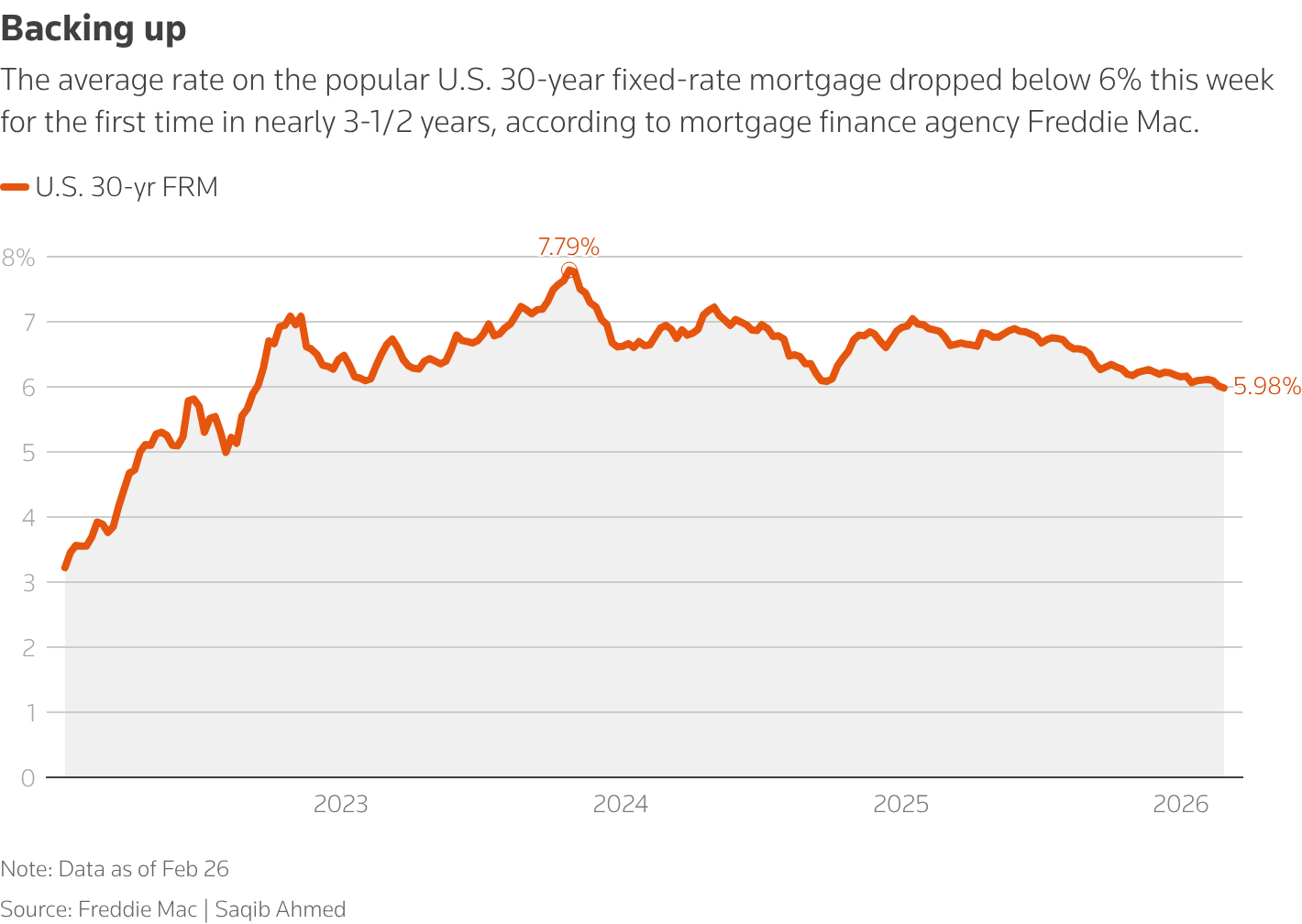
美国30年期贷款利率三年多来首次降至6%以下
Zhong Guo Xin Wen Wang· 2026-02-27 02:48
Group 1 - The average rate for a 30-year fixed mortgage in the U.S. has dropped to 5.98%, marking the first time it has fallen below 6% since September 8, 2022 [1] - The mortgage rate has decreased for three consecutive weeks, down from 6.01% a week prior and 6.76% a year ago [1] - The decline in mortgage rates is attributed to the Federal Reserve's interest rate cuts last year, which have led to an overall downward trend in mortgage rates since the second half of last year [1] Group 2 - The decrease in mortgage rates is expected to enhance the purchasing power of potential homebuyers, which is seen as positive news for the real estate market [1] - An increase in mortgage applications by 0.4% has been reported, indicating a potential uptick in market activity [1] - The U.S. real estate market has been in a downturn since 2022 due to high mortgage rates, with projected home sales for 2025 expected to be the lowest since 1995 at 4.06 million units [2]
美国30年期贷款利率降至6.01% 创三年多来最低值
Zhong Guo Xin Wen Wang· 2026-02-20 00:48
Group 1 - The average interest rate for a 30-year fixed mortgage in the U.S. has dropped to 6.01%, the lowest since September 8, 2022 [1] - This rate decreased from 6.09% a week ago and from 6.85% a year ago, indicating a significant decline [1] - The last time the rate was below 6% was on September 8, 2022, when it was 5.89% [1] Group 2 - The decline in mortgage rates is influenced by the Federal Reserve's interest rate cuts and the yield on 10-year U.S. Treasury bonds [1] - Despite the decrease in mortgage rates, the real estate market remains sluggish, with existing home sales in January down 8.4% month-over-month and 4.4% year-over-year, falling short of market expectations [1] - Analysts predict an increase in home sales this spring due to lower mortgage rates, rising inventory of homes for sale, and warmer weather [1] Group 3 - The Mortgage Bankers Association reported a 2.8% increase in mortgage applications this week, which includes both home purchase loans and refinancing of existing mortgages [2]
美国上周MBA抵押贷款申请活动指数降至330.8
Jin Rong Jie· 2026-02-04 13:07
Core Insights - The average 30-year fixed mortgage rate in the U.S. decreased to 6.21% for the week ending January 30, down from 6.24% previously [1] Mortgage Activity Summary - The MBA mortgage purchase index for the week ending January 30 was reported at 165.4, a decline from the previous value of 193.3 [1] - The MBA mortgage application activity index stood at 330.8, down from 363.3 in the prior week [1] - The MBA refinancing activity index was recorded at 1269.7, a decrease from the previous figure of 1332.2 [1]
特朗普推2000亿房改施压美联储换帅 美房产库存较疫情前低20%仍缺400万套
Sou Hu Cai Jing· 2026-01-28 05:44
Group 1 - The core viewpoint of the articles highlights the ongoing challenges in the U.S. housing market, including high prices and low inventory, exacerbated by government interventions and Federal Reserve policies [1][2] - President Trump criticized Federal Reserve Chairman Powell for maintaining high interest rates and announced plans to appoint a new chairman, while also implementing measures to influence the housing market [1] - The Federal Housing Finance Agency reported a 0.6% month-over-month increase and a 1.9% year-over-year increase in national home prices, with significant regional disparities in price changes [1] Group 2 - The current housing inventory in the U.S. is only four months of sales, which is below the six-month market equilibrium point, indicating a persistent shortage of approximately 4 million homes [2] - The average interest rate for a 30-year fixed mortgage is currently 6.09%, having decreased from 8.0% two years ago, following government actions to purchase $200 billion in mortgage loans [2] - Analysts noted that the consumer price index is expected to rise by 2.7% from June 2024 to June 2025, outpacing the 1.9% increase in home prices, which raises concerns about housing affordability amid high interest rates [2]
美联储换帅在即,特朗普版‘房改’能否奏效
Di Yi Cai Jing· 2026-01-28 05:21
Group 1: Government Actions and Market Response - The Trump administration has implemented measures to lower housing costs, including ordering Fannie Mae and Freddie Mac to purchase $200 billion in mortgage-backed securities and limiting large institutional investors from buying single-family homes [1] - The Federal Housing Finance Agency (FHFA) reported a 0.6% month-over-month increase and a 1.9% year-over-year increase in national home prices as of November 2025 [1] - Economic experts believe that the recent government measures are unlikely to provide lasting relief to the housing market, as they address short-term issues rather than long-term structural problems [1] Group 2: Housing Inventory and Price Trends - The current housing inventory in the U.S. is at a four-month sales level, which is below the six-month balance point, and is 20% lower than pre-pandemic levels [2] - There is a persistent shortage of 4 million homes in the U.S., indicating a long-term supply-demand imbalance that is expected to continue driving up home prices [2] - The average rate for a 30-year fixed mortgage is currently at 6.09%, down from a peak of 8.0% two years ago [2] Group 3: Economic Factors and Predictions - Economists predict that if mortgage rates drop to 5.5%, it could significantly impact the market by encouraging first-time homebuyers and alleviating the "lock-in effect" for homeowners with high-rate mortgages [4] - Predictions for mortgage rates in 2026 suggest they could fall to between 5% and 5.5%, potentially accelerating home price increases by 2% to 5% [5] - Various real estate platforms have differing forecasts for home price increases in 2026, with Realtor.com predicting a 2.2% increase and Zillow forecasting a 2.1% increase [5] Group 4: Regional Market Dynamics - The U.S. housing market is fragmented, with significant regional differences in affordability and supply-demand dynamics [6][7] - Cities like Chicago, New York, and Cleveland have seen the highest year-over-year price increases, while cities like Phoenix, Dallas, and Tampa have experienced declines [7] - Dallas is highlighted as a potential investment hotspot due to its rapid population growth and economic development, including the establishment of the Texas Stock Exchange [8]
美联储换帅在即 特朗普版“房改”能否奏效?
Di Yi Cai Jing· 2026-01-28 04:54
Core Viewpoint - The Trump administration has implemented measures aimed at reducing housing costs, including ordering Fannie Mae and Freddie Mac to purchase $200 billion in mortgage-backed securities and limiting large institutional investors from buying single-family homes. However, these actions are viewed as short-term solutions rather than addressing the underlying structural issues in the housing market [1][3]. Group 1: Housing Market Trends - As of November 2025, U.S. home prices increased by 0.6% month-over-month and 1.9% year-over-year, with significant regional variations in price changes [1]. - The current housing inventory in the U.S. is at a 4-month sales level, which is below the 6-month balance point, and 20% lower than pre-pandemic levels in 2019, indicating a persistent shortage of 4 million homes [2]. - The average rate for a 30-year fixed mortgage is currently 6.09%, down from a peak of 8.0% two years ago, following a significant drop in rates after the announcement of the $200 billion mortgage purchase [2][5]. Group 2: Economic Factors Influencing Housing - The Federal Housing Finance Agency (FHFA) reported that the Pacific Coast region saw a 0.4% decline in home prices over the past year, while the Northeast Central region experienced the highest annual increase at 5.1% [1]. - Economic conditions, including inflation, have led to a decrease in purchasing power for average consumers, impacting their ability to buy homes despite some areas experiencing price increases [3]. - Analysts predict that if mortgage rates drop to around 5.5%, it could significantly impact the market by encouraging first-time homebuyers and alleviating the "lock-in effect" for current homeowners [4]. Group 3: Regional Market Dynamics - The U.S. housing market is fragmented, with varying affordability and supply-demand dynamics across different regions. The Northeast and Midwest face tight inventory and construction constraints, while the South and West are experiencing affordability pressures despite more active building [6][7]. - Cities like Chicago, New York, and Cleveland have seen the highest year-over-year price increases, while cities such as Phoenix, Dallas, and Tampa have experienced declines [7]. - Dallas is highlighted as a potential investment hotspot due to its rapid population growth and economic development, including the establishment of the Texas Stock Exchange [8].
美联储换帅在即,特朗普版“房改”能否奏效
第一财经· 2026-01-28 04:31
Core Viewpoint - The article discusses the recent measures taken by the Trump administration to lower housing costs in the U.S., including the purchase of $200 billion in mortgage bonds by Fannie Mae and Freddie Mac, and the restriction on large institutional investors from buying single-family homes. However, experts believe these measures are short-term solutions and do not address the underlying structural issues in the housing market [3][4]. Group 1: Housing Market Trends - As of November 2025, U.S. home prices increased by 0.6% month-over-month and 1.9% year-over-year, with significant regional variations in price changes [3]. - The Pacific Coast region saw a 0.4% decline in home prices over the past year, while the Northeast Central region experienced the highest annual increase at 5.1% [3]. - The current housing inventory in the U.S. is at a 4-month sales level, which is below the 6-month balance point, indicating a persistent shortage of approximately 4 million homes [4]. Group 2: Interest Rates and Mortgage Trends - The average rate for a 30-year fixed mortgage is currently at 6.09%, down from a peak of 8.0% two years ago, following Trump's announcement to purchase $200 billion in mortgages [5]. - Economists suggest that if mortgage rates drop to 5.5%, it could significantly impact the market by encouraging first-time homebuyers and alleviating the "lock-in effect" for current homeowners [7]. - Predictions indicate that mortgage rates could fall to between 5% and 5.5% in 2026, potentially accelerating home price increases by 2% to 5% [8]. Group 3: Regional Market Dynamics - The U.S. housing market is fragmented, with varying affordability and supply-demand dynamics across different regions. The Northeast and Midwest face inventory constraints, while the South and West are experiencing affordability pressures despite more active construction [10][11]. - Cities like Chicago, New York, and Cleveland saw the highest year-over-year price increases, while cities such as Phoenix, Dallas, and Tampa experienced declines [11]. - Dallas is highlighted as a potential hotspot for real estate investment in 2026, driven by its status as a major financial center and significant population growth [12].

美国上周MBA抵押贷款申请活动指数升至397.2
Xin Lang Cai Jing· 2026-01-21 12:21
Core Insights - The average 30-year fixed mortgage rate in the U.S. decreased to 6.16% for the week ending January 16, down from 6.18% previously [1] - The MBA mortgage application activity index rose to 397.2, an increase from the previous value of 348 [1] - The MBA mortgage purchase index increased to 194.1, up from 184.6 [1] - The MBA mortgage refinancing activity index surged to 1580.8, compared to the prior value of 1313.1 [2] Group 1 - The average 30-year fixed mortgage rate is now at 6.16%, indicating a slight decrease [1] - The mortgage application activity index has shown a significant increase, reflecting heightened activity in the mortgage market [1] - The mortgage purchase index has also risen, suggesting an uptick in home buying activity [1] Group 2 - The refinancing activity index has experienced a notable increase, indicating more homeowners are refinancing their mortgages [2]