
3D视觉感知技术

Search documents
春节前公募基金密集调研机器人概念股
Huan Qiu Wang· 2026-02-20 02:01
Group 1 - The core focus of public funds is shifting towards the robotics industry chain, with multiple institutions conducting intensive research to uncover potential investment opportunities ahead of the new year [1][2] - Multiple public funds, including 嘉实基金, 易方达基金, and 宝盈基金, participated in a joint research on 多利科技, which is advancing in the robotics sector through a recent acquisition of 70% stake in 悍猛传动 [1] - 奥比中光, a leader in 3D visual perception technology, is also a popular subject of public fund research, with 15 institutions participating in discussions about its accelerating technology implementation in the robotics and AI vision sectors [1] Group 2 - Other companies in the robotics industry chain, such as 绿的谐波, 步科股份, and 汇川技术, have also been frequently appearing in public fund research lists, indicating strong institutional interest in the long-term potential of the robotics sector [2] - The recent activity in the robotics sector is not merely driven by seasonal sentiment, as evidenced by a surge in sales of high-end robots following the Spring Festival Gala, indicating a shift from concept to actual market demand [2] - Analysts believe that the concentrated research by public funds on the robotics industry chain reflects both a response to short-term market trends and a long-term bet on the industry's growth potential, driven by demographic changes and manufacturing upgrades [2]



10万亿!超越京沪,中国“第一城”易主了
首席商业评论· 2025-12-19 03:44
Core Viewpoint - Shenzhen has officially become China's "first city" for specialized and innovative "little giant" enterprises, surpassing Beijing and Shanghai in both quantity and quality of these companies, marking a significant milestone in its economic development [7][24]. Group 1: Achievements of Shenzhen - By the end of 2025, Shenzhen will have 1,333 "little giant" enterprises, leading the nation, with Beijing at 1,210 and Shanghai at 1,032 [7]. - The total market value of these enterprises is estimated to be close to 10 trillion yuan, showcasing their substantial economic impact [7]. - Shenzhen's "little giant" enterprises are concentrated in key areas of national focus, such as "manufacturing power" and "strengthening supply chains," with high entry barriers [7]. Group 2: Growth and Innovation - Shenzhen's "little giant" enterprises exhibit remarkable growth, with an average establishment time of 13 years to reach national recognition, which is 1.71 years faster than the national average [11]. - These companies have a high average R&D intensity of 7.63%, with annual R&D expenditures averaging 33.39 million yuan, significantly above the national average [11]. - The average number of patents filed by these enterprises is 152, with nearly 30% involved in setting international or national standards [11]. Group 3: Strategic Initiatives - Shenzhen's "20+8" industrial cluster strategy serves as a core engine for nurturing "little giant" enterprises, providing a clear industrial direction and reducing strategic ambiguity for startups [13][18]. - The government facilitates collaboration between large and small enterprises through mechanisms like "chain leader" and "chain master" systems, enhancing overall industry competitiveness [16]. - A robust market support system combines effective market access with proactive government involvement, enabling local products to be tested and iterated within the local market before global expansion [18]. Group 4: Financial Support - Shenzhen has pioneered a "bold capital" approach, allowing for long-term investments in innovative projects, particularly in high-tech sectors, to help companies navigate critical growth phases [19]. - The city has established four major equity investment platforms to support the development of innovative enterprises, with significant investments made in national-level "little giant" companies [19]. Group 5: Future Prospects - Achieving the title of "first city" is seen as a new starting point for Shenzhen, indicating a stronger industrial foundation and a pathway for future economic growth [24]. - The success of these "little giants" is expected to lead to the emergence of world-class enterprises, contributing to Shenzhen's sustained high-quality economic development [24]. - Shenzhen's model of nurturing innovation and industry collaboration is viewed as a replicable framework for other regions in China to build modern industrial systems [24].


10万亿!超越京沪,中国“第一城”易主了
Qian Zhan Wang· 2025-12-12 04:33
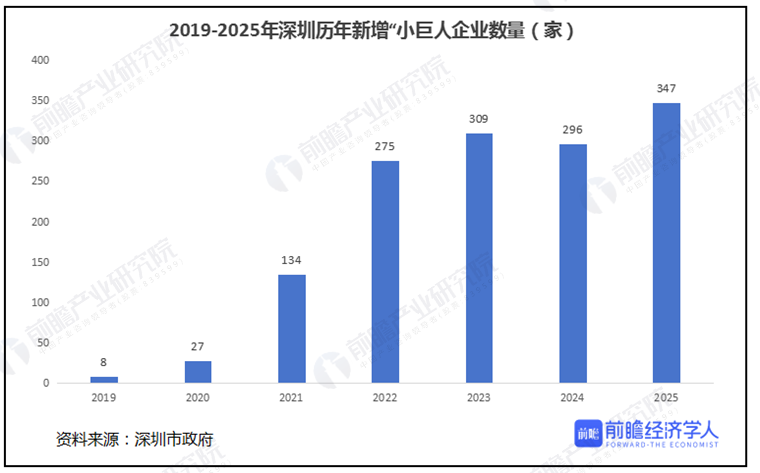
Core Viewpoint - Shenzhen has officially become China's "first city" for specialized and innovative "little giant" enterprises, surpassing Beijing and Shanghai in quantity and economic value [2][3][19]. Group 1: Overview of "Little Giants" - By the end of 2025, Shenzhen will have 1,333 "little giant" enterprises, leading the nation with 347 new additions, compared to Beijing's 1,210 and Shanghai's 1,032 [2][3]. - The total market value of these enterprises is estimated to be close to 10 trillion yuan, based on an average market value of 71 million yuan per listed "little giant" [3][8]. - These enterprises are concentrated in key areas of national focus, such as "manufacturing power" and "strengthening supply chains," with high entry barriers requiring domestic leadership in niche sectors and significant R&D investment [3][8]. Group 2: Growth and Innovation - Shenzhen's "little giants" exhibit remarkable growth, with an average time of 13 years from establishment to becoming a national-level "little giant," which is 1.71 years faster than the national average [8]. - The average R&D intensity of these enterprises is 7.63%, with annual R&D expenditure averaging 33.39 million yuan, significantly higher than the national average [8][19]. - These companies are also active in patent applications, averaging 152 patents per enterprise, with nearly 30% involved in setting international or national standards [8][19]. Group 3: Ecosystem and Support - Shenzhen's "20+8" industrial cluster strategy serves as a core engine for nurturing "little giant" enterprises, providing a structured ecosystem for growth and collaboration [9][10]. - The government facilitates connections between large and small enterprises through mechanisms like "chain leader" and "chain master" systems, resulting in over 500 technical cooperation agreements in 2024 alone [12][14]. - The city combines effective market strategies with government support, creating a comprehensive market support system that includes local validation and global expansion initiatives [14][15]. Group 4: Financial Support - Shenzhen has developed a "bold capital" approach to support innovative enterprises, allowing for long-term investments in high-tech sectors despite initial project risks [16][19]. - The city has established four major equity investment platforms to back innovative enterprises, with significant investments in numerous "little giants" [16][19]. Group 5: Future Implications - Achieving the title of "first city" for specialized and innovative enterprises marks a new starting point for Shenzhen, strengthening its industrial foundation and enhancing its resilience against global market fluctuations [19][20]. - The pathway from "little giants" to potential global leaders indicates a clear trajectory for future economic growth, with these enterprises expected to contribute significantly to Shenzhen's high-quality development [19][20].

奥比中光:长期专注于3D视觉感知技术领域
Zheng Quan Ri Bao Wang· 2025-12-04 11:14
Core Viewpoint - The company, Orbbec, has been focusing on 3D visual perception technology since its establishment, addressing diverse application needs through a comprehensive layout of various 3D visual perception technologies [1] Group 1: Technology Focus - The company has developed six major 3D visual perception technology routes: structured light, iToF (indirect Time of Flight), binocular, dToF (direct Time of Flight), Lidar, and industrial 3D measurement [1]
奥比中光科技集团股份有限公司2025年前三季度业绩预告的自愿性披露公告
Shang Hai Zheng Quan Bao· 2025-10-16 21:14
Group 1 - The company expects to achieve an operating income of approximately 714 million yuan for the first three quarters of 2025, representing a year-on-year increase of about 103.50% [3] - The net profit attributable to the parent company for the same period is projected to be around 107.5 million yuan, marking a significant turnaround from a loss in the previous year [3] - The net profit after deducting non-recurring gains and losses is estimated to be about 63.5 million yuan, also indicating a substantial improvement compared to the previous year's loss [3][5] Group 2 - The growth in performance is attributed to the continuous improvement of the upstream 3D visual perception industry chain and the accelerated expansion of downstream application scenarios [6] - The company has successfully turned around its operating profit due to effective cost control and enhanced operational efficiency [6] - The demand for smart terminal markets is expanding, and the company is expected to leverage its technological advantages to drive further profit growth and business structure upgrades [6] Group 3 - The company plans to hold a performance briefing on October 31, 2025, to discuss the third-quarter results and address investor inquiries [12][14] - Investors can submit questions from October 24 to October 30, 2025, for discussion during the briefing [13][16] - The briefing will be conducted online, allowing for interactive communication between the company and investors [15][16]
奥比中光前三季度净利同比实现扭亏为盈
Zheng Quan Ri Bao Zhi Sheng· 2025-10-16 12:43
Core Viewpoint - The company, Orbbec Technology Group, anticipates significant growth in its financial performance for the first three quarters of 2025, with a projected revenue increase of over 103% year-on-year, marking a successful turnaround from losses to profitability [1][2]. Financial Performance - The company expects to achieve a revenue of 714 million yuan for the first three quarters, up from 351 million yuan in the same period last year, representing an increase of approximately 363 million yuan and a year-on-year growth of about 103.50% [1]. - The projected net profit attributable to the parent company is 108 million yuan, a turnaround from a loss of 60 million yuan in the previous year, indicating an increase of approximately 168 million yuan [1]. - The net profit after deducting non-recurring gains and losses is expected to be 64 million yuan, compared to a loss of 101 million yuan in the same period last year, reflecting a growth of approximately 165 million yuan [1]. Business Growth Drivers - The significant revenue growth is attributed to multiple factors, including accelerated business expansion in areas such as 3D scanning, payment verification, and various robotics applications [2]. - Efficiency and cost optimization through comprehensive value chain cost control have notably enhanced research and development and operational efficiency [2]. - The company possesses strategic advantages in the 3D visual perception industry, with steadily released production capacity in intelligent manufacturing, further solidifying its technical barriers and scale effects [2]. Market Outlook - The company plans to strengthen the integration of technology and market, accelerating the conversion of technological advantages into market advantages [3]. - Future initiatives include continuous technological iteration and penetration into high-growth scenarios such as various robotics, AI edge hardware, and AR/VR fields [3]. - The company aims to create an open and shared AI intelligent terminal ecosystem, collaborating with upstream and downstream partners in the industry chain to rapidly respond to incremental market demands [3].
具身智能产业亿元级订单频现,重点关注产业链龙头奥比中光、柯力传感
Tianfeng Securities· 2025-10-12 13:50
Investment Rating - Industry rating is maintained at "Outperform the Market" [5] Core Insights - The emergence of billion-level orders in the embodied intelligence sector indicates accelerated commercialization, with significant contracts signed recently, including a multi-billion yuan framework order for the ZhiYuan Spirit G2 robot and a record-breaking 260 million yuan project with ShiHua Cultural Tourism [1][2] - The rapid expansion of the market is supported by strategic collaborations among listed companies and local policies, with the Chinese embodied intelligence market expected to reach 5.295 billion yuan by 2025, accounting for approximately 27% of the global market [2] - The industry is witnessing a systematic leap, driven by technological breakthroughs and supportive policies, solidifying China's leading position in the global robotics industry [2] Company Summaries - **Aobi Zhongguang**: A leading company in 3D visual perception, deeply partnered with Microsoft and Nvidia, holding over 70% market share in domestic service robot visual sensors [3] - **Keli Sensor**: A leading manufacturer of strain sensors, with a complete product series developed for humanoid robots, mastering key technologies such as structural decoupling and high-speed sampling communication [3]

英伟达机器人“新大脑”即将揭晓,重点关注产业链龙头奥比中光、柯力传感
Tianfeng Securities· 2025-08-24 14:15
Investment Rating - Industry Rating: Outperform the market (maintained rating) [5] Core Insights - Nvidia is set to unveil its new "brain" for robotics on August 25, which is expected to enhance humanoid robot technology and lead to a surge in domestic robot industry orders [1] - The global humanoid robot industry is anticipated to expand significantly, driven by advancements in physical AI, with Nvidia's developments potentially unlocking a trillion-dollar market [1] - The Shanghai government has released an implementation plan to accelerate the practical deployment of humanoid robots in manufacturing, aiming for 3,000 companies to adopt intelligent applications within three years [2] Summary by Sections Industry Overview - The humanoid robot sector has seen a notable increase in demand, with over 83 publicly disclosed projects in the first half of 2025, totaling nearly 330 million yuan in contracts, a significant rise from the previous year [1] - Major companies like Ubtech, Yushun Technology, and Zhiyuan Robotics dominate the market, collectively accounting for over 60% of the total contract value [1] Key Companies to Watch - **Aobi Zhongguang**: A leading company in 3D visual perception with over 70% market share in domestic service robot visual sensors, closely partnered with Microsoft and Nvidia [3] - **Keli Sensor**: A top domestic strain sensor manufacturer, specializing in the development of sensors for humanoid robots, having completed product series for various robotic applications [3]

奥比中光-UW股价下跌3.01% 新品发布在即引关注
Jin Rong Jie· 2025-07-30 19:32
Group 1 - The stock price of Aobo Zhongguang-UW closed at 69.69 yuan on July 30, 2025, down by 2.16 yuan, a decline of 3.01% from the previous trading day [1] - The opening price was 71.15 yuan, with a highest point of 72.37 yuan and a lowest point of 69.32 yuan, with a trading volume of 80,500 lots and a transaction amount of 568 million yuan [1] - Aobo Zhongguang-UW is focused on the research and application of 3D vision perception technology, with products widely used in robotics, smart home, and security sectors [1] Group 2 - The company is headquartered in Guangdong and is a key focus for institutional investors [1] - Aobo Zhongguang announced the launch of three new products on August 8 at the 2025 World Robot Conference, aimed at providing more flexible visual solutions for various types of robots [1] - As of July 29, 22 fund companies conducted research on Aobo Zhongguang, indicating strong institutional interest in the company's development [1] Group 3 - On July 30, the net outflow of main funds was 110 million yuan, accounting for 0.54% of the circulating market value [1]