
AI面试点评

Search documents
华图山鼎实际控制人易定宏:AI部门投入预算不设上限 为公司带来的变革将超乎想象
Zheng Quan Shi Bao Wang· 2026-01-18 14:23
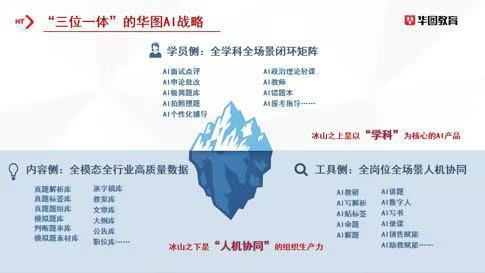
Core Viewpoint - Huatu Shanding is actively transforming its business model through AI, emphasizing that AI is essential for the education industry and is committed to an all-in approach to AI investment [2][4]. Group 1: AI Transformation Strategy - The company is advancing its AI transformation through three main paths: foundational tool development, product innovation, and diversified solutions [2]. - Huatu Shanding plans to implement 150 AI scenarios across teaching, research, and operations within the next two years, leveraging its "three-in-one" AI strategy [4]. - The company has established a dual-driven technical foundation with both public and proprietary models, integrating over 80 top domestic and international models [5]. Group 2: Cost Reduction and Efficiency Improvement - AI is driving transformation by reducing costs and increasing efficiency, with significant savings achieved through AI tools for scheduling and quality control [6][8]. - The company has pre-scheduled over 100,000 class hours using AI, resulting in a 40% reduction in overall class hours and saving millions in costs [8]. - AI's efficiency in generating exam questions has improved to ten times that of manual processes, and the cost of producing AI teaching videos has decreased to one-tenth of previous levels [8]. Group 3: New Growth Opportunities - The AI interview evaluation and AI essay correction products have shown remarkable performance, with the former achieving over one million uses within two months [9]. - AI-driven personalized learning solutions aim to provide each student with a dedicated AI teacher, enhancing the learning experience [10]. - The company is building a comprehensive data resource system, integrating over 160,000 hours of internal course transcripts and a vast array of external educational materials [11]. Group 4: Future Outlook - The company is committed to maintaining a leading position in AI education by continuously investing in cutting-edge technology and expanding its service ecosystem from exam preparation to career development [12].



“华图教育AI转型升级发布会”举办 开启教育AI新时代
Zheng Quan Ri Bao· 2026-01-18 14:11
Core Viewpoint - The transformation of the education industry driven by AI is no longer optional but essential, with Huatu Group committing to an all-in approach to AI integration, aiming to redefine educational boundaries and establish a robust competitive advantage in the AI-native era [1][2]. Group 1: AI Strategy and Implementation - Huatu Group's AI strategy is based on a "three-in-one" approach, planning to implement 150 AI scenarios across teaching, research, and operations within the next two years [4]. - The company emphasizes internal efficiency improvements through AI, which has become a critical engine for enhancing productivity in core areas such as teaching and operations [4][5]. - AI has significantly increased efficiency, with exam question generation becoming ten times faster and video production costs reduced to one-tenth of previous levels [5]. Group 2: Product Development and Market Impact - The AI products have shown strong market performance, with AI interview evaluation tools achieving over one million uses within two months and AI essay grading experiencing a 100% month-over-month growth in usage [5][6]. - Huatu has built a comprehensive data resource system, integrating over 160,000 hours of internal course transcripts and a vast array of external educational materials, enhancing the quality of AI-driven products [5][6]. Group 3: Diversification and Future Vision - The company aims to create a full-cycle service ecosystem that enhances both exam preparation and workplace skills, thereby breaking traditional educational limitations [6]. - Huatu's diversification strategy includes transforming high-cost training into standardized, scalable products, thus enabling dual revenue growth through increased scale and pricing [6]. - The future vision positions Huatu as a partner in continuous capability enhancement, evolving from a public examination training expert to a comprehensive educational service provider [6].
AI驱动!华图山鼎重构增长逻辑
Zhong Guo Zheng Quan Bao· 2026-01-18 11:47
Core Insights - Huatu's AI transformation is not just a technological upgrade but a reconstruction of its growth logic, marking a new phase driven by AI in the education ecosystem [1] Group 1: Tool-based Foundation - AI is being integrated as an internal efficiency engine, significantly reducing costs and enhancing productivity across core functions such as teaching, research, and operations [2] - The primary goal during this foundational phase is to enhance revenue-generating capabilities through efficiency improvements rather than merely cutting costs [2] - AI has already pre-scheduled over 100,000 class hours, saving approximately 40% in overall class hours and reducing costs by tens of millions, with potential for over 100 million in future optimizations [3] Group 2: Productization for Revenue - Productization is a critical breakthrough in Huatu's AI transformation, focusing on creating sustainable AI products that generate a second growth curve [4] - The "AI Interview Feedback" product has surpassed one million uses within two months, demonstrating rapid market acceptance and effectiveness [4] - The "AI Essay Correction" product has achieved a 100% month-over-month growth in usage for four consecutive months, with a total usage exceeding one million and a retention rate of 91% [4] Group 3: Diversified Breakthroughs - AI serves as a tool for business restructuring and ecosystem expansion, with three key directions for breakthrough: skill transfer for students, activation of business value, and AI companionship [5] - The transformation aims to convert high-cost, low-capacity training into low-cost, scalable standardized products, addressing the education industry's "impossible triangle" of quality, cost, and personalization [5] - The company plans to evolve its services from course offerings to a comprehensive model that includes AI products, hardware, and subscription services, potentially doubling or tripling user lifetime value [5][6] Group 4: AI Transformation Background - Huatu's commitment to AI is characterized by an "All in" approach, with no budget limits for its AI department, indicating a strong belief in the transformative potential of AI [7] - The company aims to implement 150 AI scenarios across teaching, research, and operations by 2025, supported by a robust foundation of high-quality data and intelligent tools [7][8] - Huatu has developed a dual-driven technology base with over 80 top domestic and international models, ensuring a comprehensive and innovative approach to AI integration [8] Group 5: Talent and Team - The company has assembled a team with deep industry knowledge and AI expertise, which is crucial for the rapid advancement of its AI initiatives [9] - The combination of academic background and practical experience within the team is seen as a key factor in Huatu's ability to successfully navigate its AI transformation [9]
华图山鼎实际控制人易定宏:AI部门投入预算不设上限,为公司带来的变革将超乎想象
Zheng Quan Shi Bao Wang· 2026-01-18 07:09
Core Viewpoint - Huatu Shanding is actively transforming its business model through AI, emphasizing that AI is essential for the education industry and is committed to an all-in approach to AI investment [1][3][11] Group 1: AI Transformation Strategy - The company has established a comprehensive AI transformation system through three main paths: tool-based foundation, product innovation, and diversified breakthroughs [1] - Huatu Shanding plans to implement 150 AI scenarios covering teaching, research, and operations within the next two years, leveraging its "three-in-one" AI strategy [3][4] - The company has built a dual-driven technical foundation with over 80 top domestic and international models, enabling rapid replication of diversified business [4] Group 2: Team and Expertise - A strong team has been assembled for the AI transformation, including professionals with academic backgrounds and practical experience in online education [5] - The team is expected to play a crucial role in achieving rapid breakthroughs in AI applications [5] Group 3: Cost Efficiency and Revenue Growth - AI is driving transformation by reducing costs and increasing revenue, with the potential to lower class hour costs significantly and expand the student base through intelligent recruitment [6][8] - The company has reported a 40% reduction in overall class hours and significant cost savings, with AI tools already pre-scheduling over 100,000 class hours [8] Group 4: Product Performance and Market Impact - AI products like AI interview feedback and AI essay correction have shown remarkable performance, with usage exceeding one million within two months for the interview product [9] - The AI essay correction product has achieved a 100% month-over-month growth in usage, indicating strong market demand [9] Group 5: Future Vision and Commitment - The company aims to create a comprehensive service ecosystem that extends from exam preparation to workplace readiness, breaking traditional educational ceilings [10] - Huatu Shanding is committed to maintaining a leading position in AI education by continuously investing in technology and innovation [11]
招商证券:升学就业驱动下教育需求稳固 行业供给端结构优化
智通财经网· 2025-12-24 03:29
Group 1 - The education market demand is characterized by strong anti-cyclical properties driven by pressures from further education and employment [1][2] - The "golden decade" for high school and related training markets is expected from 2024 to 2035 due to the "two-child" policy and "dragon baby" effect, providing a sustained population base for growth [2] - The number of candidates for the national civil service examination is projected to reach 3.416 million by 2025, with a year-on-year growth of 12.62% [2] Group 2 - The growth rate of non-academic profit-making licenses for off-campus training is gradually slowing, while academic licenses are continuing to shrink [3] - As of November, there were 98,208 non-academic profit-making licenses for the compulsory education stage, an increase of 3,480 licenses year-on-year [3] - A strategic cooperation between Huatu Shanding and online competitor Fenbi Technology is expected to alleviate intense price competition in the industry [3] Group 3 - AI+ education products are entering the implementation phase, with various companies launching AI-integrated educational tools [4] - Companies such as Dou Shen Education and Zhong Gong Education are introducing AI-driven products to enhance learning experiences [4] - The development of AI education platforms and tools is anticipated to improve the overall profitability of leading companies in the sector [4]

当考公遇上AI,粉笔能吸引用户付费吗?
3 6 Ke· 2025-11-28 07:58
Core Viewpoint - The rapid development of generative AI technology is transforming various industries, including education, where companies like Fenbi are increasingly investing in AI to enhance their offerings and respond to market demands [1][4][10]. Group 1: AI Development in Education - OpenAI launched a version of ChatGPT tailored for higher education, named GPT-edu, to provide personalized services for students and teachers [1]. - Domestic companies such as NetEase Youdao, TAL Education, and Fenbi have begun developing their own educational AI models, with Fenbi introducing AI teachers and question-answering systems [2][4]. - Fenbi's president announced a commitment to increase AI R&D investment by 30% annually and collaborate with top institutions to build an educational AI model laboratory [7]. Group 2: Market Dynamics and Competition - The public examination training market is facing intense competition, with Fenbi needing to enhance its product competitiveness through continuous investment in AI [4][29]. - Despite a high number of applicants for civil service exams, Fenbi's revenue and net profit have declined, indicating a challenging market environment [14][11]. - Fenbi's average monthly active users reached 9.3 million by June 30, but many users prefer more cost-effective options, impacting conversion rates to paid users [13]. Group 3: Financial Performance - Fenbi reported a revenue of 1.49 billion RMB for the first half of 2025, a decrease of 8.5% year-on-year, with net profit down 18.34% to 227 million RMB [14][15]. - Other major players in the public examination training sector, such as Zhonggong Education, also reported revenue declines, highlighting the competitive landscape [16][17]. Group 4: AI Product Performance - Fenbi's AI question-answering system has shown initial commercial success, with approximately 50,000 sales and revenue of around 20 million RMB [20]. - The AI question-answering system reportedly improved user learning efficiency by 29% to 40%, with average mock exam scores increasing by 15 to 20 points [24]. - The AI interview evaluation tool has seen significant engagement, with 470 million evaluations conducted and 350,000 users participating [26]. Group 5: Challenges and Future Outlook - Despite the promising start, AI has not yet significantly reduced costs or improved Fenbi's financial performance, as the company attributes cost reductions to overall revenue declines [27]. - Fenbi faces competition not only from other training institutions but also from AI model companies that offer free or lower-cost alternatives [35]. - The company must continue to innovate and provide effective, user-friendly AI products to capture market share and meet user expectations [36].

华图山鼎:公司高度重视AI领域的布局
Zheng Quan Ri Bao Wang· 2025-11-24 07:44
Core Viewpoint - The company emphasizes its strategic focus on the AI sector, developing a range of AI products to enhance educational training and operational efficiency [1] Group 1: AI Product Development - The company has identified key areas in AI, including AI interview evaluation, AI essay grading, AI personalized tutoring, AI simplified question banks, and AI photo-based question searching [1] - These AI products cover the entire learning scenario of student training, including learning, practice, assessment, and evaluation [1] Group 2: Operational Efficiency - The AI interview evaluation has been scaled for use in teaching, research, and teacher training, significantly improving product delivery efficiency [1] - The implementation of these AI solutions is aimed at reducing costs and increasing operational efficiency [1] Group 3: Market Reach - By the first half of 2025, the company's AI interview evaluation will have reached over 10,000 students across more than 30 provinces and cities nationwide [1]
华图山鼎(300492) - 投资者关系活动记录表
2025-11-24 00:52
Group 1: Company Overview and Expansion Plans - The Mogan Mountain base was planned in June 2025 with an initial capacity of 300 people, which expanded to 500 within a month due to high demand [1] - The base currently has a total area of approximately 4,000 square meters, with 13 classrooms and 2 self-study rooms, accommodating 1,370 students, and future plans aim for a total capacity of 1,550 [2] - The company plans to establish over 320 bases nationwide, with a target of launching more than 70 bases in 2025, aiming for an average of one new base per week [4] Group 2: Market Strategy and Product Offerings - The main product for non-degree training is the "Direct Train" program, which integrates resources through a subject-based teaching model, enhancing operational efficiency [5][6] - The company is focusing on high-quality "product + delivery" investments to meet the changing demands of students, particularly in lower-tier cities [3] - The "Direct Train" product is promoted through a three-pronged strategy: new projects will primarily offer this product, existing short-term courses will be replaced, and all branches will transition to this product [9] Group 3: AI Integration and Competitive Positioning - The company has developed a matrix of AI products, including AI interview feedback and personalized tutoring, which are applied across various learning scenarios, significantly improving delivery efficiency [7] - The competitive landscape is shifting towards larger institutions, with the company relying on three core strategies for differentiation: regional operations in lower-tier cities, focus on the "Direct Train" product, and deep integration of AI technology [8] - The company plans to launch a membership-based AI product package in 2026, aimed at expanding brand influence and driving traffic to offline bases [9]
AI成公考备考“新教练”?多家辅导机构布局AI辅助新赛道
Nan Fang Du Shi Bao· 2025-11-11 11:18
Core Insights - The education industry is entering an AI-assisted era, with major tutoring institutions actively investing in AI applications for exam preparation [1] - Huatu Education recently held an AI strategy conference in Beijing, showcasing its comprehensive AI strategic planning and product development [1] Group 1: AI Strategy and Implementation - The successful AI education products rely on three core components: supporting technology, structured vertical data accumulation, and effective human-machine collaboration [1] - Huatu's AI interview evaluation and essay grading products have seen industry-leading user engagement, with monthly usage doubling [1][3] - The CEO of Huatu, Cai Jinlong, emphasized that the true competitive advantage lies in high-quality data and human-machine collaboration mechanisms [1] Group 2: Product Development and Performance - The AI essay grading system has achieved a handwriting recognition rate 26% above the average, and its accuracy is continuously improved through feedback from hundreds of evaluators [2] - Huatu has invested over 4 to 6 billion yuan in data governance, converting vast amounts of data into high-quality structured data, creating a "content moat" [2] - The company has launched around 20 products, including AI interview evaluations and essay grading, aiming to cover 50 learning scenarios across all subjects [3] Group 3: Organizational Efficiency and Investment - AI has improved enrollment conversion rates by 35% and increased sales personnel efficiency by over 50% [2] - Huatu's R&D expenses grew by 160.41% year-on-year to 145 million yuan, primarily to expand the R&D team and solidify the foundation for AI strategy implementation [5]
华图山鼎董事长吴正杲:进军下沉市场 做教育培训领域垂直大模型
Zhong Guo Zheng Quan Bao· 2025-11-11 00:23
Core Insights - The article highlights Huatu Education's AI strategy, focusing on its product implementation, industry development forecasts, and the company's growth in the non-degree vocational education market [1][2][3] Group 1: AI Strategy and Financial Performance - Huatu Education's revenue for the first three quarters of 2025 reached 2.464 billion yuan, a year-on-year increase of 15.65%, while net profit was 249 million yuan, reflecting a significant growth of 92.48% [1][3] - The company has increased its R&D expenditure by 160.41% to 145 million yuan, primarily to expand its R&D team and solidify its AI strategy [3] Group 2: Market Expansion and Product Development - The company is focusing on the lower-tier market, where there is a demand for full-time, long-cycle preparatory services, and is leveraging its network of over 1,000 locations to enhance service delivery [2] - Huatu Education has developed a product matrix of 20 AI applications covering various learning scenarios, including AI interview feedback and AI essay grading, which have shown significant user engagement and efficiency improvements [4][5] Group 3: Organizational Efficiency and Future Outlook - Approximately 70% of Huatu's employees are utilizing an AI-enabled work platform, resulting in a 35% increase in enrollment conversion rates and over 50% improvement in sales efficiency [6] - The vocational education market in China is projected to exceed 900 billion yuan in 2024 and reach over 1.2 trillion yuan by 2030, with Huatu aiming to increase its market share from 5% to 30% through high-quality offerings and AI tools [6]