
Android操作系统

Search documents
不分拆判决太轻 美政府将就谷歌搜索反垄断案提起上诉
Feng Huang Wang· 2026-02-03 23:06
Group 1 - The U.S. federal government and most state governments will appeal the ruling on Google's antitrust case, which found Google to be a monopoly in the online search business but did not impose the strictest remedies [1] - The appeal is likely to focus on the judge's decision not to require Google to divest its Chrome browser business or terminate its lucrative default search engine agreement with Apple [1] - Google has also appealed the ruling by Judge Amit Mehta, which determined that Google violated laws to suppress competition in online search and related advertising [1] Group 2 - The ruling is seen as a significant victory for Google while posing a setback for U.S. antitrust enforcement agencies, which have found judges reluctant to intervene in rapidly changing tech markets [2]



阿里补齐最后一块拼图,但它不会成为第二个谷歌
财富FORTUNE· 2026-01-30 04:49
Core Viewpoint - Alibaba has completed a crucial piece in its AI strategy with the launch of the "Zhenwu 810E" chip, marking its full-stack self-research capability in AI, encompassing AI models, cloud computing, and core hardware [1][3]. Group 1: AI Chip Development - The "Zhenwu 810E" chip is a high-end AI chip developed entirely by Alibaba, which has already been validated in real-world applications, serving over 400 external clients including State Grid and Xiaopeng Motors [1]. - This chip signifies Alibaba's position among a select few companies globally that possess a complete self-research capability in AI, integrating AI models, computing platforms, and core hardware [3]. Group 2: Competitive Advantage - Alibaba's full-stack capability allows for significant cost advantages by eliminating supplier premiums across various segments such as computing power, networks, models, and software stacks, leading to lower marginal costs and higher iteration speeds [3][4]. - The importance of cost in AI competition is highlighted, with investors noting that companies with full-stack capabilities, like Google, have a unique edge in the market [4]. Group 3: Sustainability and Risk Management - Full-stack capabilities also imply sustainability; reliance on external resources can amplify systemic risks, while having controllable alternatives in key areas mitigates these risks [4]. - Alibaba's approach is increasingly resembling Google's, with both companies building comprehensive technology ecosystems, although their ecological positions differ [4][5]. Group 4: Distinct Market Position - Despite structural similarities, Alibaba is unlikely to become a second Google; it has its own strengths in integrating mature technologies into complex business systems, focusing on efficiency and cost reduction [5][6]. - Google has established itself as a rule-maker in the AI industry over the past two decades, while Alibaba's strength lies in embedding AI deeply within Chinese commercial scenarios rather than becoming a global knowledge processing standard [6][7]. Group 5: Future Outlook - Alibaba is evolving into a different type of AI giant, potentially serving as the intelligent infrastructure for China's commercial ecosystem, aligning with the country's economic structure [9].


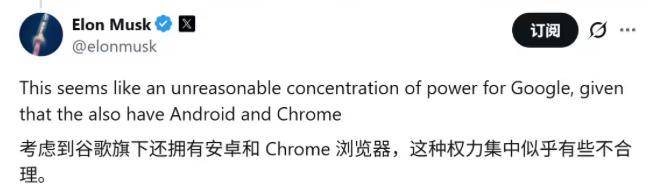
马斯克称苹果谷歌合作研发Siri AI是“不合理的权力集中”
Sou Hu Cai Jing· 2026-01-13 04:08
Core Viewpoint - Elon Musk criticized the partnership between Apple and Google, labeling it as "unreasonable power concentration" due to Google's dominance in the Android operating system and Chrome browser [1][2]. Group 1: Partnership Details - Apple and Google announced a multi-year collaboration, where the next generation of Apple's foundational model will be built on Google's Gemini model and cloud technology [2]. Group 2: Legal Actions - Musk's xAI company is suing Apple and OpenAI, claiming that Apple's integration of ChatGPT into Siri and "Apple Intelligence" creates an unfair competitive environment for rivals like Grok in the App Store [2]. - The court has rejected the motions to dismiss from Apple and OpenAI, allowing the case to proceed as planned [2].

金融时报:美政府反垄断大案接连受挫 正输掉拆分科技巨头之战
Feng Huang Wang· 2026-01-05 07:13
Core Viewpoint - The U.S. government's efforts to break up major tech giants are facing significant challenges, with recent antitrust cases against companies like Google and Meta encountering judicial resistance [2][3]. Group 1: Judicial Challenges - U.S. federal enforcement agencies have struggled to convince judges to order the divestiture of core business segments from tech giants, such as Google's Chrome browser and Meta's Instagram [2]. - Despite some landmark rulings recognizing illegal monopolistic practices, judges are often reluctant to impose the most severe remedies, such as forced breakups or annulments of mergers long after they have been completed [3]. - The ongoing antitrust cases against Apple and Amazon remain unresolved, raising questions about the government's approach to curbing the power of tech giants [3]. Group 2: Impact of AI and Market Dynamics - The rapid pace of technological change, particularly in AI, has created higher barriers for antitrust regulators, complicating their efforts to challenge large tech companies [5]. - In a notable ruling, a judge determined that Google's substantial investments in exclusive agreements maintained its illegal monopoly in the internet search market, but rejected the request to divest Chrome or Android, citing the threat posed by AI advancements [5]. - The judge's decision was influenced by the emergence of generative AI, which he noted could significantly impact Google's $200 billion annual revenue from search [5]. Group 3: Judicial Caution and Complexity - Courts exhibit caution regarding structural remedies for companies valued in the trillions, preferring to mandate behavioral corrections rather than enforce breakups [7]. - Judges emphasize the need for moderation in crafting remedies, referencing the complexities involved in reviewing intricate business arrangements [7]. - Concerns about the practicality of enforcing forced divestitures have been raised, with judges questioning the feasibility of such measures [7].

谷歌无需拆分Chrome,但代价却是由安卓用户支付
3 6 Ke· 2025-10-09 00:10
Core Viewpoint - The U.S. District Court ruled that Google will not be required to divest its Chrome browser or Android operating system in the antitrust case brought by the U.S. Department of Justice, allowing Google to maintain its current agreements and operations [1][3]. Group 1: Legal and Regulatory Context - The U.S. Department of Justice previously proposed that Google sell its Chrome browser to prevent monopolistic control over a key search access point, which is crucial for influencing user behavior and advertising [4]. - The court's decision indicates that while Google maintains control over Chrome, it must refrain from signing exclusive search engine agreements and share search data with competitors [3][4]. Group 2: Market Implications - Following the court's ruling, Alphabet's stock price surged by 5.77%, reflecting investor relief and optimism regarding Google's market position [3]. - The decision not to split Google suggests that the potential disruption to the global internet ecosystem would outweigh the benefits of breaking up its control over the browser market [9][11]. Group 3: Technical and Operational Insights - Google's transition from the Manifest V2 to Manifest V3 for Chrome extensions has raised concerns among developers, as it limits the capabilities of ad blockers, potentially increasing ad exposure and revenue for Google [6][8]. - The dominance of Chromium-based browsers, which account for nearly 90% of the global market, gives Google significant influence over the web ecosystem, complicating the case for its breakup [8]. Group 4: Broader Impact on Android - The ruling has led to a shift in Google's policies regarding Android, with increased restrictions on developer permissions, indicating that while Google avoided a major legal setback, it may impose stricter controls on its Android platform [13].
谷歌首次跻身“3万亿美元俱乐部”
财富FORTUNE· 2025-09-18 13:05
Core Viewpoint - Alphabet's market capitalization has surpassed $3 trillion for the first time, solidifying its position among the world's most valuable companies, driven primarily by advancements in artificial intelligence (AI) and favorable legal outcomes regarding its monopoly status [2][3]. Group 1: Market Performance - Alphabet's stock price surged over 4% following a significant court ruling that allowed the company to retain control over its core assets, including the Chrome browser and Android operating system, alleviating concerns about potential breakups [2]. - Year-to-date, Alphabet's stock has increased by over 32%, outperforming the S&P 500 index, which has risen by 12.5% [3]. Group 2: AI and Business Diversification - The primary driver of Alphabet's market value increase is its substantial investment in AI, particularly the integration of the Gemini AI model across its search, advertising, and cloud computing products [3]. - Other growth engines, such as Workspace, YouTube Shorts, and proprietary chips, have diversified Alphabet's revenue streams, reinforcing its image as a multifaceted technology leader rather than just a search and advertising company [3]. Group 3: Competitive Landscape - Alphabet joins the ranks of other tech giants like Apple, Microsoft, and Nvidia, which have also reached or surpassed the $3 trillion market cap, highlighting the competitive nature of the technology sector [5]. - The current economic landscape is characterized by significant capital inflow into companies perceived as innovative leaders, further boosting the valuations of top firms like Alphabet [6]. Group 4: Legal and Regulatory Environment - The recent court victory for Alphabet has clarified its legal standing regarding antitrust issues, allowing it to continue integrating its key products without the threat of being dismantled [6]. - This legal clarity has bolstered investor confidence in Alphabet's long-term growth prospects amidst economic uncertainties [6].

谷歌总市值首破3万亿美元
Huan Qiu Wang Zi Xun· 2025-09-16 04:48
Core Insights - Alphabet's stock price surged by 4.3% to $251.76, marking its market capitalization surpassing $3 trillion for the first time, making it the fourth tech company to join the "trillion-dollar club" after Nvidia, Microsoft, and Apple [1] - Since the stock price low in April 2025, Alphabet's market value has increased by over $1.2 trillion, reflecting a cumulative growth of more than 70%, significantly outpacing the S&P 500's 12.5% increase during the same period [1] - The rapid deployment of Alphabet's self-developed Gemini large model in advertising and cloud services is noteworthy, with cloud revenue reaching $13.6 billion in Q2 2025, a 32% year-over-year increase [1] - A recent U.S. court ruling determined that Alphabet does not need to divest its Chrome browser and Android operating system, only requiring the sharing of some search data, alleviating investor concerns regarding potential business breakups [1] - Following the court ruling, Citigroup raised Alphabet's target price from $225 to $280, suggesting that the reduction in regulatory risk premium will unlock long-term value [1]
谷歌无需剥离Chrome浏览器丨南财合规周报(第206期)
2 1 Shi Ji Jing Ji Bao Dao· 2025-09-07 13:24
Regulatory Governance - Tencent responded to a lawsuit from miHoYo, stating that it cannot provide user data without a formal judicial process due to privacy laws [2] - The lawsuit involves a civil case between Shanghai miHoYo and Shenzhen Tencent, scheduled for a hearing on September 5 [2] Industry Trends - The express delivery industry is experiencing a price increase in key regions such as Guangdong and Zhejiang, driven by national "anti-involution" policies [3] - Analysts predict that the average price per delivery will rise, improving company profits and enhancing the income stability of delivery personnel [3] Legal Developments - A U.S. court ruled that Google does not need to divest Chrome but must open certain search data to competitors [4][5] - This ruling is part of a broader antitrust lawsuit initiated in 2020, which accuses Google of maintaining its market dominance through high entry barriers [5] AI Developments - Meituan launched its first open-source large model, LongCat-Flash-Chat, which features 560 billion parameters and is designed for efficiency and performance [6] - Douyin established a smart medical technology company focusing on AI applications [7][8] - Antom, a brand under Ant Group, introduced an AI agent payment solution that enhances transaction security and efficiency [8] - DeepSeek is reportedly developing advanced AI agent functionalities to compete with leading tech companies [8] - Apple is planning to enhance Siri with an AI search tool in collaboration with Google, utilizing the Gemini model for improved performance [8][9]
谷歌无需剥离Chrome浏览器丨合规周报
2 1 Shi Ji Jing Ji Bao Dao· 2025-09-07 13:22
Regulatory Governance - Tencent responded to the lawsuit from miHoYo, stating that the request for QQ user data can only be fulfilled through formal judicial procedures due to privacy laws [2] - A new civil lawsuit between miHoYo and Tencent is set to be heard on September 5 in Shenzhen [2] Industry Trends - The express delivery industry is experiencing a price increase in key regions such as Guangdong and Zhejiang, driven by national "anti-involution" policies [3] - Analysts predict that the average price per delivery will rise, improving company profits and enhancing the income stability of delivery personnel [3] Legal Developments - A U.S. court ruled that Google does not need to divest Chrome but must open certain search data to competitors [4][5] - This ruling is part of a significant antitrust lawsuit initiated in 2020, which accuses Google of maintaining its market dominance through high entry barriers [5] AI Developments - Meituan launched its first open-source large model, LongCat-Flash-Chat, which features a mixed expert model architecture and boasts 560 billion parameters [6] - Antom, a brand under Ant Group, introduced an AI agent payment solution that enhances payment intent recognition and transaction traceability [8] - DeepSeek is reportedly developing advanced AI agent functionalities, aiming to compete with leading tech companies like OpenAI [8] - Apple is collaborating with Google to enhance Siri with an AI search tool, integrating a new system called "World Knowledge Answers" [8]


谷歌反垄断裁决保住根基,数据共享引入持续性竞争压力
Haitong Securities International· 2025-09-04 10:02
Investment Rating - The report maintains a positive outlook on the industry, interpreting the recent antitrust ruling favorably for Google, indicating a stable foundation for its business model [2][6][10]. Core Insights - The U.S. District Judge's ruling on September 2, 2025, preserved Google's core business by rejecting the forced breakup of Chrome and Android, which are critical to its traffic and data collection model [6][10]. - The ruling introduces behavioral remedies that will impose ongoing competitive pressure on Google, requiring it to enhance product quality and technical innovation to maintain market share [3][7]. - The emergence of generative AI tools like ChatGPT is recognized as a potential competitive threat to Google's dominance, suggesting that market power may not be permanent [8][10]. Summary by Sections Antitrust Ruling - The court's decision to reject the breakup of Chrome and Android means Google's traffic funnel and data collection model remain intact, which is crucial for its advertising and data ecosystem [2][6]. - The ruling includes behavioral remedies such as banning exclusive default search agreements and requiring data sharing with competitors, which could gradually weaken Google's data advantage over time [12][10]. Competitive Landscape - Google will face sustained but moderate competitive pressure, shifting its reliance from contractual moats to product quality and innovation [3][7]. - The ruling allows competitors like Bing and OpenAI to potentially compete for default search positions, increasing user choice [12][10]. Implications for Apple - Google pays Apple approximately USD 18–20 billion annually for traffic acquisition costs, which supports Apple's service revenue growth. The ruling does not disrupt this model in the short term [9][10]. - However, the ban on exclusivity may enhance Apple's bargaining power, allowing it to negotiate better terms with Google and other competitors [9][10]. Strategic Focus - The ruling reinforces strategic certainty around Google's core ecosystem, enabling management to focus on advancing AI initiatives and cloud expansion [10]. - Long-term, the obligations for data sharing and the ban on exclusivity may pressure Google's advertising profitability [10].