
C2M全链解决方案

Search documents
“C2M模式”实现多方价值共赢 贝好家积极探索“好房子”实践路径
Zhong Guo Jin Rong Xin Xi Wang· 2025-12-23 07:47
Core Insights - The article highlights the successful launch of the "Financial City·Beicheng S1" project in Chengdu, which achieved 20 signed contracts within a month, ranking second in the city's annual cumulative signing volume for residential properties priced over 20 million [1] - The project utilizes a C2M (Customer to Manufacturer) model, leveraging big data and AI technology to enhance the development process and better meet customer needs [1][2] - The C2M model emphasizes customer involvement throughout the development process, transforming them from passive recipients to active participants in product design and iteration [5][6] Group 1: C2M Model Implementation - The C2M solution has been successfully implemented in multiple projects, with the Chengdu Beicheng S1 serving as a comprehensive example of this approach [3] - The model integrates various data sources to create algorithms that inform product decisions, allowing for precise targeting of customer preferences and pricing expectations [2][3] - The approach aims to break traditional zero-sum competition by fostering value creation among customers, service providers, and developers [1][3] Group 2: Customer-Centric Development - The C2M model places customer needs at the forefront, with a focus on identifying and addressing these needs throughout the development chain [5][6] - The introduction of interactive online communities allows customers to engage in the design process, providing feedback that can directly influence project outcomes [5][6] - This shift towards a customer-centric approach is seen as a significant evolution in the real estate development paradigm, moving away from traditional experience-based methods [6][7] Group 3: Strategic Positioning and Partnerships - The company positions itself as a "good partner" rather than a traditional developer, focusing on leveraging its data and customer insights to assist other developers [7][8] - The C2M model is designed for scalability, allowing for collaboration with various developers to create homes that better meet customer demands [7][8] - The company plans to expand its C2M solutions to more cities and partners, potentially including local investment companies and financial institutions, to further explore specialized roles within the industry [10]

房地产下半场新解法:用造车的方式造房子?
Sou Hu Cai Jing· 2025-12-19 11:23
Core Insights - Beike's subsidiary, Beihome, is innovating in the real estate sector by adopting a C2M (Customer to Manufacturer) model, positioning itself as a partner to developers rather than a traditional developer [2][10] - The launch of the "Financial City · Beichen S1" project in Chengdu marks Beihome's first self-operated project, showcasing its commitment to high-quality residential development [3][7] Group 1: Project Overview - Beihome acquired a land parcel in Chengdu for 1.076 billion, with a floor price of 27,300 per square meter, establishing a new benchmark for land prices [3] - The Beichen S1 project features luxury units ranging from 275 to 560 square meters, priced between 15.9 million and 54 million, with 108 total units [3] - Within a month of opening, Beichen S1 achieved 20 signed contracts, ranking second in the city for residential sales above 20 million [3] Group 2: Investment and Cost Structure - The construction cost of Beichen S1 exceeds 30,000 per square meter, with total costs surpassing 57,300 per square meter when including land costs [4] - Beihome has invested significantly in the project, with management deciding to allocate several hundred million from land price differences to enhance product quality [4][5] - The project features high-end materials and technology, with construction costs for luxury facades exceeding 4,000 per square meter, significantly higher than the industry average [4] Group 3: Innovative Features and Design - Beichen S1 incorporates a "Six Senses® Smart System," integrating over 310 smart devices, which is four times the average for high-end residences in China [5] - Unique design elements address common residential pain points, such as air conditioning in garbage rooms and specialized features for elderly residents [5][7] - The project has been recognized for its thoughtful design and high-quality materials, setting a new standard for luxury housing in Chengdu [6][8] Group 4: Strategic Vision and Market Positioning - Beihome aims to redefine real estate development by prioritizing customer needs over traditional development practices, as exemplified by the Beichen S1 project [7][11] - The company has garnered interest from over 50 developers, indicating strong industry recognition and potential for collaboration [8] - Beihome's C2M model is expected to drive innovation in the housing sector, similar to the impact of Huawei's technology in the automotive industry [10][11]

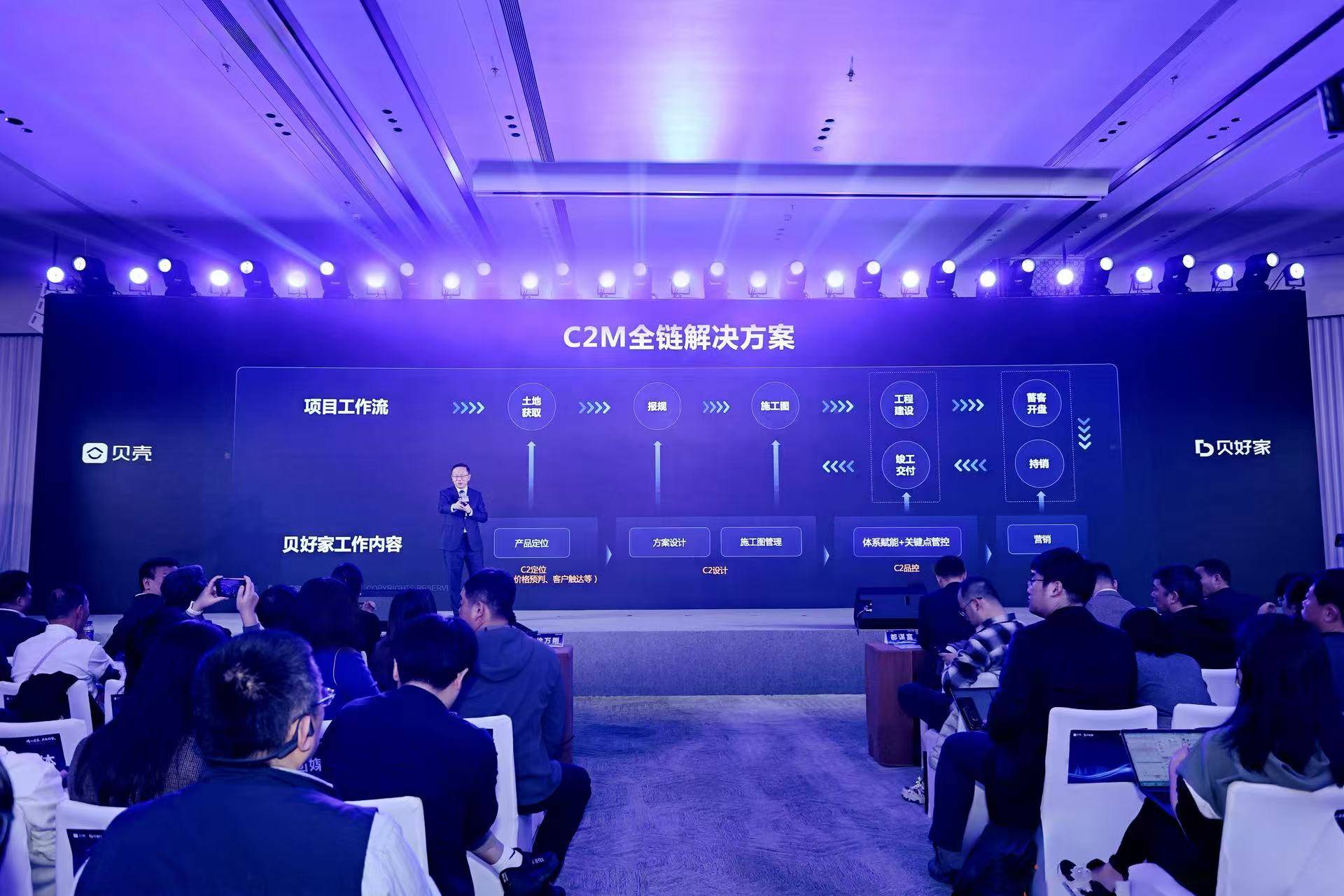
房地产供求关系深度调整,大数据和AI如何造出“好房子”?
Bei Jing Ri Bao Ke Hu Duan· 2025-12-15 08:21
Core Insights - Beike's subsidiary, Beihome, has launched a C2M full-chain solution aimed at transforming the real estate market by better aligning housing supply with market demand [1] - The real estate market is shifting from a seller's market to a buyer's market, with second-hand home transactions in key cities rising to approximately 73%, and in some cities exceeding 80% [1] - The C2M model leverages big data and AI to analyze customer needs and predict housing price trends before project development, providing solutions for product positioning, unit mix, and pricing strategies [1] Industry Trends - The real estate market is experiencing a significant transition, characterized by longer decision-making cycles for buyers and an increase in property viewings [1] - The supply of housing continues to grow, indicating a shift in the supply-demand relationship within the market [1] - Beihome has implemented 17 projects in major cities such as Beijing, Shanghai, and Guangzhou, collaborating with notable developers like China Overseas Land & Investment and China State Construction Engineering [2] Challenges - Experts highlight that the C2M model may face common challenges such as funding pressures, supply chain integration, and brand competition, which could be exacerbated in the real estate sector due to its high product value and complex supply chains [2]
贝好家CEO徐万刚首度回应“停做自操盘”质疑:不是卖得不好所以不做开发了,轻资产模式是主动选择
Mei Ri Jing Ji Xin Wen· 2025-12-14 13:28
Core Viewpoint - Beike Group's subsidiary, Beihome, emphasizes its focus on a light-asset model rather than becoming a developer, aiming to leverage its strengths in the real estate market [1][3] Group 1: Company Strategy - Beihome's CEO Xu Wanggang stated that the decision to not pursue self-operated projects is not due to poor market performance but rather a strategic shift to collaborate with developers [1][3] - The company aims to focus on its C2M (Customer to Manufacturer) model, which is designed to better meet customer needs through comprehensive services and partnerships with other real estate firms [1][2] - Beihome has launched its C2M positioning plan based on data and AI algorithms to predict customer preferences and guide product positioning [2] Group 2: Market Performance - As of December 11, the Beichen S1 project in Chengdu achieved 20 signed contracts within a month of opening, ranking second in total signed contracts for high-end residential properties in the city for 2025 [1][2] - The Shanghai Beilian C1 project also performed well, ranking third in sales area and number of units sold in November [1][2] Group 3: Future Collaborations - Beihome is exploring new collaboration methods, not limited to developers but also including city investment companies, construction agents, and financial partners [4] - The company has established 17 projects across major cities such as Beijing, Shanghai, and Guangzhou, collaborating with various real estate firms [3]
贝壳旗下贝好家发布C2M全链解决方案 CEO徐万刚:并不想成为一家开发商
Zheng Quan Shi Bao Wang· 2025-12-13 06:51
Core Insights - The core viewpoint of the article emphasizes the shift in the real estate market from a seller's market to a buyer's market, highlighting the importance of "customer sovereignty" in housing development [1][4]. Group 1: Market Dynamics - The real estate market has transitioned from primarily addressing "availability" to focusing on "quality," with consumers seeking better living conditions [1]. - Since 2021, the market has shifted to a buyer's market, leading to longer transaction cycles and increased caution among homebuyers [1]. - High-quality projects continue to perform well, indicating a demand for good housing and services despite market challenges [1]. Group 2: C2M Strategy - Beike's subsidiary, Beihome, has launched a C2M (Customer to Manufacturer) full-chain solution, which includes positioning, design, construction management, and marketing [2][3]. - The C2M model aims to leverage big data and AI to accurately predict customer preferences and guide product positioning [1]. Group 3: Project Development - Beihome has decided to limit its self-operated projects to focus on partnerships with developers, allowing for a broader range of projects [4][5]. - The "Financial City·Beichen S1" project in Chengdu serves as a model for validating the C2M approach, achieving significant sales shortly after launch [4]. - The "Beilian C1" project in Shanghai also demonstrates the effectiveness of the C2M model, ranking high in sales shortly after its opening [4]. Group 4: Business Model - The company prefers a light-asset model to enhance its advantages and does not aim to become a traditional developer [5]. - Beihome has established 17 projects across major cities in China, collaborating with various developers to meet customer needs [5].
贝好家:以C2M构建房地产开发新模式
Huan Qiu Wang· 2025-12-10 01:33
Core Insights - Beike Group has launched Beihome as a data-driven residential development service platform, focusing on the C2M (Customer to Manufacturer) model to enhance housing supply and meet consumer needs [1][2][12] - The "14th Five-Year Plan" emphasizes the construction of a new real estate development model, promoting high-quality development and a balance between supply and demand [2][12] - Beihome has successfully implemented 17 C2M model cooperation projects across various cities, demonstrating the effectiveness of its data-driven approach [2][3][12] Group 1 - Beihome's C2M model integrates data analysis and AI algorithms to predict customer preferences and optimize product positioning [3][4][5] - The platform aims to create "good houses" that align with consumer demands, moving from a focus on availability to quality [3][12] - The C2M model allows for customer participation in the entire development process, enhancing engagement and satisfaction [3][4] Group 2 - Beihome's projects, such as Chengdu Beichen S1 and Shanghai Beilian C1, showcase the successful application of the C2M model, achieving strong sales and market recognition [4][9][12] - The platform's data capabilities include comprehensive market data, customer insights, and feasibility studies, forming a robust foundation for decision-making [5][11] - Beihome plans to expand its operations in major cities like Guangzhou, Shenzhen, and Wuhan, continuing to leverage the C2M model for future developments [11][12]

贝好家武斌:平均带看成交比已升至16.8:1,“以人定房”才能降低中间成本
3 6 Ke· 2025-11-06 07:56
Core Insights - The current real estate market is experiencing a fundamental shift, with second-hand housing transactions dominating the market, accounting for 70% in first and second-tier cities and 80% nationwide, indicating a need for better understanding of consumer demands and pricing dynamics [2][3] - The traditional linear development process in real estate is leading to mismatches between products and customer needs, highlighting the importance of a customer-centric approach in housing development [2][3] Group 1: Market Dynamics - The ratio of new effective customer rooms (new customers viewing properties to new listings) has dropped significantly below 1 since 2021, indicating a challenging market environment where buyers are less urgent [2] - The average number of viewings before a purchase has increased from 10 to 16.8, reflecting a longer decision-making cycle for customers [2] Group 2: C2M Development Model - The C2M (Customer to Manufacturer) model aims to create homes that meet customer needs by utilizing data-driven insights and customer participation throughout the development process [3][4] - The ideal development scenario involves initial product positioning based on customer data before land acquisition, followed by continuous customer involvement in design and iteration [3] Group 3: Core Capabilities of Beihome - Beihome is focusing on three core capabilities: C2M product positioning, deep customer insights, and online customer engagement [4][5] - The C2M product positioning involves scientific pricing and matching of housing types to customer demographics, preventing mismatches from the outset [5] - Deep customer insights are derived from the Beike platform, allowing for detailed profiling of potential customers and their preferences [5] Group 4: Company Positioning - Beihome does not aim to be a traditional developer but rather a data-driven residential development service platform, providing comprehensive C2M solutions to partners [6] - As of October 2025, Beihome has launched 17 projects across major cities in China, with two projects serving as test cases for validating their C2M capabilities [6]