CXL内存

Search documents
美光科技:乘AI之东风,存储龙头高速增长
Changjiang Securities· 2026-02-08 05:46
Investment Rating - The investment rating for the industry is "Positive" and maintained [11] Core Insights - Micron Technology is a leading global storage company, with a projected market share of 23% in DRAM and 13% in NAND Flash by 2025. The company has maintained a leading position in product launches over its 45-year history and operates under an IDM model, focusing on core storage products [4][9] - The storage industry is characterized by cyclical growth and concentrated competition, with a market size expected to exceed $300 billion by 2026. The industry is dominated by a few key players, including Samsung, Hynix, and Micron in DRAM, and Samsung, Hynix, Micron, SanDisk, and Kioxia in NAND Flash [7][34] - The demand for storage is being driven by AI, with significant growth in Cloud Memory revenue. The company has initiated the construction of several wafer fabs, which is expected to solidify its leading position in the storage industry [4][9][102] Summary by Sections Storage: The Foundation of Data Storage - Storage devices are essential for storing data, information, and software programs. The main semiconductor storage products are RAM (primarily DRAM) and ROM (primarily NAND Flash). The storage industry exhibits cyclical growth, with increasing demand for storage bits and periodic price fluctuations contributing to sustained market growth [7][32] AI-Driven Storage Technology Upgrades and Expanding Demand - AI data centers are being constructed to support complex AI computations, utilizing a tiered storage architecture that includes HBM, DRAM, and NAND Flash. This architecture enhances data transfer efficiency and reduces overall costs. The demand for DRAM and NAND Flash is expected to grow rapidly due to the increasing parameters of large models and the advent of the inference era [8][47] HBM Generational Upgrades and Market Expansion - HBM technology has evolved significantly, with the latest generation (HBM4) expected to achieve a maximum capacity of 48GB and a bandwidth of 2TB/s. The HBM market is projected to reach $100 billion by 2028, with a CAGR of 40% from 2025 to 2028 [49][55] NAND Flash Demand Growth and HBF Technology Implementation - The demand for NAND Flash is anticipated to surge as AI models expand, necessitating the offloading of KV cache to NAND Flash to alleviate real-time inference bottlenecks. The HBF technology, which combines high-capacity NAND Flash with HBM structures, is expected to address the growing storage and bandwidth requirements of large models [57][67] Micron Technology: Riding the AI Wave for Rapid Growth - Micron Technology's revenue is projected to reach $37.378 billion in 2025, with a year-on-year growth of 48.85%. The company expects a net profit of $8.539 billion, reflecting a significant increase of 998%. The DRAM product line is expected to account for over 70% of revenue, with capital expenditures projected at $15.857 billion, representing 42% of revenue [83][90][101]

未来三年分红规划,这些公司已提前布局(名单)
Zheng Quan Shi Bao Wang· 2025-12-15 01:39
Core Viewpoint - The article highlights the increasing trend of cash dividends among listed companies in China, with a focus on their commitment to return profits to shareholders through substantial cash distributions over the next three years. Group 1: Cash Dividend Trends - Listed companies in China have shown a significant increase in cash dividend intentions, with the total cash dividends exceeding 2.47 trillion yuan this year, surpassing the total for the entire previous year [2][4] - Major companies like BYD, Hikvision, and Zijin Mining have reported cash dividends exceeding 10 billion yuan for the first time this year, with many traditional "dividend giants" increasing their payouts [4][5] Group 2: Future Dividend Plans - Nearly 40 companies have established shareholder return plans for the next three years (2026-2028), with most committing to distribute at least 10% of their annual distributable profits in cash [7] - Specific companies have set higher targets, such as Qibin Group, which plans to distribute over 50% of its annual distributable profits in cash, and China Merchants Shekou, which aims for a minimum of 40% [7][9] Group 3: Market Performance and Institutional Interest - Companies that announced shareholder return plans have seen an average stock price increase of over 4.5%, outperforming the average increase of the CSI 300 index [10] - Notably, companies like Wangzi New Materials and Aibison have experienced stock price increases exceeding 50% since their announcements [10][12] Group 4: Institutional Research Activity - Among the 37 companies with announced return plans, 17 have received significant institutional interest, with some receiving over 350 institutional research inquiries [11][12] - Companies like Baiwei Storage and Shiji Information have also reported substantial stock price increases alongside their active engagement with institutional investors [12][13]





未来三年分红规划,这些公司已提前布局
Zheng Quan Shi Bao· 2025-12-15 00:36
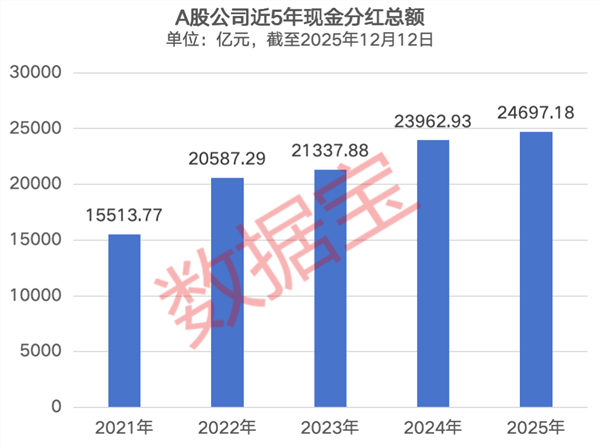
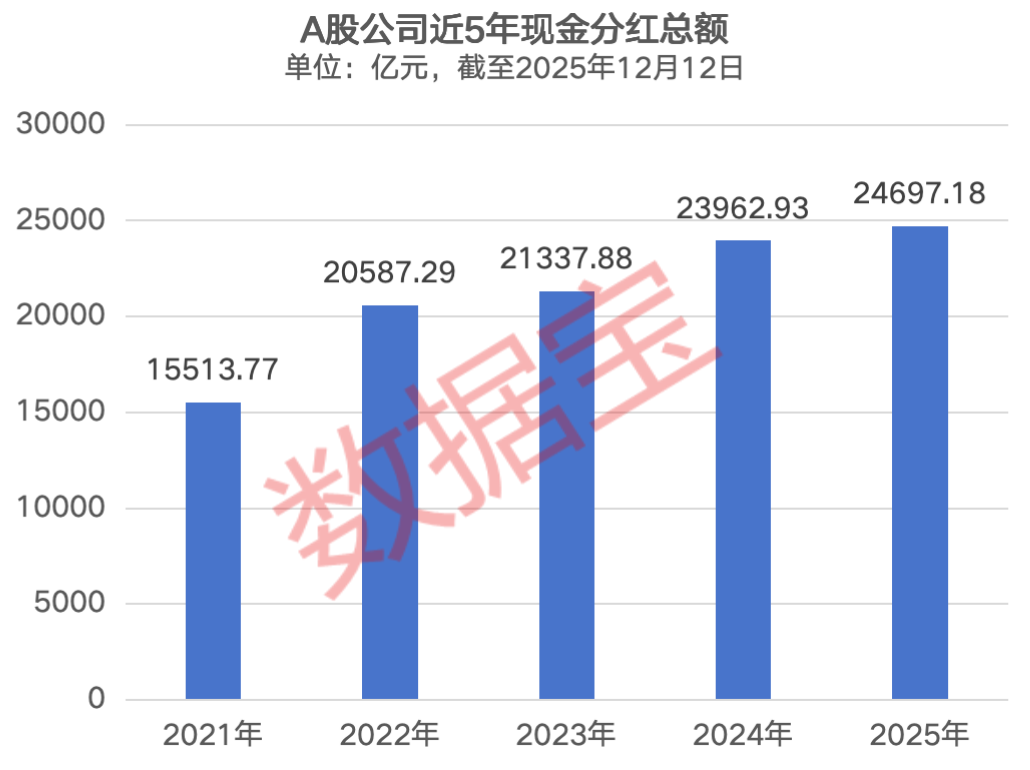
Core Viewpoint - The trend of cash dividends among listed companies in China has significantly increased in 2025, with total cash dividends exceeding the entire amount of 2024, reflecting a strong commitment to returning value to investors [3][5]. Group 1: Cash Dividend Policies and Trends - In 2024, the Shanghai and Shenzhen Stock Exchanges initiated policies to enhance cash dividends, promoting multiple distributions per year and pre-dividend announcements [2]. - By December 12, 2025, A-share listed companies had distributed a total of 2.47 trillion yuan in cash dividends, surpassing the total for the entire previous year [3]. - The number of companies participating in cash dividends and the total amount distributed have been on the rise, indicating an improving dividend ecosystem in the A-share market [3]. Group 2: Major Companies and Their Dividend Contributions - Companies like BYD, Hikvision, and Zijin Mining have each implemented cash dividends exceeding 10 billion yuan for the first time in 2025 [5]. - China Construction Bank and Bank of China reported cash dividends exceeding 100 billion yuan, with increases of over 45% compared to the previous year [6]. - Several companies, including Crystal Integrated and Huaxin Yongdao, announced their first dividends since listing in 2024 [7]. Group 3: Future Shareholder Return Plans - 37 companies have announced shareholder return plans for the next three years (2026-2028), with most committing to distribute at least 10% of their annual distributable profits in cash [8]. - Specific companies like Qibin Group and China Merchants Shekou have set cash dividend ratios of 50% and 40% of net profits, respectively, for the upcoming years [9][10]. - The majority of these companies are from sectors such as electronics, machinery, and pharmaceuticals, indicating a broad commitment across industries [8]. Group 4: Market Performance and Institutional Interest - Companies that announced shareholder return plans have seen an average stock price increase of over 4.5%, outperforming the average gain of the CSI 300 index [11]. - Notable performers include Wangzi New Materials and Aibison, with stock price increases of over 54% and 50% since their announcements, respectively [11]. - 17 companies among those with return plans received significant institutional interest, with some like Baiwei Storage attracting nearly 350 institutional inquiries [12][13].
最新一代内存标准,没人用?
半导体芯闻· 2025-06-27 10:21
Core Viewpoint - The CXL (Compute Express Link) market has not yet launched as expected, primarily due to the underperformance of key players like Samsung Electronics and Intel [1][3]. Group 1: Market Status - The CXL market is currently stagnant, with a notable lack of discussions surrounding it, attributed to the weak performance of market leaders Samsung and Intel [3]. - Intel's next-generation server CPU, "Diamond Rapids," which is crucial for CXL's market launch, may face delays due to internal restructuring and layoffs [3][4]. - Samsung is in a holding pattern, waiting for the market to open, as the development of CXL-compatible memory products cannot proceed without corresponding processors [4]. Group 2: Opportunities and Risks - The introduction of CXL may lead to a decline in overall sales of processors and memory, as it aims to utilize existing resources more efficiently, which could negatively impact companies reliant on these sales in the short term [6][7]. - However, CXL-compatible chips are high-value products that could improve the profit structure for both Samsung and Intel, aligning with the semiconductor industry's trend towards high-value offerings to avoid cyclical fluctuations and competition with low-cost manufacturers [7]. - The CXL market is expected to see significant growth by 2026, with hyperscale cloud service providers likely to dominate this market due to their need for improved resource utilization and cost savings [8][9].