
DDR6

Search documents
存储“超级周期”:笔记本、国产手机集体涨价
财联社· 2026-01-10 05:33
Core Viewpoint - The storage chip price surge is impacting various sectors, leading to increased prices for consumer electronics, AI hardware, and AIoT devices, with significant price hikes expected in 2026 [1][2][4]. Group 1: Storage Price Increases - In Q1 2026, general DRAM contract prices are expected to rise by 55% to 60%, while NAND flash prices will increase by 33% to 38%, with consumer-grade QLC products seeing a rise of at least 40% [1]. - Samsung and SK Hynix plan to raise server DRAM prices by 60% to 70% in Q1 2026 compared to Q4 2025 [1]. - The current cycle of storage price increases is driven by demand mismatch, capital expenditure, and technology migration, likely continuing until late 2026 or even 2027 [1]. Group 2: Impact on Consumer Electronics - Major PC manufacturers like Lenovo, Dell, and HP are planning price increases of up to 20% due to rising storage costs, with HP's CEO warning of particularly challenging conditions in the second half of 2026 [2]. - The average price of laptops has increased by 500 to 1500 yuan compared to late 2025, with some models seeing price hikes of 5% to 10% since late 2025 [2]. - TrendForce has revised down global smartphone production forecasts for 2026 from a 0.1% increase to a 2% decrease, and global laptop shipments are expected to decline by 5.4%, potentially reaching a 10.1% decrease [4]. Group 3: Smartphone Price Adjustments - The smartphone industry is experiencing a price increase trend due to rising storage costs, with IDC predicting the average smartphone price will rise to $465 in 2026, leading to a market revenue of $578.9 billion [5]. - Storage costs in smartphones have risen from 10%-15% to over 20%, with mid-range phones seeing storage costs approaching 30% [5]. - Domestic brands like Redmi and iQOO have raised prices for new models by 100-600 yuan, with some mid-range models increasing by 20% [6]. Group 4: AIoT and Chip Manufacturers - AIoT chip manufacturers are experiencing varied impacts from storage price increases, with some transitioning from DDR4 to DDR5 due to price surges [9]. - Companies like Rockchip report that while storage shortages and price hikes affect demand, the growth momentum in AIoT will mitigate negative impacts [9]. - Other AIoT companies, such as Espressif, indicate that their use of Nor Flash means that price increases will not significantly affect demand [10]. Group 5: Opportunities in the Storage Industry - Companies in the storage supply chain are benefiting from rising prices, with chip testing firms like Liyan Chip reporting increased demand and capacity utilization [12]. - The storage industry is expected to enter a high-growth phase driven by price increases, technological iterations, and domestic replacements, particularly in DRAM and NAND sectors [13].

铂科新材20250825
2025-08-25 14:36
Summary of the Conference Call for Platinum Materials (铂科新材) Company Overview - **Company**: Platinum Materials (铂科新材) - **Industry**: Magnetic materials and components, specifically focusing on inductors and related products Key Financial Performance - **Revenue Growth**: - 2025 H1 revenue reached 860 million CNY, a year-on-year increase of approximately 8% [3] - Q2 revenue was 477 million CNY, with a year-on-year growth of 3.5% and a quarter-on-quarter increase of 24% [3] - **Profitability**: - Net profit for H1 was 191 million CNY, a year-on-year increase of about 3% [3] - Q2 profit was 117 million CNY, with a significant increase of nearly 60% quarter-on-quarter [2][3] - **Gross Margin**: - Overall gross margin approached 40% in H1, with a Q2 margin increase of approximately three percentage points [6] Product Line Performance - **Core Products**: - Magnetic core products accounted for 76% of total revenue, with a quarter-on-quarter growth of 25% [4] - Ceramic powder revenue was approximately 27 million CNY, with a 10% quarter-on-quarter increase [4] - Chip inductors and components saw a revenue decline to nearly 170 million CNY year-on-year [4] Industry Segmentation - **Market Segments**: - Photovoltaic sector contributed 46%-47% to total revenue, with growth driven by installation rush [5] - Automotive sector accounted for 12% of revenue, with significant growth in charging stations and new energy vehicles [11] - Communication and power supply sectors contributed 10%-34% [5] Capacity and Production Strategy - **Production Capacity**: - Current magnetic core capacity is approximately 20,000 tons, expected to reach 40,000-50,000 tons by year-end [7] - Total production capacity across two bases is about 70,000 tons, with dynamic adjustments based on market conditions [8] - **Future Plans**: - New projects aimed at expanding inductor production capacity are expected to generate at least 600 million CNY in output by 2026 [8] Research and Development - **R&D Investment**: - R&D expenses increased from 5% to over 7% of revenue, primarily for module inductor development [2][9] - New product developments include DDR5 and DDR6, with DDR5 already in mass production and DDR6 expected to enter large-scale production by 2027 [12][14] Market Trends and Future Outlook - **Growth Drivers**: - Chip inductors are identified as a key growth area, with expectations for significant revenue increases in H2 2025 [12] - The company is focusing on high-value projects and partnerships with semiconductor firms to enhance product offerings [12] - **Profitability Expectations**: - Anticipated slight decline in gross margins in early 2026 due to new facility depreciation, but overall profitability is expected to improve as production scales up [18] Competitive Landscape - **Market Position**: - Major competitors in the chip inductor market include companies like Flex, TI, ADI, and Infineon, with limited global suppliers [13] - Platinum Materials is positioned to capture market share through innovative solutions and direct customer engagement [29] Conclusion - **Strategic Focus**: - The company is committed to vertical integration, ensuring quality control from powder production to final products [32] - Future growth will be driven by advancements in AI, GPU applications, and expanding into new markets while maintaining a focus on high-margin products [15][16]
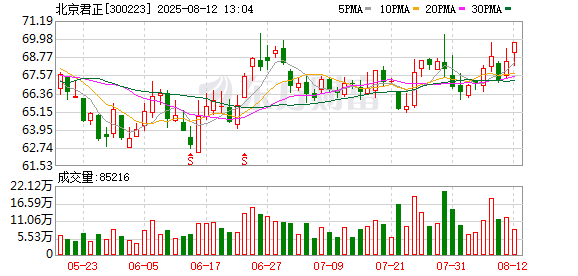
北京君正(300223.SZ):暂无布局DDR6的计划
Ge Long Hui· 2025-08-12 07:04
Group 1 - The company, Beijing Junzheng (300223.SZ), has no plans to enter the DDR6 market at this time [1]

北京君正:公司暂无布局DDR6的计划
Mei Ri Jing Ji Xin Wen· 2025-08-12 05:03
Core Viewpoint - The company, Beijing Junzheng, has no plans to develop DDR6 technology at this time [1] Company Summary - Beijing Junzheng responded to an investor inquiry on August 12, indicating that there are currently no plans for DDR6 technology development [1]
芯片ETF(512760)涨超1.1%,半导体行业三重周期共振或推动估值修复
Mei Ri Jing Ji Xin Wen· 2025-08-04 07:12
Group 1 - The semiconductor industry is experiencing a comprehensive rebound, driven by a triple resonance of macro policy cycles, inventory cycles, and AI innovation cycles, leading to valuation expansion [1] - TSMC has raised its annual revenue growth forecast from 25% to 30%, indicating strong ongoing demand for AI and a moderate recovery in non-AI demand [1] - The storage technology sector is at a critical juncture, with DDR6 expected to complete certification by 2026, significantly enhancing bandwidth and channel count [1] Group 2 - Google has increased its full-year capital expenditure to $85 billion, reflecting strong demand for AI infrastructure [1] - There is a positive feedback loop between AI applications and computing infrastructure, with Google AI search monthly active users surpassing 2 billion [1] - LCD panel prices are stabilizing overall, with a slight decline in 65-inch products, indicating a reshuffling of the competitive landscape in the industry [1] Group 3 - The Chip ETF (512760) tracks the China Semiconductor Index (990001), which focuses on the Chinese semiconductor industry chain, selecting relevant listed companies from design, manufacturing, to packaging and testing [1] - The index constituents exhibit high technical content and growth potential, reflecting a distinct technology innovation style in asset allocation [1]
20cm速递 | 关注科创芯片ETF国泰(589100)投资机会,三重周期共振下的半导体估值扩张
Mei Ri Jing Ji Xin Wen· 2025-08-01 06:07
Group 1 - The semiconductor industry is in the early stages of a comprehensive rebound, driven by a tripartite resonance of macro policy cycles, industry inventory cycles, and AI innovation cycles [1] - North America's strong increase in computing power has significantly boosted the switch and server supply chain, while consumer electronics are experiencing a bottom rebound due to AI edge innovation [1] - TSMC has raised its annual revenue growth forecast from 25% to 30%, indicating sustained strong demand for AI and a moderate recovery in non-AI demand [1] Group 2 - Storage technology is accelerating its iteration, with DDR6 expected to complete certification by 2026, providing opportunities for domestic storage companies to upgrade [1] - The U.S. AI action plan may further restrict semiconductor exports, promoting self-sufficiency in domestic manufacturing, equipment, and materials [1] - The Guotai Science and Technology Chip ETF (589100) tracks the Science and Technology Chip Index (000685), which can fluctuate by up to 20% in a single day, reflecting the overall performance and technological development of listed companies in China's integrated circuit industry [1]

20cm速递|科创芯片ETF国泰(589100)飘红,三重周期共振或重构半导体估值
Mei Ri Jing Ji Xin Wen· 2025-07-31 04:49
Group 1 - The semiconductor industry is experiencing a comprehensive rebound driven by a combination of macro policy cycles, inventory cycles, and AI innovation cycles, leading to valuation expansion [1] - North America's strong increase in computing power has significantly boosted the switch and server supply chain, while consumer electronics are benefiting from AI-side innovations, indicating a bottoming out and rebound [1] - TSMC has raised its annual revenue growth forecast from 25% to 30%, reflecting strong ongoing demand for AI and a moderate recovery in non-AI demand [1] Group 2 - The storage sector is facing technological iterations, with DDR6 expected to complete certification by 2026, significantly enhancing bandwidth and channel count [1] - The U.S. AI action plan may further restrict semiconductor exports, accelerating the self-sufficiency of domestic semiconductor manufacturing, equipment, and materials [1] - Google has increased its annual capital expenditure to $85 billion, indicating sustained strong demand for AI infrastructure, with Google AI search monthly active users surpassing 2 billion [1] Group 3 - The electronic industry's prosperity is validated by financial reports, with a strong cyclical recovery in semiconductors, as evidenced by TI's 2Q25 revenue nearing the guidance upper limit and a 15% quarter-over-quarter growth in the industrial sector [1] - The Guotai ETF (589100) tracks the Sci-Tech Chip Index (000685), which can experience daily fluctuations of up to 20%, reflecting the overall performance of Chinese technology innovation enterprises in the semiconductor industry [2] - The index includes companies involved in semiconductor materials, equipment, design, manufacturing, and packaging testing, focusing on leading enterprises with high R&D investment characteristics [2]
集成电路ETF(159546)涨超1.2%,半导体行业三重周期共振或迎估值扩张
Mei Ri Jing Ji Xin Wen· 2025-07-31 02:51
Core Viewpoint - The semiconductor industry is experiencing a comprehensive rebound, driven by the convergence of macro policy cycles, inventory cycles, and AI innovation cycles, leading to an expansion in valuations [1] Group 1: Industry Trends - Recent strong growth in North American computing power has boosted sentiment in the switch and server supply chain, while consumer electronics are benefiting from AI-side innovations showing signs of bottoming out [1] - TSMC has raised its annual revenue growth forecast from 25% to 30%, reflecting sustained strong demand for AI and a moderate recovery in non-AI demand [1] - The acceleration of storage technology iterations is notable, with DDR6 expected to complete certification by 2026, significantly enhancing bandwidth and channel count [1] Group 2: Policy and Market Dynamics - The U.S. AI action plan may further restrict semiconductor exports, promoting self-sufficiency in domestic manufacturing, equipment, and materials [1] - Google has increased its annual capital expenditure to $85 billion, indicating ongoing growth in demand for AI infrastructure, which creates a positive feedback loop with computing power infrastructure [1] Group 3: Investment Opportunities - The Integrated Circuit ETF (159546) tracks the Integrated Circuit Index (932087), which selects listed companies involved in IC design, manufacturing, packaging, testing, and related materials and equipment, reflecting the overall performance of the semiconductor industry [1] - For investors without stock accounts, options include the Guotai CSI All-Share Integrated Circuit ETF Initiated Link C (020227) and Link A (020226) [1]
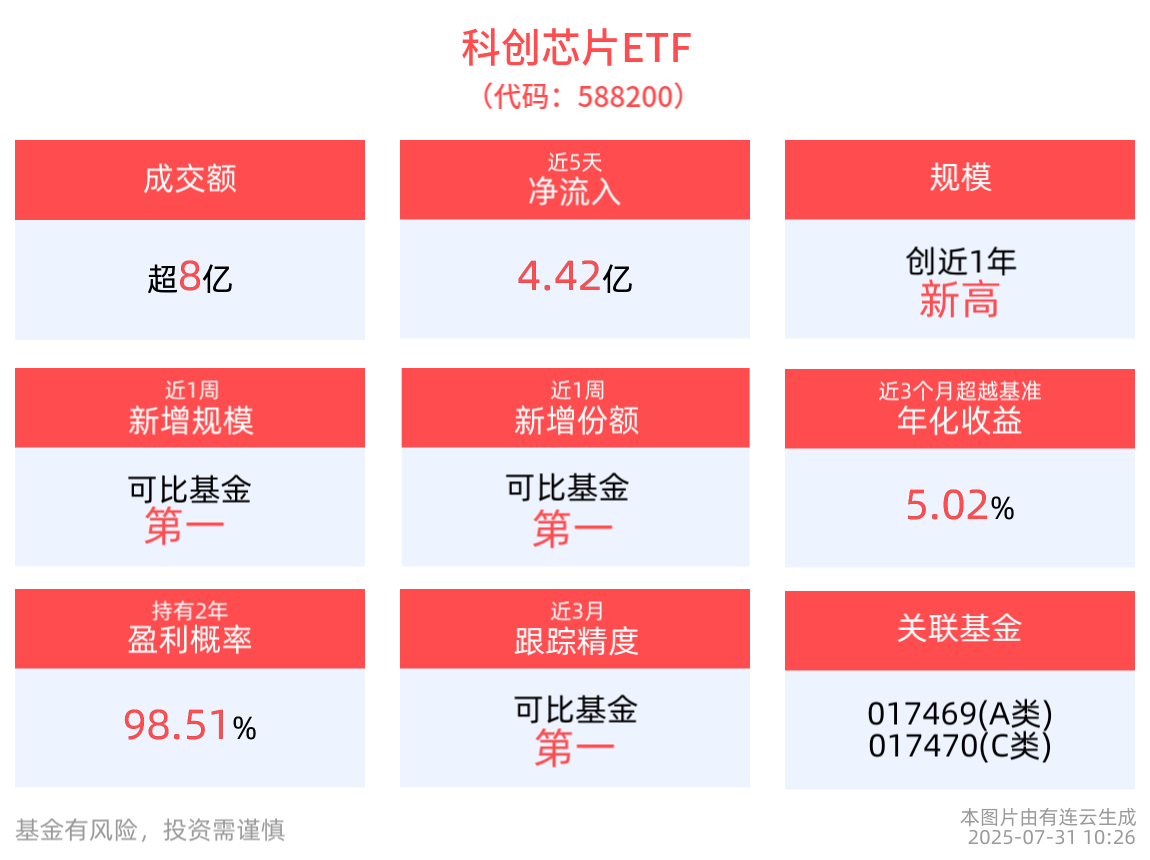
最新资金净流入4.02亿元,科创芯片ETF(588200)红盘蓄势,东芯股份20cm涨停
Xin Lang Cai Jing· 2025-07-31 02:50
Group 1: ETF Performance - The Sci-Tech Chip ETF has seen a recent trading volume turnover of 2.5%, with a transaction value of 830 million yuan [3] - As of July 30, the ETF's latest scale reached 33.012 billion yuan, marking a one-year high and ranking first among comparable funds [3] - The ETF experienced a significant increase in shares, with a growth of 19.8 million shares over the past week, also ranking first among comparable funds [3] Group 2: Fund Inflows and Leverage - The latest net inflow for the Sci-Tech Chip ETF is 402 million yuan, with three out of the last five trading days showing net inflows totaling 442 million yuan [3] - The ETF has seen a net financing purchase amount of 6.7277 million yuan this month, with the latest financing balance reaching 1.636 billion yuan [3] Group 3: Historical Returns - As of July 30, the ETF's net value has increased by 69.83% over the past year, ranking first among comparable funds and placing in the top 4.96% of index equity funds [4] - The ETF's highest monthly return since inception was 25.18%, with the longest consecutive monthly gains being four months and a maximum increase of 36.01% [4] - The average return for months with gains is 8.40%, and the historical two-year holding profit probability is 98.51% [4] Group 4: Industry Outlook - The storage chip industry is expected to enter a price increase cycle, with average month-on-month price changes for DDR3, DDR4, and DDR5 being +14.05%, +33.38%, and +2.75% respectively [4] - The semiconductor industry is experiencing a comprehensive rebound, driven by macro policy cycles, inventory cycles, and AI innovation cycles [5] - North American demand for computing power is rising sharply, boosting the growth of the switch and server supply chain, with TSMC raising its annual revenue growth forecast from 25% to 30% [5] Group 5: Key Stocks in the Index - The top ten weighted stocks in the Sci-Tech Chip Index include SMIC, Haiguang Information, Cambricon, and others, collectively accounting for 57.76% of the index [5] - The performance of individual stocks varies, with notable changes in weight and price fluctuations among the top stocks [7]



电子行业周报:半导体全面反弹伊始,看好三重周期共振下的估值扩张行情-20250728
Guoxin Securities· 2025-07-28 14:57
Investment Rating - The report maintains an "Outperform" rating for the electronic industry, indicating expected performance above the market index by more than 10% [10]. Core Viewpoints - The semiconductor sector is experiencing a comprehensive rebound, driven by a triple-cycle resonance that is expected to lead to valuation expansion. The report highlights a 4.65% increase in the semiconductor sub-industry, with a general electronic industry increase of 2.85% over the past week [1][11]. - The report emphasizes the strong demand for AI-related innovations, particularly in the context of North America's rising computing power and the positive trends in US-China trade negotiations. This has led to a rebound in consumer electronics, particularly benefiting large-cap stocks like Industrial Fulian and Pengding Holdings [1]. - TSMC has raised its revenue growth forecast from approximately 25% to 30% due to sustained strong AI demand and a mild recovery in non-AI demand [1]. - The report suggests that the electronic sector will see a "valuation expansion" trend in 2025, driven by macroeconomic policy cycles, inventory cycles, and AI innovation cycles [1]. Summary by Relevant Sections Semiconductor Sector - The semiconductor industry is highlighted as a key area of growth, with companies such as SMIC, Huahong Semiconductor, and Aojie Technology recommended for investment due to their strong performance and growth potential [1][10]. - The report notes that TI's Q2 2025 revenue reached $4.448 billion, a year-on-year increase of 16.4%, indicating a robust cyclical recovery across all downstream sectors except for automotive [3]. AI and Cloud Computing - Google's parent company, Alphabet, reported a Q2 2025 revenue of $96.428 billion, with cloud revenue growing by 31.67% year-on-year, reflecting strong demand for AI infrastructure and services [4]. - The report suggests that AI remains a high-growth investment theme, with recommendations for companies like Industrial Fulian and Longxin Zhongke [4]. Consumer Electronics - The report notes a decline in LCD TV panel prices, particularly for 65-inch panels, while other sizes remained stable. It anticipates increased procurement as the year-end sales season approaches [8]. - Companies such as BOE Technology Group are recommended due to their competitive positioning in the LCD market [8]. Key Investment Recommendations - The report lists a range of companies across different sectors, including: - Semiconductor: SMIC, Aojie Technology, Huahong Semiconductor, and others [10]. - Consumer Electronics: Industrial Fulian, Xiaomi Group, and others [9]. - AI Computing: Shengyi Technology, Industrial Fulian, and others [7].

