DRAM/NAND存储芯片

Search documents
美光为何持续上涨?
美股研究社· 2026-01-30 11:13
Core Viewpoint - The semiconductor market is undergoing a fundamental transformation, particularly in the storage chip sector, with a permanent shift in manufacturing capacity towards AI core products, making Micron a bottleneck supplier in the industry [1][3]. Group 1: Market Transformation - The current storage market is fundamentally different from previous cycles, as the so-called "overcapacity" is actually a permanent transfer of capacity to high-bandwidth memory (HBM) used in AI accelerators [3]. - The shortage of storage chips is expected to last until at least 2027, with major cloud service providers prioritizing securing supply over negotiating lower prices [3]. - The shortage affects not only flagship AI GPUs but also smartphones, enterprise servers, and consumer storage products, indicating a significant shift in the supply chain [3]. Group 2: High-Bandwidth Memory (HBM) Impact - HBM is now a core variable for investors, with demand for storage chips growing exponentially due to new AI accelerators, outpacing traditional DRAM market growth [4]. - The growth rate of HBM is expected to allow suppliers to escape the commodity pricing model, presenting a unique investment opportunity for Micron [4]. - Micron's potential profit growth is substantial, even without dominating the HBM market, as it can achieve significant margins by capturing a market share aligned with its overall DRAM position [4][5]. Group 3: Financial Performance - Micron's revenue from cloud memory has nearly doubled year-over-year, with a gross margin of 66% and an operating margin of 55% in the latest quarter [6]. - The company has demonstrated strong operational leverage, with significant profit margin improvements in its cloud storage segment, indicating it has gained true pricing power [5][6]. - Free cash flow is under pressure but is being reinvested into business expansion, reflecting a strategic choice rather than a sign of poor profitability [7]. Group 4: Strategic Positioning - Micron's position in the HBM market is more about long-term participation than current rankings, with a diversified customer base that reduces reliance on single clients [9]. - The company's production ramp-up for new HBM products is methodical, allowing it to capture market share without needing to make price concessions [9]. - Micron's high capital expenditures are viewed as a sign of confidence in the industry's future, with investments tied to signed demand contracts rather than speculative judgments [13]. Group 5: Future Valuation - The market undervalues Micron based on its future earnings potential, with a forward non-GAAP P/E ratio of only 13 and expected triple-digit growth in earnings per share [11]. - The company's structural advantages position it as a proactive supplier rather than a passive participant in the market, marking a significant shift in its profitability and operational strategy [15].



市场开始质疑“超预期”逻辑! 美股高估值时代 没有强业绩指引=卖事实
智通财经网· 2026-01-21 11:30
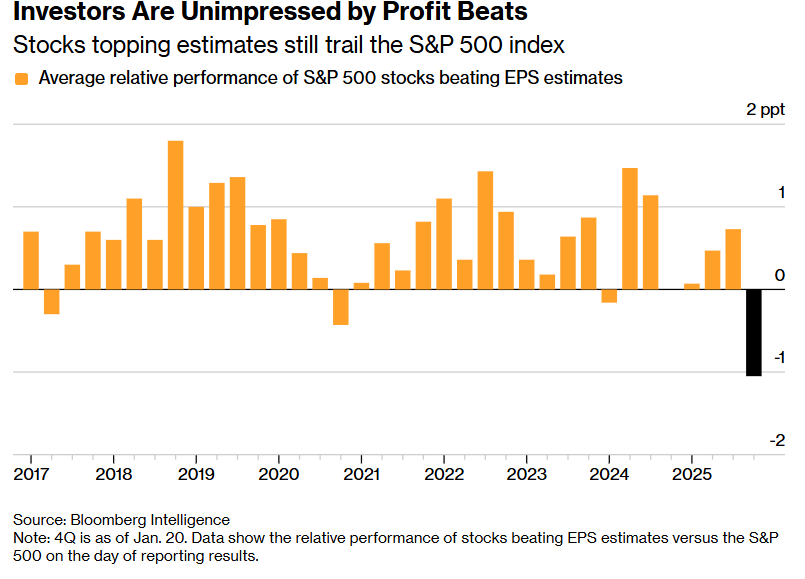
Core Viewpoint - The recent earnings season for U.S. stocks has shown that actual profits significantly exceeded market expectations, yet investors reacted with the worst stock price performance following earnings beats on record, indicating a cautious sentiment towards future guidance and macroeconomic uncertainties [1][5][15]. Group 1: Earnings Performance - Approximately 81% of S&P 500 companies reported actual profits that surpassed fourth-quarter consensus estimates, but their stock prices lagged the benchmark index by an average of 1.1 percentage points, marking the worst relative performance since 2017 [1][15]. - Companies like 3M and State Street saw significant stock price declines despite beating earnings expectations, as investors focused on their bleak forecasts [2][15]. - Netflix's disappointing earnings outlook led to a pre-market drop of about 6%, failing to provide a positive start to the earnings season for tech giants [2][15]. Group 2: Market Sentiment and Valuation - Investors are increasingly focused on management comments and earnings guidance, particularly regarding AI computing demand and consumer health, which are critical narratives for the ongoing bull market [6][13]. - The current market threshold for upward movement is not merely beating consensus expectations but rather providing strong forward guidance to justify high valuations in a sensitive macroeconomic environment [7][13]. - The S&P 500 is trading at approximately 22 times forward earnings, above the 10-year average of 19 times, indicating that any signs of weak demand could trigger significant sell-offs [13][15]. Group 3: Geopolitical and Economic Concerns - Concerns over geopolitical tensions and macroeconomic uncertainties, exacerbated by aggressive tariff threats from former President Trump, have led to increased scrutiny from investors in the historically high U.S. stock market [8][15]. - The potential for a global trade war has heightened investor caution, impacting sentiment towards the stock market as it enters its third year of a bull run [8][15]. Group 4: Specific Company Insights - TSMC reported exceptionally strong earnings, with a gross margin exceeding 60% and a projected revenue growth rate of nearly 30% for 2026, significantly boosting investor confidence in semiconductor stocks [14][15]. - The demand for DRAM and NAND storage chips remains robust, driven by the increasing importance of these products in AI training and inference systems, highlighting a critical growth area in the tech sector [13][14].

前方高能! AI燃爆存储芯片超级周期,这位业绩跑赢97%同行的基金经理押注“存储”为最佳主题
Zhi Tong Cai Jing· 2026-01-16 02:56
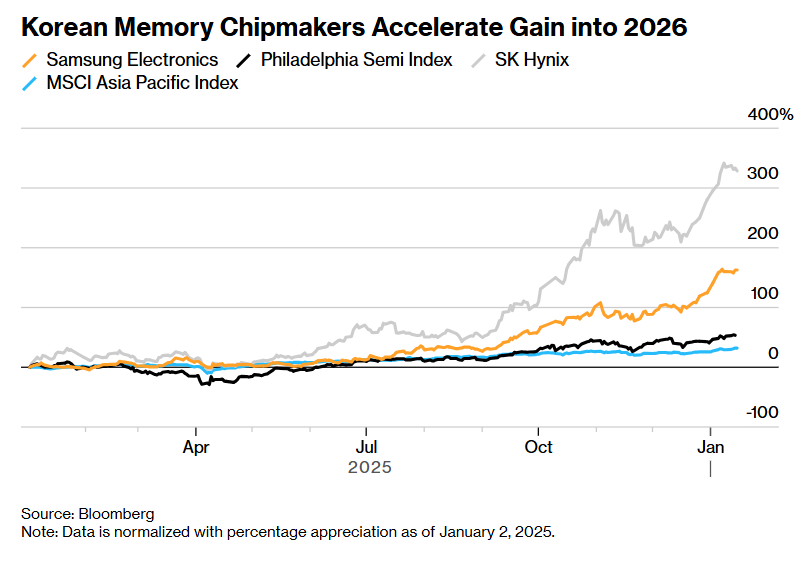
Core Viewpoint - The unprecedented global wave of artificial intelligence (AI) is expected to drive a significant increase in demand for chips, particularly AI chips and storage chips, over the next decade, with storage chip stocks being highlighted as the most promising investment area by industry experts [1][4]. Group 1: Market Trends and Performance - The Korean stock market, driven by major storage chip companies SK Hynix and Samsung Electronics, is projected to surge by 76% in 2025, marking it as one of the most dynamic markets globally [2]. - Micron Technology (MU.US), the only major U.S. storage chip manufacturer, is expected to see its stock price increase by 240% in 2025, with an 18% rise already noted in 2026 [2]. - The demand for DRAM/NAND storage chips remains robust, with prices experiencing significant increases due to the heightened importance of storage chips in AI training and inference systems [2][11]. Group 2: Company Performance and Projections - TSMC reported a record gross margin exceeding 60% and significantly raised its revenue growth forecast for 2026 to nearly 30%, indicating strong performance in the chip manufacturing sector [3]. - ClearBridge Investments' fund manager Divya Mathur has seen his fund outperform 97% of peers, heavily investing in Samsung Electronics and SK Hynix, which are expected to see substantial stock price increases [4]. - The storage chip sector is anticipated to enter a "super cycle" that could last until at least 2027, with meaningful supply increases not expected until early 2028 [13][14]. Group 3: Price Dynamics and Supply Constraints - Analysts predict that the prices of DRAM and NAND storage chips will experience steep increases, with forecasts for 2026 showing a potential rise of 88% for DRAM and 74% for NAND [15]. - The supply of storage products is constrained as manufacturers focus on advanced HBM storage systems, leading to shortages in traditional storage products [11]. - The ongoing construction of large AI data centers is driving demand for storage components, which is expected to exceed supply, benefiting companies like Micron, SK Hynix, and Samsung [11][12].
花旗:AI算力与存储需求爆表 芯片产能扩张启幕! 半导体设备喜迎新一轮牛市
美股IPO· 2026-01-07 16:20
Core Viewpoint - Citigroup's recent report highlights that semiconductor equipment manufacturers, particularly ASML, Lam Research, and Applied Materials, are poised to benefit significantly from the rapid expansion of AI chip and storage chip capacities amid a global AI infrastructure build-out and a "supercycle" in storage chips [2] Group 1: Semiconductor Equipment Market Outlook - The global semiconductor equipment sector is expected to enter a "Phase 2 bull market," with a new bullish trajectory anticipated following a super bull market in 2024-2025 [2] - Citigroup forecasts the global wafer fab equipment (WFE) market to reach approximately $115 billion in 2026, representing a year-on-year growth of 10%, significantly above the average growth rate of the past decade [7] - The three major chip manufacturers—TSMC, Samsung, and Intel—are projected to account for about 59% of the WFE market, with TSMC's capital expenditure (capex) guidance for 2026 expected to be between $46 billion and $48 billion [7] Group 2: Capital Expenditure Trends - Micron Technology has raised its capital expenditure for the fiscal year 2026 from $18 billion to $20 billion, indicating a substantial year-on-year increase of 45%, which may prompt competitors like Samsung and SK Hynix to follow suit [4] - The anticipated strong demand for AI chips and storage solutions is expected to lead to significant increases in capital expenditures from major manufacturers, with TSMC, Samsung, and Intel likely to revise their capex guidance upwards in upcoming earnings reports [2][4] Group 3: AI Infrastructure and Demand - The launch of Google's Gemini3 AI application has led to a surge in AI computing demand, further validating the notion that the AI infrastructure build-out is still in its early stages of supply-demand imbalance [5] - The ongoing construction of large-scale AI data centers by tech giants like Microsoft, Google, and Meta is driving the expansion of advanced process AI chips and storage capacities, reinforcing the long-term bullish outlook for the semiconductor equipment sector [5] Group 4: Semiconductor Market Growth Projections - The global semiconductor market is projected to grow by 22.5% in 2025, reaching a total value of $772.2 billion, with further expansion expected in 2026 to approximately $975.5 billion, marking a year-on-year increase of 26% [9] - The growth is primarily driven by strong demand in the AI GPU-dominated logic chip sector and the HBM storage systems, with both areas expected to achieve robust double-digit growth [12] Group 5: Equipment Demand Surge - The "Phase 2 upcycle" indicates a shift in valuation from "valuation bottom recovery" to "sustained profit upgrades," suggesting that leading semiconductor equipment companies may experience greater profit elasticity than revenue elasticity [13] - The demand for advanced semiconductor manufacturing equipment, particularly in lithography, etching, deposition, and advanced packaging, is expected to surge due to the AI infrastructure and storage supercycle [13][14]