DeepRare

Search documents
全球首个医学循证推理智能体DeepRare推出
Ke Ji Ri Bao· 2026-02-24 00:42
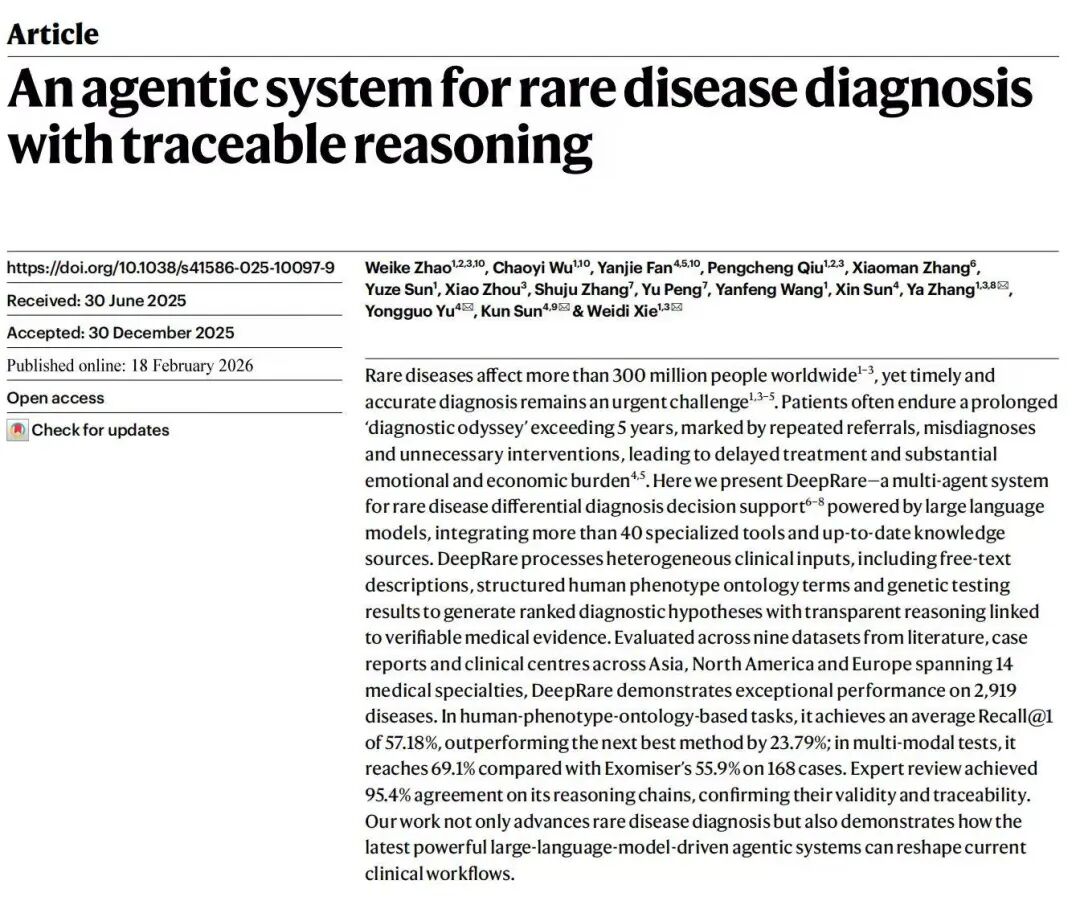
Core Insights - Shanghai Jiao Tong University and Xinhua Hospital have launched DeepRare, the world's first intelligent rare disease diagnostic system, addressing the global challenge of high misdiagnosis rates in rare diseases [1][2] - DeepRare utilizes a "central-body" architecture, surpassing traditional medical AI by integrating vast medical literature and clinical cases, enabling a human-like reasoning process for diagnosis [1] - Clinical data shows that DeepRare's primary diagnostic accuracy for pure phenotype diagnosis is 57.18%, a 23.79 percentage point improvement over the best international models [1] Group 1 - DeepRare's system generates a complete evidence chain for each diagnosis, addressing the trust issues associated with AI in healthcare [1] - The system's accuracy improves to 70.61% when incorporating genetic sequencing data, significantly outperforming international tools [1] - The generated inference reports have achieved a 95.40% satisfaction rate among doctors, ensuring that diagnoses are well-supported [1] Group 2 - The online diagnostic platform for DeepRare was launched on July 26, 2025, attracting over 1,000 global professional users within six months [2] - The system has been deployed and tested at Xinhua Hospital, becoming part of the quality control process for rare disease diagnosis [2] - A "10,000 clinical validation plan" has been initiated, aiming to complete thousands of clinical validations through international collaboration [2]
晚报 | 2月24日主题前瞻
Xuan Gu Bao· 2026-02-23 14:27
Group 1: Gold Market - As of February 23, gold prices are approaching $5,200 per ounce, with COMEX gold futures reaching a daily high of $5,198.8 per ounce. During the Spring Festival holiday (February 16 to February 23), the international gold market experienced a strong rally, with COMEX gold futures rising over 2% [1] - Analysts believe that the significant rise in gold prices has attracted more short-term trading funds, increasing volatility in gold assets. Despite the fluctuations, the long-term investment logic for gold remains unchanged, although volatility may amplify after sharp price increases [1] Group 2: Robotics - The 2026 Spring Festival Gala featured impressive robot performances that gained widespread attention and sparked social media discussions. Various companies showcased their robots, including MagicBotZ1 and 松延动力, which performed alongside popular singers [1] -宇树科技's founder Wang Xingxing highlighted the debut of their G1 and H2 humanoid robots, which feature autonomous cluster control technology, achieving a maximum speed of 4 m/s. The company aims to produce 10,000 to 20,000 units this year [2] Group 3: Glass Fiber - Due to rising costs and supply constraints, glass fiber manufacturers are expected to initiate a second round of price increases, with planned monthly adjustments of 10% to 15%. If these plans proceed, prices could double by the end of the year, following a cumulative increase of over 50% since 2025 [3] - Research indicates that special glass fiber cloth is emerging in response to the demands of the AI era, with Low-DK and Low-CTE fiber cloths experiencing significant demand due to their applications in chip materials and packaging [3] Group 4: Computing Power - Recent updates in global models have led to a record high in token usage, with a week-on-week growth rate exceeding 15%. This surge is attributed to frequent iterations of global models, including ClaudeOpus4.6 and GPT-5.3 [4] - Analysts note that tokens represent a pure derivative of electricity, with China's low electricity prices enhancing its global AI service pricing power. AWS has raised prices by 15%, indicating a shift in cloud pricing logic [4] Group 5: 6G Development - Chinese scientists have achieved a world-first integration of fiber optic and wireless communication systems, setting a new record for data transmission rates. This breakthrough supports multi-channel real-time 8K video access and enhances bandwidth by over ten times compared to current 5G standards [5] - The new system addresses the "bandwidth gap" between fiber and wireless communications, significantly improving interference resistance and showing great potential for applications in 6G base stations and wireless data centers [5] Group 6: New Materials - A research team from Tianjin University and South China University of Technology has developed an organic cathode material with excellent electronic conductivity and high energy density, surpassing traditional lithium iron phosphate batteries. This new battery can operate in extreme temperatures and exhibits good flexibility and safety [6] - Compared to conventional lithium battery materials, organic materials like quinone compounds are seen as promising "green battery stars" due to their abundant resources and flexible molecular structures [6] Group 7: AI Diagnostics - Shanghai Jiao Tong University and Xinhua Hospital have developed the world's first intelligent rare disease diagnostic system, DeepRare, which addresses the global challenges of rare disease diagnosis [7] - Clinical data shows that DeepRare's accuracy in phenotype diagnosis is 57.18%, outperforming international models by 23.79 percentage points. With genetic sequencing data, its accuracy for complex cases exceeds 70.61% [7]

青年早新闻|“日本没资格要求入常”
Xin Lang Cai Jing· 2026-02-21 00:47
Group 1 - China's UN representative reiterated that Japan has no qualification to demand a permanent seat on the Security Council due to its refusal to reflect on historical aggression and interference in other countries' sovereignty [1] - The representative emphasized that Security Council reform should not only benefit a few powerful countries but also enhance the representation and voice of developing countries, particularly addressing historical injustices faced by Africa [1] - The need for a strategic and long-term perspective in planning Security Council reforms was highlighted, indicating that current world dynamics should not be the sole consideration [1] Group 2 - Chinese scientists developed an astronomical AI model named "Xingyan" that can detect signals from faint celestial bodies, achieving the deepest space imaging known to date, reaching over 13 billion light-years [3] - A groundbreaking AI-based diagnostic system for rare diseases, named DeepRare, was published in the journal Nature, providing a solution to the global challenge of high misdiagnosis rates in rare diseases [4]

首个!中国团队研发出一款AI看病系统,成功破解世界难题
Ke Ji Ri Bao· 2026-02-20 15:47
Core Insights - The article highlights the launch of DeepRare, the world's first intelligent rare disease diagnostic system developed by a joint team from Shanghai Jiao Tong University and Xinhua Hospital, addressing the global challenge of difficult diagnosis and high misdiagnosis rates in rare diseases [1][4]. Group 1: System Overview - DeepRare employs an innovative "central-body" architecture, surpassing traditional medical AI by breaking data silos and integrating vast amounts of medical literature and clinical cases for deep knowledge internalization [4]. - The system abandons traditional AI's pattern matching, utilizing a human-like "slow thinking" capability through "hypothesis-verification-self-reflection" to analyze diagnostic clues [4]. - DeepRare provides full-process evidence-based "white-box reasoning," ensuring that each diagnostic conclusion is accompanied by a complete traceable evidence chain, addressing the trust crisis in AI healthcare [4]. Group 2: Performance Metrics - Clinical data validation shows that DeepRare's pure phenotype diagnostic accuracy reached 57.18%, an improvement of 23.79 percentage points over the best international models, changing the paradigm that "without genetic testing, diagnosis is difficult" [4]. - The system's diagnostic recall rate surpasses that of rare disease specialists with ten years of clinical experience [4]. - After incorporating genetic sequencing data, the comprehensive first-diagnosis accuracy for complex cases exceeded 70.61%, significantly outperforming commonly used international tools [4]. - The inference reports generated by the system achieved a 95.40% satisfaction rate among doctors, ensuring that diagnoses are "well-founded" [4].

破解罕见病诊断难题,全球首个医学循证推理智能体上线
Xin Lang Cai Jing· 2026-02-20 05:14
Core Insights - The article discusses the development of DeepRare, the world's first intelligent rare disease diagnostic system, which addresses the global challenges of difficult diagnosis and high misdiagnosis rates in rare diseases [1][2]. Group 1: System Features - DeepRare employs a "central-embodiment" architecture that surpasses traditional medical AI by linking vast medical literature and real clinical data, enabling deep understanding and internalization of medical knowledge [2]. - Unlike traditional AI, DeepRare exhibits "slow thinking" capabilities similar to human doctors, allowing it to ask questions, validate hypotheses, and iteratively refine diagnostic clues [3]. - The system provides a complete evidence chain for each diagnostic conclusion, enhancing trust in AI by making the reasoning process transparent [3]. Group 2: Diagnostic Performance - DeepRare achieved a first-position accuracy rate of 57.18% in phenotype diagnosis, improving by 23.79 percentage points over the previous best international model [4]. - In retrospective human-machine comparison experiments, DeepRare outperformed rare disease specialists with ten years of clinical experience in diagnostic recall rates [4]. - When gene sequencing data is included, DeepRare's comprehensive first-position diagnostic accuracy exceeds 70.6%, significantly better than the current international standard tool, Exomiser, which has a 53.2% accuracy rate [4]. Group 3: Real-World Application - DeepRare has been deployed in Xinhua Hospital and is undergoing internal testing, functioning as a digital quality control tool to ensure thorough patient evaluations [7]. - The system has launched an online rare disease diagnostic platform that has attracted over 1,000 professional users and covers more than 600 medical and research institutions globally [8]. - A "ten-thousand clinical validation plan" has been initiated to conduct real-world clinical validations of rare diseases, aiming to create a global intelligent diagnostic network [8].
中国科研团队研发出一款AI看病系统
Xin Lang Cai Jing· 2026-02-19 16:52
Core Viewpoint - A team led by professors from Shanghai Jiao Tong University has developed an AI system named DeepRare, which is the world's first "traceable reasoning process" intelligent doctor for rare diseases, published in the journal Nature [1] Group 1: Technology and Innovation - DeepRare provides a complete "evidence chain" with each diagnosis, unlike previous medical AIs that only offered conclusions without supporting evidence [1] - The system is designed to think like a human doctor, proposing hypotheses, validating them with evidence, and self-correcting if necessary before reaching a conclusion [1] Group 2: Market Implications - The development of DeepRare addresses the long-standing challenge of diagnosing rare diseases, which often require patients to visit multiple hospitals without a definitive diagnosis [1] - This innovation could significantly enhance trust in AI-assisted medical diagnoses, potentially leading to broader acceptance and integration of AI in healthcare [1]
AI进化速递丨OpenAI最新一轮融资总额预计超1000亿美元
Di Yi Cai Jing· 2026-02-19 13:16
Group 1 - Chinese research team developed an AI medical system called DeepRare [1] - Zhongke Shuguang's SothisAI integrates with Zhipu GLM-5 and Qwen3.5 [1] - Ant Group's subsidiary will release the enterprise version of the Bailing large model [1] Group 2 - Taichu Yuqi completed deep adaptation of Zhipu GLM-5.0 and Alibaba's Qianwen dual open-source models [1] - The national version "OpenClaw" by NetEase Youdao announced open-source, activating the Agent innovation ecosystem [1] - OpenAI's latest funding round is expected to exceed $100 billion [1]
能看罕见病的AI系统!中国科研团队研发
Shang Hai Zheng Quan Bao· 2026-02-19 06:57
Core Insights - A team led by professors from Shanghai Jiao Tong University has developed an AI system named DeepRare, which is the world's first "traceable reasoning" intelligent doctor for rare diseases, published in the journal Nature [1][3] Group 1: System Features - DeepRare provides a complete "evidence chain" with each diagnosis, allowing for greater trust from medical professionals compared to previous AI systems that only provided conclusions without justification [3] - The system simulates human reasoning by proposing hypotheses, validating them with evidence, and self-correcting if necessary, leading to a more thorough diagnostic process [3] Group 2: Performance Metrics - The system achieved an initial diagnostic accuracy of 57.18% based solely on clinical symptoms, which is an improvement of nearly 24 percentage points over the previous best international model [3] - When genetic data is included, the diagnostic accuracy can exceed 70% [3] Group 3: Implementation and Adoption - Since its launch in July of the previous year, over 600 medical institutions worldwide have registered to use the online diagnostic platform, including major hospitals in China and top laboratories in Europe and the U.S. [3] - The system has been deployed internally at Shanghai Xinhua Hospital and will assist doctors in diagnosing rare disease patients [3] Group 4: Future Plans - The research team plans to initiate a global alliance for rare disease diagnosis and treatment, aiming to validate the system with 20,000 real cases in the next six months [4]
腾讯研究院AI速递 20250725
腾讯研究院· 2025-07-24 10:24
Group 1: AI Initiatives and Innovations - Trump signed the "AI Action Plan" with a framework of three pillars (AI innovation, infrastructure, international diplomacy) and introduced over 90 executive orders [1] - The U.S. government plans to relax AI regulations, promote open-source models, accelerate data center construction, and revitalize the semiconductor manufacturing industry [1] - Lovable launched the next-generation AI programming product "Lovable Agent," achieving $100 million in annual revenue with a 91% reduction in error rates [2] - ByteDance released the end-to-end simultaneous interpretation model Seed LiveInterpret 2.0, achieving human-level accuracy and reducing translation delay by over 60% [3] - Higgs Audio V2, developed by Li Mu's team, is based on 10 million hours of audio data and supports various advanced speech generation capabilities [4][5] Group 2: Healthcare and Historical Research - DeepRare, the world's first rare disease reasoning AI diagnostic system, achieved an average Recall@1 of 57.18%, outperforming the best methods by 23.79% [6] - Google DeepMind's Aeneas model assists in interpreting Latin inscriptions from 7th to 8th centuries, with an average error of only 13 years [7] Group 3: Technology Development and Market Trends - Vivo open-sourced its self-developed Blue River operating system kernel, designed for embedded and mobile devices, addressing memory safety issues [8] - Microsoft CEO Nadella emphasized that AI should ultimately drive GDP growth rather than merely showcase technological prowess, identifying healthcare, education, and productivity as key areas for AI value creation [9] - The potential for free, round-the-clock access to GPT-5 for everyone was discussed, highlighting a transformative shift in education and computing methods [10]